Introduction
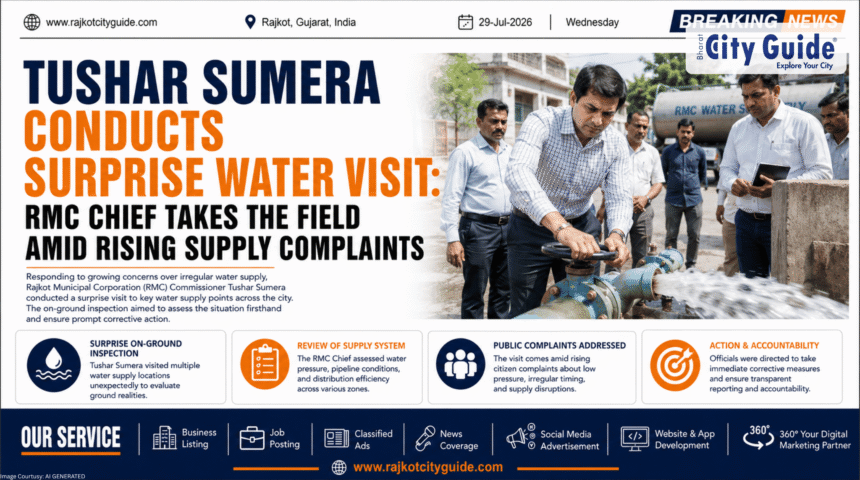
Urban governance is often tested by how effectively a city manages its most basic amenities. In the bustling city of Rajkot, Gujarat, the administration faced intense pressure as local citizens began raising frequent grievances regarding irregular and inadequate water distribution. Stepping up to address these civil concerns head-on, the newly appointed Rajkot Municipal Corporation (RMC) Commissioner took direct action. To evaluate the ground reality, Tushar Sumera Conducts Surprise Water Visit across key residential areas and critical water infrastructure sites in the city.
- Introduction
- What is “Tushar Sumera Conducts Surprise Water Visit”?
- Why This News is Important
- Background Information: Water Management Dynamics in Rajkot
- Key Highlights of the Field Inspection
- Detailed Explanation of the Event
- Benefits and Operational Importance
- How It Impacts the Citizens of Rajkot
- Industry Perspective on Urban Water Management
- Challenges and Long-Term Solutions
- Future Outlook
- Frequently Asked Questions (FAQs)
- Conclusion
This unexpected field inspection marks a major shift towards aggressive accountability within the civic body. By bypassing traditional office briefings and physically descending onto the streets, the Municipal Commissioner demonstrated a commitment to transparency and speedy issue resolution. During his extensive tour, the top bureaucrat visited local neighborhoods such as Lal Bahadur Nagar, interacting directly with household members to gather unfiltered feedback on water pressure and scheduling. Furthermore, the inspection covered massive infrastructure projects, including the vital Nyari Filter Plant and the ongoing construction of the South Zone office building. This article presents a thorough, detailed analysis of this administrative move, providing necessary historical context, infrastructure assessments, and the broader social impact of this comprehensive municipal inspection.
What is “Tushar Sumera Conducts Surprise Water Visit”?
The event titled Tushar Sumera Conducts Surprise Water Visit refers to an unannounced, high-level administrative field inspection carried out by the Municipal Commissioner of Rajkot. In Indian civic governance, a surprise visit or “field inspection” is a tactical management tool used by IAS officers to catch municipal staff off-guard, view operational workflows in their natural state, and prevent lower-level officials from temporarily sanitizing records or hiding structural inefficiencies.
During this specific operation, Commissioner Tushar Sumera, accompanied by a select group of senior hydraulic engineers and project managers, evaluated the entire municipal supply chain. The visit moved sequentially from the grassroots consumption points (residential households) up to the macro-distribution centers (filter plants and zone offices). This extensive exercise ensures that the high-ranking leadership remains completely aware of real-world operational challenges rather than relying solely on heavily curated administrative dashboards.
Why This News is Important
This field inspection carries immense institutional and social importance for several distinct reasons:
1. Rebuilding Public Trust in Municipal Governance
Public dissatisfaction grows rapidly when essential daily resources like drinking water become unpredictable. By stepping out into the heat and knocking on citizens’ doors, the RMC Commissioner bridges the gap between the administrative elite and common urban households, reassuring the public that their complaints are actively monitored at the highest tier.
2. Speeding Up Critical Infrastructure Delays
Large urban infrastructure projects, such as filtration units and zonal headquarters, frequently suffer from bureaucratic friction and contractor delays. A surprise visit by the executive head of the corporation forces contractors and site engineers to speed up construction timelines, clear bottlenecks, and strictly adhere to quality benchmarks.
3. Instituting Internal Accountability
When field workers and station operators know that the city’s top official could show up at any hour without notice, operational discipline improves instantly. It discourages negligence, improper maintenance of machinery, and casual handling of public distribution schedules.
Background Information: Water Management Dynamics in Rajkot
To understand why the Rajkot Municipal Corporation (RMC) Chief felt compelled to conduct a surprise field visit, one must understand the unique geography and chronic water challenges of Rajkot. As the primary economic and industrial hub of the Saurashtra region, Rajkot features an expanding urban sprawl and a rapidly growing population. Unlike regions fed by perennial rivers, Saurashtra relies heavily on seasonal rain patterns, localized reservoirs, and major pipelines like the Narmada canal network.
The city principally depends on three main local reservoirs: Aji-1, Nyari-1, and Bhadar-1. Managing the extraction, treatment, and distribution of water from these reservoirs to hundreds of thousands of households requires an intricate network of filtration plants, pumping stations, and underground storage tanks (ESRs and GSRs).
Over the past few weeks, several pockets within Rajkot’s West and South zones registered an uptick in complaints. Citizens complained of low water pressure, muddy discharge during the initial minutes of pumping, and erratic distribution timings that disrupted daily routines. With the summer season placing an extra strain on urban water reserves, the administration realized that structural issues within the distribution network needed immediate executive oversight.
Key Highlights of the Field Inspection
- Grassroots Engagement: RMC Commissioner Tushar Sumera interacted directly with residents of Lal Bahadur Nagar to confirm the status of daily water supply.
- Direct Verification: The Commissioner asked residents specific questions regarding the exact time of water arrival and the adequacy of the water pressure.
- Infrastructure Assessment: A comprehensive evaluation was conducted at the Nyari Filter Plant to inspect treatment processes and output volume.
- Development Review: The administrative team inspected the under-construction South Zone office complex to push for timely completion.
- Engineering Directives: Strict instructions were given to the hydraulic engineering department to resolve lingering community distribution issues immediately.
Detailed Explanation of the Event
The Ground Assessment at Lal Bahadur Nagar
The field operation commenced with the Commissioner making an unannounced stop at Lal Bahadur Nagar, a residential sector that had registered multiple complaints regarding utility distribution. Walking through the neighborhood, Commissioner Sumera engaged directly with homemakers and local elders. He specifically inquired, “Is the water supply regular, and do you receive it at the scheduled time with sufficient pressure?”
[Reservoir Source: Nyari/Aji]
       │
       ▼
[Treatment & Filtration: Nyari Filter Plant]  ◄─── (Inspected for Quality & Volume)
       │
       ▼
[Zonal Distribution: South Zone Infrastructure] ◄─── (Reviewed Construction Progress)
       │
       ▼
[End Consumer: Lal Bahadur Nagar Households]  ◄─── (Direct Verification of Pressure)
By gathering testimonies directly from consumers, the Commissioner cross-verified the official logs provided by the area’s line inspectors. Residents provided mixed feedback, highlighting specific days when pressure dropped drastically, which allowed the Commissioner to pinpoint potential valve leakages or unauthorized distribution alterations in the sub-lines.
Technical Inspection at the Nyari Filter Plant
Following the neighborhood visit, the inspection team moved to the Nyari Filter Plant, a critical asset responsible for purifying millions of liters of raw water daily before it flows into residential pipelines. Tushar Sumera inspected the primary aeration units, the chemical dosing systems, and the filtration beds.
The focus here was on both quality and capacity. The Commissioner reviewed the daily laboratory testing logs to ensure the treated water meets established safety criteria. He warned the station staff that any compromise in water purity or treatment protocols would result in immediate disciplinary suspension.
Accelerating the South Zone Office Construction
The final stop of the field tour was the construction site of the new South Zone office building. As Rajkot expands, decentralizing administration into dedicated zones (East, West, and South) is critical for efficient urban management. The South Zone office will eventually serve as the primary nerve center for handling civic complaints, tax collections, and building plan approvals for thousands of southern residents.
The Commissioner walked through the under-construction structure, reviewing architectural plans with the site engineers. Noting that certain phases of the project were falling behind schedule, he issued a strict warning to the construction agency, ordering them to deploy additional manpower to ensure the building becomes operational within the stipulated deadline.
Benefits and Operational Importance
The decision by Tushar Sumera to take direct field action brings several immediate operational advantages to the municipal framework:
Elimination of Internal Filtering
In a standard bureaucratic setup, lower-tier staff tend to filter out negative data before sending reports to the Commissioner’s desk. Direct field inspections bypass this barrier, allowing the executive head to witness systemic errors, broken valves, and sluggish project speeds first-hand.
Optimized Resource Allocation
By visiting both the consumption point (the neighborhood) and the treatment point (the Nyari plant) on the same day, the Commissioner could trace distribution problems back to their source. This helps the RMC decide whether a community’s low water pressure requires minor localized pipe repairs or a complete overhaul of the filtration plant’s pumping machinery.
Heightened Contractor Compliance
Public works contractors frequently delay municipal buildings due to payment cycles or material management issues. A physical site visit by an IAS officer serves as a firm reminder that the city leadership is tracking project timelines closely, minimizing the risk of arbitrary project extensions.
How It Impacts the Citizens of Rajkot
The direct intervention of the RMC Chief has an immediate, positive ripple effect on the daily lives of local citizens:
- Improved Quality of Life: Regular, high-pressure water supply saves households from the financial burden of purchasing expensive private water tankers or installing secondary booster pumps.
- Health and Safety Assurance: Stringent checks at the Nyari Filter Plant minimize the risk of waterborne contaminants entering the municipal grid, safeguarding the health of families and school children.
- Streamlined Civic Services: The rapid completion of the South Zone office means citizens in the southern sectors will no longer need to travel long distances to the central RMC headquarters to resolve basic property tax or utility disputes.
Industry Perspective on Urban Water Management
Urban governance experts note that as Indian cities transition into mega-urban spaces, water distribution networks become increasingly complex. Modern urban water systems cannot be managed efficiently through passive desk administration alone.
Leading researchers emphasize that proactive field management—combining unexpected site audits with direct community feedback loops—is standard practice for successful municipal corporations across developed nations. Experts praise the RMC’s approach, stating that physical inspections, when combined with modern SCADA (Supervisory Control and Data Acquisition) systems for digital flow tracking, create a highly resilient urban utility network.
Challenges and Long-Term Solutions
While surprise visits offer valuable short-term fixes, the RMC faces several long-term structural challenges that require sustained attention:
- Aging Pipeline Infrastructure: Many older neighborhoods in Rajkot feature distribution lines laid decades ago. These pipes are prone to internal corrosion, leading to frequent leakages and drop-offs in water pressure. Replacing these lines without disrupting daily traffic remains a logistical challenge.
- Illegal Booster Pump Usage: A major challenge highlighted by field staff is the illegal use of inline electric suction pumps by certain households. These devices draw excess water directly from the main line, depriving neighboring houses of natural pressure. Resolving this requires strict enforcement drives and heavy financial penalties.
- Rapid Suburban Expansion: The speed at which new residential societies are built on the outskirts of Rajkot outpaces the rate at which the RMC can extend its main filtration and distribution lines, creating temporary supply gaps.
Future Outlook
Looking ahead, the Rajkot Municipal Corporation is planning to implement a series of technology-driven upgrades to prevent supply disruptions. The city is gradually shifting toward a 24×7 metered water supply model in select pilot zones, which will use smart meters to track consumption and automatically detect leakages.
Additionally, following the Commissioner’s directive, the hydraulic department is setting up a centralized digital dashboard to track real-time flow data from the Nyari and Aji plants down to individual zonal reservoirs. With Tushar Sumera establishing a clear precedent of conducting unannounced field checks, citizens can expect municipal engineers and line inspectors to maintain a high level of operational alertness over the coming months.
Frequently Asked Questions (FAQs)
1. Why did RMC Commissioner Tushar Sumera conduct a surprise field visit?
The surprise visit was prompted by a rising number of complaints from Rajkot citizens regarding irregular distribution timings, low water pressure, and localized supply disruptions.
2. Which residential area did the Commissioner visit during his tour?
The Commissioner visited Lal Bahadur Nagar, where he walked through the streets and talked directly with local families regarding their daily utility supply.
3. What infrastructure sites were reviewed during the surprise inspection?
The inspection team evaluated the operational efficiency of the Nyari Filter Plant and reviewed the construction progress of the upcoming South Zone office building.
4. What questions did the Commissioner ask the local residents?
He specifically asked residents if they received their municipal water regularly, whether it arrived at the scheduled time, and if the line pressure was sufficient for their household needs.
5. What instructions were given regarding the new South Zone office?
Observing delays in the construction timeline, the Commissioner issued a strict warning to the contracting agency to deploy more workers and complete the project promptly.
6. How does a surprise visit help improve municipal administration?
It prevents field staff from covering up operational inefficiencies, provides the leadership with accurate ground data, and motivates contractors to complete delayed public projects on time.
Conclusion
The recent initiative where Tushar Sumera Conducts Surprise Water Visit highlights a proactive, highly accountable approach to urban governance in Rajkot. By engaging directly with the residents of Lal Bahadur Nagar and personally inspecting the operations at the Nyari Filter Plant, the Municipal Commissioner successfully bypassed bureaucratic filters to address community concerns head-on. Furthermore, his strict instructions at the South Zone office site emphasize the administration’s focus on completing vital infrastructure projects without unnecessary delays. As Rajkot continues to expand, this combination of active field supervision, tough administrative accountability, and long-term infrastructure investment will be essential to ensure that every citizen enjoys reliable access to the city’s most critical public utilities.