Introduction
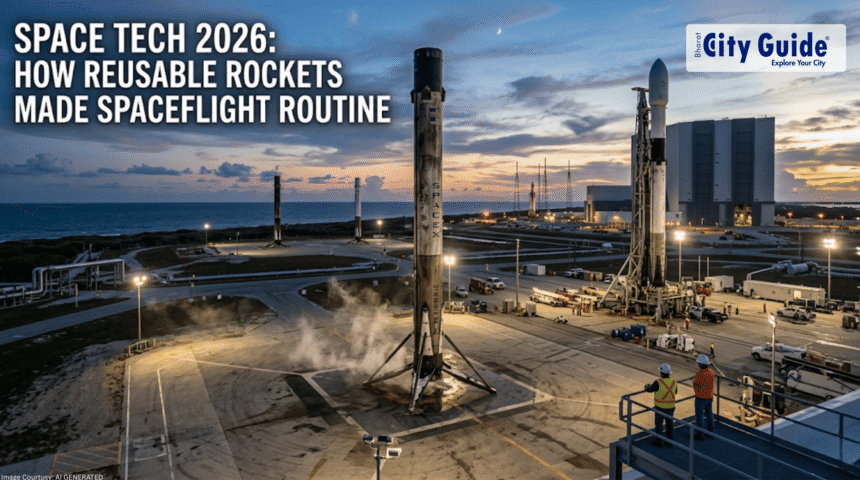
For most of human history, spaceflight was an extraordinary, fragile, and expensive endeavor. Rockets were built to be used once and discarded, making access to space rare and costly. That model began to change dramatically in 2015, when SpaceX successfully landed and reused an orbital-class rocket booster. Since then, reusable rockets have transformed space technology from experimental exploration into a maturing industrial system.
- Introduction
- The Breakthrough: Reusability Changes Everything
- Cost Reduction and Access to Space
- From Falcon to Starship: Scaling Reusability
- Space as Infrastructure, Not Just Exploration
- Satellite Constellations and Routine Launches
- Science Accelerated by Lower Launch Costs
- Space Technology and Resource Expansion
- Mars and the Long-Term Vision
- Environmental Considerations
- Global Competition and Innovation
- Risks and Challenges
- Why Reusable Rockets Matter
- Space Technology in 2026: A New Normal
- Conclusion
By 2026, space technology is no longer defined solely by national prestige or scientific curiosity. It has become a practical infrastructure supporting communications, Earth observation, navigation, defense, and emerging plans for lunar and Martian exploration. With launch costs cut by as much as 90 percent through reusability, space is transitioning from an exclusive frontier to a working domain of the global economy.
The Breakthrough: Reusability Changes Everything
Traditional rockets followed a disposable model. After a single launch, boosters fell into the ocean or burned up in the atmosphere. This made each mission enormously expensive and limited how often launches could occur.
SpaceX’s Falcon 9, first successfully landed in 2015, overturned this assumption. By recovering, refurbishing, and reflighting rocket stages, the company demonstrated that rockets could behave more like aircraft than fireworks.
Reusability reduced:
- Manufacturing costs
- Launch turnaround time
- Barriers to entry for new missions
What once took years of planning and hundreds of millions of dollars could now be done faster, cheaper, and more frequently.
Cost Reduction and Access to Space
The economic impact of reusable rockets is difficult to overstate. Launch costs dropped from tens of thousands of dollars per kilogram to a fraction of that price.
This cost collapse enabled:
- Frequent satellite launches
- Small companies and universities accessing orbit
- Rapid deployment of space infrastructure
Lower costs mean space missions no longer require extraordinary justification. They can be routine, iterative, and commercial.
From Falcon to Starship: Scaling Reusability
Falcon 9 proved reusability was possible. Starship, SpaceX’s fully reusable next-generation vehicle, aims to scale that concept dramatically.
Starship is designed to:
- Carry massive payloads
- Support rapid reflight
- Enable deep-space missions
By 2026 roadmaps, Starship testing supports ambitions ranging from lunar logistics to eventual Mars missions. While technical challenges remain, the philosophy is clear: spaceflight must be scalable to be sustainable.
Space as Infrastructure, Not Just Exploration
By 2026, space technology increasingly functions as infrastructure. Satellites support:
- Global communications
- Navigation and timing
- Weather forecasting
- Earth monitoring
Reusable rockets make it economical to replace and upgrade satellites regularly, improving reliability and performance. This turns space systems into living networks rather than static assets.
Satellite Constellations and Routine Launches
The rise of large satellite constellations would be impossible without reusable rockets. Thousands of satellites can now be deployed and maintained in low Earth orbit.
These constellations:
- Expand global internet access
- Improve resilience through redundancy
- Reduce latency for data transmission
Routine launches allow operators to refresh hardware frequently, keeping pace with advances in computing and communications technology.
Science Accelerated by Lower Launch Costs
Scientific research benefits enormously from cheaper access to space. Instruments that once waited decades for a launch can now fly more quickly.
Reusable rockets enable:
- More frequent space telescopes
- Earth science missions
- Microgravity research
Lower costs encourage experimentation. Failed missions become learning opportunities rather than catastrophic losses, accelerating scientific progress.
Space Technology and Resource Expansion
Beyond Earth orbit, reusable rockets open pathways to resource expansion. The Moon and near-Earth asteroids contain materials that could support long-term space activity.
Potential benefits include:
- In-space fuel production
- Construction materials for orbital platforms
- Reduced dependence on Earth launches
By making transport cheaper, reusable rockets are a prerequisite for any serious space-based economy.
Mars and the Long-Term Vision
Mars exploration represents the ultimate test of maturing space technology. Reusability is central to making interplanetary travel feasible.
Starship roadmaps envision:
- Cargo missions to Mars
- Life-support testing
- Infrastructure development
While human settlement remains a long-term goal, the technological groundwork laid by reusable rockets makes it conceptually achievable rather than purely speculative.
Environmental Considerations
Rocket launches have environmental impacts, but reusability reduces waste and manufacturing emissions by extending vehicle lifetimes.
Fewer discarded stages mean:
- Less material consumption
- Lower overall emissions per launch
- More efficient use of resources
As spaceflight scales, environmental management becomes part of responsible space technology development.
Global Competition and Innovation
Reusable rockets have reshaped global competition. Other space agencies and private companies are now pursuing reusability to remain competitive.
This competition drives:
- Faster innovation cycles
- New launch providers
- Diversification of space capabilities
Space technology in 2026 is no longer dominated by a few national programs. It is a global, multi-actor ecosystem.
Risks and Challenges
Despite progress, challenges remain:
- Technical complexity of full reusability
- Launch safety at higher frequencies
- Space debris management
- Regulatory coordination
As access increases, governance becomes more important to ensure sustainability and safety in orbit.
Why Reusable Rockets Matter
Reusable rockets matter because they change the economics of possibility.
They:
- Turn spaceflight into a routine activity
- Enable scientific discovery at scale
- Support global communication systems
- Lay groundwork for interplanetary expansion
Space technology matures not when exploration ends, but when access becomes affordable and reliable.
Space Technology in 2026: A New Normal
By 2026, the idea of landing rockets, reflighting them, and launching weekly or even daily missions feels increasingly normal. This normalization is the true sign of maturity.
Space is no longer just about reaching orbit. It is about operating there continuously, supporting life on Earth while expanding humanity’s reach beyond it.
Conclusion
The rise of reusable rockets marks one of the most important transitions in modern engineering. What began with a single Falcon booster landing in 2015 has grown into a new model for spaceflight that cuts costs by up to 90 percent and enables ambitious plans for the Moon and Mars.As space technology matures toward 2026, reusability is no longer a novelty. It is the foundation of a sustainable space economy, expanding scientific knowledge, enabling global services, and opening the door to humanity’s next great frontier.Space technology matures not when exploration ends, but when access becomes affordable and reliable.
Gujarati Television: Tradition Meets Modern Entertainment
Gujarati television has emerged as a dynamic source of regional entertainment, delivering a wide variety of content including family dramas, reality shows, comedy series, and culturally rich programs. It strongly reflects the traditions, values, and everyday experiences of Gujarati society, which helps viewers feel a deep emotional connection with the content. The shows are designed to appeal to audiences of all generations, often focusing on relatable themes and strong moral storytelling. With the growing presence of digital streaming platforms, Gujarati TV content is now reaching audiences far beyond the state, including viewers across India and abroad. This expansion, along with enhanced production quality and fresh narratives, has allowed Gujarati television to grow while still maintaining its cultural roots.