Introduction
Self driving cars moved from science fiction to real-world deployment in the late 2010s, when Waymo began operating Level 4 autonomous vehicles on public roads without a human safety driver. That milestone marked a turning point: autonomous driving was no longer just a research demo, but a commercial technology entering daily life.
- Introduction
- From Waymo’s Level 4 Breakthrough to Today
- Self-Driving Cars in 2026: Pilots, Not Ubiquity
- Robotaxi Services and Regional Expansion
- Why Scaling Is Slow
- The Role of 6G and Ultra-Low Latency Networks
- Why Latency Matters
- 6G and Vehicle-to-Everything (V2X)
- Edge Computing and Cooperative Driving
- Why Self-Driving Cars Matter
- Safety Improvements
- Traffic Efficiency and Sustainability
- Accessibility and Inclusion
- Challenges and Open Questions
- Trust and Public Acceptance
- Regulation and Liability
- Infrastructure Readiness
- The Road Ahead
- Conclusion
By 2026, the story of self-driving cars is no longer about whether autonomy is possible. Instead, it is about where, how, and at what scale it works. Limited but real robotaxi services are operating in select cities, while planners and researchers design ultra-low-latency 6G networks and edge-computing systems to support the next phase of autonomous mobility. The result is a future that is cautious, localized, and increasingly connected—rather than a sudden replacement of all human-driven cars.
From Waymo’s Level 4 Breakthrough to Today
Understanding Level 4 Autonomy
Autonomous driving is commonly described using levels defined by the SAE (Society of Automotive Engineers). Level 4 vehicles can handle all driving tasks within specific conditions or geographic areas, known as geofenced zones. Unlike lower levels, they do not require a human driver to monitor the road or take over during normal operation in those areas.
Waymo’s “Waymo Driver” system integrates lidar, radar, cameras, high-definition maps, and machine learning to perceive the environment, predict behavior, and plan safe maneuvers. Within its operational design domain, the system controls steering, acceleration, braking, and decision-making end to end.
Early Driverless Operations
Waymo achieved a major milestone as early as 2017, when it received permission to test fully driverless vehicles on public roads in Arizona. This was one of the first examples of a Level 4 system operating in live traffic without a safety driver behind the wheel.
Through the early 2020s, Waymo expanded these experiments into commercial robotaxi services in selected U.S. cities. Vehicles operated without human drivers, carrying paying passengers across defined urban areas. These deployments proved that autonomous driving could function safely and reliably—but also highlighted the importance of careful geographic limitation and extensive validation.
A Template for Deployment
Waymo’s approach established a model that most of the industry now follows:
- Start in well-mapped, geofenced urban zones
- Operate limited fleets with strict safety oversight
- Gradually expand coverage as confidence and data grow
This incremental strategy reflects both the complexity of real-world driving and the high safety standards required for public acceptance.
Self-Driving Cars in 2026: Pilots, Not Ubiquity
By 2026, autonomous vehicles are neither a novelty nor a universal presence. Instead, they exist as targeted services in specific locations.
Robotaxi Services and Regional Expansion
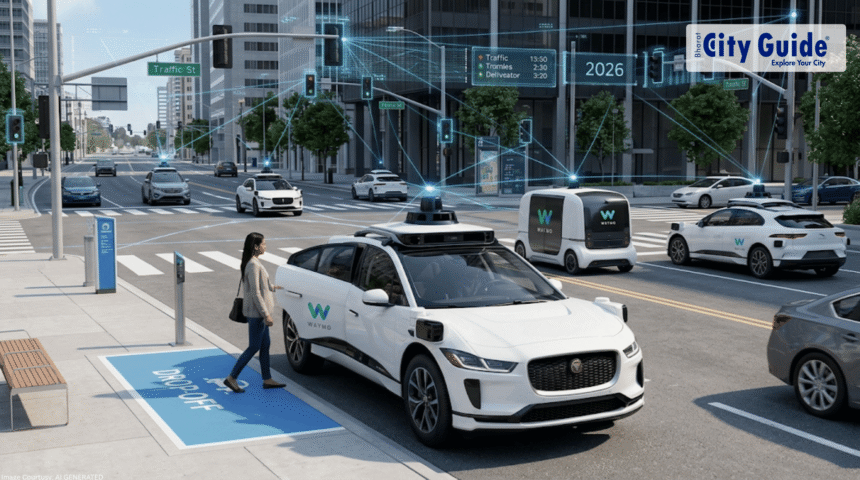
Waymo remains widely regarded as a leader in Level 4 autonomy, continuing to operate driverless ride-hailing services where its system has been validated. Riders can request a vehicle, travel to their destination, and exit without any human intervention in the driving process.
Other companies and regions are following similar paths. In the Middle East, parts of Europe, and Asia, governments and mobility providers are launching or planning fully driverless robotaxi pilots around 2025–2026. Cities such as Dubai and Singapore have positioned themselves as early adopters, combining supportive regulation with advanced digital infrastructure.
In Europe, regulatory approvals in countries like Switzerland signal a cautious but growing openness to driverless commercial services in defined contexts.
Why Scaling Is Slow
Despite these advances, self-driving cars in 2026 are not replacing privately owned vehicles at scale. Several constraints remain:
- High hardware and operational costs
- Complex regulatory approval processes
- Technical challenges in handling rare or ambiguous driving scenarios
As a result, most deployments involve fleets of dozens or hundreds of vehicles, not millions. Autonomy is progressing, but deliberately.
The Role of 6G and Ultra-Low Latency Networks
While current Level 4 vehicles are designed to operate safely on their own, connectivity plays an increasingly important role in scaling autonomous mobility.
Why Latency Matters
Autonomous vehicles must perceive, decide, and act in fractions of a second. While onboard sensors handle immediate safety, connectivity allows vehicles to:
- Share information with nearby cars
- Communicate with traffic infrastructure
- Receive updates about hazards beyond sensor range
Ultra-low latency is essential for these interactions to be useful in real time.
6G and Vehicle-to-Everything (V2X)
Although 6G networks are still in research and early testing phases, they are central to long-term visions of autonomous transport. Proposed 6G capabilities include:
- Latency measured in milliseconds or less
- Extremely high reliability for safety-critical data
- Dense connectivity supporting thousands of devices per square kilometer
These features support advanced vehicle-to-everything (V2X) communication, where cars exchange data with other vehicles, traffic lights, road sensors, and edge-computing nodes.
Edge Computing and Cooperative Driving
Edge computing complements 6G by placing processing power close to roads and intersections. Instead of relying on distant cloud servers, vehicles can interact with nearby edge nodes for:
- Real-time traffic coordination
- Cooperative lane merging and intersection handling
- Dynamic route optimization
While current Level 4 systems do not depend on constant connectivity, future architectures aim to improve efficiency and coordination through these networks—without compromising safety if connections fail.
Why Self-Driving Cars Matter
The push toward autonomous vehicles is driven by more than convenience. It is rooted in safety, efficiency, and accessibility.
Safety Improvements
Human error contributes to the vast majority of road crashes. Distraction, fatigue, impairment, and risky behavior are persistent problems. Level 4 systems are designed to:
- Maintain constant attention
- Follow traffic laws consistently
- Avoid aggressive or impaired driving
While no system is perfect, autonomy aims to reduce the frequency and severity of accidents caused by human limitations.
Traffic Efficiency and Sustainability
Robotaxis and autonomous fleets can optimize routes, reduce unnecessary stops, and maintain smoother traffic flow. Over time, this can:
- Reduce congestion in dense cities
- Lower fuel consumption and emissions
- Enable more efficient use of vehicles through shared fleets
When integrated with public transport, autonomous shuttles can help solve first-mile and last-mile challenges.
Accessibility and Inclusion
For people who cannot drive due to age, disability, or financial barriers, self-driving services offer new mobility options. Autonomous vehicles can provide on-demand transportation without requiring a driver, potentially improving independence and access to jobs, healthcare, and social activities.
Challenges and Open Questions
Despite progress, important challenges remain as of 2026.
Trust and Public Acceptance
High-profile incidents involving autonomous vehicles can undermine trust, even if overall safety performance is strong. Transparent reporting, clear communication, and careful rollout remain essential.
Regulation and Liability
Governments continue to grapple with questions of responsibility, insurance, and standards. Harmonizing rules across regions is especially challenging for global deployment.
Infrastructure Readiness
Not all cities are equally prepared. High-quality mapping, road maintenance, digital infrastructure, and regulatory capacity all influence where autonomous services can operate safely.
The Road Ahead
Self-driving cars in 2026 represent a transitional phase. Level 4 robotaxis are real, operating daily in selected locations, but autonomy is still bounded by geography and conditions. Meanwhile, emerging technologies such as 6G, edge computing, and smart infrastructure are being designed to support broader scaling in the late 2020s and beyond.
Rather than a sudden revolution, autonomous driving is unfolding as a measured evolution—one that balances innovation with safety and public trust.
Conclusion
The future of self-driving cars in 2026 is neither hype nor disappointment. It is a story of practical autonomy: real robotaxis, real passengers, and real benefits, delivered in carefully defined contexts. Waymo’s early Level 4 deployments showed what was possible, and ongoing pilots around the world are refining how autonomy fits into complex urban systems.
As ultra-low-latency networks and edge intelligence mature, autonomous vehicles are expected to become more cooperative, efficient, and scalable. For now, they stand at the intersection of automation and connectivity—proving that the road to autonomy is not about replacing humans overnight, but about building safer and smarter mobility step by step.