Introduction
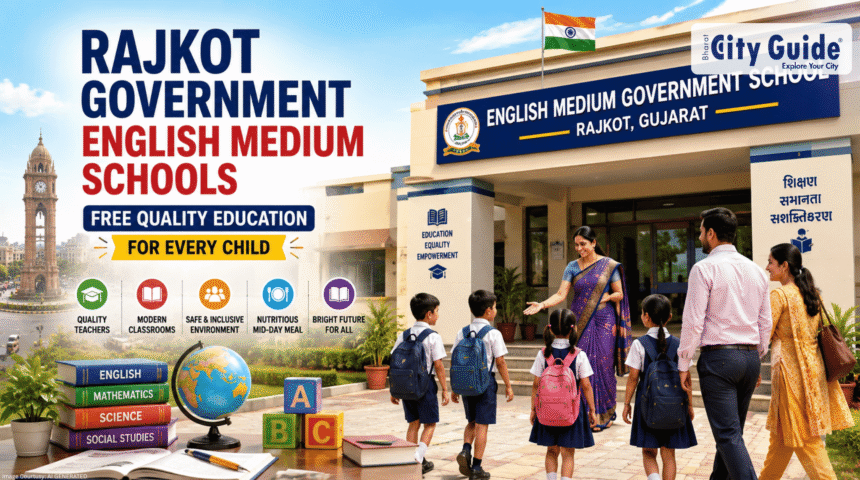
The educational landscape of Gujarat is witnessing a massive structural shift, and Rajkot is at the absolute epicenter of this transformation. In a landmark decision that promises to redefine access to primary education, the state authorities have announced that all three premier English medium primary schools in Rajkot will now be fully managed and operated directly by the government. This major administrative move is designed to accommodate a larger number of students from diverse socio-economic backgrounds, ensuring that high-quality English-medium instruction is no longer a luxury reserved exclusively for affluent families.
- Introduction
- What are Government English Medium Schools in Rajkot?
- Why This News is Important
- Background Information: The Evolution of Public Education in Gujarat
- Key Highlights of the Announcement
- Detailed Explanation of the Event
- Benefits of Government-Run English Medium Schools
- How It Impacts Different Segments of Society
- Expert Insights and Industry Perspective
- Challenges and Limitations
- Future Outlook
- Frequently Asked Questions (FAQs)
- Conclusion
For decades, families belonging to lower and middle-income brackets faced an uphill battle when attempting to enroll their children in English-medium institutions. The sky-rocketing tuition fees, heavy security deposits, and hidden administrative costs of private schools often forced parents to opt for Gujarati medium public schools, even if they strongly desired an English-medium foundation for their children’s career growth. With the government taking full control of these three critical primary institutions, the doors have been thrown wide open. Admissions are set to rise exponentially, breaking down financial barriers and establishing a more equitable playing field.
Furthermore, this development has sparked localized movements within the region. Citizens and community leaders are already advocating for an expansion of this model, with a prominent demand emerging for a new government English-medium school in the densely populated Gandhigram area. As education becomes the primary vehicle for upward social mobility in modern India, the strengthening of Government English medium schools in Rajkot marks a progressive milestone. It reflects a growing public realization that state-funded education can match, and perhaps even exceed, the standards of private commercial enterprises.
What are Government English Medium Schools in Rajkot?
Government English medium schools in Rajkot represent a specialized category of primary and upper-primary educational institutions funded and monitored by the state government and local municipal bodies, such as the Rajkot Municipal Corporation (RMC) school board. Unlike conventional government schools that historically offered instruction primarily in the regional language—Gujarati—these specific institutions utilize English as the primary medium of instruction across all major subjects, including Mathematics, Science, and Social Studies, while keeping Gujarati and Hindi as essential language subjects.
The core objective behind establishing and running these schools is to bridge the widening gap between public and private education sectors. These institutions follow the standardized state board or national board curricula but remove the financial burden associated with English-medium schooling. They provide textbooks, uniforms, mid-day meals, and high-quality teaching resources entirely free of cost or at a nominal, highly subsidized rate. By taking direct operational control of these three major primary schools, the government ensures that standard operating procedures, teacher recruitment criteria, and infrastructural quality comply with top-tier educational benchmarks.
Why This News is Important
This announcement carries profound weight for several societal, economic, and political reasons. Firstly, it directly addresses the intense financial stress experienced by parents. The post-pandemic economic environment has made it increasingly difficult for middle-class and working-class families to sustain private school expenses. When the government steps in to run English-medium primary schools, it offers an immediate, premium alternative that safeguards a child’s academic future without draining the family’s life savings.
Secondly, it marks a significant shift in public perception regarding state-run infrastructure. Traditionally, public schools were viewed as a last resort due to perceived deficiencies in infrastructure and English fluency training. By aggressively managing and promoting government English medium schools in Rajkot, the government is actively challenging this stereotype. It proves that the public sector can deliver contemporary, language-proficient education.
Lastly, the decision has immediate logistical importance. By keeping these schools fully public, the government can implement an open, transparent, and merit-based or lottery-based admission system that accommodates an unprecedented number of students. It effectively prevents the commercialization of primary seats and guarantees that the Right to Education (RTE) principles are upheld in spirit and action.
Background Information: The Evolution of Public Education in Gujarat
To truly appreciate the significance of this development, one must look at the historical trajectory of primary education within the state of Gujarat. For a long period, the state’s public schooling system was deeply anchored in vernacular medium teaching. While this successfully preserved local culture and ensured high literacy rates across rural and urban sectors, the globalized job market gradually shifted its preference toward individuals with strong English communication skills.
Seeing this trend, private players capitalised on the demand, setting up thousands of private English-medium schools across cities like Ahmedabad, Surat, Vadodara, and Rajkot. This created an educational divide: children from wealthy backgrounds gained access to global opportunities through English fluency, while children from underprivileged backgrounds faced systemic limitations despite their inherent talent.
To fix this imbalance, the Gujarat government introduced pilot projects involving public English-medium rooms within existing school structures. Over the last decade, this evolved into dedicated English-medium primary schools. In Rajkot, specific primary schools were developed to meet this exact demand. However, operational structures, management ambiguities, and seat limitations sometimes restricted their full potential. The recent decision to bring all three major primary institutions completely under government operations clarifies the governance framework, ensures sustainable funding, and sets the stage for massive expansion.
Key Highlights of the Announcement
- Complete State Control: All three prominent English-medium primary schools in Rajkot will now be managed and run directly by the government infrastructure.
- Massive Admission Drive: The transition allows for an expanded intake capacity, ensuring a large number of students secure seats for the upcoming academic sessions.
- Zero Commercial Fees: Education in these institutions remains highly accessible and affordable, completely eliminating the exorbitant capitation fees charged by private entities.
- Rising Demand in Gandhigram: Following this decision, local residents and educational activists have officially demanded the launch of a new government English-medium school in the Gandhigram locality to cater to local neighborhood children.
- Standardized Recruitment: Teachers in these schools will be subject to strict government qualification standards, ensuring highly trained and certified educators manage the classrooms.
Detailed Explanation of the Event
The transition of Rajkot’s three primary English-medium schools into fully government-managed entities comes after extensive administrative evaluations. Previously, mixed management models or public-private partnerships often ran into administrative bottlenecks regarding seat allocation, fee structures, and resource distribution. By taking complete administrative ownership, the education department has streamlined the decision-making process.
The primary driver for this shift is the overwhelming volume of admission applications received year after year. The demand for English-medium education among lower-middle-class families in Rajkot has broken previous records. Parents have stood in long queues, hoping to secure one of the limited seats available. Recognizing this immense public demand, the state determined that expanding the capacity under direct government supervision was the most sustainable way forward.
Simultaneously, the announcement has triggered a wave of civic advocacy. The Gandhigram area, known for its dense residential population and a substantial percentage of working-class families, currently lacks adequate public English-medium options within a walkable distance. Local representatives have highlighted that sending primary-aged children to far-off sectors of Rajkot poses safety risks and increases transportation costs. Therefore, the demand to establish a dedicated government English-medium school in Gandhigram has gained significant traction, putting pressure on municipal planners to allocate budgets for local school expansions.
Benefits of Government-Run English Medium Schools
1. Financial Relief for Families
The most immediate benefit is the reduction of household educational expenditure. Private school fees in urban Rajkot can range anywhere from tens of thousands to over a lakh rupees per annum for primary sections alone. Government schools eliminate these costs, allowing parents to redirect their hard-earned money toward nutritional support, health insurance, and higher education savings.
2. Qualified and Certified Teaching Staff
Government teacher recruitment processes in Gujarat are exceptionally rigorous, requiring candidates to pass statewide eligibility tests (such as TET/TAT) along with formal degrees in education (B.Ed/D.El.Ed). Consequently, the educators employed in government English medium schools in Rajkot possess verified pedagogical credentials, ensuring high teaching standards.
3. Superior Nutritional and Welfare Schemes
Students enrolled in government-run primary schools benefit directly from central and state welfare initiatives. This includes the PM POSHAN (Mid-Day Meal) scheme, which provides free, nutritious, hygienic lunches that support physical development and concentration levels. Additionally, free health check-ups and immunization drives are regularly conducted on campus.
4. Inclusive Social Environment
Public schools serve as a melting pot for children from various communities, castes, and economic strata. This diverse environment fosters empathy, social integration, and a grounded worldview among young learners, qualities that can sometimes be missing in hyper-exclusive private academies.
How It Impacts Different Segments of Society
For Students
Students receive an opportunity to build fluency in the global language of business and technology right from their formative years. This early exposure simplifies higher learning concepts in science and technology, which are predominantly documented in English, giving them a strong foundation for future competitive exams.
For Parents
Parents experience peace of mind. They no longer have to compromise on the quality of their child’s education due to financial constraints. The transparency of government operations also reduces fears regarding sudden, arbitrary fee hikes or forced purchases of expensive stationery from specific vendors.
For the Private Education Sector
This move introduces healthy competition. Private schools in Rajkot can no longer take their student intake for granted. To retain students, mid-tier private schools will be forced to reassess their fee structures and improve their value proposition, ultimately benefiting consumers across the board.
Expert Insights and Industry Perspective
Educational experts across Gujarat view this move as a step in the right direction, aligning closely with the mandates of the National Education Policy (NEP). Modern pedagogical research emphasizes that while early education is highly effective in the mother tongue, the introduction of English as a medium of instruction in urban centers satisfies a critical economic demand.
Industry professionals point out that India’s service and technology sectors require a workforce that is comfortable with English communication. By introducing robust government English medium schools in Rajkot, the state is preparing its future workforce right from the primary level. Experts suggest that for this model to remain successful over the long term, the government must prioritize continuous professional development for teachers to ensure their language delivery remains natural, accurate, and engaging for young children.
Challenges and Limitations
While the decision is highly commendable, executing it flawlessly comes with a distinct set of operational challenges:
- Managing Classroom Strengths: With an “unlimited” or highly expanded admission strategy, these schools run the risk of overcrowding. Maintaining an optimal student-to-teacher ratio (ideally 30:1) is critical for effective learning.
- Infrastructure Upkeep: Ensuring that smart boards, computer labs, sanitation facilities, and playgrounds are consistently maintained requires dedicated administrative funding and strict oversight.
- Fluency Transition: Many students entering these schools come from households where English is never spoken. Teachers face the complex task of handholding these children through the transition without causing academic anxiety.
Future Outlook
The future looks incredibly promising for public education in Rajkot. If the management of these three primary institutions yields high academic performance and positive parent feedback, it will likely serve as a blueprint for the entire state of Gujarat.
We can expect the government to look favorably upon the public demand for a school in Gandhigram, potentially announcing new budget allocations in the upcoming civic sub-committees. Over the next few years, the line separating public and private school quality is expected to blur, making public education the primary choice for families across all socio-economic brackets in Rajkot.
Frequently Asked Questions (FAQs)
1. Which schools are included in the recent Rajkot government announcement?
The announcement covers all three primary English-medium schools in Rajkot, which will now be fully managed and operated by the government to ensure expanded, transparent admissions.
2. Will there be any tuition fees for students in these government English medium schools in Rajkot?
No, government-run primary schools offer education free of cost, along with associated benefits like free textbooks, uniforms, and mid-day meals under state welfare guidelines.
3. Why is there a demand for a government English-medium school in Gandhigram?
Gandhigram is a highly populated residential area with many working-class families. A local school would eliminate long commutes and ensure a safe, affordable, and accessible learning environment for neighborhood children.
4. What curriculum do these government English medium schools follow?
These schools follow the standardized curriculum prescribed by the Gujarat State Board of School Textbooks (GSSTB) or relevant central guidelines, tailored for English-medium instruction.
5. How are teachers selected for these specialized English-medium public schools?
Teachers are selected through strict government eligibility tests (like TET/TAT). They must possess formal educational degrees and undergo verification to ensure fluency and proficiency in teaching subjects in English.
6. Can students from any socio-economic background apply for admission?
Yes, these schools are open to all citizens. The expansion of seats is explicitly intended to give students from lower and middle-income families equal access to high-quality English education.
Conclusion
The decision to place all three primary English-medium institutions under direct state administration is a landmark victory for democratic education. By expanding seat capacities and removing financial barriers, the Government English medium schools in Rajkot are poised to transform the lives of thousands of young learners. While infrastructural hurdles and classroom sizing challenges require continuous monitoring, the underlying strategy is commendable. Addressing community demands, such as opening a dedicated facility in Gandhigram, will further solidify this educational reform. Providing top-tier English instruction for free ensures that Rajkot’s youth are well-equipped to participate in and contribute to the modern global economy.