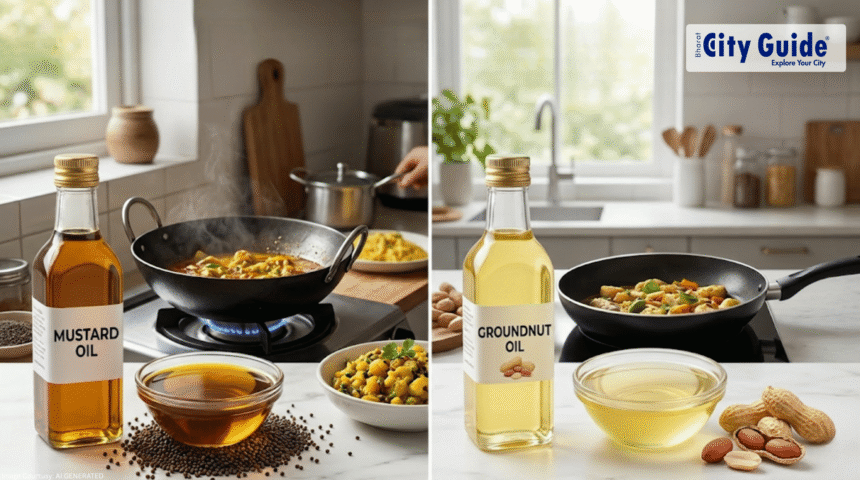
Which Is Healthier for Everyday Indian Cooking in 2026?
In Indian kitchens, oil is more than a cooking medium—it carries tradition, flavour, and nutrition in every spoon. From sarson ka tadka in dal to groundnut oil in Gujarati and Maharashtrian cooking, oils shape how Indian food tastes and how it affects our health.
- Which Is Healthier for Everyday Indian Cooking in 2026?
- Nutritional Strengths
- Mustard Oil Caution: Erucic Acid
- Best Uses for Mustard Oil
- Nutritional Strengths
- Groundnut Oil Cautions
- Best Uses for Groundnut Oil
- 1) Can I use only mustard oil daily?
- 2) Is erucic acid dangerous?
- 3) Is groundnut oil heart-healthy?
- 4) Which oil is better for frying?
- 5) Should I switch to olive oil?
- Nutritional Strengths
- Mustard Oil Caution: Erucic Acid
- Best Uses for Mustard Oil
- Nutritional Strengths
- Groundnut Oil Cautions
- Best Uses for Groundnut Oil
- 1) Can I use only mustard oil daily?
- 2) Is erucic acid dangerous?
- 3) Is groundnut oil heart-healthy?
- 4) Which oil is better for frying?
- 5) Should I switch to olive oil?
Yet in 2026, many households are confused:
- Is mustard oil healthier than groundnut oil?
- Should we avoid mustard oil because of erucic acid?
- Is peanut oil safer for the heart?
- Do we need imported “fancy” oils instead?
The truth is far less dramatic and far more practical.
Both mustard oil and groundnut oil are considered good everyday oils in the Indian context when used wisely. The real difference lies in their fatty acid profiles, balance in your overall diet, and how you cook with them.
Let’s break it down in simple, science-backed, Indian-kitchen-friendly terms.
Why Oil Choice Matters More in 2026
Compared to earlier generations, today’s Indian diets include:
- More ultra-processed foods
- More refined oils
- More frequent frying
- More sedentary work and screen time
At the same time, India continues to face high rates of:
- Heart disease
- Diabetes
- Obesity
- Fatty liver
Since oils are calorie-dense and chemically sensitive to heat, choosing and using the right oil matters—not for fear, but for balance.
The goal is not to avoid oil, but to choose better oils and use them in moderation.
The Big Picture: Both Are Generally “Good” Oils
Indian nutrition bodies and global research agree on a few key ideas:
✅ Prefer oils rich in unsaturated fats
✅ Limit saturated and trans fats
✅ Rotate oils for fatty acid balance
✅ Avoid repeated reheating
Mustard and groundnut oils both fit into the “better choice” category because they are:
- Rich in monounsaturated fats (MUFA)
- Moderate in polyunsaturated fats (PUFA)
- Lower in saturated fat compared to ghee, butter, or vanaspati
- Suitable for Indian cooking temperatures
So the debate is not about good vs bad—but about which suits your needs and diet pattern better.
Understanding Fats in Simple Words
Before comparing, let’s decode fat types quickly.
Monounsaturated Fat (MUFA)
- Heart-friendly
- Helps improve cholesterol balance
- Stable at cooking heat
- Found in mustard and groundnut oil
Polyunsaturated Fat (PUFA)
- Essential for health
- Includes omega-6 and omega-3
- Less stable at very high heat
Saturated Fat (SFA)
- Needed in small amounts
- Too much may raise heart risk in some people
Omega-6 vs Omega-3 Balance
Modern Indian diets are often high in omega-6 and low in omega-3.
Too much omega-6 relative to omega-3 may promote inflammation. So oils with some omega-3 can be beneficial.
This is where mustard oil stands out.
Fatty Acid Profile Comparison
(Approximate ranges from comparative studies)
| Feature | Mustard Oil | Groundnut Oil |
| Saturated Fat | ~7–10% | ~10–18% |
| MUFA | ~25% | ~50–61% |
| PUFA | ~18% | ~18–30% |
| Omega-3 | Present (ALA) | Very low |
| Special Note | Contains erucic acid | Peanut allergy concern |
Mustard Oil: The Traditional Indian Heavyweight
Mustard oil has been a staple in North and East India for centuries.
Nutritional Strengths
1) Omega-3 Presence
Mustard oil contains alpha-linolenic acid (ALA), a plant-based omega-3.
Since Indian diets are often low in omega-3, this is a meaningful advantage.
2) Good Omega-6:Omega-3 Ratio
This helps balance inflammation and supports heart health.
3) MUFA Content
MUFA supports:
- Better LDL levels
- Stable HDL levels
- Overall heart health
4) Heat Stability
Mustard oil handles Indian cooking styles well:
- Tadka
- Sabzi
- Frying
- Pickles
Mustard Oil Caution: Erucic Acid
Mustard oil contains erucic acid. Very high doses in animal studies have been linked to heart muscle changes.
Important practical context:
- Normal Indian culinary use is not at those extreme levels
- Regulatory bodies allow mustard oil within defined limits
- Moderation and rotation are advised
So mustard oil is fine—but not as your only oil forever.
Best Uses for Mustard Oil
✔ Dal tadka
✔ Bengali and North Indian sabzis
✔ Pickles
✔ Fish curries
✔ Khichdi
Groundnut Oil: The Versatile Everyday Oil
Groundnut (peanut) oil is widely used in Western and Central India.
Nutritional Strengths
1) Very High MUFA
Groundnut oil is rich in oleic acid, which is strongly linked with heart benefits.
2) Vitamin E & Antioxidants
These support:
- Cell protection
- Oxidative stability
- Skin and immune health
3) Heat Stability
Good for:
- Shallow frying
- Regular cooking
- Occasional deep frying
4) Neutral Taste
Great when you don’t want strong flavour interference.
Groundnut Oil Cautions
1) Low Omega-3
It doesn’t help omega-3 intake much.
So include other sources:
- Flaxseeds
- Walnuts
- Fish
- Chia seeds
2) Peanut Allergy
Anyone with peanut allergy must avoid it.
Best Uses for Groundnut Oil
✔ Everyday sabzi
✔ Gujarati/Maharashtrian cooking
✔ Shallow frying
✔ Snacks needing neutral flavour
Which Oil Is Better?
There is no universal winner.
Mustard Oil Edge
✔ Better omega-3 balance
✔ Strong flavour
✔ Traditional benefits
Groundnut Oil Edge
✔ Very high MUFA
✔ Neutral taste
✔ Fewer specific fatty acid concerns
Best Strategy (Science-Backed)
Rotation or blending.
This gives:
- Fatty acid diversity
- Nutrient balance
- Taste variety
How Much Oil Is Reasonable?
A practical guideline:
👉 ~4–5 teaspoons visible oil per adult per day
(from all cooking combined)
Needs vary by:
- Activity
- Health status
- Medical advice
Common Mistakes in Indian Kitchens
❌ Reusing oil repeatedly
❌ Deep frying often
❌ Pouring oil freely without measuring
❌ Thinking “healthy oil = unlimited oil”
❌ Using only one oil forever
Smart Practical Guidance
Use Mustard Oil For:
- Tadka
- Pickles
- Regional dishes
- When you want omega-3 support
Use Groundnut Oil For:
- Everyday cooking
- Neutral flavour needs
- Occasional frying
Combine With:
- Less fried food
- More whole foods
- Good protein and fiber intake
Oil cannot fix a poor diet—but it can support a good one.
One Small Habit That Helps
For one week:
👉 Measure oil with a teaspoon instead of pouring directly.
Most families cut excess oil naturally with this one step.
Long-Term Health Impact
Smart oil use may support:
✅ Better cholesterol balance
✅ Lower inflammation
✅ Heart health
✅ Weight control
✅ Fat-soluble vitamin absorption
Conclusion
The mustard oil vs groundnut oil debate is not about good vs bad.
Both are better traditional options compared to trans-fat-rich and heavily processed fats.
Mustard oil offers:
- Omega-3
- Strong flavour
- Cultural roots
Groundnut oil offers:
- Very high MUFA
- Neutral versatility
- Stability
The smartest 2026 approach?
👉 Use both
👉 Rotate
👉 Keep quantities moderate
👉 Avoid reheating oil repeatedly
You don’t need imported exotic oils for health.
Your traditional Indian kitchen already holds solid choices.
Balance, not extremes, wins.
FAQs
1) Can I use only mustard oil daily?
Better to rotate. Variety improves fatty acid balance.
2) Is erucic acid dangerous?
Risk is linked to very high intakes. Moderate culinary use is generally considered acceptable, but rotation is wise.
3) Is groundnut oil heart-healthy?
Yes, due to high MUFA, when used moderately.
4) Which oil is better for frying?
Both handle heat reasonably well, but avoid frequent deep frying and reused oil.
5) Should I switch to olive oil?
Not necessary for Indian cooking. Mustard and groundnut oils already provide good fat profiles.Which Is Healthier for Everyday Indian Cooking in 2026?
In Indian kitchens, oil is more than a cooking medium—it carries tradition, flavour, and nutrition in every spoon. From sarson ka tadka in dal to groundnut oil in Gujarati and Maharashtrian cooking, oils shape how Indian food tastes and how it affects our health.
Yet in 2026, many households are confused:
- Is mustard oil healthier than groundnut oil?
- Should we avoid mustard oil because of erucic acid?
- Is peanut oil safer for the heart?
- Do we need imported “fancy” oils instead?
The truth is far less dramatic and far more practical.
Both mustard oil and groundnut oil are considered good everyday oils in the Indian context when used wisely. The real difference lies in their fatty acid profiles, balance in your overall diet, and how you cook with them.
Let’s break it down in simple, science-backed, Indian-kitchen-friendly terms.
Why Oil Choice Matters More in 2026
Compared to earlier generations, today’s Indian diets include:
- More ultra-processed foods
- More refined oils
- More frequent frying
- More sedentary work and screen time
At the same time, India continues to face high rates of:
- Heart disease
- Diabetes
- Obesity
- Fatty liver
Since oils are calorie-dense and chemically sensitive to heat, choosing and using the right oil matters—not for fear, but for balance.
The goal is not to avoid oil, but to choose better oils and use them in moderation.
The Big Picture: Both Are Generally “Good” Oils
Indian nutrition bodies and global research agree on a few key ideas:
✅ Prefer oils rich in unsaturated fats
✅ Limit saturated and trans fats
✅ Rotate oils for fatty acid balance
✅ Avoid repeated reheating
Mustard and groundnut oils both fit into the “better choice” category because they are:
- Rich in monounsaturated fats (MUFA)
- Moderate in polyunsaturated fats (PUFA)
- Lower in saturated fat compared to ghee, butter, or vanaspati
- Suitable for Indian cooking temperatures
So the debate is not about good vs bad—but about which suits your needs and diet pattern better.
Understanding Fats in Simple Words
Before comparing, let’s decode fat types quickly.
Monounsaturated Fat (MUFA)
- Heart-friendly
- Helps improve cholesterol balance
- Stable at cooking heat
- Found in mustard and groundnut oil
Polyunsaturated Fat (PUFA)
- Essential for health
- Includes omega-6 and omega-3
- Less stable at very high heat
Saturated Fat (SFA)
- Needed in small amounts
- Too much may raise heart risk in some people
Omega-6 vs Omega-3 Balance
Modern Indian diets are often high in omega-6 and low in omega-3.
Too much omega-6 relative to omega-3 may promote inflammation. So oils with some omega-3 can be beneficial.
This is where mustard oil stands out.
Fatty Acid Profile Comparison
(Approximate ranges from comparative studies)
| Feature | Mustard Oil | Groundnut Oil |
| Saturated Fat | ~7–10% | ~10–18% |
| MUFA | ~25% | ~50–61% |
| PUFA | ~18% | ~18–30% |
| Omega-3 | Present (ALA) | Very low |
| Special Note | Contains erucic acid | Peanut allergy concern |
Mustard Oil: The Traditional Indian Heavyweight
Mustard oil has been a staple in North and East India for centuries.
Nutritional Strengths
1) Omega-3 Presence
Mustard oil contains alpha-linolenic acid (ALA), a plant-based omega-3.
Since Indian diets are often low in omega-3, this is a meaningful advantage.
2) Good Omega-6:Omega-3 Ratio
This helps balance inflammation and supports heart health.
3) MUFA Content
MUFA supports:
- Better LDL levels
- Stable HDL levels
- Overall heart health
4) Heat Stability
Mustard oil handles Indian cooking styles well:
- Tadka
- Sabzi
- Frying
- Pickles
Mustard Oil Caution: Erucic Acid
Mustard oil contains erucic acid. Very high doses in animal studies have been linked to heart muscle changes.
Important practical context:
- Normal Indian culinary use is not at those extreme levels
- Regulatory bodies allow mustard oil within defined limits
- Moderation and rotation are advised
So mustard oil is fine—but not as your only oil forever.
Best Uses for Mustard Oil
✔ Dal tadka
✔ Bengali and North Indian sabzis
✔ Pickles
✔ Fish curries
✔ Khichdi
Groundnut Oil: The Versatile Everyday Oil
Groundnut (peanut) oil is widely used in Western and Central India.
Nutritional Strengths
1) Very High MUFA
Groundnut oil is rich in oleic acid, which is strongly linked with heart benefits.
2) Vitamin E & Antioxidants
These support:
- Cell protection
- Oxidative stability
- Skin and immune health
3) Heat Stability
Good for:
- Shallow frying
- Regular cooking
- Occasional deep frying
4) Neutral Taste
Great when you don’t want strong flavour interference.
Groundnut Oil Cautions
1) Low Omega-3
It doesn’t help omega-3 intake much.
So include other sources:
- Flaxseeds
- Walnuts
- Fish
- Chia seeds
2) Peanut Allergy
Anyone with peanut allergy must avoid it.
Best Uses for Groundnut Oil
✔ Everyday sabzi
✔ Gujarati/Maharashtrian cooking
✔ Shallow frying
✔ Snacks needing neutral flavour
Which Oil Is Better?
There is no universal winner.
Mustard Oil Edge
✔ Better omega-3 balance
✔ Strong flavour
✔ Traditional benefits
Groundnut Oil Edge
✔ Very high MUFA
✔ Neutral taste
✔ Fewer specific fatty acid concerns
Best Strategy (Science-Backed)
Rotation or blending.
This gives:
- Fatty acid diversity
- Nutrient balance
- Taste variety
How Much Oil Is Reasonable?
A practical guideline:
👉 ~4–5 teaspoons visible oil per adult per day
(from all cooking combined)
Needs vary by:
- Activity
- Health status
- Medical advice
Common Mistakes in Indian Kitchens
❌ Reusing oil repeatedly
❌ Deep frying often
❌ Pouring oil freely without measuring
❌ Thinking “healthy oil = unlimited oil”
❌ Using only one oil forever
Smart Practical Guidance
Use Mustard Oil For:
- Tadka
- Pickles
- Regional dishes
- When you want omega-3 support
Use Groundnut Oil For:
- Everyday cooking
- Neutral flavour needs
- Occasional frying
Combine With:
- Less fried food
- More whole foods
- Good protein and fiber intake
Oil cannot fix a poor diet—but it can support a good one.
One Small Habit That Helps
For one week:
👉 Measure oil with a teaspoon instead of pouring directly.
Most families cut excess oil naturally with this one step.
Long-Term Health Impact
Smart oil use may support:
✅ Better cholesterol balance
✅ Lower inflammation
✅ Heart health
✅ Weight control
✅ Fat-soluble vitamin absorption
Conclusion
The mustard oil vs groundnut oil debate is not about good vs bad.
Both are better traditional options compared to trans-fat-rich and heavily processed fats.
Mustard oil offers:
- Omega-3
- Strong flavour
- Cultural roots
Groundnut oil offers:
- Very high MUFA
- Neutral versatility
- Stability
The smartest 2026 approach?
👉 Use both
👉 Rotate
👉 Keep quantities moderate
👉 Avoid reheating oil repeatedly
You don’t need imported exotic oils for health.
Your traditional Indian kitchen already holds solid choices.
Balance, not extremes, wins.
FAQs
1) Can I use only mustard oil daily?
Better to rotate. Variety improves fatty acid balance.
2) Is erucic acid dangerous?
Risk is linked to very high intakes. Moderate culinary use is generally considered acceptable, but rotation is wise.
3) Is groundnut oil heart-healthy?
Yes, due to high MUFA, when used moderately.
4) Which oil is better for frying?
Both handle heat reasonably well, but avoid frequent deep frying and reused oil.
5) Should I switch to olive oil?
Not necessary for Indian cooking. Mustard and groundnut oils already provide good fat profiles.