Introduction
The most transformative technologies are often the least visible. Unlike smartphones or computers, which demand attention, the Internet of Things (IoT) operates quietly in the background. Billions of connected sensors, devices, and systems continuously collect data, communicate with one another, and make decisions without human intervention. They regulate traffic lights, balance power grids, manage homes, track shipments, and optimize cities, all while remaining largely unseen.
- Introduction
- What Is IoT and Why It Stays Invisible
- Smart Cities: Traffic That Thinks
- Smart Homes: Comfort on Autopilot
- Energy and Smart Grids: Saving Power Quietly
- Healthcare IoT: Monitoring Without Hospitals
- Industry and Supply Chains: Efficiency at Scale
- Agriculture: Feeding Billions with Data
- Environmental Monitoring and Sustainability
- Edge Computing: The Next Phase of IoT
- Security and Privacy Challenges
- Why IoT in Everyday Life Matters
- A World Without These Silent Runners
- Conclusion
Understanding IoT in everyday life reveals how modern society increasingly depends on hidden technological layers. These silent runners optimize resources, reduce waste, and improve efficiency at a scale no manual system could match. While rarely noticed, IoT has become one of the most important foundations of modern living.
What Is IoT and Why It Stays Invisible
The Internet of Things refers to physical objects embedded with sensors, software, and connectivity, allowing them to collect and exchange data. Unlike traditional computers, IoT devices are designed to operate automatically, responding to conditions rather than commands.
Examples include:
- Traffic sensors embedded in roads
- Smart meters in homes
- Environmental sensors in factories
- Wearable health trackers
IoT remains largely invisible because it is infrastructure technology. Its purpose is not interaction, but optimization. When IoT works well, people notice less friction, fewer delays, and smoother services, not the technology itself.
Smart Cities: Traffic That Thinks
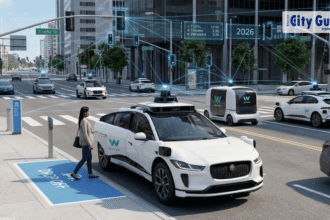
One of the most visible impacts of IoT in everyday life appears in urban environments, even if citizens do not consciously recognize it. Smart traffic systems use sensors, cameras, and connected signals to monitor vehicle flow in real time.
These systems:
- Adjust traffic lights dynamically
- Reduce congestion and idle time
- Improve emergency vehicle routing
- Lower fuel consumption and emissions
Instead of fixed timing, intersections respond to actual conditions. The result is smoother traffic, shorter commutes, and fewer accidents, achieved quietly through continuous data exchange.
As cities grow, these IoT systems become essential for maintaining mobility without endless road expansion.
Smart Homes: Comfort on Autopilot
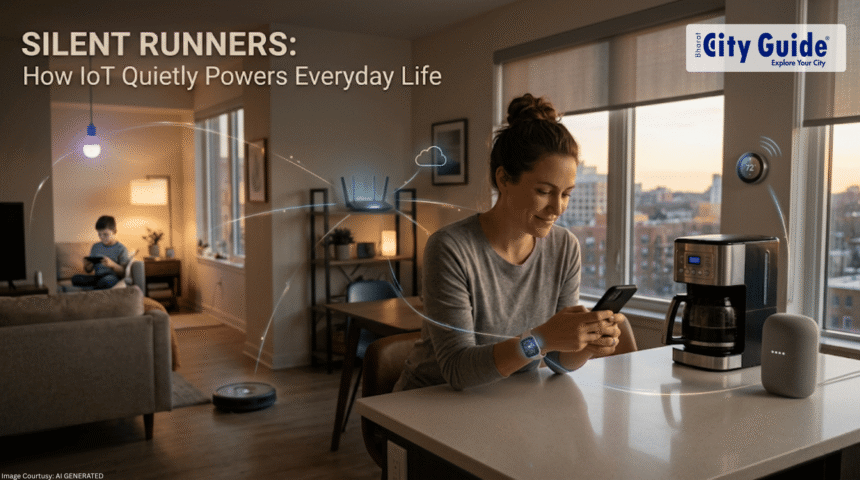
Inside homes, IoT devices manage daily life with minimal human input. Smart thermostats, lighting systems, security cameras, and appliances form interconnected ecosystems.
Key benefits include:
- Automated temperature control based on occupancy
- Lighting that adjusts to time of day and activity
- Security systems that monitor continuously
- Energy usage optimization
Rather than users constantly adjusting settings, homes adapt automatically. Over time, these systems learn patterns and preferences, delivering comfort while reducing waste.
This shift from manual control to ambient intelligence defines the modern smart home.
Energy and Smart Grids: Saving Power Quietly
Energy systems are among the most impactful applications of IoT. Traditional power grids distribute electricity blindly, reacting slowly to demand changes. Smart grids, by contrast, use IoT sensors to monitor usage in real time.
Smart grid capabilities include:
- Load balancing across regions
- Rapid detection of outages
- Integration of renewable energy
- Consumer-level energy feedback
Studies show that smart grid technologies can reduce energy waste by around 10 percent, a massive saving at national and global scales. These efficiencies occur without lifestyle changes, achieved through invisible coordination between devices.
By 2026, edge computing is expected to further enhance smart grids by processing data locally, reducing latency and increasing resilience.
Healthcare IoT: Monitoring Without Hospitals
Healthcare is increasingly shaped by IoT devices that extend care beyond hospitals. Wearables, remote monitoring tools, and connected medical devices continuously track patient data.
Examples include:
- Heart rate and oxygen monitoring
- Glucose sensors for diabetics
- Smart inhalers and medication trackers
These systems enable early detection of health issues, reduce hospital visits, and support aging populations. Doctors receive data-driven insights without requiring patients to be physically present.
IoT shifts healthcare from reactive treatment to preventive, continuous care, improving outcomes while lowering costs.
Industry and Supply Chains: Efficiency at Scale
Modern supply chains depend on IoT to function smoothly. Sensors track goods from production to delivery, monitoring location, temperature, humidity, and handling conditions.
This allows companies to:
- Prevent spoilage of food and medicine
- Optimize inventory levels
- Predict maintenance needs
- Reduce losses and delays
Factories use IoT-enabled machines to detect wear before breakdowns occur, a practice known as predictive maintenance. This reduces downtime, saves resources, and increases productivity.
The global economy increasingly relies on these invisible systems to keep goods moving efficiently.
Agriculture: Feeding Billions with Data
IoT plays a critical role in modern agriculture, where precision matters. Sensors in fields measure soil moisture, temperature, and nutrient levels, while drones and satellites provide real-time imagery.
Benefits include:
- Optimized irrigation
- Reduced fertilizer use
- Early pest detection
- Higher crop yields
Instead of applying resources uniformly, farmers use data to act only where needed. This conserves water, protects ecosystems, and improves food security.
As global population grows, IoT-driven agriculture helps produce more food with fewer inputs.
Environmental Monitoring and Sustainability
Environmental protection increasingly depends on IoT networks. Sensors monitor air quality, water pollution, deforestation, and wildlife movement.
Governments and researchers use this data to:
- Detect pollution sources
- Enforce environmental regulations
- Predict natural disasters
- Track climate patterns
Early warning systems powered by IoT can save lives by detecting floods, earthquakes, or wildfires faster than traditional methods.
Here, IoT acts as a planetary nervous system, sensing changes humans cannot monitor alone.
Edge Computing: The Next Phase of IoT
As IoT expands, processing all data in distant cloud centers becomes inefficient. This is driving the rise of edge computing, where data is processed closer to where it is generated.
Edge computing enables:
- Faster response times
- Reduced bandwidth usage
- Improved privacy
- Greater reliability during outages
By 2026, edge computing is expected to power the next wave of IoT growth, allowing real-time decision-making in applications like autonomous vehicles, smart grids, and industrial automation.
This evolution makes IoT even quieter, faster, and more autonomous.
Security and Privacy Challenges
The invisibility of IoT is both a strength and a risk. Billions of connected devices increase the attack surface for cyber threats.
Challenges include:
- Weak security in low-cost devices
- Data privacy concerns
- Systemic risks from interconnected failures
Securing IoT requires built-in encryption, regular updates, and network-level protections. As societies depend more on invisible systems, trust becomes as important as efficiency.
Why IoT in Everyday Life Matters
The true importance of IoT lies not in convenience, but in optimization at scale. Small efficiency gains multiplied across billions of devices translate into massive resource savings.
IoT:
- Reduces energy and water waste
- Improves safety and reliability
- Supports sustainable growth
- Enables complex systems to function smoothly
Most people never notice when IoT works, but they feel the consequences when it fails. Traffic jams, power outages, and supply disruptions often trace back to broken sensors or data gaps.
A World Without These Silent Runners
Imagining modern life without IoT reveals how dependent society has become on hidden technology. Cities would be less efficient, energy use higher, healthcare more reactive, and supply chains more fragile.
IoT does not replace human decision-making. It augments it, handling complexity at speeds and scales humans cannot manage alone.
Conclusion
The Internet of Things represents a quiet revolution. Billions of sensors and devices operate behind the scenes, making modern life smoother, safer, and more efficient without demanding attention.
From smart grids saving energy to homes adjusting automatically and cities optimizing traffic, IoT in everyday life proves that the most powerful technologies are often the least visible. As edge computing and connectivity expand, these silent runners will play an even greater role in managing the resources and systems that sustain modern civilization.
Technology does not always announce itself. Sometimes, it simply works, and the world runs better because of it.