Introduction
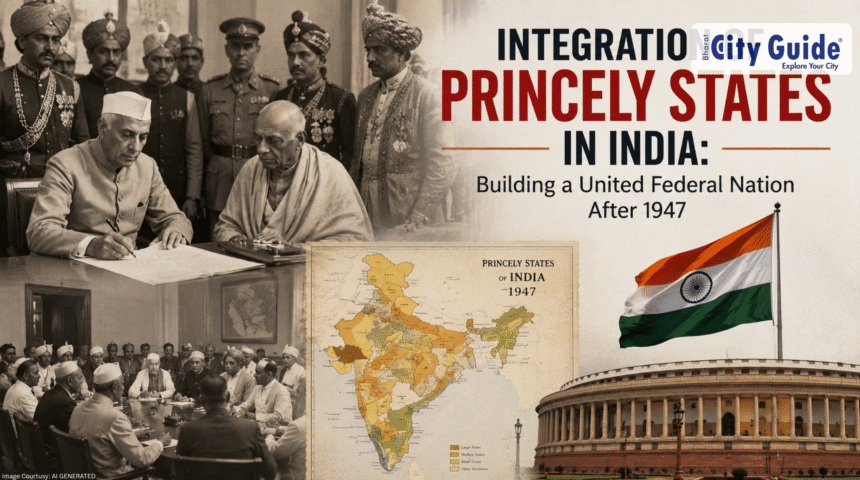
When India gained independence from British colonial rule on August 15, 1947, freedom brought both celebration and immense uncertainty. The end of British rule did not automatically create a politically unified nation-state. Instead, the Indian subcontinent faced one of the most complex state-building challenges in modern history: integrating more than 560 princely states into a single national framework. These princely states—ruled by hereditary monarchs under indirect British suzerainty—varied dramatically in size, governance, geography, and political ambition. Their future posed a critical question: would India emerge as a cohesive union, or fragment into multiple sovereignties?
- Introduction
- What Was the Integration of Princely States in India?
- Why the Integration of Princely States in India Was Crucial
- The Political Landscape in 1947
- Leadership Behind Integration
- Instrument of Accession: The Legal Framework
- Diplomatic Strategy: Persuasion Over Fragmentation
- Complex Cases: Hyderabad, Junagadh, and Kashmir
- Role of Military and Strategic Action
- Federalism and Constitutional Transformation
- Privy Purses and Transitional Compromise
- Linguistic Reorganization and Federal Evolution
- Challenges and Criticism
- Legacy of the Integration of Princely States in India
- Best Lessons from India’s Integration Experience
- Frequently Asked Questions About the Integration of Princely States in India
- Conclusion
The Integration of Princely States in India became one of the most decisive achievements in the making of modern India. Without successful political consolidation, India’s territorial unity, democratic development, security architecture, and constitutional federalism may have faced severe instability.
This extraordinary process required diplomacy, legal innovation, strategic negotiation, political persuasion, and, in certain cases, decisive military action. Under the leadership of Sardar Vallabhbhai Patel and V.P. Menon, India undertook one of history’s most significant peaceful consolidations of diverse political territories.
The story of this integration is not merely administrative history—it is the foundational narrative of India’s transformation from a partitioned post-colonial landscape into a united, federal republic.
What Was the Integration of Princely States in India?
The Integration of Princely States in India refers to the political and administrative process through which over 560 princely states acceded to the newly independent Dominion of India between 1947 and the early 1950s.
Background:
Under British rule, princely states were not directly governed by the British Crown in the same way as British Indian provinces. Instead:
- They had local rulers
- They retained internal autonomy
- They recognized British paramountcy
With British withdrawal, paramountcy lapsed, theoretically giving these states options to:
- Join India
- Join Pakistan
- Attempt independence
Core Objective:
Prevent fragmentation and create territorial unity.
Why the Integration of Princely States in India Was Crucial
1. National Unity
Fragmentation could have created:
- Political instability
- Border disputes
- Strategic insecurity
2. Economic Integration
A unified market required:
- Shared infrastructure
- Trade continuity
- Administrative coherence
3. Security
Independent princely states could have created geopolitical vulnerabilities.
4. Democratic Nation-Building
Federal constitutionalism required territorial consolidation.
The Political Landscape in 1947
At independence, India consisted of:
- British-administered provinces
- 560+ princely states
Major Variations:
Some states were:
- Large (Hyderabad, Kashmir, Mysore)
- Small estates
- Strategically located
- Religiously sensitive
Immediate Challenge:
Without integration, India risked becoming a patchwork of competing sovereignties.
Leadership Behind Integration
Sardar Vallabhbhai Patel
Often called the “Iron Man of India,” Patel led political integration efforts with remarkable strategic clarity.
V.P. Menon
A senior civil servant who played a central role in negotiation and policy execution.
Strategic Method:
- Persuasion
- Legal accession
- Diplomatic pressure
- Strategic assurances
Key Achievement:
Rapid integration with minimal widespread conflict.
Instrument of Accession: The Legal Framework
The Instrument of Accession was the key constitutional mechanism.
States Agreed To:
Transfer control over:
- Defense
- External affairs
- Communications
Benefit:
Allowed rulers to preserve some internal autonomy initially while joining India.
Strategic Importance:
This flexible framework made accession more politically acceptable.
Diplomatic Strategy: Persuasion Over Fragmentation
Many rulers joined through negotiation.
Incentives Included:
- Security
- Political relevance
- Financial arrangements (Privy Purses)
- Stability
Strategic Principle:
Integration was framed as mutually beneficial.
Complex Cases: Hyderabad, Junagadh, and Kashmir
Hyderabad
A large princely state seeking independence.
Outcome:
Military-police action (Operation Polo) integrated it into India.
Junagadh
A Muslim ruler over a Hindu-majority population acceded to Pakistan.
Outcome:
Political and military intervention followed by accession to India.
Jammu and Kashmir
A strategically critical state whose accession occurred amid invasion and conflict.
Significance:
These cases demonstrated that integration could require varied strategies.
Role of Military and Strategic Action
Although diplomacy was primary, force was used selectively.
Why:
- Prevent instability
- Counter secession risks
- Protect sovereignty
Strategic Lesson:
Nation-building sometimes required both negotiation and firmness.
Federalism and Constitutional Transformation
Integration was not merely territorial—it laid the foundation for federal democracy.
Key Outcomes:
- State reorganization
- Constitutional inclusion
- Administrative modernization
- Democratic participation
Long-Term Impact:
India became a union with strong central authority and state representation.
Privy Purses and Transitional Compromise
To encourage peaceful accession, rulers received financial guarantees.
Purpose:
- Reduce resistance
- Ensure smoother transition
Later Evolution:
Privy purses were eventually abolished.
Historical Significance:
This was a pragmatic transitional strategy.
Linguistic Reorganization and Federal Evolution
After initial integration, India further refined its federal system.
Through:
- State reorganization
- Linguistic states
- Democratic decentralization
Bigger Picture:
Political integration created the platform for adaptive federalism.
Challenges and Criticism
Concerns Included:
- Use of force in some regions
- Center-state tensions
- Regional identity concerns
- Kashmir disputes
Historical Reality:
The process was complex and not without controversy.
Legacy of the Integration of Princely States in India
Major Achievements:
- Territorial unity
- Political consolidation
- Security architecture
- Federal democracy
- National identity
Strategic Importance:
It remains one of the most consequential nation-building projects of the 20th century.
Best Lessons from India’s Integration Experience
Strategic Priorities:
- Diplomatic flexibility
- Constitutional innovation
- Leadership clarity
- Security preparedness
- Federal adaptability
Formula:
Unity + Strategy + Federalism + Nation Building
Frequently Asked Questions About the Integration of Princely States in India
How many princely states were integrated?
More than 560.
Who led the integration process?
Sardar Vallabhbhai Patel, supported by V.P. Menon.
What was the Instrument of Accession?
A legal agreement enabling princely states to join India.
Was force used?
Primarily diplomacy was used, though selective military action occurred.
Why was Hyderabad important?
Its size and strategic location made it highly significant.
Did all states join willingly?
Many did, though some cases were contested.
Why is this integration historically important?
It helped create a unified, federal India.
Conclusion
The Integration of Princely States in India was one of the greatest political consolidation efforts in modern history. At a moment when fragmentation could have weakened the newly independent nation, visionary leadership, constitutional strategy, and pragmatic diplomacy helped transform extraordinary diversity into a functioning federal union.
India’s successful integration after 1947 was not inevitable—it was carefully built through negotiation, institutional design, and strategic statecraft.
In shaping a united India from hundreds of princely entities, this process did more than define borders—it laid the political foundation for one of the world’s largest democracies.