Introduction
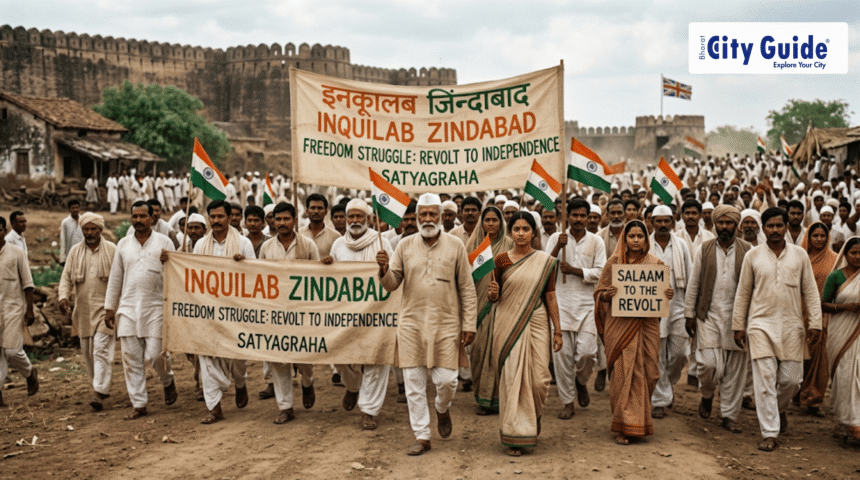
The Indian Freedom Struggle is one of the most inspiring stories of courage, unity, and sacrifice in world history. It represents the relentless efforts of millions of Indians who fought against British colonial rule to achieve independence in 1947. This journey, which lasted for nearly two centuries, was marked by revolts, political movements, social reforms, and the leadership of visionary individuals.
- Introduction
- What is the Indian Freedom Struggle?
- Historical Background of the Indian Freedom Struggle
- Causes of the Indian Freedom Struggle
- The Revolt of 1857: The First War of Independence
- Phases of the Indian Freedom Struggle
- Major Movements in the Indian Freedom Struggle
- Role of Revolutionary Activities
- Role of Women in the Indian Freedom Struggle
- Role of Youth and Students
- Impact of World Wars on the Indian Freedom Struggle
- Formation of Political Groups and Ideologies
- Partition of India and Independence
- Key Leaders of the Indian Freedom Struggle
- Achievements of the Indian Freedom Struggle
- Challenges Faced During the Indian Freedom Struggle
- Lessons from the Indian Freedom Struggle
- FAQs About the Indian Freedom Struggle
- Internal Linking Suggestions
- External Reference Suggestions
- Conclusion
Understanding the Indian Freedom Struggle is crucial not only for historical knowledge but also for appreciating the values of democracy, equality, and freedom that shape modern India. From the Revolt of 1857 to the Quit India Movement, every phase contributed to the ultimate goal of independence.
In this blog, we will explore the causes, key events, major movements, influential leaders, and the overall journey from revolt to independence in a simple yet detailed manner.
What is the Indian Freedom Struggle?
The Indian Freedom Struggle refers to the series of events, movements, and efforts undertaken by Indians to free their country from British colonial rule. It was not a single event but a long and complex process involving:
- Armed revolts
- Non-violent protests
- Political negotiations
- Social reforms
The struggle officially culminated on 15th August 1947, when India gained independence from British rule.
Historical Background of the Indian Freedom Struggle
Before diving deeper into the Indian Freedom Struggle, it is important to understand the background.
British Entry into India
- The British came to India as traders through the East India Company in the early 17th century.
- Gradually, they gained political control using military strength and diplomacy.
- After the Battle of Plassey (1757), British dominance increased significantly.
Expansion of British Rule
- By the mid-19th century, most parts of India were under British control.
- Indian rulers lost power, and economic exploitation increased.
- Traditional industries declined due to British policies.
This created dissatisfaction among Indians, leading to resistance and eventually the Indian Freedom Struggle.
Causes of the Indian Freedom Struggle
The Indian Freedom Struggle was not sudden; it was the result of multiple causes:
1. Political Causes
- Loss of sovereignty of Indian rulers
- Doctrine of Lapse introduced by Lord Dalhousie
- Lack of representation of Indians in governance
2. Economic Exploitation
- Heavy taxation on farmers
- Destruction of local industries
- Drain of wealth to Britain
3. Social and Cultural Factors
- Western education led to awareness
- Social reforms created new thinking
- Interference in traditional customs
4. Military Causes
- Discrimination against Indian soldiers
- Low salaries and poor treatment
5. Immediate Cause: Revolt of 1857
- Introduction of greased cartridges offended religious beliefs
- Triggered the first major uprising against British rule
The Revolt of 1857: The First War of Independence
The Revolt of 1857 marked the beginning of the Indian Freedom Struggle.
Key Features:
- Started in Meerut
- Spread to Delhi, Kanpur, Lucknow, and Jhansi
- Led by leaders like Rani Lakshmibai, Bahadur Shah Zafar, and Tantia Tope
Reasons for Failure:
- Lack of unity
- Limited resources
- Poor coordination
Importance:
- End of East India Company rule
- Beginning of direct British Crown rule
Phases of the Indian Freedom Struggle
The Indian Freedom Struggle can be divided into three major phases:
1. Moderate Phase (1885–1905)
This phase focused on peaceful methods.
Key Features:
- Formation of Indian National Congress in 1885
- Leaders like Dadabhai Naoroji and Gopal Krishna Gokhale
- Demand for reforms, not independence
Methods Used:
- Petitions
- Meetings
- Discussions
2. Extremist Phase (1905–1919)
This phase saw a more aggressive approach.
Key Features:
- Leaders like Bal Gangadhar Tilak, Bipin Chandra Pal, Lala Lajpat Rai
- Demand for Swaraj (self-rule)
Major Movements:
- Swadeshi Movement
- Boycott of British goods
3. Gandhian Phase (1919–1947)
This was the most powerful phase of the Indian Freedom Struggle.
Key Features:
- Leadership of Mahatma Gandhi
- Use of non-violence (Ahimsa) and truth (Satyagraha)
Major Movements in the Indian Freedom Struggle
1. Non-Cooperation Movement (1920–1922)
- Boycott of British institutions
- Promotion of khadi and local products
- Mass participation across India
2. Civil Disobedience Movement (1930–1934)
- Salt March (Dandi March) led by Gandhi
- Violation of British laws
- Nationwide protests
3. Quit India Movement (1942)
- Call for immediate independence
- “Do or Die” slogan
- Massive participation despite repression
Role of Revolutionary Activities
Apart from non-violent movements, revolutionary activities played a crucial role in the Indian Freedom Struggle.
Key Revolutionaries:
- Bhagat Singh
- Chandrashekhar Azad
- Subhas Chandra Bose
Contributions:
- Armed resistance
- Inspiring youth
- Formation of INA (Indian National Army)
Role of Women in the Indian Freedom Struggle
Women played a vital role in the Indian Freedom Struggle.
Notable Women Leaders:
- Rani Lakshmibai
- Sarojini Naidu
- Annie Besant
- Kasturba Gandhi
Contributions:
- Participation in protests
- Leading movements
- Spreading awareness
Role of Youth and Students
Young people were the backbone of the Indian Freedom Struggle.
Contributions:
- Participation in protests
- Joining revolutionary groups
- Spreading nationalist ideas
Impact of World Wars on the Indian Freedom Struggle
World War I:
- Economic hardship
- Increased political awareness
World War II:
- Weakening of British power
- Rise of demand for independence
Formation of Political Groups and Ideologies
During the Indian Freedom Struggle, various political ideologies emerged:
- Liberalism
- Extremism
- Socialism
- Communal politics
These ideologies influenced the direction of the movement.
Partition of India and Independence
The final phase of the Indian Freedom Struggle led to independence but also partition.
Key Events:
- Mountbatten Plan
- Division into India and Pakistan
- Independence on 15th August 1947
Consequences:
- Mass migration
- Communal violence
- Loss of lives
Key Leaders of the Indian Freedom Struggle
Mahatma Gandhi
- Leader of non-violent movements
- Father of the Nation
Jawaharlal Nehru
- First Prime Minister
- Promoter of modern India
Subhas Chandra Bose
- Leader of INA
- Advocate of armed struggle
Sardar Vallabhbhai Patel
- Unified princely states
Achievements of the Indian Freedom Struggle
The Indian Freedom Struggle achieved:
- Political independence
- Democratic system
- Fundamental rights
- National unity
Challenges Faced During the Indian Freedom Struggle
- British repression
- Internal divisions
- Lack of resources
- Communal tensions
Lessons from the Indian Freedom Struggle
- Unity is strength
- Non-violence is powerful
- Leadership matters
- Persistence leads to success
FAQs About the Indian Freedom Struggle
1. When did the Indian Freedom Struggle start?
It began in 1857 with the first major revolt against British rule.
2. Who led the Indian Freedom Struggle?
Many leaders contributed, including Mahatma Gandhi, Nehru, and Subhas Bose.
3. What was the main goal?
The main goal was to achieve independence from British rule.
4. Why was the Revolt of 1857 important?
It marked the beginning of organized resistance.
5. What was Gandhi’s role?
He led non-violent movements and united people.
6. What led to independence in 1947?
Continuous movements, global pressure, and weakening British control.
Internal Linking Suggestions
You may also read:
- “Top 10 Historical Events That Shaped India”
- “Role of Mahatma Gandhi in Indian Independence”
- “Partition of India: Causes and Consequences”
External Reference Suggestions
- National Archives of India
- NCERT History Books
- British Library Archives
- UNESCO Historical Records
Conclusion
The Indian Freedom Struggle is a powerful reminder of the sacrifices made by countless individuals for the freedom we enjoy today. From the Revolt of 1857 to independence in 1947, this journey reflects determination, unity, and resilience.
It teaches us that even the strongest empires can be challenged through courage and collective effort. As citizens, it is our responsibility to honor this legacy by preserving unity, respecting diversity, and contributing to the nation’s growth.