Introduction
Factory floors have always reflected the technological state of society. From hand tools and assembly lines to programmable machines, each leap in automation reshaped productivity and labor. The story of industrial automation began in earnest in 1961, when the first industrial robot, Unimate, was installed in a General Motors plant. That single robotic arm marked the beginning of a transformation that continues today.
- Introduction
- From Unimate to Smart Factories: A Brief History
- What Is Industrial Automation Today?
- Hyperautomation: The New Industrial Paradigm
- Advanced Robotics on the Factory Floor
- Predictive Maintenance: Fixing Problems Before They Happen
- AI and Machine Vision in Manufacturing
- Digital Twins: Virtual Factories in Real Time
- Automation and Workforce Transformation
- Safety Improvements Through Automation
- Energy Efficiency and Resource Optimization
- Industrial Automation by 2026: What’s Next
- Global Competitiveness and Automation
- Ethical and Social Considerations
- Why Automation Matters
- Conclusion
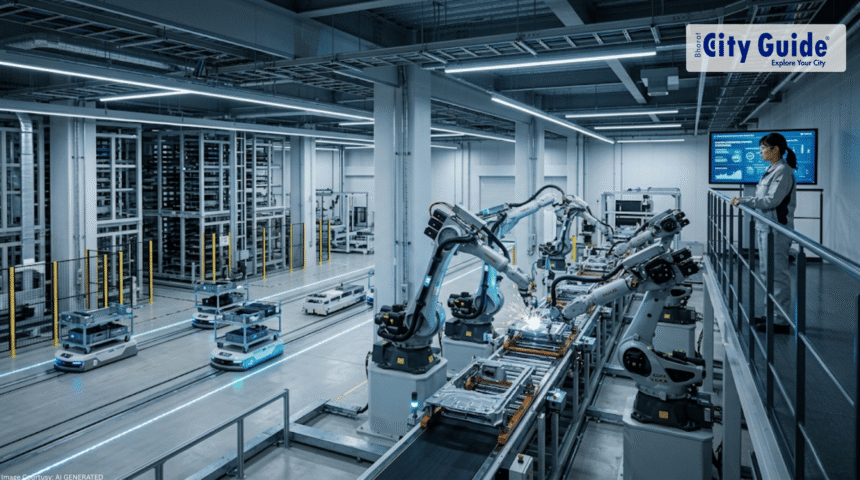
In the 2020s, automation has entered a new phase known as hyperautomation, where robots, artificial intelligence, sensors, and software systems work together as integrated ecosystems. Understanding industrial automation trends reveals how modern factories operate, why productivity continues to rise, and how automation increasingly frees humans from repetitive labor to focus on creativity, design, and decision-making.
From Unimate to Smart Factories: A Brief History
Unimate was simple by today’s standards. It performed repetitive tasks such as moving hot metal parts, reducing injury risk for human workers. Yet its impact was revolutionary. For the first time, machines could be reprogrammed to perform physical labor autonomously.
Throughout the late 20th century, automation expanded steadily:
- 1970s–1980s: Programmable logic controllers (PLCs) and early robotics
- 1990s: Computer-integrated manufacturing and robotics precision improvements
- 2000s: Sensors, machine vision, and networked production systems
By the 2010s, automation was no longer limited to isolated machines. Entire production lines became digitally coordinated, laying the groundwork for today’s smart factories.
What Is Industrial Automation Today?
Modern industrial automation goes far beyond robots welding or assembling parts. It includes:
- Robotics
- Control systems
- Sensors and IoT devices
- AI-driven analytics
- Software automation
Factories now operate as cyber-physical systems, where digital intelligence continuously optimizes physical processes.
Automation today is not about replacing humans outright, but about augmenting human capability and increasing system reliability.
Hyperautomation: The New Industrial Paradigm
Hyperautomation refers to the combination of multiple automation technologies working together. Robots handle physical tasks, while software bots, AI models, and predictive systems manage planning, optimization, and maintenance.
Key components of hyperautomation include:
- Advanced robotics
- Machine learning algorithms
- Digital twins of production systems
- Predictive maintenance platforms
Instead of reacting to problems, factories anticipate them.
Advanced Robotics on the Factory Floor
Industrial robots in the 2020s are vastly more capable than early models. They feature:
- Greater dexterity
- Higher precision
- Adaptive control systems
Collaborative robots, or cobots, are designed to work safely alongside humans. Unlike traditional robots enclosed behind safety cages, cobots can share workspace, assisting with assembly, packaging, and inspection.
This collaboration enables flexible production without sacrificing safety.
Predictive Maintenance: Fixing Problems Before They Happen
One of the most impactful automation trends is predictive maintenance. Instead of servicing machines on fixed schedules or after failures, factories use sensors and AI to predict when equipment will fail.
By 2026, predictive maintenance systems are expected to:
- Reduce downtime significantly
- Extend equipment lifespan
- Lower maintenance costs
Sensors monitor vibration, temperature, and performance, while AI models detect early signs of wear. This shift transforms maintenance from a cost center into a strategic advantage.
AI and Machine Vision in Manufacturing
Machine vision systems allow robots to “see” their environment. Combined with AI, they enable:
- Defect detection
- Quality control
- Object recognition
Unlike rule-based systems, AI-powered vision improves over time. Factories can detect micro-defects invisible to the human eye, increasing product quality while reducing waste.
These systems are central to high-precision industries such as electronics, automotive manufacturing, and pharmaceuticals.
Digital Twins: Virtual Factories in Real Time
A digital twin is a virtual replica of a physical system. Modern factories create digital twins of production lines to simulate performance, test changes, and optimize workflows.
Digital twins enable:
- Rapid process optimization
- Scenario testing without downtime
- Real-time monitoring and adjustment
By 2026, digital twins are expected to become standard in large-scale manufacturing, driving efficiency gains without physical trial and error.
Automation and Workforce Transformation
One of the most debated aspects of automation is its impact on jobs. While automation reduces demand for repetitive manual labor, it increases demand for:
- Engineers
- Technicians
- Data analysts
- System designers
Humans shift from direct production to supervision, optimization, and creativity. Automation handles consistency and endurance, while humans provide adaptability and innovation.
This transformation requires reskilling and education but does not eliminate the need for human expertise.
Safety Improvements Through Automation
Automation significantly improves workplace safety. Robots take over tasks that involve:
- Heavy lifting
- Toxic environments
- Extreme temperatures
As a result, injury rates decline, and workers face fewer long-term health risks. Safety systems embedded in modern robots further reduce accidents, making factories safer overall.
Energy Efficiency and Resource Optimization
Modern automation systems optimize not only labor but also resources. AI-driven control systems reduce:
- Energy consumption
- Material waste
- Water usage
Smart factories dynamically adjust operations based on demand, minimizing idle time and unnecessary energy use. These efficiencies support sustainability goals while lowering costs.
Industrial Automation by 2026: What’s Next
Looking ahead, industrial automation trends point toward:
- Greater AI autonomy in decision-making
- Wider adoption of edge computing
- More flexible, reconfigurable factories
By 2026, robots are expected to become more adaptive, learning from experience rather than relying solely on preprogrammed routines. Factories will operate as intelligent ecosystems rather than static production lines.
Global Competitiveness and Automation
Automation is now a strategic economic factor. Nations with advanced manufacturing automation gain:
- Higher productivity
- Better quality control
- Greater supply chain resilience
As global competition intensifies, automation becomes essential for maintaining industrial leadership.
Ethical and Social Considerations
While automation offers clear benefits, it raises important questions:
- Workforce displacement
- Data privacy
- Decision transparency
Responsible automation strategies emphasize human oversight, ethical AI deployment, and inclusive workforce transitions.
Why Automation Matters
Industrial automation matters because it underpins modern living standards. From vehicles and electronics to food and medicine, automated factories produce goods at scales impossible by manual labor alone.
By freeing humans from repetitive tasks, automation enables:
- Creativity
- Innovation
- Higher-value work
Rather than diminishing human roles, automation redefines them.
Conclusion
From Unimate in 1961 to today’s hyperautomated smart factories, industrial automation has reshaped how the world produces goods. Modern robots, AI systems, and predictive maintenance tools work together to create efficient, safe, and adaptable manufacturing environments.The future of automation is not about machines replacing humans but about machines amplifying human potential. As industrial automation trends continue through 2026 and beyond, factories will become smarter, cleaner, and more flexible, supporting both economic growth and human creativity.
Gujarati TV Industry: Tradition-Focused Content in a Digital Age
The Gujarati TV industry has become an important part of regional entertainment, delivering a wide variety of programs such as daily serials, reality shows, comedy content, and culturally inspired stories. It reflects the rich traditions, values, and everyday life of Gujarati society, allowing viewers to connect closely with the content. With a strong emphasis on family-driven narratives and socially meaningful themes, it continues to attract audiences from all age groups. The rise of digital platforms has significantly expanded its reach, making Gujarati television content accessible not only across Gujarat but also to viewers throughout India and globally. This growing presence, along with improved production quality and fresh storytelling approaches, ensures that Gujarati TV continues to evolve while preserving its cultural essence.