Introduction
Modern economic growth runs on an invisible foundation: semiconductors. From smartphones and laptops to cars, factories, power grids, and financial markets, computer chips sit at the core of nearly every productive system. Understanding the semiconductor industry history is essential to understanding how the modern global economy was built.
- Introduction
- Before Semiconductors: Limits of the Analog Economy
- The Birth of the Semiconductor Industry
- Moore’s Law and Exponential Growth
- From PCs to Everything: Chips in 90% of Devices
- Semiconductors as an Economic Multiplier
- The Rise of Global Semiconductor Supply Chains
- Capital Intensity and Industry Scale
- Semiconductors and National Economic Strategy
- Challenges Facing the Semiconductor Economy
- The Future: Chips as the Engine of Next-Generation Growth
- A World Without Semiconductors
- Conclusion
Since Intel released the first commercial microprocessor in 1971, semiconductors have evolved from niche components into a $500 billion–plus global industry. Today, chips are embedded in roughly 90 percent of electronic devices, driving productivity, automation, and GDP growth across nearly every sector. As nations race toward advanced nodes like 2-nanometer chips, semiconductors have become not just an economic asset but a strategic one.
Before Semiconductors: Limits of the Analog Economy
Before semiconductors, economies relied on mechanical, electromechanical, and analog systems. Calculation was slow, automation was limited, and scaling productivity required large increases in labor and capital.
Factories depended on human coordination rather than programmable machines. Communication relied on physical transport or analog signals. Data processing was manual, expensive, and error-prone.
Economic growth was constrained by how fast humans could work, communicate, and manage complexity. Semiconductors shattered those limits by enabling cheap, fast, and scalable computation.
The Birth of the Semiconductor Industry
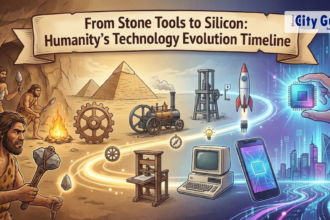
The semiconductor story begins with the transistor, invented in 1947 at Bell Labs. Transistors replaced bulky vacuum tubes, reducing size, power consumption, and failure rates.
The next breakthrough came with the integrated circuit in the late 1950s, which allowed multiple transistors to be placed on a single silicon chip. This innovation laid the groundwork for mass production and cost reduction.
In 1971, Intel introduced the 4004 microprocessor, the first commercially available CPU on a single chip. This moment is widely seen as the birth of modern computing and a turning point in semiconductor industry history.
Moore’s Law and Exponential Growth
One of the defining forces behind semiconductor progress has been Moore’s Law, the observation that the number of transistors on a chip roughly doubles every two years while costs fall.
This exponential improvement drove decades of economic expansion by making computing:
- Faster
- Cheaper
- Smaller
- More energy efficient
As chips improved, entirely new industries emerged, from personal computing and software to digital media, e-commerce, and cloud services. Semiconductor innovation did not just improve existing industries; it created new ones.
From PCs to Everything: Chips in 90% of Devices
By the late 20th century, semiconductors moved beyond computers into everyday life. Today, chips are found in:
- Smartphones and tablets
- Cars and electric vehicles
- Industrial robots and CNC machines
- Medical imaging and diagnostics
- Smart grids and energy systems
- Financial trading infrastructure
Estimates commonly show that around 90 percent of modern electronic devices contain semiconductors. This ubiquity makes chips the connective tissue of the digital economy.
When chip supply is disrupted, entire industries slow down, as seen during recent global shortages that halted auto production and raised consumer prices.
Semiconductors as an Economic Multiplier
The economic importance of semiconductors extends far beyond their direct market value. Chips act as a multiplier for productivity and GDP.
Computing and Productivity
Cheap computing allows businesses to automate tasks, optimize logistics, analyze markets, and innovate faster. This boosts output without proportional increases in labor.
Automation and Industry
Factories equipped with semiconductor-powered machinery produce more with fewer errors. Automation raises efficiency, improves quality, and lowers costs across manufacturing.
Digital Services and GDP
Entire sectors such as cloud computing, artificial intelligence, fintech, and e-commerce depend on advanced chips. These sectors contribute trillions of dollars to global GDP.
Without semiconductors, modern economic growth rates would be impossible to sustain.
The Rise of Global Semiconductor Supply Chains
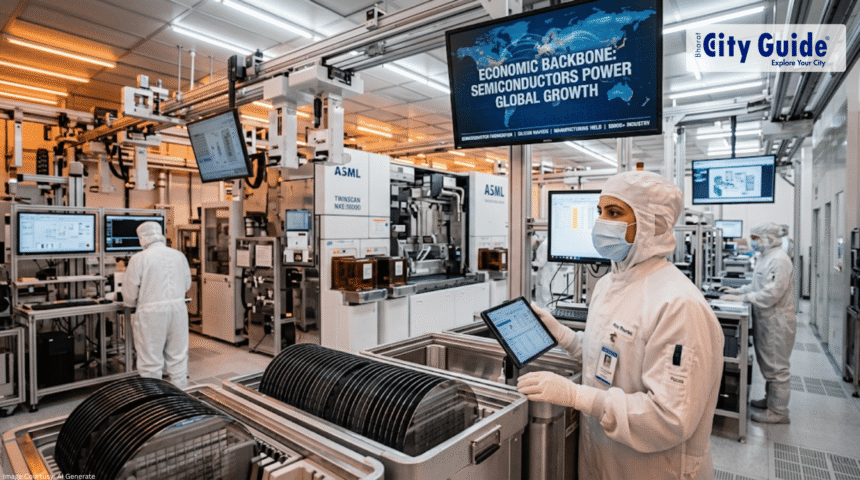
As the industry matured, semiconductor production became highly specialized and globalized. Design, fabrication, packaging, and testing often occur in different countries.
One of the most important players in this system is TSMC (Taiwan Semiconductor Manufacturing Company). As a pure-play foundry, TSMC manufactures chips designed by companies like Apple, NVIDIA, and AMD.
TSMC’s technology roadmaps aim for 2-nanometer process nodes by around 2026, reflecting how cutting-edge fabrication now requires extreme precision, massive capital investment, and advanced materials science.
This concentration of expertise has made semiconductors both economically powerful and geopolitically sensitive.
Capital Intensity and Industry Scale
The semiconductor industry is among the most capital-intensive in the world. Building a leading-edge fabrication plant can cost $15–20 billion or more.
These massive investments create high barriers to entry, consolidating advanced manufacturing among a few players. However, they also generate enormous economic spillovers in engineering, construction, materials, and research.
The result is an industry that not only produces chips but also anchors entire innovation ecosystems.
Semiconductors and National Economic Strategy
Because semiconductors underpin economic productivity, governments increasingly view them as strategic infrastructure. Policies supporting domestic chip manufacturing are framed as investments in:
- Economic resilience
- Technological leadership
- Long-term GDP growth
Subsidies, tax incentives, and public-private partnerships reflect the recognition that control over semiconductor supply chains influences national competitiveness.
In the modern world, economic power and semiconductor capability are deeply linked.
Challenges Facing the Semiconductor Economy
Despite its success, the semiconductor industry faces significant challenges.
Supply Chain Fragility
Highly specialized production makes the industry vulnerable to disruptions, whether from natural disasters, geopolitical tensions, or logistics failures.
Rising Costs
As nodes shrink, costs rise sharply. Advanced lithography, materials, and energy demands strain even the largest firms.
Energy and Sustainability
Chip manufacturing consumes significant energy and water. Balancing growth with environmental responsibility is an increasing priority.
Addressing these challenges is critical because so much of the global economy depends on semiconductor continuity.
The Future: Chips as the Engine of Next-Generation Growth
Looking ahead, semiconductors will play a central role in shaping future economic growth. Artificial intelligence, autonomous systems, biotechnology, and clean energy all rely on advanced computing.
As transistor scaling slows, innovation will increasingly come from:
- Advanced packaging
- Chiplet architectures
- Specialized accelerators
- Energy-efficient designs
These advances will continue the pattern established throughout semiconductor industry history: turning scientific progress into economic expansion.
A World Without Semiconductors
Imagining an economy without semiconductors reveals their true importance. Modern finance, logistics, healthcare, and manufacturing would collapse into slow, manual systems.
Global GDP would shrink dramatically as productivity gains vanish. Automation would stall, innovation would slow, and economic complexity would become unmanageable.
Semiconductors are not optional tools; they are the economic backbone of modern civilization.
Conclusion
From Intel’s 1971 microprocessor to today’s race toward 2-nanometer chips, the semiconductor industry history tells the story of how computing became the engine of global economic growth. Chips now power nearly every device, industry, and supply chain, driving productivity, automation, and GDP worldwide.
As economies become more digital, interconnected, and data-driven, semiconductors will only grow in importance. They are not just components inside machines; they are the foundation upon which modern economic life is built.