Introduction
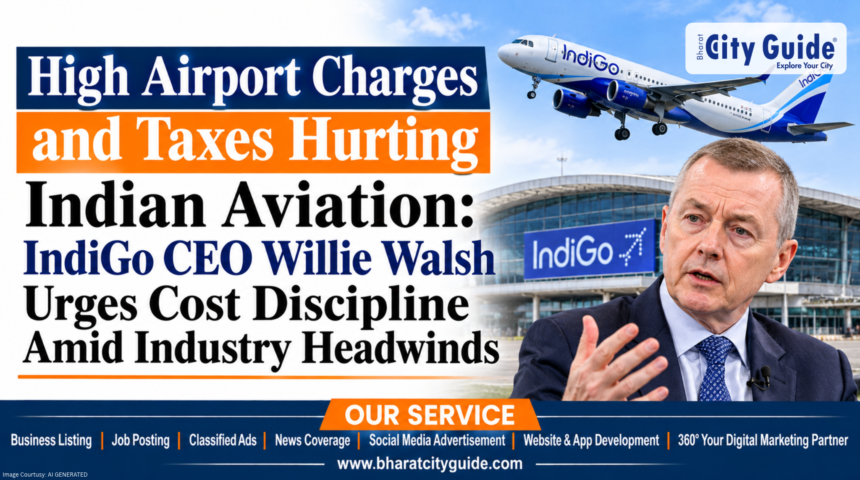
The economics governing every modern airport hub across India have come under sharp focus as civil aviation faces intensifying cost pressures. Speaking at a media briefing in New Delhi on Monday, November 2, 2026, IndiGo Chief Executive Officer Willie Walsh called for lower airport charges and reduced taxation across the country. Walsh emphasized that India’s domestic and international aviation markets would achieve far superior operational resilience if airlines benefited from a more competitive cost environment.
The call for structural reform arrives at a critical juncture for Indian carriers. InterGlobe Aviation Limited (IndiGo) reported a net loss of ₹1,879.1 crore (US$198 million) for the September quarter of 2026, severely impacted by rising Aviation Turbine Fuel (ATF) prices, adverse foreign exchange swings, and elevated infrastructure overheads. In response to rising fuel bills, passenger traffic dropped 4.7% year-on-year during the quarter as higher fares dampened short-term travel demand.
Despite these operational hurdles, Walsh expressed unwavering optimism regarding India’s long-term aviation trajectory. Addressing media representatives during his first in-person briefing since assuming leadership in August 2026, he outlined IndiGo’s strategy to navigate macro pressures while preparing for long-haul international expansion. This report analyzes Walsh’s critique of airport tariffs, evaluates IndiGo’s financials, and examines key growth catalysts like wide-body aircraft deliveries and the new Navi Mumbai airport hub.
What is Airport Tariff Structure and How Does It Impact Airline Operations?
To understand why airport costs play a pivotal role in airline profitability, it is essential to break down the fee structures imposed on commercial carriers. Every commercial airport operates as a capital-intensive infrastructure hub, recovering its land acquisition, runway maintenance, security, and terminal development costs through structured aeronautical and non-aeronautical charges.
In India, aeronautical tariffs at major privatized and state-run facilities are regulated by the Airport Economic Regulatory Authority of India (AERA). These charges are directly levied on airlines and traveling passengers through several distinct fee channels:
- Landing and Parking Charges: Fees calculated based on aircraft maximum takeoff weight (MTOW) for utilizing runways, taxiways, and apron bays.
- User Development Fees (UDF) & Passenger Service Fees (PSF): Mandatory levies added directly to passenger ticket pricing to fund terminal expansion and passenger amenities.
- Route Navigation Facility Charges (RNFC): Payments made to air traffic management authorities for airspace and navigation support.
- Ground Handling & Terminal Space Rentals: Operational expenses paid by airlines to lease check-in counters, maintenance hangars, and cargo facilities within the airport perimeter.
When airport operators adjust user fees upward to recoup infrastructure investments, airlines face elevated operating baselines. For budget carriers operating on thin profit margins, rising ground charges directly constrain their ability to offer low-cost fares to price-sensitive consumers.
Current Situation: IndiGo Q2 2026 Financial Performance and CEO Update
During the quarter ended September 30, 2026, IndiGo faced significant margin compression. The airline’s financial metrics reflect broader industry challenges stemming from elevated fuel costs, rupee depreciation against the US Dollar, and higher operational overheads.
Key Q2 FY2026-27 Financial & Operational Metrics
| Financial / Operational Parameter | Reported Value (Q2 Sept 2026) | Year-on-Year / Contextual Details |
| Net Financial Result | Net Loss of ₹1,879.1 Crore ($198 Million) | Impacted by fuel prices & FX volatility |
| Total Consolidated Income | ₹24,311.9 Crore | Rose 24% YoY despite net loss |
| Free Cash Reserves | ₹39,929.0 Crore | Strong balance sheet liquidity cushion |
| Total Cash Balance | ₹52,685.4 Crore | Includes restricted cash reserves |
| Passenger Traffic Volume | Declined 4.7% YoY | Driven by higher airfares and capacity cuts |
| Active Fleet Size | 400+ Aircraft | Operating 2,100+ daily flights |
Speaking at the New Delhi briefing, Willie Walsh noted that while short-term industry headwinds remain challenging, IndiGo maintains a robust free cash balance of ₹39,929 crore to absorb external shocks. He reiterated that controlling operational costs across airport operators, fuel suppliers, and maintenance partners remains vital for sustainable market growth.
Why Is Controlling Airport Charges Important for Indian Aviation?
The demand for cost reform at every major airport hub carries significant implications for passengers, airlines, and national infrastructure planning:
1. Direct Impact on Retail Airfares
Aeronautical charges and user development fees are factored into passenger ticket prices. When airport tariffs rise, airlines are forced to pass these expenses onto travelers. Lowering facility charges directly supports affordable air travel for millions of first-time domestic flyers.
2. Protecting Airline Profitability
Fuel accounts for nearly 40% of an Indian airline’s operating expenses, while currency fluctuations inflate foreign-denominated aircraft leasing costs. Because carriers cannot control global crude oil benchmarks, reducing domestic airport and ground fees offers a manageable lever to stabilize operating costs.
3. Enhancing Global Transit Hub Competitiveness
India is strategically positioned to develop major international transit hubs competing with Middle Eastern and Southeast Asian aviation centers. High landed costs at a primary Indian airport discourage foreign carriers from establishing connecting flights, limiting India’s potential to capture global transfer traffic.
Key Highlights of Willie Walsh’s New Delhi Briefing
- Call for Tariff Rationalization: Urged domestic airport operators and civil aviation regulators to lower charges to foster a competitive cost ecosystem.
- Reaffirmed Long-Haul Vision: Stated that IndiGo possesses all structural capabilities to successfully expand into international long-haul markets.
- Airbus A350 Delivery Schedule: Confirmed that deliveries for IndiGo’s ordered fleet of wide-body Airbus A350 aircraft are expected to commence in Q2 2028.
- Navi Mumbai Airport Shift: Identified the newly developed Navi Mumbai International Airport as a major strategic growth hub, confirming a partial shift of international operations.
- Strong Liquidity Reserves: Highlighted total cash reserves of ₹52,685.4 crore to navigate short-term macroeconomic volatility.
Strategic Operational Moves: Wide-Body Expansion and Navi Mumbai Airport
To secure future market leadership, IndiGo is executing two major operational pivots designed to expand its international footprint and bypass congestion at primary metropolitan facilities.
1. Wide-Body Fleet Integration (Airbus A350s)
IndiGo is transitioning from a purely narrow-body budget operator into a dual-fleet carrier. The airline expects to begin receiving its long-haul Airbus A350 aircraft starting in the second quarter of 2028. These wide-body jets will allow IndiGo to operate non-stop long-haul routes to Europe, North America, and Australia, competing directly with international legacy carriers.
2. Strategic Shift to Navi Mumbai International Airport
Metropolitan infrastructure constraints at existing facilities—such as Mumbai’s Chhatrapati Shivaji Maharaj International Airport—have long limited flight additions due to runway slot saturation. Walsh identified the newly developed Navi Mumbai International Airport as a prime opportunity. Deciding to shift a portion of IndiGo’s international operations to Navi Mumbai allows the airline to secure fresh landing slots, optimize turn-around times, and lower regional operational bottlenecks.
Cost Structure Comparison: Aviation Turbine Fuel vs. Airport Overheads
Evaluating an airline’s primary cost heads illustrates why industry executives are pressing for cost controls across government and private infrastructure touchpoints:
| Cost Category | Key Drivers | Controllability / Regulatory Status |
| Aviation Turbine Fuel (ATF) | Crude oil benchmarks, state VAT, central excise | High volatility; subject to regional taxation |
| Airport & Landing Charges | AERA regulated tariffs, UDF, ground rents | Regulated by government; open to tariff reform |
| Aircraft Lease Rentals | Global interest rates, USD/INR exchange rate | Fixed contracts in foreign currency; affected by FX |
| Maintenance & Engineering | OEM spare parts, engine overhaul schedules | Highly specialized; dependent on global supply chains |
Advantages of Expanding India’s Airport Infrastructure
- Unlocking Regional Connectivity: Modern regional airport developments under government schemes have connected tier-2 and tier-3 cities to major economic hubs.
- Creating Secondary Metro Hubs: Green-field projects like Navi Mumbai and Noida (Jewar) relieve operational congestion at primary city centers.
- Boosting Cargo Capabilities: Dedicated air cargo terminals at modern airport facilities support e-commerce, pharmaceutical exports, and high-value manufacturing logistics.
Potential Challenges Facing Airport and Airline Stakeholders
- Balancing Capital Expenditures with Low Tariffs: Private airport developers invest thousands of crores in terminal infrastructure and require sustainable tariff returns to service project debt.
- High Taxation on Jet Fuel: ATF in India remains subject to central and state levies, keeping fuel costs significantly higher than global averages.
- Passenger Price Sensitivity: Rapid airfare increases driven by input costs lead to immediate drops in passenger volume, as seen in Q2 2026 traffic figures.
Frequently Asked Questions (FAQs)
What did IndiGo CEO Willie Walsh say about airport charges?
IndiGo CEO Willie Walsh stated that high airport charges and taxes are harming the growth of Indian aviation. He urged airport operators and regulators to offer more competitive pricing structures to support airline profitability and fleet expansion.
What was IndiGo’s financial performance in the September 2026 quarter?
IndiGo reported a net loss of ₹1,879.1 crore (US$198 million) for the September quarter of 2026. The loss was driven by higher Aviation Turbine Fuel (ATF) costs, rupee depreciation, and a 4.7% drop in passenger volume caused by elevated airfares.
When will IndiGo receive its Airbus A350 wide-body aircraft?
According to CEO Willie Walsh, IndiGo expects to start taking delivery of its long-haul Airbus A350 aircraft starting in the second quarter of 2028.
Why is Navi Mumbai International Airport important for IndiGo?
Navi Mumbai International Airport provides critical slot capacity and modern infrastructure that allows IndiGo to expand its international flight network beyond the slot-constrained existing Mumbai airport.
How many aircraft does IndiGo currently operate?
IndiGo currently operates a fleet of over 400 aircraft, managing more than 2,100 daily flights across domestic and international routes.
How do airport tariffs affect ticket prices for everyday passengers?
Airport tariffs, including User Development Fees (UDF) and landing charges, are directly added to the final ticket cost paid by passengers. Higher airport tariffs lead to increased airfares.
Conclusion
In conclusion, the remarks by IndiGo CEO Willie Walsh highlight a fundamental challenge facing the Indian aviation sector: balancing rapid infrastructure growth with sustainable operating costs. As high fuel prices, currency pressures, and elevated airport tariffs weigh on quarterly profitability, collaboration between government regulators, airport operators, and airlines will be vital to keeping air travel affordable.
IndiGo’s long-term strategy—anchored by strong cash reserves of ₹52,685 crore, wide-body Airbus A350 deliveries scheduled for 2028, and a strategic expansion into Navi Mumbai International Airport—demonstrates resilience despite short-term headwinds. By addressing cost structures across every major airport hub, India can protect its position as one of the fastest-growing aviation markets in the world.