Introduction
India is in the middle of a major transformation in urban mobility. With rising fuel prices, growing air pollution concerns, and increasing pressure on fossil fuel imports, electric vehicles (EVs) have emerged as a key solution for sustainable transportation.
- Introduction
- Key Policy Components
- Tier-1 Cities:
- Tier-2 Cities:
- 1. EV Adoption Rates
- 2. Charging Infrastructure Development
- 3. Consumer Awareness and Behavior
- 4. Economic Factors
- 5. Government Incentive Impact
- 1. Electric Two-Wheelers
- 2. Electric Cars
- 3. Electric Three-Wheelers
- 1. Charging Network Gaps
- 2. Grid Capacity Issues
- 3. Battery Supply Chain Constraints
- 4. High Initial Cost
- Positive Outcomes:
- Tier-1 Cities:
- Tier-2 Cities:
- Key Measures:
- 1. Range Anxiety
- 2. Charging Time
- 3. Resale Value Uncertainty
- Expected Trends:
- Benefits:
- 1. Uneven Infrastructure Development
- 2. High Battery Costs
- 3. Limited Awareness in Smaller Cities
- 4. Supply Chain Dependency
- 1. What is India’s EV policy?
- 2. Which cities adopt EVs faster?
- 3. What is the biggest challenge in Tier-2 cities?
- 4. Are EVs cheaper to run?
- 5. What vehicles are most popular?
- 6. Is EV adoption growing in India?
- 7. What is the future of EVs in India?
To support this shift, the Indian government has introduced several initiatives under its broader electric mobility strategy. The national EV framework aims to accelerate adoption, strengthen infrastructure, and reduce dependence on internal combustion engine vehicles.
A key question today is how effective these policies have been across different urban landscapes. The outcomes vary significantly between Tier-1 metropolitan cities and rapidly growing Tier-2 urban centres.
In this detailed analysis, we examine Assessing The Outcomes Of India’s National E-Vehicle Policy In Tier-1 And Tier-2 Urban Centres, focusing on adoption trends, infrastructure readiness, consumer behavior, challenges, and future outlook.
Overview of India’s National Electric Vehicle Policy
India’s EV policy framework focuses on:
- Promoting electric mobility
- Reducing carbon emissions
- Supporting domestic manufacturing
- Expanding charging infrastructure
Key Policy Components
- Subsidies for EV buyers
- Incentives for manufacturers
- Charging infrastructure development
- Battery localization support
Growth of Electric Vehicles in India
Electric vehicle adoption in India has been increasing steadily across:
- Two-wheelers
- Three-wheelers
- Passenger cars
- Commercial fleets
Tier-1 vs Tier-2 Cities: Understanding the Difference
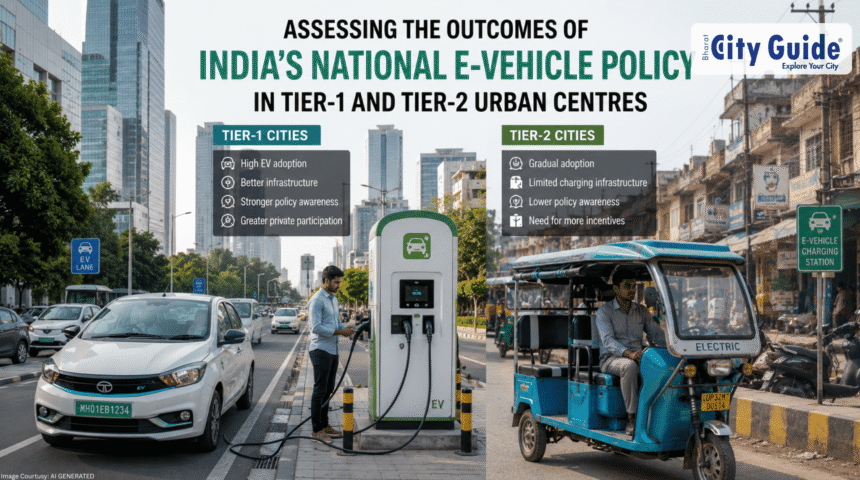
Tier-1 Cities:
Major metropolitan areas like:
- Delhi
- Mumbai
- Bengaluru
- Chennai
These cities have:
- Higher income levels
- Better infrastructure
- Early EV adoption
Tier-2 Cities:
Emerging urban centres like:
- Jaipur
- Lucknow
- Indore
- Surat
These cities are:
- Rapidly urbanizing
- More price-sensitive
- Infrastructure-limited
Assessing The Outcomes Of India’s National E-Vehicle Policy In Tier-1 And Tier-2 Urban Centres
The impact of EV policy differs significantly between these two categories.
1. EV Adoption Rates
Tier-1 Cities:
- Higher adoption rates
- Strong consumer awareness
- Early availability of models
Tier-2 Cities:
- Growing but slower adoption
- Price-sensitive consumers
- Limited model availability
2. Charging Infrastructure Development
Tier-1 Cities:
- Expanding charging networks
- Public and private charging stations
- Corporate charging hubs
Tier-2 Cities:
- Limited infrastructure
- Slow rollout of charging stations
- Dependency on home charging
3. Consumer Awareness and Behavior
Tier-1 Cities:
- High awareness of EV benefits
- Interest in sustainability
- Early adopters dominate
Tier-2 Cities:
- Awareness growing
- Concerns about range and cost
- Preference for traditional vehicles still strong
4. Economic Factors
Tier-1 Cities:
- Higher purchasing power
- Greater willingness to invest in EVs
- Leasing and financing options available
Tier-2 Cities:
- Budget constraints
- Preference for low-cost vehicles
- Sensitivity to battery replacement costs
5. Government Incentive Impact
Government subsidies have:
- Boosted EV demand in Tier-1 cities
- Moderately influenced Tier-2 adoption
Role of Key EV Categories
1. Electric Two-Wheelers
Ather 450X and similar models are driving urban adoption.
2. Electric Cars
Tata Nexon EV has become one of the most popular EVs in India.
3. Electric Three-Wheelers
Widely used in Tier-2 cities for transport and delivery services.
Infrastructure Challenges in India
1. Charging Network Gaps
Especially in Tier-2 and semi-urban areas.
2. Grid Capacity Issues
Local electricity infrastructure needs upgrades.
3. Battery Supply Chain Constraints
Dependence on imports for lithium batteries.
4. High Initial Cost
EVs still cost more than conventional vehicles.
Environmental Impact of EV Adoption
Positive Outcomes:
- Reduced air pollution in cities
- Lower carbon emissions
- Improved urban air quality
Role of Private Sector in EV Expansion
Companies are contributing through:
- EV manufacturing
- Charging network development
- Battery innovation
Fleet Electrification in Urban Centres
Tier-1 Cities:
- Ride-hailing companies adopting EVs
- Corporate fleet electrification
Tier-2 Cities:
- Delivery services gradually adopting EVs
Policy Support and Government Initiatives
Key Measures:
- FAME schemes
- State-level EV policies
- Tax incentives
- Charging infrastructure subsidies
Consumer Challenges in EV Adoption
1. Range Anxiety
Fear of running out of charge.
2. Charging Time
Longer compared to refueling petrol vehicles.
3. Resale Value Uncertainty
Unclear second-hand market.
Tier-1 City Success Stories
Cities like Bengaluru and Delhi show:
- Rapid EV growth
- Strong charging infrastructure
- Corporate adoption
Tier-2 City Growth Potential
Tier-2 cities offer:
- Large untapped markets
- Lower congestion
- Growing middle class
Future of EV Policy in India
Expected Trends:
- Faster charging networks
- Battery swapping models
- Affordable EV launches
- Improved rural-urban penetration
Integration with Renewable Energy
EV adoption aligns with:
- Solar energy expansion
- Clean grid development
- Sustainable transport systems
Economic Impact of EV Growth
Benefits:
- Job creation in EV sector
- Reduction in fuel imports
- Growth of local manufacturing
Key Barriers to Policy Success
1. Uneven Infrastructure Development
2. High Battery Costs
3. Limited Awareness in Smaller Cities
4. Supply Chain Dependency
Frequently Asked Questions (FAQs)
1. What is India’s EV policy?
It is a government initiative to promote electric mobility.
2. Which cities adopt EVs faster?
Tier-1 cities lead in adoption.
3. What is the biggest challenge in Tier-2 cities?
Lack of charging infrastructure.
4. Are EVs cheaper to run?
Yes, they have lower running costs.
5. What vehicles are most popular?
Two-wheelers and compact electric cars.
6. Is EV adoption growing in India?
Yes, it is increasing rapidly.
7. What is the future of EVs in India?
Strong growth supported by policy and innovation.
Conclusion
India’s electric vehicle transition is one of the most important shifts in its modern transportation history. While Tier-1 cities are leading adoption with better infrastructure and higher awareness, Tier-2 cities represent the next major growth frontier.
The Assessing The Outcomes Of India’s National E-Vehicle Policy In Tier-1 And Tier-2 Urban Centres shows that while progress is significant, challenges such as infrastructure gaps, affordability, and awareness must be addressed to ensure balanced nationwide adoption.
As policy support strengthens and technology improves, India’s EV ecosystem is expected to become more inclusive, efficient, and environmentally sustainable in the coming years.