Introduction
The administrative machinery of Gujarat has reached a pivotal milestone in executing one of the most vital democratic and demographic exercises in recent history. Under the structural frameworks of Census 2027, the city and district of Rajkot have officially brought the curtain down on the first phase of field operations, popularly termed the House Listing and Housing Census. Carried out over a dedicated timeline, thousands of government personnel traversed the urban corridors and rural stretches of Rajkot to meticulously map residential infrastructures, commercial properties, and mixed-use environments.
- Introduction
- What is Census 2027?
- Why This News is Important
- Background Information
- Key Highlights of the Rajkot Census Operations
- Detailed Explanation of the Event
- Benefits and Importance of the Drive
- How It Impacts People
- Expert Insights and Industry Perspective
- Challenges and Limitations
- Future Outlook
- Frequently Asked Questions (FAQs)
- Conclusion
This structural layout serves as the foundational architecture for the actual population count scheduled for early next year. According to senior administrative officials, with Phase 1 safely under wraps, the focus has completely shifted toward preparing for the high-stakes second phase. This final phase, the actual enumeration of citizens, is slated to commence globally across the region in February 2027.
The timely execution of this project in a fast-evolving economic hub like Rajkot underscores the modern urgency of structural tracking. Originally disrupted by unprecedented global events over the early part of the decade, the modern census workflow has undergone a massive technological shift. Now driven by mobile applications, geo-fenced data aggregation, and structured digital frameworks, Census 2027 represents a massive leap forward from standard historical operations.
Understanding the successful completion of the Rajkot house listing drive provides crucial insight into how India’s public policies, resource allocations, and infrastructure blueprints will be designed for the next decade.
What is Census 2027?
Census 2027 is the official, comprehensive nationwide demographic exercise conducted by the Government of India to count and record critical socioeconomic data of every living individual across the length and breadth of the country. Managed under the office of the Registrar General and Census Commissioner of India, it marks a historic transition into the modern digital era. Frequently described as the first truly “Digital Census,” this massive data harvesting operation utilizes advanced mobile software, cloud storage interfaces, and direct data-logging platforms to bypass the prolonged processing delays traditionally associated with paper forms.
YouTube
Operationally, the process is divided into two distinct, carefully timed phases:
- Phase 1: House Listing and Housing Census: In this phase, enumerators physically visit every neighborhood to map buildings, identify households, note structural properties (such as construction materials and access to basic amenities like drinking water, electricity, and sanitation), and allocate distinct census identification numbers.
- Phase 2: Population Enumeration: This is the phase where the actual individual human count takes place. Every individual is tracked based on age, marital status, educational qualifications, economic occupation, language profile, and migration parameters.
For Census 2027, an unprecedented option known as “Self Enumeration” has also been introduced. This empowers tech-savvy citizens to securely log into an official national portal and register their family parameters directly, streamlining the field team’s burden.
YouTube
Why This News is Important
The successful completion of the house listing phase in Rajkot carries immense weight because an accurate census forms the bedrock of all planning activities. Rajkot is the fourth-largest city in Gujarat and is widely recognized as an engine of micro, small, and medium enterprises (MSMEs). The city has witnessed an unprecedented influx of industrial workers, student populations, and commercial immigrants over the past decade. Without fresh, certified data from Census 2027, municipal planners and federal state ministries would be forced to work with outdated figures from over fifteen years ago.
Furthermore, this milestone serves as a functional litmus test for the digital platforms developed for the current census cycle. Proving that thousands of enumerators can systematically log, categorize, and complete thousands of housing entries in a heavily populated district with minimal technical glitches demonstrates the viability of the nationwide digital layout. It provides a blueprint that can be replicated across other regions as they prepare for the ultimate head-count phase.
Background Information
Historically, the census in India is a decennial exercise, meaning it occurs strictly every ten years. The last successful nationwide count took place in 2011. The subsequent iteration was scheduled to begin its initial field operations in 2020 and conclude individual logging in 2021. However, the unexpected outbreak of the COVID-19 pandemic severely restricted movement, forcing multiple indefinite administrative delays to safeguard public health.
As the years rolled by, the necessity for refreshed population metrics grew acute. Welfare schemes, food security distributions, public healthcare allocations, and educational seats were operating under old limits, leaving a significant portion of the newly grown population outside the safety net. Realizing the urgency, the administration recalibrated its timelines, completely modernized the underlying software, and initiated the revised cycle under the banner of Census 2027.
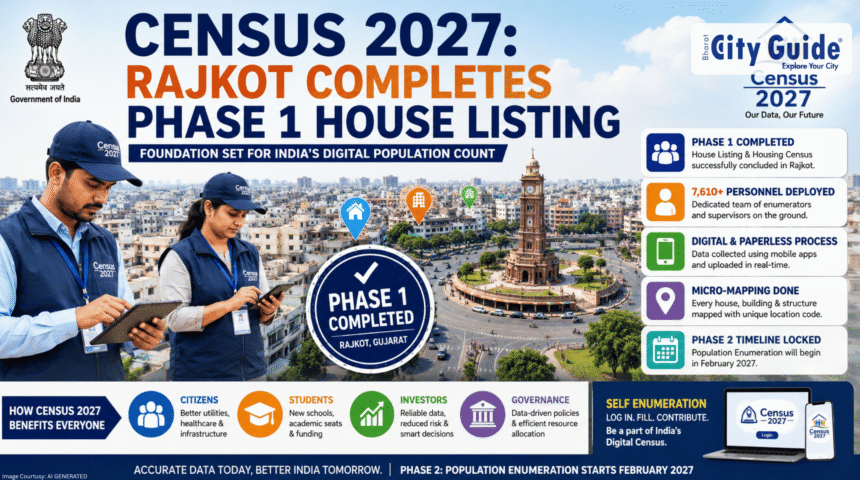
In Gujarat, the administrative machinery mobilized thousands of schoolteachers, municipal staff, and rural revenue desk officers. For the Rajkot zone specifically, a massive workforce of over 7,610 specialized personnel was deployed, backed by intensive training programs focused on utilizing the newly developed digital mapping toolkits.
YouTube
Key Highlights of the Rajkot Census Operations
- Phase 1 Successfully Completed: The critical House Listing and Housing Census phase has wrapped up smoothly across the entire Rajkot territory.
- Massive Personnel Deployment: Over 7,610 government employees, including field enumerators and localized supervisors, were deployed on the ground. YouTube
- Granular Micro-Mapping: Thousands of unique housing units, commercial structures, and mixed-use premises were assigned permanent location codes and uploaded to central databases.
- Transition to Digital Formats: The field operations completely bypassed traditional paper registries, relying heavily on specialized mobile data interfaces.
- Phase 2 Timeline Locked: The district administration has confirmed that the actual citizen-counting phase will commence in February 2027.
- Integration of Self Enumeration: Initial setups for online self-reporting profiles have been updated to ensure a smooth transition into the final population count.
Detailed Explanation of the Event
The completion of the primary census phase in Rajkot represents a triumph of logistically complex coordination between the Rajkot Municipal Corporation (RMC) and the district revenue authorities. The house listing drive required field personnel to knock on doors across every ward of the city, as well as every remote village within the surrounding talukas.
Structuring the Data Collection
During this phase, enumerators did not just count walls; they captured a complex snapshot of living conditions. This involved noting whether a structure was residential, institutional, or industrial, checking for basic amenities, and verifying local addresses against official master maps. Each house was assigned a unique geometric position tag to eliminate overlapping or missing entities in the upcoming count.
Overcoming Initial Material Delays
The process was not without its minor friction points. At the start of the deployment phase, local news outlets reported slight delays in getting digital reference kits and administrative handbooks out to the entire field force. However, the local administration intervened rapidly, speeding up material distribution channels within 24 hours and ensuring that the structured training modules successfully translated into effective field operations.
Looking Ahead to February 2027
With the field validation sheets now compiled, the database sets up a perfect digital grid for February 2027. When enumerators return to the field for Phase 2, they will not waste time finding locations. Instead, they will go directly to the verified addresses on their digital manifests to record individual personal details, maximizing accuracy and efficiency.
Benefits and Importance of the Drive
1. Accurate Delimitation and Political Representation
As urban centers grow, ward boundaries need to be realigned to ensure fair political representation. The structural data generated by Census 2027 will help authorities balance municipal wards equally, ensuring every citizen’s vote carries equal weight.
2. Targeted Welfare Distribution
Modern public welfare programs rely heavily on direct benefit transfers (DBT) and targeted subsidization. Accurate housing and economic data ensure that housing benefits, subsidized clean energy connections, and food safety allocations reach vulnerable segments without leakages.
3. Smart Infrastructure Blueprinting
For an expanding city like Rajkot, planning new flyovers, underground drainage lines, metro links, and primary healthcare units cannot be done blindly. Knowing exactly where housing density has surged allows urban planners to deploy public funds precisely where the demand is greatest.
4. Commercial and Industrial Investment Clarity
Private enterprises, automotive factories, and real estate developers utilize demographic trends to decide where to invest capital. A certified, updated census layout reduces the risks associated with market expansion, spurring job creation across the district.
How It Impacts People
For the Common Citizen
The average resident will see a direct correlation between these collected metrics and the long-term availability of local civic amenities. As data filters into state departments, neighborhoods that have grown rapidly over the last decade will finally see proportional upgrades in water supply timelines, waste collection routines, and localized police patrolling.
For Students and Educational Seekers
The census records the exact youth and child density within specific municipal zones. This gives the education department the data it needs to sanction new government schools, upgrade regional colleges, and allocate academic resources where they are most urgently required.
For Investors and Local Entrepreneurs
Rajkot’s famous engineering and casting clusters stand to gain immensely. Updated demographic data gives entrepreneurs a clear look at local labor pools, consumption trends, and purchasing power metrics, facilitating smoother business expansion.
Expert Insights and Industry Perspective
Demographic analysts and urban governance experts note that the transition to a digital-first approach for Census 2027 solves a long-standing issue in public administration: data obsolescence. Historically, by the time paper-bound census figures were collected, manually cross-checked, scanned, and published, years had passed, rendering much of the data outdated for immediate policy decisions.
Industry specialists emphasize that by capturing structural configurations directly via verified mobile software, the turnaround time for data processing is cut drastically. Furthermore, embedding geographic and location codes directly into individual entries ensures high data integrity, minimizing the manual errors that frequently occurred with handwritten registries.
Challenges and Limitations
Despite its successful rollout, a massive project like Census 2027 faces several natural challenges:
- Digital Literacy Barriers: While the self-enumeration feature is highly efficient, a significant portion of the rural population may lack the digital literacy or connectivity required to use online portals, keeping them dependent on physical enumerator visits.
- Privacy and Data Security Concerns: In an era of heightened awareness around data privacy, citizens are occasionally hesitant to share detailed household metrics. Ensuring the absolute security of the central cloud databases is paramount to maintaining public trust.
- Tracking Migrant Populations: Rajkot has a large floating population of seasonal industrial laborers. Ensuring these individuals are counted accurately without omission or duplication remains a complex logistical puzzle for field teams.
Future Outlook
With Phase 1 complete in Rajkot, the countdown to the final phase has officially begun. Over the next few months, the administrative machinery will focus on data scrubbing, identifying gaps in the house listing grid, and running mock validation tests on their software platforms.
Come February 2027, the second phase will launch nationwide. This phase will see teams focus entirely on individual citizen profiles to compile India’s new master demographic ledger. The successful trial run in Rajkot offers a promising indicator that Gujarat’s administrative machinery is well-prepared to deliver a smooth, high-fidelity digital count.
Frequently Asked Questions (FAQs)
1. What was the objective of the recently concluded phase of Census 2027 in Rajkot?
The primary objective was the House Listing and Housing Census. This phase mapped structural layouts, identified individual households, and assigned location codes to prepare a precise geographic framework for the upcoming final population count.
2. When will the actual population counting start for Census 2027?
The second phase, which encompasses the actual individual population enumeration, is scheduled to begin in February 2027.
3. How does a digital census benefit citizens compared to older methods?
A digital census ensures rapid processing, eliminates human reading errors from paper forms, and enables quicker implementation of data-driven welfare policies. It also introduces the convenience of self-enumeration.
4. Can I fill out my Census 2027 information online by myself?
Yes, the current census cycle features a “Self Enumeration” option. Citizens can securely log into the official government census portal to input their family details directly.
YouTube
5. How many government workers were involved in the Rajkot house listing drive?
The Rajkot district administration deployed a dedicated force of over 7,610 trained employees, including field enumerators and supervisors, to ensure full coverage.
YouTube
6. Will my personal information remain safe during Census 2027?
Yes, all data collected under the Census Act is strictly confidential. The information is encrypted and processed at an aggregate level solely for national planning and statistical analysis; it cannot be accessed by unauthorized entities.
Conclusion
The smooth completion of the first phase of house listing operations in Rajkot marks a major milestone for Census 2027 in Gujarat. By resolving early logistical hurdles and moving away from paper-heavy processes, the district’s field teams have established a clear, reliable digital foundation for the upcoming headcount. As the administration prepares for the final population enumeration in February 2027, residents can look forward to a future where public policy, municipal funding, and structural development are guided by accurate, real-time data, driving balanced growth for communities nationwide.