Introduction
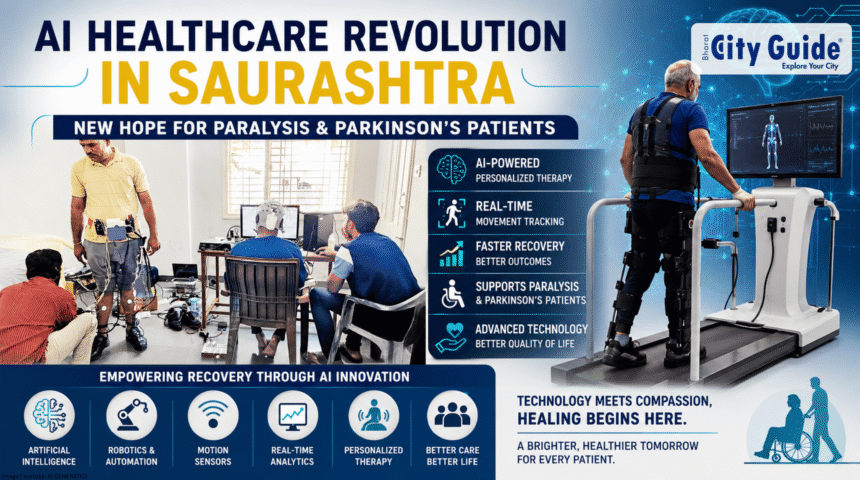
The healthcare sector in India is witnessing a major transformation, and Saurashtra is emerging as a significant beneficiary of this change. The latest breakthrough comes through the AI Healthcare Revolution in Saurashtra, where advanced artificial intelligence-powered rehabilitation machines developed with support from IIT Gandhinagar are helping paralysis and Parkinson’s disease patients regain mobility, independence, and confidence.
- Introduction
- What is the AI Healthcare Revolution in Saurashtra?
- Why This Healthcare Innovation Matters for Saurashtra
- Understanding Paralysis: Causes and Challenges
- Understanding Parkinson’s Disease
- How AI Machines Help Paralysis Patients
- How AI Machines Support Parkinson’s Disease Patients
- Technologies Powering the AI Healthcare Revolution in Saurashtra
- Benefits of AI-Based Rehabilitation Systems
- Impact on Rural and Semi-Urban Healthcare
- Challenges and Limitations of AI Healthcare Technology
- Future of AI Healthcare in Gujarat
- Why IIT Gandhinagar’s Contribution is Significant
- Frequently Asked Questions (FAQs)
- Conclusion
For years, patients suffering from neurological disorders such as paralysis and Parkinson’s disease have relied on traditional physiotherapy and rehabilitation methods that often require long treatment periods. However, cutting-edge AI-based healthcare technologies are now changing the rehabilitation landscape by providing personalized therapy, precise movement tracking, and data-driven recovery programs.
This development is being viewed as a healthcare milestone for Saurashtra, offering renewed hope to thousands of patients and families dealing with neurological disabilities. The AI Healthcare Revolution in Saurashtra demonstrates how technology and healthcare can work together to improve lives and create better treatment outcomes.
What is the AI Healthcare Revolution in Saurashtra?
The AI Healthcare Revolution in Saurashtra refers to the introduction of advanced artificial intelligence-based rehabilitation systems designed to assist patients suffering from neurological disorders, especially paralysis and Parkinson’s disease.
These smart machines use artificial intelligence, sensors, robotics, and real-time data analysis to support patient rehabilitation. Unlike traditional therapy methods, AI-powered systems continuously monitor patient movements and adjust therapy sessions according to individual needs.
Simple Explanation
Think of these machines as intelligent rehabilitation assistants that can understand a patient’s condition, monitor progress, and provide customized exercises to improve mobility and muscle control.
Medical Perspective
From a medical standpoint, AI-assisted rehabilitation combines:
- Artificial Intelligence
- Motion Sensors
- Robotics
- Neurological Assessment Tools
- Real-Time Performance Tracking
- Personalized Therapy Algorithms
Together, these technologies help improve motor functions, balance, coordination, and recovery outcomes.
Why This Healthcare Innovation Matters for Saurashtra
The AI Healthcare Revolution in Saurashtra is important because neurological disorders are becoming increasingly common due to aging populations, lifestyle changes, and rising cases of stroke-related disabilities.
Key Reasons This Innovation Matters
- Faster rehabilitation support
- Better therapy accuracy
- Personalized treatment plans
- Reduced dependence on manual therapy
- Improved patient motivation
- Better monitoring of recovery progress
- Increased accessibility to advanced healthcare
For many patients in smaller cities and towns of Saurashtra, access to advanced rehabilitation technologies has traditionally been limited. This initiative helps bridge that gap.
Understanding Paralysis: Causes and Challenges
Paralysis occurs when a person loses the ability to move one or more parts of the body due to damage to the nervous system.
Common Causes of Paralysis
- Stroke
- Spinal cord injuries
- Brain injuries
- Multiple sclerosis
- Neurological disorders
- Infections affecting the nervous system
- Birth-related neurological conditions
Challenges Faced by Paralysis Patients
- Difficulty walking
- Loss of muscle control
- Reduced independence
- Difficulty performing daily tasks
- Emotional and psychological stress
- Increased dependence on caregivers
Traditional rehabilitation often requires months or years of therapy. AI-assisted rehabilitation aims to improve treatment efficiency and patient engagement.
Understanding Parkinson’s Disease
Parkinson’s disease is a progressive neurological disorder that affects movement and coordination.
The disease develops when certain brain cells responsible for producing dopamine gradually deteriorate.
Common Symptoms of Parkinson’s Disease
- Tremors or shaking
- Muscle stiffness
- Slower movement
- Balance problems
- Difficulty walking
- Changes in speech
- Reduced facial expressions
Parkinson’s disease does not currently have a cure, but modern therapies can help manage symptoms and improve quality of life.
This is where the AI Healthcare Revolution in Saurashtra can play a significant role.
How AI Machines Help Paralysis Patients
AI-powered rehabilitation systems offer several advantages over traditional therapy methods.
Personalized Therapy Programs
Each patient’s condition is different. AI systems analyze movement patterns and create customized rehabilitation exercises.
Real-Time Feedback
Patients receive immediate feedback regarding posture, movement accuracy, and exercise performance.
Progress Tracking
Doctors and therapists can monitor improvement through digital reports and performance analytics.
Increased Motivation
Interactive therapy sessions often improve patient participation and consistency.
Enhanced Recovery Monitoring
AI algorithms identify areas requiring additional attention and adjust rehabilitation programs accordingly.
How AI Machines Support Parkinson’s Disease Patients
Parkinson’s patients often experience mobility challenges that worsen over time.
AI-assisted rehabilitation systems can help by:
Improving Balance
Smart systems detect instability and guide patients through balance-enhancing exercises.
Enhancing Coordination
AI-driven exercises help improve hand-eye coordination and movement precision.
Monitoring Tremors
Advanced sensors can track tremor intensity and progression over time.
Encouraging Consistent Exercise
Regular guided therapy sessions help maintain mobility and muscle function.
Providing Data-Based Insights
Doctors can use AI-generated reports to optimize treatment strategies.
Technologies Powering the AI Healthcare Revolution in Saurashtra
Several advanced technologies work together to make these healthcare systems effective.
Artificial Intelligence
AI analyzes patient performance and adapts therapy plans accordingly.
Robotics
Robotic systems assist patients during movement exercises and rehabilitation training.
Motion Sensors
Sensors capture detailed movement information with high accuracy.
Machine Learning
The system continuously learns from patient data to improve recommendations.
Data Analytics
Healthcare professionals receive actionable insights based on patient progress.
Digital Rehabilitation Platforms
Therapists can remotely monitor patients and adjust treatment plans when needed.
Benefits of AI-Based Rehabilitation Systems
The introduction of AI-powered rehabilitation brings numerous benefits.
For Patients
- Better recovery support
- Increased confidence
- Improved mobility
- Enhanced independence
- Personalized treatment
For Healthcare Providers
- Accurate patient monitoring
- Better treatment planning
- Data-driven decision making
- Improved therapy efficiency
For Families
- Better visibility into patient progress
- Reduced caregiving burden
- Increased hope for recovery
These benefits collectively contribute to the growing success of the AI Healthcare Revolution in Saurashtra.
Impact on Rural and Semi-Urban Healthcare
One of the most significant aspects of this initiative is its potential impact on underserved regions.
Many patients living in rural areas struggle to access advanced neurological rehabilitation facilities.
AI-enabled healthcare solutions can help by:
- Expanding specialized care access
- Supporting remote monitoring
- Reducing travel requirements
- Improving treatment continuity
- Enhancing healthcare quality
This could transform neurological care across the Saurashtra region.
Challenges and Limitations of AI Healthcare Technology
While AI offers tremendous potential, it is important to maintain realistic expectations.
Current Challenges
- High implementation costs
- Need for trained professionals
- Infrastructure requirements
- Technology adoption barriers
- Data privacy concerns
AI is designed to support healthcare professionals rather than replace them.
Human expertise remains essential for diagnosis, treatment planning, and patient care.
Future of AI Healthcare in Gujarat
The success of the AI Healthcare Revolution in Saurashtra may encourage broader adoption across Gujarat and India.
Future Possibilities
- Smart rehabilitation centers
- Remote therapy solutions
- Home-based AI rehabilitation devices
- Advanced neurological monitoring
- Predictive healthcare systems
- Improved patient outcomes
As technology continues to evolve, AI-driven healthcare solutions may become more affordable and accessible.
Why IIT Gandhinagar’s Contribution is Significant
IIT Gandhinagar has established itself as a leading center for research and innovation.
Its involvement in healthcare technology demonstrates how academic institutions can contribute directly to solving real-world medical challenges.
Key Contributions
- Research-driven innovation
- Development of AI-based healthcare tools
- Collaboration with healthcare professionals
- Focus on patient-centric solutions
- Advancement of rehabilitation technologies
Such innovations highlight India’s growing capabilities in medical technology and artificial intelligence.
Frequently Asked Questions (FAQs)
What is the AI Healthcare Revolution in Saurashtra?
It refers to the introduction of AI-powered rehabilitation technologies that help paralysis and Parkinson’s patients improve mobility and recovery outcomes.
How do AI rehabilitation machines work?
They use artificial intelligence, sensors, robotics, and data analytics to monitor patient movements and customize therapy programs.
Can AI cure paralysis?
No. AI cannot cure paralysis, but it can support rehabilitation and help improve mobility and recovery potential.
How does AI help Parkinson’s patients?
AI systems assist with balance training, movement exercises, tremor monitoring, and rehabilitation planning.
Are AI rehabilitation machines safe?
When used under professional medical supervision, these systems are generally considered safe and effective rehabilitation tools.
Why is this development important for Saurashtra?
It provides access to advanced rehabilitation technologies that can improve healthcare outcomes for neurological patients across the region.
Will AI replace doctors and physiotherapists?
No. AI acts as a support tool. Doctors, neurologists, and physiotherapists remain essential for diagnosis, treatment, and patient care.
Conclusion
The AI Healthcare Revolution in Saurashtra represents a remarkable step forward in neurological rehabilitation and patient care. Through the integration of artificial intelligence, robotics, motion tracking, and personalized therapy systems, patients suffering from paralysis and Parkinson’s disease now have access to innovative treatment support that was once available only in highly specialized centers.
The involvement of IIT Gandhinagar highlights the growing role of Indian research institutions in developing solutions that directly improve lives. While AI is not a replacement for medical professionals, it serves as a powerful tool that enhances rehabilitation effectiveness, patient monitoring, and treatment personalization.
For thousands of families across Saurashtra, this technological breakthrough brings renewed optimism and hope. As AI healthcare technologies continue to advance, they have the potential to transform rehabilitation services not only in Gujarat but throughout India, creating a future where quality healthcare becomes more accessible, efficient, and patient-focused.