Introduction
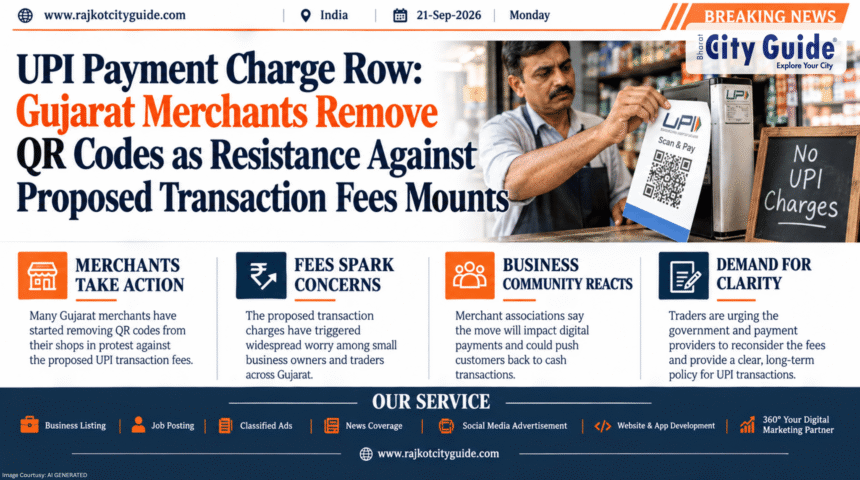
A major storm is brewing across the commercial landscape of western India as the UPI Payment Charge Row intensifies, threatening to disrupt the rapid digital payment transformation that has defined the nation’s retail ecosystem over the past decade. In commercial hubs across Gujarat—most notably the wholesale textile markets of Ahmedabad, the diamond and garment centers of Surat, and trade clusters in Rajkot—merchant associations have begun taking decisive defensive action. Following reports regarding the implementation of transaction charges and Merchant Discount Rates (MDR) on commercial digital payments exceeding specified thresholds, traders have started stripping UPI QR codes from their billing counters and invoice stationery.
- Introduction
- What is UPI Payment Charge Row?
- Why This News is Important
- Background Information
- Key Highlights
- Detailed Explanation of the Event
- Benefits, Features, and Importance
- How It Impacts People
- Expert Insights and Industry Perspective
- Challenges and Limitations
- Future Outlook
- Frequently Asked Questions (FAQs)
- Conclusion
Trade unions and commercial bodies across major markets like Relief Road and Kalupur in Ahmedabad have issued formal warnings to financial regulators and municipal authorities. Their stance is unambiguous: if transaction charges on Unified Payments Interface (UPI) operations are not completely eliminated or strictly capped, the commercial sector will dismantle its digital payment infrastructure and return exclusively to traditional cash and bank check settlements. This growing rift between small-to-medium enterprise (SME) owners and digital payment policy frameworks marks one of the most significant challenges to India’s cashless economy drive since the introduction of zero-MDR mandates.
What is UPI Payment Charge Row?
The UPI Payment Charge Row refers to the widespread commercial conflict, merchant protest movement, and policy debate surrounding the proposed introduction of transaction fees—specifically Merchant Discount Rates (MDR) and Prepaid Payment Instrument (PPI) interchange fees—on high-value Person-to-Merchant (P2M) digital transfers.
+--------------------------------------------------------------------------------+
|                         UPI PAYMENT CHARGE CONFLICT MECHANISM                  |
+--------------------------------------------------------------------------------+
                                         |
    +------------------------------------+------------------------------------+
    |                                    |                                    |
    v                                    v                                    v
[ POLICY & BANKING SIDE ]      [ MERCHANT & TRADER SIDE ]       [ CONSUMER & MARKET SIDE ]
- Proposed MDR on transactions  - Removing QR codes from bills  - Risk of extra costs passed on
- Costs to maintain infrastructure- Threatening cash/check return- Confusion over payment options
- Target: High-value P2M payments- Squeezed thin profit margins- Potential loss of digital ease
For years, the National Payments Corporation of India (NPCI) and the Central Government maintained a zero-MDR policy for standard bank-to-bank UPI transactions, forcing payment service providers (PSPs), acquiring banks, and fintech companies to absorb infrastructure and cybersecurity maintenance costs. As policy discussions shift toward reintroducing a tiered fee structure (such as a 0.4% MDR on P2M transactions above ₹2,000 or interchange fees on wallet-based transactions), commercial merchants fear that financial institutions will pass these recurring operational overheads directly onto retail shopkeepers and wholesalers.
Why This News is Important
The escalation of the UPI Payment Charge Row carries severe ramifications for India’s macroeconomic stability, tax compliance framework, and digital infrastructure adoption:
- Threat to Cashless Economy Momentum: Over 80% of routine commercial transactions in urban retail markets rely on instant QR code scanning. Dismantling this physical setup threatens to reverse years of consumer habit formation.
- Re-Emergence of Cash Economy Operations: If wholesale markets pivot back to cash and paper checks, tax transparency gains achieved through digital audit trails risk being eroded.
- Business Margin Vulnerability: In high-volume, low-margin sectors like wholesale textiles, steel trading, and bullion, even a fraction of a percent in transaction fees can wipe out a merchant’s net profit margin.
Background Information
The Unified Payments Interface (UPI), launched by the National Payments Corporation of India (NPCI) in 2016, revolutionized retail banking by facilitating instant, zero-cost transfers between bank accounts using mobile applications and QR codes. To drive rapid mass adoption, the Government of India mandated a zero-Merchant Discount Rate (MDR) policy for UPI and RuPay debit card transactions starting in January 2020. Under this structure, merchants paid 0% transaction fees, while the government provided a small annual budget subsidy to banks to offset operational expenses.
However, as monthly UPI transaction volumes surged into billions of operations totaling trillions of rupees, payment service providers (PSPs) and acquiring banks faced mounting infrastructure costs, server upkeep expenses, and elevated fraud-mitigation expenditures. Consequently, regulatory circulars introducing interchange fees on Prepaid Payment Instruments (PPI) and proposed MDR frameworks on commercial transactions above ₹2,000 sparked widespread anxiety among trade associations. Merchants argue that while large enterprise chains can easily absorb or negotiate merchant rates, small traders and unorganized market vendors cannot tolerate additional financial overheads.
Key Highlights
- Active Boycott in Major Markets: Textile and garment wholesalers across Relief Road, Maskati Market, and Kalupur in Ahmedabad have removed physical UPI QR codes from billing desks and printed invoices.
- Unanimous Ultimatum: Trade associations in Surat, Rajkot, and Ahmedabad have issued a unified demand: complete removal of transaction fees on UPI, or a complete shift back to cash and bank checks.
- Impact on High-Value Sales: Traders highlight that while micro-transactions under ₹500 remain unaffected, typical B2B and retail textile purchases routinely exceed ₹2,000 to ₹5,000, making them prime targets for transaction charges.
- Operational Expense Fears: Merchants express concern that soundbox subscription fees, terminal hardware charges, and percentage-based MDRs will systematically erode their already thin retail profit margins.
- Customer Friction Points: Shopkeepers warn that if charges are involuntarily imposed, they will be forced to pass those costs directly onto end consumers, causing heated disputes at retail checkout counters.
Detailed Explanation of the Event
[Policy Shift / Charge Proposals] ➔ [Trader Anxiety in Wholesale Hubs] ➔ [Physical QR Code Removal] ➔ [Demand for Zero-MDR / Return to Cash]
1. Gujarat Textile Markets Lead the Resistance
The epicenter of the current protest movement lies within Gujarat’s historic textile trading districts. In Ahmedabad’s famous Relief Road and Kalupur markets, shop owners have systematically removed QR code standees provided by popular fintech providers. The decision was taken after market associations met to review growing operational costs. Shopkeepers reported that payment providers have slowly begun imposing hidden charges, soundbox monthly rentals, and tiered processing fees on merchant accounts handling substantial monthly volumes.
2. The Mechanics of the Merchant Dispute
The core friction revolves around transaction thresholds. While individual consumers (Person-to-Person / P2P) transfer money without incurring fees, commercial transactions (Person-to-Merchant / P2M) above ₹2,000 are subject to proposed charges ranging from 0.4% to 1.1% depending on the payment instrument used (such as PPI wallets or commercial RuPay credit cards on UPI).
For a textile merchant selling a sari or suit piece worth ₹5,000, a 0.5% or 1.1% fee translates to a direct deduction of ₹25 to ₹55 per sale. In a wholesale market operating on slim 2% to 3% profit margins, such charges drastically reduce take-home earnings.
3. Escalation Across Rajkot, Surat, and Regional Trade Hubs
Following Ahmedabad’s lead, commercial bodies in Surat—the nation’s premier synthetic fabric and diamond processing hub—and Rajkot’s industrial hardware markets voiced similar outrage. Market leaders pointed out that forcing merchants to absorb payment processing fees while simultaneously encouraging digital business transparency creates an unsustainable economic burden. In response, several regional markets have placed notices at billing counters asking customers to pay exclusively via physical currency notes or direct account-to-account Real-Time Gross Settlement (RTGS) / National Electronic Funds Transfer (NEFT) for high-value purchases.
Benefits, Features, and Importance
1. Protection of Small Business Profit Margins
The firm stance taken by trade associations highlights the economic reality of small-scale retail operations. Eliminating mandatory transaction fees ensures that local shopkeepers are not penalized for offering modern, convenient payment channels to the public.
2. Preservation of Consumer Payment Freedom
If regulatory frameworks maintain zero-fee structures for basic retail purchases, end consumers can continue enjoying quick, frictionless checkouts without facing unexpected surcharges at checkout desks.
3. Long-Term Viability of Digital Infrastructure
Resolving the charge dispute through transparent, balanced policymaking ensures that fintech companies, acquiring banks, and merchants can co-exist sustainably without triggering a mass abandonment of digital infrastructure.
How It Impacts People
| Stakeholder Group | Direct Impact & Practical Outcomes |
| Small Merchants & Retailers | Prevents margin erosion on high-value sales; avoids recurring hardware/processing deductions. |
| General Consumers | Risks losing the convenience of QR code scanning at local clothing, grocery, and hardware stores. |
| Fintech & Payment Service Providers | Faces declining active QR deployment, reduced transaction volume, and lost merchant relationships. |
| Banking Institutions | Experiences a surge in physical cash handling, check processing overheads, and branch queue loads. |
Expert Insights and Industry Perspective
Financial technology analysts and economic commentators observe that the current conflict stems from a fundamental structural dilemma within India’s digital payments architecture. While zero-MDR policies were instrumental in driving unprecedented public adoption, operating world-class payment networks requires continuous capital investment in cybersecurity, cloud processing infrastructure, and server capacity.
Trade economists argue that imposing a flat percentage fee on wholesale transactions is fundamentally flawed. Instead of imposing percentage-based MDRs that heavily penalize high-value purchases, experts suggest that regulators consider capped nominal fee structures or permanent government subsidies for registered small-and-medium businesses to maintain a friction-free ecosystem.
Challenges and Limitations
Navigating the payment charge dispute involves several complex operational challenges:
- Enforcement Discrepancies: Distinguishing between small micro-vendors (who qualify for zero-MDR under P2PM frameworks) and established commercial retailers creates operational confusion at point-of-sale terminals.
- Cash Management Costs: Returning to cash transactions introduces significant security risks, physical counting delays, bank deposit logistical costs, and fake currency risks for merchants.
- Consumer Resistance: Shoppers who have grown accustomed to carrying only smartphones may take their business elsewhere if forced to carry physical cash notes for routine shopping trips.
Future Outlook
Over the coming weeks, delegations from major trade bodies—including the Confederation of All India Traders (CAIT) and regional Gujarat trade unions—are expected to submit formal representations to the Ministry of Finance and the NPCI.
If regulatory authorities introduce explicit fee caps or reaffirm zero-MDR protection for small-to-medium retail enterprises, merchant confidence is likely to recover, leading to the re-installation of QR codes. Conversely, if transaction charges are enforced without clear exemptions, wholesale and retail markets may see a permanent return to cash and bank check settlements.
Frequently Asked Questions (FAQs)
Why are Gujarat traders removing UPI QR codes from their shops?
Traders are removing QR codes to protest proposed UPI transaction charges, MDR fees, and recurring hardware rentals that threaten to erode their retail profit margins.
Will normal peer-to-peer (P2P) UPI transactions be charged?
No, normal P2P transfers (sending money to friends, family, or personal contacts from a bank account) remain free of charge for general citizens.
What is the proposed fee structure causing the conflict?
The dispute centers on proposed Merchant Discount Rates (MDR) and PPI interchange charges ranging from 0.4% to 1.1% on commercial merchant transactions above ₹2,000.
Which cities in Gujarat are most affected by this trader protest?
Major commercial hubs including Ahmedabad, Surat, and Rajkot are seeing active protests and QR code removals across textile, hardware, and retail markets.
How does this dispute impact general shoppers?
If shopkeepers refuse to accept UPI payments, customers will be required to pay via physical cash, checks, or direct bank transfers for high-value purchases.
What alternative payment methods are merchants demanding?
Merchants are asking customers to settle bills using physical cash or direct account transfers (NEFT/RTGS) until transaction charges on UPI are permanently scrapped.
Conclusion
The UPI Payment Charge Row represents a pivotal crossroads for India’s digital payment revolution. The decision by Gujarat’s prominent textile and retail merchants to remove QR codes highlights the delicate balance between sustaining digital infrastructure costs and protecting small business profitability. For digital payments to remain the backbone of the national economy, regulators, financial institutions, and commercial trade associations must collaborate to establish a fair, transparent, and sustainable framework that preserves merchant trust while maintaining the convenience millions of consumers enjoy every day.