Introduction
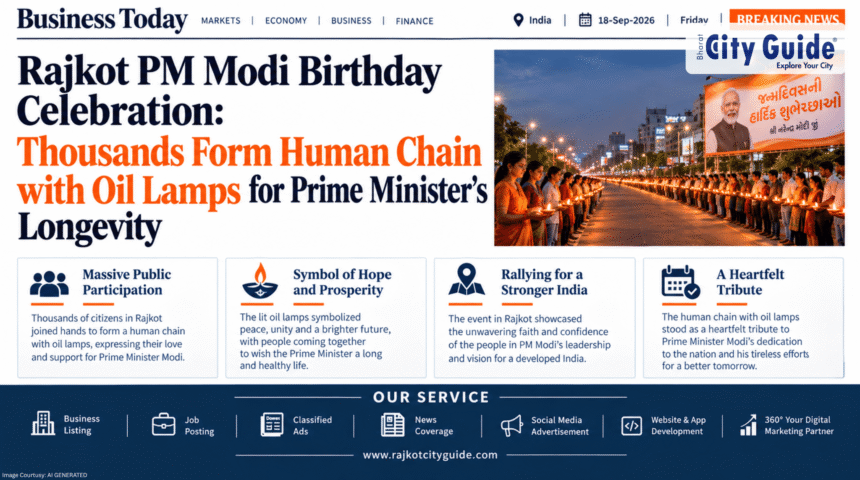
The recent Rajkot PM Modi Birthday Celebration witnessed an extraordinary display of civic unity, devotion, and cultural symbolism across the heart of Saurashtra. Marking Prime Minister Narendra Modi’s 76th birthday and celebrating his 25 consecutive years in public elected office, thousands of citizens, community leaders, local volunteers, and municipal officials gathered across Rajkot’s major public squares and heritage circles. Forming a continuous human chain through key arterial roads, participants held traditional illuminated oil lamps (divdas or diyas) in their hands, creating a glowing visual corridor across the city.
- Introduction
- What is Rajkot PM Modi Birthday Celebration?
- Why This News is Important
- Background Information
- Key Highlights
- Detailed Explanation of the Event
- Benefits, Features, and Importance
- How It Impacts People
- Expert Insights and Industry Perspective
- Challenges and Limitations
- Future Outlook
- Frequently Asked Questions (FAQs)
- Conclusion
This unique human chain event was organized as part of the nationwide Aashirwad No Divdo and Seva Sankalp Abhiyan initiatives. Thousands of men, women, and youth stood shoulder-to-shoulder, holding glowing earthen lamps to offer collective prayers for Prime Minister Modi’s long, healthy, and prosperous life in service to the nation. Far beyond a standard political assembly, the gathering reflected deep emotional bonds between the residents of Rajkot and the Prime Minister, whose early political journey was famously anchored by his first electoral victory in the historic Rajkot-II assembly constituency back in 2002.
What is Rajkot PM Modi Birthday Celebration?
The Rajkot PM Modi Birthday Celebration refers to the grand multi-location public gathering and ceremonial lamp-lighting campaign (Aashirwad No Divdo) organized across Rajkot, Gujarat. The centerpiece of this event was a massive human chain created by thousands of residents holding lit oil lamps, forming a symbolic chain of light along major public circles and avenues.
+--------------------------------------------------------------------------+
|                 RAJKOT PM MODI BIRTHDAY CELEBRATION (2026)               |
+--------------------------------------------------------------------------+
                                     |
    +--------------------------------+--------------------------------+
    |                                |                                |
    v                                v                                v
[ AASHIRWAD NO DIVDO ]         [ MASSIVE HUMAN CHAIN ]        [ SEVA SANKALP ABHIYAN ]
- Lighting of oil lamps        - Thousands stand linked       - Month-long service drive
- Chanting and prayers         - Symbolic ring of light       - Health & welfare camps
- Public cultural programs     - Community-wide unity         - Last-mile civic outreach
This celebration comprises three core elements:
- Aashirwad No Divdo (Lamps of Blessing): Citizens light traditional earthen divdas simultaneously at public squares, temples, lakes, and circles to offer collective prayers for the Prime Minister’s health and longevity.
- Community Human Chain: A physical formation where people of all ages stand side-by-side along major roadways, holding illuminated lamps to represent unity and shared national purpose.
- Seva Day Integration: Pairing spiritual and cultural celebrations with tangible public service drives, including blood donation camps, health checkups, and welfare distribution.
Why This News is Important
The spectacle of a massive human chain illuminated by oil lamps carries both cultural resonance and strategic civic importance:
- Special Historical Connection: Rajkot holds a unique place in Prime Minister Narendra Modi’s life, as it was the constituency that elected him as a Member of the Legislative Assembly (MLA) for the first time in February 2002, launching his parliamentary and executive governance journey.
- Statewide Cultural Coordination: The event in Rajkot was part of a larger statewide drive where more than 88 lakh lamps were lit across 18,500 locations in Gujarat under the Seva Sankalp Abhiyan.
- Pairing Spirit with Public Service: The public gathering coincided with the launch of major municipal projects and social welfare distribution campaigns across urban wards.
Background Information
Prime Minister Narendra Modi’s political history with Rajkot runs deep. In 2001, after assuming office as the Chief Minister of Gujarat, Modi needed to win a seat in the Gujarat Legislative Assembly within six months. The Rajkot-II seat was made available, and in February 2002, he won his inaugural election from this venue. Over the decades, Rajkot residents have maintained a special affection for the Prime Minister, viewing his national and global political trajectory as closely intertwined with their regional heritage.
For his 76th birthday, political organizations, civic groups, social foundations, and local citizens collaborated to craft a peaceful, visually striking ceremony. Moving away from traditional fireworks or loud rallies, organizers opted for a traditional lamp-lighting human chain (Aashirwad No Divdo). This concept drew inspiration from ancient Indian traditions where lighting a divdo signifies emitting positive light, dispelling darkness, and seeking blessings for well-being and long life.
Key Highlights
- Massive Human Chain: Thousands of citizens linked arms across prominent circles and thoroughfares in Rajkot.
- Illuminated Oil Lamps: Participants held traditional earthen divdas, illuminating streets as twilight fell.
- Collective Prayers: Chants, devotional bhajans, and group prayers were held for the longevity, health, and leadership of PM Narendra Modi.
- Part of Statewide Initiative: Aligned with Gujarat’s massive drive to light 88 lakh lamps across thousands of centers.
- Union Minister Presence: Senior political dignitaries, including Union Minister Mansukh Mandaviya, participated in Rajkot’s regional celebratory programs.
- Civic Infrastructure Push: The celebration coincided with the announcement of significant civic development proposals by the Rajkot Municipal Corporation.
Detailed Explanation of the Event
As evening approached, families, youth groups, senior citizens, and civic leaders began assembling along designated roads and prominent intersections across Rajkot. Volunteers distributed clay lamps, oil, and wicks to participants as they lined up along the pavements and pedestrian lanes.
[Citizens Assemble at Circles] ➔ [Oil Lamps Distributed] ➔ [Human Chain Formed] ➔ [Lamps Lit at Dusk] ➔ [Collective Prayers Offered]
At the appointed hour, as devotional songs and bhajans played from public address systems, thousands of lamps were lit simultaneously. Participants formed an unbroken human chain, holding their glowing divdas toward the road to form a glowing golden ribbon through the city.
Local pandits and community leaders recited prayers invoking health and strength for the Prime Minister, while attendees joined in unison. The calm, glowing atmosphere attracted onlookers and passing commuters, many of whom paused to join the human chain or light lamps of their own.
Benefits, Features, and Importance
1. Fostering Community Solidarity
The event brought together diverse socio-economic groups, spanning students, shopkeepers, senior citizens, and women’s self-help groups, reinforcing a shared spirit of civic community and national pride.
2. Eco-Friendly and Culturally Rooted Celebration
By choosing clay lamps (diyas) over plastic decorations or chemical fireworks, the organizers maintained an environmentally sustainable event that highlighted traditional Indian craftsmanship and rural potters.
3. Integration with Welfare Initiatives
The human chain was not merely symbolic; it served as an anchor for the month-long Seva Sankalp Abhiyan (Service Resolve Campaign), driving registration for health insurance schemes, blood donation drives, and public cleanliness campaigns.
How It Impacts People
| Stakeholder Group | Direct Impact & Event Experience |
| Local Citizens & Families | Participated in a uplifting community cultural event celebrating traditional heritage and collective prayer. |
| Youth & Volunteers | Gained hands-on experience in organizing large-scale crowd management and civic service drives. |
| Traditional Artisans | Local potters and small-scale vendors experienced heightened demand for handmade clay lamps and oil supplies. |
| Civic Administration | Used the high-visibility platform to roll out public health initiatives and announce citywide infrastructure improvements. |
Expert Insights and Industry Perspective
Cultural commentators and social observers note that public gatherings built around light and human linkage carry significant symbolic power. Combining a physical human chain with the soft illumination of traditional diyas creates a peaceful, emotionally resonant public atmosphere compared to traditional political rallies.
Furthermore, political analysts highlight how Gujarat continues to serve as an anchor for campaigns celebrating Prime Minister Modi governance milestone of 25 years in elected public life. Linking regional events in Rajkot, Vadnagar, and Kankaria with national initiatives reinforces a narrative of continuous public service (Seva).
Challenges and Limitations
Organizing a massive human chain holding live flames along busy city thoroughfares presents operational considerations that require meticulous planning:
- Crowd and Traffic Control: Managing traffic flow around major city circles while thousands of pedestrians gather along roadsides demands strict police coordination.
- Fire Safety Standards: Ensuring that thousands of open oil lamps are handled safely in crowded public spaces requires positioning fire tenders and safety marshals along the chain.
- Post-Event Cleanliness: Collecting thousands of used clay lamps and cleaning leftover oil spots from public footpaths is vital to maintaining urban hygiene after the event concludes.
Future Outlook
The success of Rajkot’s human chain celebration establishes a template for future community-driven cultural observances across Gujarat. As the month-long Seva Sankalp Abhiyan continues through October, Rajkot will host additional public welfare camps, medical screening drives, and urban plantation initiatives.
This spiritual and social gathering highlights Rajkot’s enduring historical relationship with PM Narendra Modi, blending civic pride with public service commitments for the city’s future.
Frequently Asked Questions (FAQs)
What was the unique highlight of the Rajkot PM Modi Birthday Celebration?
The primary highlight was a massive human chain formed by thousands of citizens holding lit traditional oil lamps (divdas) along major public roads and circles to pray for PM Modi’s long life.
What is the name of the lamp-lighting program organized in Gujarat?
The program was titled Aashirwad No Divdo (Lamps of Blessing), held as part of the broader Seva Sankalp Abhiyan.
Why does Rajkot hold special political significance for PM Narendra Modi?
Rajkot is where PM Narendra Modi won his very first legislative assembly election in February 2002 (Rajkot-II constituency), marking the beginning of his elected public service career.
How many lamps were planned to be lit across Gujarat for PM Modi’s birthday?
Over 88 lakh lamps were scheduled to be lit across more than 18,500 locations state-wide.
Which leaders attended the celebratory programs in Rajkot?
Senior political dignitaries, including Union Minister Mansukh Mandaviya and local municipal leaders, attended key celebratory and service events in Rajkot.
What other public activities were organized alongside the human chain?
The event was paired with Bhajan Sandhya devotional music programs, blood donation camps, health drives, and civic infrastructure project announcements.
Conclusion
The Rajkot PM Modi Birthday Celebration showcased a remarkable blend of devotion, unity, and public service. By coming together in a massive human chain with glowing oil lamps in hand, the people of Rajkot paid tribute to Prime Minister Narendra Modi’s quarter-century of public leadership while reaffirming their deep bond with his political journey. As the light from thousands of divdas illuminated the streets of Rajkot, the event stood out as a memorable celebration of leadership, heritage, and community spirit.