Introduction
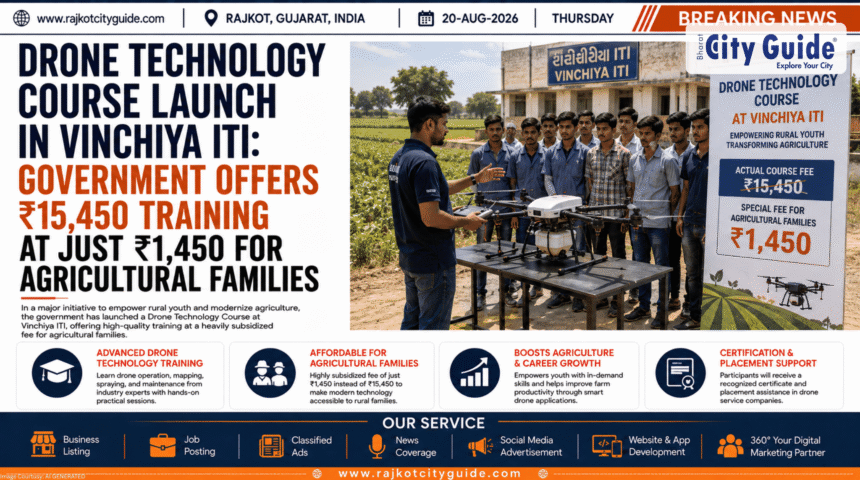
Modern technology is rapidly reshaping Indian agriculture and rural skill development, bringing sophisticated aerial tools directly to regional farming communities. In a major initiative aimed at empowering rural youth and modernizing farming practices across the Saurashtra region, the Gujarat Government has officially introduced specialized aviation vocational training. The Drone Technology Course Launch In Vinchiya ITI represents a major leap forward in decentralized technical education, bringing high-tech skill training out of major metros and directly into semi-rural industrial training institutes.
- Introduction
- What is Drone Technology Course Launch In Vinchiya ITI?
- Why This News is Important
- Background Information
- Key Highlights
- Detailed Explanation of the Event
- Benefits, Features, and Importance
- How It Impacts People
- Expert Insights and Industry Perspective
- Challenges and Limitations
- Future Outlook
- Frequently Asked Questions (FAQs)
- Conclusion
The project gained significant momentum during a high-level review meeting chaired by Water Resources, Water Supply, Food, Civil Supplies, and Consumer Affairs Minister Kunvarji Bavaliya. During his official visit to inspect the administrative and academic setup at the Vinchiya Government Industrial Training Institute (ITI) in Rajkot district, the minister reviewed the readiness of the newly established drone training department.
The most groundbreaking aspect of this initiative is its heavily subsidized fee structure designed to support local communities. While the standard commercial value of this comprehensive training program is fixed at ₹15,450, candidates hailing from agricultural families can enroll for a nominal fee of just ₹1,450. By absorbing ₹14,000 per student through state support, the government is ensuring that financial constraints do not prevent rural youth from mastering precision farming, aerial spraying, crop health monitoring, and professional drone piloting.
What is Drone Technology Course Launch In Vinchiya ITI?
The Drone Technology Course Launch In Vinchiya ITI refers to the official introduction of a certified vocational training curriculum in unmanned aerial vehicle (UAV) piloting, maintenance, and agricultural applications at the Industrial Training Institute in Vinchiya, Rajkot.
                    ┌──────────────────────────────────────────────┐
                    │  DRONE TECHNOLOGY COURSE LAUNCH IN VINCHIYA  │
                    │      Government ITI Skill Upgrade Scheme     │
                    └──────────────────────┬───────────────────────┘
                                           │
        ┌──────────────────────────────────┼──────────────────────────────────┐
        ▼                                  ▼                                  ▼
┌────────────────────────┐      ┌────────────────────────┐      ┌────────────────────────┐
│  HEAVY FEE SUBSIDY     │      │ AGRICULTURAL PURPOSE   │      │ VOCATIONAL SKILLING    │
│ • Standard: ₹15,450    │      │ • Nano-Urea Spraying   │      │ • DGCA Flight Norms    │
│ • Farmers: ₹1,450      │      │ • Crop Health Mapping  │      │ • Assembly & Repairs   │
└────────────────────────┘      └────────────────────────┘      └────────────────────────┘
This vocational program is designed to train students in the mechanics, flight controls, navigation algorithms, payload management, and safety protocols required to operate industrial and agricultural drones. Rather than remaining a high-cost private certification available only in major urban centers, this course integrates UAV training into the public ITI ecosystem, making certified drone pilot education affordable for rural youth.
Why This News is Important
The establishment of a specialized drone training department at Vinchiya ITI carries immense socioeconomic and technological importance for Gujarat’s agrarian landscape:
- Democratizing Modern Technology: Brings advanced UAV aviation skills to rural students who previously lacked access to expensive private aviation academies.
- Transforming Regional Agriculture: Enables precise, automated spraying of liquid fertilizers, nano-urea, and pesticides, reducing manual labor and exposure to harmful chemicals.
- Unlocking High-Yield Rural Employment: Prepares rural youth for emerging job opportunities as certified drone operators, agricultural service entrepreneurs, and repair technicians.
- Massive Financial Relief: The 90% fee subsidy for farming families (reducing fees from ₹15,450 to ₹1,450) removes financial entry barriers for agricultural households.
Background Information
Agriculture in Gujarat, particularly across the arid and semi-arid tracts of Saurashtra, is undergoing a rapid transition toward technology-assisted farming. Conventional farming methods face challenges such as agricultural labor shortages, rising input costs, inefficient pesticide application, and health hazards associated with manual knapsack spraying.
                    [ EVOLUTION OF AGRICULTURAL SPRAYING ]
                                       │
  ┌────────────────────────────────────┼────────────────────────────────────┐
  ▼                                    ▼                                    ▼
[Manual Knapsack Spraying]     [Tractor-Mounted Boom Systems]        [Precision Ag-Drones]
 • High manual labor demands   • High soil compaction risks          • 10x faster coverage
 • Chemical exposure hazards   • High water consumption              • 90% water saving efficiency
 • Uneven crop coverage        • Limited field maneuverability       • Zero soil degradation
Agricultural drones (agri-drones) have emerged as an effective solution, capable of spraying an acre of farmland in under ten minutes while using up to 90% less water and ensuring uniform chemical distribution. However, the lack of trained, certified drone pilots in rural talukas created a major bottleneck in scaling up drone adoption among local farmers.
To address this gap, the Gujarat Labor, Skill Development, and Employment Department initiated plans to set up specialized drone training labs across select ITIs. During his review visit to Vinchiya, Cabinet Minister Kunvarji Bavaliya inspected the newly developed drone simulators, practical assembly kits, and flight maneuver areas, confirming that the institute is fully equipped to launch its inaugural batch.
Key Highlights
- Official Minister Inspection: Water Resources and Civil Supplies Minister Kunvarji Bavaliya personally reviewed the academic infrastructure at Vinchiya ITI.
- Massive 90% Fee Subsidy: The standard course fee of ₹15,450 is reduced to just ₹1,450 for candidates belonging to farming households.
- Hands-On Practical Training: Covers drone assembly, flight simulation, transmitter controls, battery management, and field flight maneuvers.
- Focus on Precision Agriculture: Specialized modules on spraying nano-urea, micronutrients, insecticides, and conducting multi-spectral crop mapping.
- State-of-the-Art Infrastructure: Includes computer-based flight simulators, practice flying arenas, and maintenance toolkits at the Vinchiya campus.
- Entrepreneurship Support: Prepares students to launch custom-hiring centers, offering drone spraying services to local farmers on a commercial basis.
Detailed Explanation of the Event
During his comprehensive review meeting at the Vinchiya ITI campus, Minister Kunvarji Bavaliya interacted with instructors, administrative officers, and local representatives to evaluate the institute’s readiness for the course launch.
                        [ STUDENT JOURNEY & TRAINING WORKFLOW ]
                                           │
  Enrollment & Subsidy Verification ──► Simulator Training & Theory Class
                                                               │
  Certification & Career Launch ◄── Field Flight & Spraying Practice ◄─┘
1. Curriculum and Training Framework
The drone course at Vinchiya ITI blends theoretical knowledge with intensive practical flight sessions:
- Theory & Regulations: Understanding flight physics, airspace classifications, Directorate General of Civil Aviation (DGCA) safety guidelines, and weather assessment.
- Simulator Practice: Mastering joystick controls, orientation awareness, and emergency landing protocols using computer flight simulators.
- Assembly & Maintenance: Learning motor calibration, propeller balancing, flight controller configuration, and sensor troubleshooting.
- Field Operations: Flying actual quadcopters and hexacopters over open agricultural fields, executing automated flight paths, and operating liquid payload systems.
2. Subsidy Execution and Target Audience
To ensure the program benefits its intended audience, the administration established simple verification protocols. Applicants from families holding valid agricultural land records (such as 7/12 and 8-A extracts) qualify for the discounted ₹1,450 fee structure. The state government covers the remaining ₹14,000 balance per trainee under technical skill development grants.
3. Review of Broader ITI Facilities
Alongside the drone lab review, Minister Bavaliya inspected existing technical trades at Vinchiya ITI—including electrician, fitter, motor mechanic, and computer operator tracks—instructing officials to align overall vocational training with local industry demands.
Benefits, Features, and Importance
The introduction of affordable drone training provides valuable technical, economic, and agricultural benefits:
| Feature / Metric | Standard Private Academy | Vinchiya ITI Subsidized Course | Direct Advantage to Trainees |
| Course Fee | ₹15,000 – ₹30,000 | ₹1,450 (For Agri Families) | Save over 90% in training costs. |
| Location Access | Metros / Major Cities | Local Taluka Level (Vinchiya) | Eliminates travel and lodging expenses. |
| Curriculum Focus | General Aerial Photography | Agricultural Spraying & Mapping | Directly applicable to local farming needs. |
| Equipment Access | Limited Shared Access | Dedicated ITI Simulators & Drones | Ample hands-on flight practice time. |
| Career Path | Freelance Photography | Agri-Service Business / Custom Hiring | Steady income in high-demand rural sectors. |
How It Impacts People
+-----------------------------------------------------------------------+
|                IMPACT OF VINCHIYA ITI DRONE TECHNOLOGY                |
+-----------------------------------+-----------------------------------+
|            RURAL YOUTH            |            LOCAL FARMERS          |
|  - High-tech skill acquisition    |  - Access to affordable spraying  |
|  - Modern career opportunities    |  - Reduced crop cultivation costs |
|  - Local employment options       |  - Protection from chemical hazard|
+-----------------------------------+-----------------------------------+
|         AGRI-ENTREPRENEURS        |         RURAL ECONOMY             |
|  - Low capital entry cost         |  - Technological modernization    |
|  - Custom drone hiring services   |  - Higher crop yield efficiency   |
+-----------------------------------+-----------------------------------+
For Rural Youth and Students
Trainees gain industry-aligned technological skills right in their home taluka. Mastering drone operations allows young individuals to secure jobs with ag-tech firms, drone manufacturing companies, or state survey agencies, reversing the trend of forced rural-to-urban migration.
For Farmers and Agricultural Communities
Farmers gain access to a network of skilled local drone operators capable of spraying crops quickly, efficiently, and safely. Utilizing agri-drones reduces water usage by up to 90%, lowers chemical wastage, protects farmers from hazardous pesticide inhalation, and ensures even crop coverage.
For Local Entrepreneurs
Graduates can establish custom-hiring centers or service enterprises, offering drone-based spraying services to neighboring farms. With government subsidy schemes available for commercial agricultural drone purchases, trained youth can build sustainable micro-businesses with strong profit margins.
Expert Insights and Industry Perspective
Agricultural scientists and skill development experts view the integration of drone training into rural ITIs as a vital step toward modernizing Indian agriculture.
                        [ FUTURE OF SMART FARMING ]
                                     │
  ┌──────────────────────────────────┴──────────────────────────────────┐
  ▼                                                                     ▼
[Conventional Farming Challenges]                     [Drone-Assisted Farming Solutions]
 • High chemical wastage                               • Targeted precision spraying
 • Labor scarcity during peak season                   • Rapid acre-per-minute coverage
 • Health risks from manual spraying                   • Remote automated flight operations
Industry analysts highlight that while India’s agricultural drone sector is growing rapidly, the main barrier to widespread adoption has been a shortage of skilled operators in rural areas. Private drone training institutes often charge high tuition fees that remain out of reach for rural families. By offering subsidized training through public ITIs, Gujarat is creating a practical model that bridges the gap between modern technology and rural accessibility.
Challenges and Limitations
Despite its immense potential, expanding rural drone training involves a few operational considerations:
- Strict Regulatory Compliance: Drone pilots must continuously comply with changing airspace regulations, digital sky permissions, and altitude restrictions.
- Capital Cost of Equipment: While training is subsidized, purchasing commercial-grade agricultural spraying drones requires initial capital, necessitating smooth access to government-backed business loans.
- Weather Sensitivity: Practical flight training depends on favorable weather, as strong winds or heavy rain can delay outdoor flying sessions.
Future Outlook
Following the launch at Vinchiya ITI, the Labor, Skill Development, and Employment Department plans to replicate this subsidized drone training model across other industrial training institutes in Saurashtra and wider Gujarat.
As the first cohorts graduate, local agricultural cooperatives, Farmer Producer Organizations (FPOs), and private ag-tech startups are expected to hire these trained operators. This initiative establishes a strong foundation for precision farming, equipping a new generation of rural youth to lead Gujarat’s technological agricultural transformation.
Frequently Asked Questions (FAQs)
1. What is the fee structure for the Drone Technology Course Launch In Vinchiya ITI?
The standard course fee is ₹15,450. However, candidates belonging to agricultural families receive a major government subsidy, allowing them to enroll for just ₹1,450.
2. Who inspected the drone training facilities at Vinchiya ITI?
Gujarat Cabinet Minister Kunvarji Bavaliya, whose portfolios include Water Resources, Food, and Civil Supplies, personally visited and reviewed the facilities at Vinchiya ITI.
3. What are the main topics covered in the Vinchiya ITI drone course?
The curriculum includes flight physics, DGCA safety regulations, computer flight simulation, drone assembly and maintenance, automated flight planning, and agricultural spraying techniques.
4. How does drone technology benefit local farmers in Gujarat?
Drones enable precise spraying of fertilizers and pesticides in minutes, drastically reducing water usage, cutting chemical waste, avoiding manual labor shortages, and protecting farmers from toxic chemical exposure.
5. Who is eligible for the subsidized ₹1,450 course fee?
Students whose families hold valid agricultural land records (such as 7/12 or 8-A land extracts) qualify for the subsidized fee structure.
6. What career opportunities are available after completing this course?
Graduates can work as certified agri-drone operators, survey technicians, or drone maintenance specialists, or start their own custom-hiring spraying business for local farms.
7. Will the drone course include practical flight training?
Yes. Trainees undergo extensive practical sessions, including computer-based flight simulation and real-world outdoor flying exercises using agricultural quadcopters and hexacopters.
Conclusion
The Drone Technology Course Launch In Vinchiya ITI marks a major milestone in empowering Gujarat’s rural youth through modern vocational training. By reducing the course fee from ₹15,450 to just ₹1,450 for farming families, the government has made cutting-edge aviation and precision farming skills accessible to all. As these trained operators take to the skies, this initiative will accelerate agricultural modernization, boost rural entrepreneurship, and drive economic growth across the Saurashtra region.