Introduction
Pursuing higher education at prestigious international universities has long been a dream for thousands of ambitious students across Gujarat. However, the steep financial burden of overseas tuition fees, living expenses, travel costs, and visa processing often poses a significant barrier for middle-class families. In a major student-friendly move, Chief Minister Bhupendra Patel’s administration announced a key policy revision under the Gujarat Education Loan Update, bringing immense relief to aspiring scholars from unreserved categories across the state.
- Introduction
- What is Gujarat Education Loan Update?
- Why This News is Important
- Background Information
- Key Highlights
- Detailed Explanation of the Event
- Benefits, Features, and Importance
- How It Impacts People
- Expert Insights and Industry Perspective
- Challenges and Limitations
- Future Outlook
- Frequently Asked Questions (FAQs)
- Conclusion
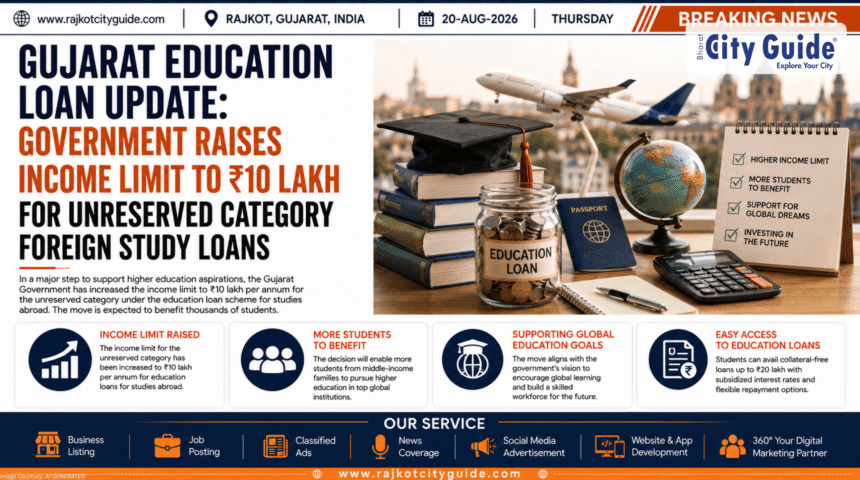
Under the new government resolution issued by the Social Justice and Empowerment Department, the annual family income ceiling for the Foreign Study Loan Scheme—managed by the Gujarat Unreserved Educational and Economical Development Corporation (GUEEDC)—has been officially increased from ₹6 lakh to ₹10 lakh. This significant ₹4 lakh expansion opens up subsidized, low-interest government loan options for thousands of middle-class students previously ineligible due to rigid income brackets.
This policy amendment reflects the state government’s commitment to ensuring that financial constraints do not hinder meritorious youth from acquiring global exposure, advanced technical knowledge, and international academic credentials. By revising the income threshold, the state paves the way for a broader group of students to apply for financial assistance of up to ₹15 lakh at a highly subsidized simple interest rate of 4% per annum.
What is Gujarat Education Loan Update?
The Gujarat Education Loan Update refers to the official policy revision implemented by the Government of Gujarat regarding the eligibility criteria for the Foreign Study Loan Scheme (Videsh Abhyas Loan Yojana).
                    ┌──────────────────────────────────────────────┐
                    │        GUJARAT EDUCATION LOAN UPDATE         │
                    │   Foreign Study Loan Policy Revision (GUEEDC)│
                    └──────────────────────┬───────────────────────┘
                                           │
        ┌──────────────────────────────────┼──────────────────────────────────┐
        ▼                                  ▼                                  ▼
┌────────────────────────┐      ┌────────────────────────┐      ┌────────────────────────┐
│  INCOME LIMIT REVISION │      │ SUBSIDIZED FINANCING   │      │ ELIGIBLE PROGRAMS      │
│ • Increased to ₹10 Lakh│      │ • Up to ₹15 Lakh Loan  │      │ • Master's, PG Diploma │
│ • ₹4 Lakh Expansion    │      │ • 4% Simple Interest   │      │ • Professional Degrees │
└────────────────────────┘      └────────────────────────┘      └────────────────────────┘
Formulated under the Gujarat Unreserved Educational and Economical Development Corporation (GUEEDC), this scheme provides low-interest financial assistance to meritorious students belonging to unreserved (general) communities who seek admission to recognized foreign universities for postgraduate, doctoral, or professional degree programs. The latest update specifically addresses the primary administrative hurdle by elevating the family income cap to align with modern economic conditions and rising international study expenses.
Why This News is Important
The policy decision to expand foreign education financial support carries far-reaching educational, economic, and social significance for Gujarat’s youth:
- Expanded Accessibility for the Middle Class: Salaried middle-class families earning between ₹6 lakh and ₹10 lakh annually were previously excluded from state loan schemes. This expansion allows a vast demographic to access low-cost capital.
- Relief from High-Interest Commercial Loans: Instead of relying on private banks and Non-Banking Financial Companies (NBFCs) charging 10% to 14% compound interest, eligible students can now secure government-backed loans at a simple interest rate of 4%.
- Global Skill Acquisition: Empowering Gujarat’s youth to study in top international institutions builds a highly skilled talent pool proficient in emerging technologies, engineering, healthcare, management, and research.
- Support for Equal Educational Opportunity: Ensures that academic merit and talent take precedence over a family’s immediate liquid financial capacity when pursuing higher education abroad.
Background Information
The Gujarat Unreserved Educational and Economical Development Corporation (GUEEDC) was established to provide targeted welfare, educational support, and economic empowerment initiatives for economically weaker sections within unreserved communities. Among its various educational initiatives, the Foreign Study Loan Scheme emerged as one of the most popular options for students aspiring to pursue higher education in countries like the United States, the United Kingdom, Canada, Australia, Germany, and Ireland.
                   [ EVOLUTION OF GUEEDC FOREIGN LOAN SCHEME ]
                                        │
  ┌─────────────────────────────────────┼─────────────────────────────────────┐
  ▼                                     ▼                                     ▼
[Legacy Eligibility]                 [Directorate Proposal]                [Revised Policy Standard]
 • Family income cap: ₹6 Lakh         • Directorate recommendation          • Family income cap: ₹10 Lakh
 • Restrictive eligibility            • Focus on middle-class relief        • Subsidized 4% interest rate
 • High reliance on private loans     • Formal department submission        • ₹15 Lakh max loan ceiling
Under the earlier framework, the annual family income cap was set at ₹6 lakh. However, driven by inflation, rising living costs, and gradual salary revisions across middle-income households, many deserving students found their family income slightly exceeding the ₹6 lakh limit. This disqualified them from receiving government assistance, forcing families to take high-interest private education loans or mortgage personal assets under unfavorable terms.
Recognizing these ground realities, the Directorate of Developing Castes Welfare submitted a formal proposal requesting an upward revision of the income criteria. Following thorough administrative review and concurrence from the Finance Department, the Social Justice and Empowerment Department officially approved the proposal, expanding the income threshold to ₹10 lakh.
Key Highlights
- Income Limit Increased: The annual family income ceiling for foreign education loan eligibility has been raised from ₹6 lakh to ₹10 lakh.
- Substantial ₹4 Lakh Expansion: The ₹4 lakh increase directly benefits middle-class families previously excluded from the welfare program.
- Maximum Loan Amount: Eligible students can secure financial loan assistance of up to ₹15 lakh for foreign university programs.
- Subsidized Interest Rate: The loan is provided at a minimal simple interest rate of 4% per annum, drastically reducing the total repayment burden.
- Coverage of Comprehensive Costs: The loan amount covers university tuition fees, living expenses, books, hostel accommodation, and initial travel expenses.
- Structured Repayment Period: Includes a moratorium period covering the course duration plus one additional year, followed by flexible repayment tenure up to 5-6 years.
Detailed Explanation of the Event
The official notification issued by the Social Justice and Empowerment Department outlines the revised terms governing the Foreign Study Loan Scheme.
                      [ APPLICATION & DISBURSEMENT WORKFLOW ]
                                         │
  Online Portal Application (e-SamajKalyan) ──► Document & Income Verification
                                                        │
  Sanction Order & Collateral Mortgage ◄── Direct Loan Disbursement to Account
1. Updated Income Eligibility Criteria
Effective immediately under the new resolution, any student belonging to an unreserved category whose combined family annual income from all sources does not exceed ₹10 lakh is eligible to apply. Applicants must produce an official income certificate issued by a competent state authority (such as a Mamlatdar or TDO) to verify compliance.
2. Loan Structure and Interest Mechanics
The core financial parameters of the GUEEDC foreign study loan remain highly supportive:
- Maximum Sanction Limit: Up to ₹15 lakh per eligible student.
- Interest Rate Structure: Simple interest rate capped at 4% per annum. The government subsidizes the remaining interest cost, protecting students from market volatility.
- Moratorium Protection: Students are not required to begin principal repayment while completing their academic course. Repayment starts 12 months after course completion or upon securing employment, whichever occurs first.
3. Application Process via e-SamajKalyan Portal
The entire application process is integrated into the state’s unified digital portal. Students must submit their academic credentials, foreign university admission offer letters, income verification, and category proof through the e-SamajKalyan platform.
Benefits, Features, and Importance
The administrative revision brings several distinct financial and academic advantages:
| Scheme Feature | Previous Policy Standard | Revised Policy Standard | Key Benefit for Students |
| Annual Family Income Cap | Max ₹6.00 Lakh | Max ₹10.00 Lakh | Opens scheme access to broader middle-class families. |
| Maximum Loan Capital | Up to ₹15.00 Lakh | Up to ₹15.00 Lakh | Substantial capital assistance for international tuition fees. |
| Interest Rate | 4% Simple Interest | 4% Simple Interest | Protects students from 10–14% private bank interest rates. |
| Repayment Moratorium | Course Duration + 1 Year | Course Duration + 1 Year | Relieves immediate financial pressure during academic tenure. |
| Eligible Courses | MBBS, Master’s, PG Diplomas | MBBS, Master’s, PG Diplomas | Covers a wide range of professional global programs. |
How It Impacts People
+-----------------------------------------------------------------------+
|                 IMPACT OF REVISED EDUCATION LOAN POLICY               |
+-----------------------------------+-----------------------------------+
|            ASPIRING STUDENTS      |          MIDDLE-CLASS PARENTS     |
|  - Broader global education options|  - Substantial financial relief   |
|  - Minimal debt post-graduation   |  - Reduced need for private loans |
|  - Focus on studies, not stress   |  - Protection of family savings   |
+-----------------------------------+-----------------------------------+
|           ACADEMIC COMMUNITY      |         STATE DEVELOPMENT         |
|  - Increased international exposure| - Inflow of globally skilled talent|
|  - High-value research degrees    |  - Enhanced human capital pool    |
+-----------------------------------+-----------------------------------+
For Aspiring Students
Students gain direct access to affordable credit, enabling them to target top-tier foreign universities without being forced into high-interest commercial debt. The 4% simple interest rate and moratorium period allow graduates to focus on their studies and career launch without immediate financial strain.
For Middle-Class Parents
Parents earning between ₹6 lakh and ₹10 lakh annually receive critical financial breathing room. Instead of liquidating family savings, selling ancestral property, or borrowing from high-interest private lenders, parents can secure structured, government-backed financing for their children’s global education.
For the State’s Human Capital
As more students complete advanced degrees, specialized master’s programs, and technical certifications abroad, Gujarat benefits from an enriched pool of global talent. Graduates return with advanced domain expertise, international industry exposure, and entrepreneurial skills that drive state economic growth.
Expert Insights and Industry Perspective
Education policy experts and financial advisors have welcomed the government’s decision to revise the income limit, describing it as a necessary adjustment to reflect current inflation and foreign education expenses.
                      [ FINANCIAL COMPARISON OF STUDY LOANS ]
                                         │
  ┌──────────────────────────────────────┴──────────────────────────────────────┐
  ▼                                                                             ▼
[GUEEDC Government Loan Scheme]                               [Private Bank / Commercial Loan]
 • 4% Simple Interest Rate                                     • 10% – 14% Compound Interest Rate
 • Government interest subsidy                                 • High processing fees & hidden costs
 • Flexible, student-centric moratorium                        • Immediate interest servicing demands
Financial analysts note that the cost of studying abroad—encompassing tuition, accommodation, healthcare insurance, and travel—has risen significantly over the past five years. Restricting subsidized loans to an outdated ₹6 lakh income limit excluded a large segment of deserving middle-class families who, despite decent household incomes, could not easily manage multi-lakh foreign education bills without assistance. Experts emphasize that providing low-cost credit at 4% simple interest serves as a high-return social investment that yields long-term economic dividends for the state.
Challenges and Limitations
While the policy expansion offers clear benefits, successful execution involves several practical considerations:
- Increased Application Volumes: Raising the income ceiling will likely lead to a surge in applications on the e-SamajKalyan portal, requiring efficient administrative processing to prevent approval bottlenecks.
- Collateral and Documentation Requirements: Applicants must still comply with statutory security norms, such as mortgaging immovable property or providing adequate guarantees corresponding to the sanctioned loan amount.
- Managing Exchange Rate Volatility: Foreign currency fluctuations can increase overall study costs, meaning students must carefully budget their expenses alongside the ₹15 lakh maximum loan limit.
Future Outlook
Following the publication of the official resolution, the revised income limit of ₹10 lakh takes effect immediately for the current academic processing cycle. The Gujarat Unreserved Educational and Economical Development Corporation is expanding portal capacity and streamlining verification workflows across district offices to handle the anticipated rise in loan applications.
Moving forward, this policy update is expected to boost foreign education enrollments among Gujarat’s middle-class students. By systematically removing financial entry barriers, Gujarat continues to establish itself as a progressive state dedicated to empowering its youth through quality higher education and global learning opportunities.
Frequently Asked Questions (FAQs)
1. What is the main update in the Gujarat foreign education loan scheme?
The annual family income ceiling for unreserved category students applying for the GUEEDC Foreign Study Loan Scheme has been increased from ₹6 lakh to ₹10 lakh.
2. What is the maximum loan amount available under the scheme?
Eligible students can receive a foreign study loan of up to ₹15 lakh for approved higher education programs abroad.
3. What is the interest rate charged on the GUEEDC foreign study loan?
The loan is provided at a subsidized simple interest rate of 4% per annum.
4. Which courses are covered under the foreign education loan scheme?
The scheme covers foreign university admissions for MBBS, Master’s degrees, Post-Graduate Diplomas, and equivalent professional degree programs.
5. Where can eligible students apply for the loan?
Students can apply online through the official Gujarat Government e-SamajKalyan portal (esamajkalyan.gujarat.gov.in) or via the official GUEEDC portal.
6. When does the loan repayment period begin?
Repayment begins after a moratorium period that covers the duration of the academic course plus one additional year (12 months).
7. What documents are required to prove income eligibility under the updated rule?
Applicants must submit an official annual family income certificate (showing an income of ₹10 lakh or less) issued by an authorized state official, such as a Mamlatdar or District Welfare Officer.
Conclusion
The latest Gujarat Education Loan Update represents a major step forward for middle-class students aspiring to pursue global higher education. By raising the annual family income cap from ₹6 lakh to ₹10 lakh and providing loans up to ₹15 lakh at a low 4% simple interest rate, the state government has removed a key financial barrier for unreserved category applicants. This student-centric policy ensures that academic ambition and merit—rather than financial constraints—determine the global educational opportunities available to Gujarat’s youth.