Introduction ABP News
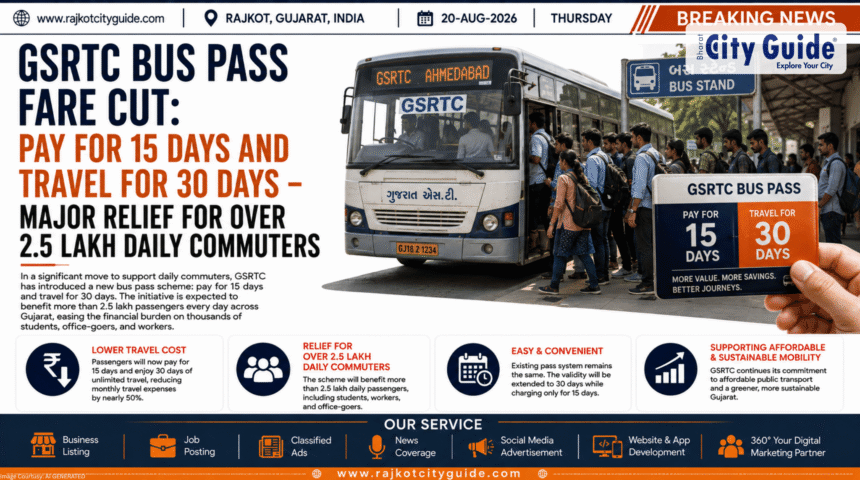
In a transformative decision aimed at easing the financial burden on daily travelers across Gujarat, the Gujarat State Road Transport Corporation (GSRTC) has officially revised the pricing structure for its Daily Passenger Pass Scheme. Under the direction of the state transport leadership, this major public-welfare initiative introduces a steep GSRTC Bus Pass Fare Cut, doubling the travel benefits for regular passengers. Under the newly implemented guidelines, daily commuters will now pay the equivalent of only 15 days of one-way bus fare to enjoy unlimited travel for a full 30 days on their designated routes.
- Introduction ABP News
- What is GSRTC Bus Pass Fare Cut?
- Why This News is Important
- Background Information
- Key Highlights
- Detailed Explanation of the Event
- Benefits, Features, and Importance
- How It Impacts People
- Expert Insights and Industry Perspective
- Challenges and Limitations
- Future Outlook
- Frequently Asked Questions (FAQs)
- Conclusion
Previously, daily passengers were charged an 18-day fare equivalent for a 30-day monthly bus pass. The new policy effectively increases the government concession to 50%, allowing commuters to travel for an entire month while paying for only half of it. Furthermore, the pricing for quarterly passes (90 days) has been slashed from a 54-day fare charge down to just 45 days, locking in substantial long-term savings for regular travelers.
This policy adjustment directly impacts more than 2.5 lakh daily commuters throughout Gujarat. Salaried office workers, factory laborers, small business owners, traders, and rural-to-urban commuters who rely on state transport (ST) buses every day stand to gain immediate financial relief. By lowering monthly transit expenses, GSRTC not only supports household budgets but also strengthens public transit usage across the state.
What is GSRTC Bus Pass Fare Cut?
The GSRTC Bus Pass Fare Cut refers to the official fare reduction and concession restructuring under the Daily Passenger Pass Scheme (Dainik Musafir Pass Yojana) managed by the Gujarat State Road Transport Corporation.
Gujarat Samachar
                    ┌──────────────────────────────────────────────┐
                    │          GSRTC BUS PASS FARE CUT             │
                    │   50% Travel Concession for Daily Commuters  │
                    └──────────────────────┬───────────────────────┘
                                           │
        ┌──────────────────────────────────┼──────────────────────────────────┐
        ▼                                  ▼                                  ▼
┌────────────────────────┐      ┌────────────────────────┐      ┌────────────────────────┐
│      MONTHLY PASS      │      │     QUARTERLY PASS     │      │   DIRECT BENEFICIARIES │
│ • Pay for 15 Days      │      │ • Pay for 45 Days      │      │ • 2.5 Lakh+ Commuters  │
│ • Travel for 30 Days   │      │ • Travel for 90 Days   │      │ • Employees & Traders  │
└────────────────────────┘      └────────────────────────┘      └────────────────────────┘
The scheme provides a discounted, route-specific travel pass for commuters who travel regularly between fixed origin and destination stops. Instead of buying individual daily tickets, commuters purchase a monthly or quarterly pass. The latest update increases the subsidy, allowing pass holders to pay for fewer days while maintaining full monthly access across Express, Gurjarnagari, and Local ST bus services.
Why This News is Important
The decision to slash ST bus pass fares carries significant economic and administrative importance for Gujarat’s workforce:
- Immediate Household Savings: Direct reductions in daily travel costs translate into substantial monthly savings for working-class families and middle-income households.
- Curbing Private Vehicle Congestion: Lowering public transit costs encourages commuters to leave two-wheelers and private vehicles at home, reducing highway congestion and carbon emissions.
- Boosting Formal Public Transit Adoption: Makes state-run buses more economical than unorganized private shuttles, vans, or shared taxis.
- Sustained Regional Workforce Mobility: Facilitates affordable daily movement between rural villages, industrial hubs, and urban centers, boosting regional economic activity.
Background Information
As one of India’s largest state transport undertakings, the Gujarat State Road Transport Corporation (GSRTC) operates thousands of bus routes connecting remote villages, taluka headquarters, major industrial zones, and metropolitan cities. Daily commuting (updown) is a way of life for hundreds of thousands of citizens in Gujarat who live in suburban or rural regions and work in industrial clusters like GIDC estates, commercial centers, or government offices.
                  [ HISTORICAL COMPARISON OF GSRTC PASS FARES ]
                                       │
  ┌────────────────────────────────────┴────────────────────────────────────┐
  ▼                                                                         ▼
[Legacy Fare Framework]                                   [Revised 2026 Fare Framework]
 • Monthly Pass: Pay for 18 Days                          • Monthly Pass: Pay for 15 Days
 • Quarterly Pass: Pay for 54 Days                        • Quarterly Pass: Pay for 45 Days
 • Net Concession: ~40%                                   • Net Concession: 50% (Half-Price)
Historically, GSRTC offered concessions through its pass system, charging passengers for 18 days of travel on a 30-day monthly pass. While this provided basic savings compared to buying single daily tickets, rising fuel prices and living costs led daily commuter associations to request additional fare relief.
Responding to public feedback, the Gujarat State Road Transport Corporation revised the Daily Passenger Pass rules. By capping the monthly charge at a flat 15-day fare equivalent, GSRTC instituted a true 50% concession structure.
Key Highlights
- 50% Total Concession: Daily pass holders now receive a 50% discount on total monthly travel costs.
- 15 Days Pay for 30 Days Travel: Monthly pass holders pay for 15 days of one-way fare to travel for 30 consecutive days.
- 45 Days Pay for 90 Days Travel: Quarterly pass pricing drops from 54 days of fare down to 45 days for 90 full days of travel.
- 2.5 Lakh+ Direct Beneficiaries: Over 250,000 daily commuters across Gujarat benefit immediately from the lower pass rates.
- Applies to Multiple Bus Classes: Valid across GSRTC Local, Express, and Gurjarnagari service categories.
- Digital & Offline Access: Commuters can issue and renew passes online via the official GSRTC e-Pass portal or at localized bus depot counters.
Detailed Explanation of the Event
The official directive reforming the Daily Passenger Pass Scheme significantly lowers transit expenses for regular ST bus users across Gujarat.
                        [ PASS ISSUANCE & SAVINGS WORKFLOW ]
                                         │
  Select Route & Bus Class ──► Apply via GSRTC e-Pass Portal / Depot ──► Pay 15-Day Equivalent Fare
                                                                                │
  Unlimited 30-Day Commute ◄── Receive Digital / Physical Pass ─────────────────┘
1. The Math Behind the Fare Reduction
Under the old pricing model, a passenger traveling a route with a ₹50 one-way fare paid:
- Single Ticket Costs: ₹50×2 (round trip)×30 days=₹3,000 per month.
- Old Monthly Pass (18-Day Rate): ₹50×2×18 days=₹1,800.
- New Monthly Pass (15-Day Rate): ₹50×2×15 days=₹1,500.
This calculation delivers an immediate ₹300 monthly savings on a ₹50 route, slashing travel costs in half compared to buying daily single tickets.
2. Quarterly Pass Restructuring
For commuters seeking longer validity, the quarterly pass offers even greater convenience:
- Old Quarterly Pass: Charged at 54 days of one-way fare for 90 days of travel. Gujarat Samachar
- New Quarterly Pass: Charged at 45 days of one-way fare for 90 days of travel. Gujarat Samachar+ 1
Passengers locking in quarterly passes save both time and money, eliminating the need to renew their pass every month.
3. Application and Renewal Procedures
Passes can be issued or renewed through two primary channels:
- Online e-Pass Portal: Commuters can log into the GSRTC digital portal (
pass.gsrtc.in), submit route details and photo identification, pay digitally, and download their digital pass. - Depot Pass Counters: Physical pass issuance counters operating at all major GSRTC bus stations assist commuters with manual registration and instant pass printing.
Benefits, Features, and Importance
The revised pass scheme delivers notable benefits for everyday commuters and the state transport ecosystem:
| Parameter / Feature | Old Pass Policy | New Revised Policy | Direct Commuter Advantage |
|---|---|---|---|
| Monthly Pass Charge | 18-Day Fare Equivalent | 15-Day Fare Equivalent | 50% Flat Discount compared to daily single tickets. |
| Quarterly Pass Charge | 54-Day Fare Equivalent | 45-Day Fare Equivalent | Pay for half the period over 3 full months. |
| Travel Duration | 30 Days / 90 Days | 30 Days / 90 Days | Full-month coverage with fewer paid days. |
| Eligible Categories | Salaried, Traders, Workers | All Daily Commuters | Inclusive access for all regular commuters. |
| Application Modes | Counter & Online | Counter & Online Portal | Fast digital issuance via pass.gsrtc.in. |
How It Impacts People
+-----------------------------------------------------------------------+
|                    IMPACT OF GSRTC BUS PASS FARE CUT                  |
+-----------------------------------+-----------------------------------+
|            DAILY WORKFORCE        |           SMALL TRADERS           |
|  - 50% reduction in transit costs |  - Lower operational overheads    |
|  - Predictable monthly budgeting  |  - Affordable inter-city travel   |
|  - Reduced financial stress       |  - Expanded business reach        |
+-----------------------------------+-----------------------------------+
|            STATE TRANSPORT        |           GENERAL PUBLIC          |
|  - Higher passenger retention     |  - Safer, organized commuting     |
|  - Increased bus seat occupancy   |  - Lower traffic on highways      |
+-----------------------------------+-----------------------------------+
For Salaried Employees and Industrial Workers
Factory workers, GIDC employees, and office staff commuting daily between towns save thousands of rupees annually. These direct savings help offset household inflation, food costs, and utility bills.
For Small Business Owners and Traders Gujarat Samachar
Merchants, artisans, and vendors who travel between regional centers to source goods or manage shops benefit from lower travel overheads, making regional business trips far more economical.
For Students and Job Seekers ABP News
While students already receive dedicated academic concessions, apprentices, interns, and young job seekers who do not qualify for student passes can now use the discounted daily passenger pass to access urban employment hubs affordably.
Expert Insights and Industry Perspective
Transport economists and urban planning experts have commended GSRTC’s fare restructuring as a forward-thinking move in public transit management.
                      [ PUBLIC TRANSIT VALUE CREATION ]
                                     │
  ┌──────────────────────────────────┴──────────────────────────────────┐
  ▼                                                                     ▼
[Higher Concession Rate (50%)]                       [Systemic Network Benefits]
 • Increases rider loyalty & retention               • Maximizes seat utilization rates
 • Shifts commuters from private vehicles            • Predictable upfront revenue for GSRTC
 • Lowers suburban living costs                      • Reduces road congestion & emissions
Experts point out that public bus corporations operate most efficiently when bus occupancy remains high and stable. By offering a true 50% concession, GSRTC secures upfront monthly revenue, builds long-term passenger loyalty, and fills off-peak seats. Rather than losing passengers to private vans or personal two-wheelers, the corporation strengthens its role as the state’s main transport provider.
Challenges and Limitations
While the fare cut offers clear advantages, implementing it smoothly requires addressing a few operational considerations:
- Peak-Hour Capacity Management: Lower pass prices could increase peak-hour passenger volumes, requiring GSRTC to deploy additional buses on busy industrial routes.
- Counter Congestion During Renewal Cycles: Pass issuance counters at major depots may experience heavy queues at the beginning of each month, making digital online pass adoption essential.
- Route Constraints: The pass remains restricted to designated origin-destination routes, meaning commuters must buy separate tickets if traveling outside their authorized path.
Future Outlook
Looking ahead, the response to the GSRTC Bus Pass Fare Cut is expected to drive higher adoption of public transit across Gujarat. As passenger volume grows on popular inter-city and suburban routes, GSRTC may expand fleet deployments, introduce additional non-stop express runs, and upgrade digital pass verification systems using QR-code scanning across all depots.
This fare reform sets a positive example for public transport policy in India, proving that targeted subsidies can ease living costs for citizens while increasing rider engagement across state transit networks.
Frequently Asked Questions (FAQs)
1. What is the new monthly pass discount under the GSRTC Bus Pass Fare Cut?
Under the revised rules, monthly pass holders pay for only 15 days of one-way fare to enjoy 30 days of unlimited travel on their selected route—a flat 50% concession.
Gujarat Samachar
2. How much do passengers pay for a quarterly GSRTC pass under the new scheme? IndiaStudyChannel
A quarterly (90-day) pass now costs the equivalent of a 45-day fare, down from the previous 54-day charge.
3. How many daily commuters benefit from this GSRTC pass fare cut?
More than 2.5 lakh (250,000) daily commuters—including salaried employees, workers, traders, and regular travelers—benefit directly across Gujarat.
4. Which types of GSRTC buses accept the Daily Passenger Pass? ABP News
The daily pass is valid for Local, Express, and Gurjarnagari bus services operating on the designated route specified on the pass.
5. How can I apply for a new GSRTC daily passenger bus pass?
Commuters can apply online via the official GSRTC e-Pass portal (pass.gsrtc.in) or visit the pass issuance counter at any major GSRTC bus depot with a passport-size photo and valid ID proof.
6. What was the previous charge for a monthly GSRTC passenger pass?
Previously, a 30-day monthly passenger pass required paying the equivalent of an 18-day fare.
7. Can I renew my GSRTC bus pass online?
Yes. Commuters can renew their existing passenger passes digitally through the official GSRTC portal using net banking, UPI, or credit/debit cards.
Conclusion
The GSRTC Bus Pass Fare Cut provides major economic relief for daily commuters throughout Gujarat. By capping monthly pass costs at a 15-day fare equivalent and quarterly pass costs at 45 days, the transport corporation offers a 50% concession that directly eases monthly living expenses for over 2.5 lakh workers, traders, and daily travelers. This student- and worker-friendly policy reinforces public transport as an affordable, convenient, and reliable way to travel across the state.