Introduction
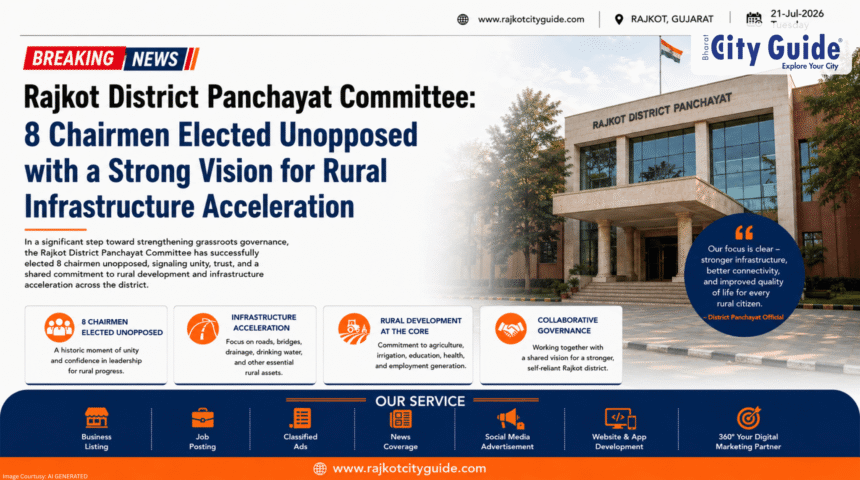
Local governance in Gujarat has taken a significant step forward with the complete restructuring of the core leadership bodies within the Rajkot District Panchayat. In a notable display of political consensus and administrative unity, the elections for the chairmen of eight essential statutory committees concluded with all candidates being elected completely unopposed. This development marks a pivotal moment for the administrative apparatus of the region, ensuring stability and alignment across various developmental wings. The newly appointed leadership team has immediately taken charge, taking a collective oath to fast-track long-pending public welfare projects and bring efficiency to rural governance.
- Introduction
- What is the Rajkot District Panchayat Committee?
- Why This News is Important
- Background Information
- Key Highlights
- Detailed Explanation of the Event
- Functional Areas of the Elected Committees
- Benefits and Future Impact of the Consensus
- How It Impacts the Local Population
- Industry Perspective and Governance Insights
- Challenges and Limitations
- Future Outlook
- Frequently Asked Questions (FAQs)
- Conclusion
The main focal point of this new administrative term is a clear commitment to transforming the regional infrastructure landscape. The newly elected chairmen have collectively pledged to prioritize rural road connectivity, enhance public health frameworks, and streamline agricultural support systems. This structural consolidation within the Rajkot District Panchayat Committee comes at a time when rural areas are demanding faster execution of public works and better accountability in local spending. By eliminating internal electoral friction through unopposed selections, the local government has set a streamlined trajectory for its administrative agenda. This comprehensive deep-dive explores the restructuring, the profiles of the newly appointed leadership, the core priority areas, and the long-term impact on the socio-economic framework of Rajkot district.
What is the Rajkot District Panchayat Committee?
The Rajkot District Panchayat Committee refers to the collective group of specialized governance bodies operating under the Rajkot District Panchayat, which is the highest tier of the three-tier Panchayati Raj system at the district level in Gujarat. Governed by the Gujarat Panchayats Act, the District Panchayat does not operate as a single monolithic entity. Instead, it delegates its executive, financial, legislative, and monitoring functions to various statutory and non-statutory committees. Each specific committee focuses on a distinct sector of rural administration.
These committees include the Executive Committee, Public Works Committee, Education Committee, Public Health Committee, Social Justice Committee, and Agriculture Committee, among others. Each body consists of elected district panchayat members and is headed by a Chairman. The chairmen hold executive powers to draft plans, clear budgetary allocations, monitor the work of government engineers and administrative officers, and ensure that state and central government welfare schemes reach the grass-roots level effectively.
Why This News is Important
The unopposed election of chairmen across eight major committees is an important administrative milestone for several reasons:
- Elimination of Political Friction: Unopposed selections indicate institutional stability and alignment within the ruling body, minimizing internal delays and ensuring rapid execution of public projects. Rajkot District
- Direct Acceleration of Infrastructure Projects: Local bodies often suffer from bureaucratic delays during transition periods. The immediate consensus ensures that executive desks are occupied without delay, allowing pending development plans to move forward seamlessly.
- Focus on Road Infrastructure: The explicit declaration by the new leadership to prioritize road building address a critical practical need for rural populations—improving transport, healthcare access, and market connectivity.
- Model for Local Governance: This development serves as an example of coordinated governance for other district panchayats across Gujarat, demonstrating how local political units can streamline structural appointments to focus entirely on development.
Background Information
The Panchayati Raj institutions in Gujarat have traditionally carried the responsibility of transforming rural economies. In Rajkot district, which covers a vast geographical area comprising numerous talukas and hundreds of villages, the District Panchayat serves as the primary governance link between the state administration and the rural population. Over the last few years, the demand for better infrastructure in Saurashtra’s rural hubs has intensified due to rapid agrarian growth and expanding micro-industries.
Statutorily, these committees are reconstituted or reassigned mid-term to allow fresh leadership opportunities and align governance goals with current public demands. The recent selection process drew attention from regional analysts as the leadership sought to maintain total administrative alignment. By selecting all eight chairmen without a single dissenting vote or opposing nomination, the Rajkot District Panchayat Committee has secured a solid political mandate to execute its fiscal budget and infrastructure targets without facing procedural roadblocks.
Key Highlights
- Total Consensus: Chairmen for 8 key functional committees of the Rajkot District Panchayat were elected completely unopposed.
- Core Pledges: The new leadership team took a collective pledge to accelerate overall rural development, emphasizing transparency and public accountability.
- Top Priority Set: The newly appointed chairmen officially designated the restoration, widening, and construction of rural roads as their number one operational priority.
- Balanced Governance: The appointments span across vital sectors including infrastructure, finance, health, public welfare, and social justice.
- Streamlined Executive Function: With the offices filled, the executive wings can immediately begin clearing pending tenders and allocating rural development funds.
Detailed Explanation of the Event
The election process for the leadership roles of the Rajkot District Panchayat was conducted under the supervision of designated election authorities and senior administrative officers. According to local reports, the nomination window closed with only one valid nomination form submitted for each of the eight open chairmanships. Consequently, the election officer formally announced the unopposed victory of all eight candidates for their respective committees.
Following the formal announcement, a celebratory gathering was held at the Rajkot District Panchayat headquarters. The newly appointed chairmen were greeted by fellow panchayat members, local leaders, and administrative staff. In their first joint press briefing post-appointment, the chairmen expressed their gratitude for the shared trust placed in them. They emphasized that their immediate focus would shift away from politics and directly toward the execution of public works. They outlined plans to review all active project files within their first week in office, focusing on clearing bottlenecks that have delayed rural connectivity projects.
Functional Areas of the Elected Committees
To understand the impact of these appointments, it is essential to examine the eight core committees that drive the district’s rural administration:
1. The Executive Committee (Executive Wing)
This is the central engine of the panchayat. It oversees financial planning, monitors general administration, and coordinates between all other committees. The chairman of this committee holds the keys to budget approvals and overall policy execution.
2. The Public Works Committee (PWC)
Responsible for building public infrastructure, this committee oversees the construction of district roads, government buildings, community halls, and rural bridges. Given the new leadership’s focus on roads, this committee will play a vital role in the current term.
3. The Public Health Committee
This body manages rural health centers, primary health units, vaccination drives, and sanitation initiatives. Its leadership is responsible for ensuring that medical supplies and infrastructural updates reach rural clinics effectively.
4. The Agriculture and Animal Husbandry Committee
Given that Rajkot’s rural economy relies heavily on farming, this committee plays a crucial role. It manages irrigation projects, seed distribution networks, fertilizer availability, and animal healthcare initiatives.
5. The Social Justice Committee
This statutory body ensures that development benefits reach marginalized communities, focusing on the welfare, education, and economic upliftment of underprivileged groups.
6. The Education Committee
Tasked with supervising primary schools across the district, this wing focuses on improving school infrastructure, checking teacher attendance, distributing educational materials, and lowering dropout rates.
7. The Appeal and Cooperatives Committees
These specialized bodies handle administrative dispute resolutions, internal grievances, and the promotion of rural cooperative networks that support dairy and cottage industries.
Benefits and Future Impact of the Consensus
The unopposed formation of these committees brings several clear advantages to the local administration:
| Operational Parameter | Traditional Scenario (Contested/Divided) | New Scenario (Unopposed Consensus) |
|---|---|---|
| Decision-Making Speed | Projects face delays due to debates and political divisions. | Files are cleared faster with aligned committee heads. |
| Budgetary Allocations | Factional disputes can lead to stalled fund utilization. | Smooth pass-through of development funds across sectors. |
| Infrastructure Focus | Scattered priorities based on competing political interests. | Unified focus on rural roads and primary infrastructure. |
| Bureaucratic Coordination | Officers face conflicting directives from divided leaders. | Clear, consistent directives enhance administrative execution. |
How It Impacts the Local Population
The restructuring of the Rajkot District Panchayat Committee directly influences the daily lives of rural citizens across the district:
- For Rural Commuters and Farmers: The commitment to prioritize road infrastructure means faster repairs of pothole-ridden surfaces and improved farm-to-market roads. This helps farmers transport perishable crops to urban markets efficiently, reducing transit losses.
- For Rural Students: With a dedicated head taking charge of the Education Committee, primary schools are expected to see increased surprise inspections and better maintenance of basic facilities like clean drinking water and separate restrooms.
- For Health Seekers: Fast-tracked decisions in the Public Health Committee will facilitate the steady procurement of medicines and better staffing at Primary Health Centers (PHCs), saving villagers from traveling long distances to the main city for basic treatments.
Industry Perspective and Governance Insights
Public administration experts often note that the success of local decentralization depends heavily on the operational health of its committees. When committees are paralyzed by political disputes, local governance stalls, leaving allocated funds unspent at the close of the financial year.
Conversely, an integrated leadership model within a District Panchayat allows for long-term planning. Experts highlight that by identifying rural road networks as their primary target, the new chairmen have picked a high-impact focus area. Improved road infrastructure naturally stimulates local economies by lowering transportation costs and encouraging small-scale industrial investments in rural zones.
Challenges and Limitations
Despite the optimistic start, the new leadership faces several practical challenges:
- Monsoon Damage Reclamation: The immediate hurdle for the Public Works Committee will be repairing roads damaged during the monsoon seasons. Restoring these roads requires rapid fund mobilization and strict quality control.
- Quality Assurance in Construction: Fast-tracking projects can sometimes lead to compromised construction quality. The chairmen will need to implement strict monitoring systems to ensure contractors adhere to durable engineering standards.
- Balancing Budgets: Allocating substantial funds to road infrastructure must not starve other critical sectors like rural education, water supply, and minor irrigation networks. Managing these trade-offs requires careful fiscal strategy.
Future Outlook
Over the next few months, the performance of the Rajkot District Panchayat Committee will be closely measured against its initial promises. The public will look for visible progress on rural road repairs and the revival of delayed community infrastructure projects.
Administrative observers expect the newly formed executive body to roll out a comprehensive district development blueprint within the quarter. This plan will likely outline specific timelines for village road upgrades, public health enhancements, and water conservation efforts ahead of the next fiscal cycle.
Frequently Asked Questions (FAQs)
1. What is the significance of the chairmen being elected unopposed?
Elections without opposition show complete agreement among the elected members. This eliminates internal disputes, prevents political gridlock, and allows the committee heads to begin work immediately without facing institutional delays.
2. Which areas will the Rajkot District Panchayat Committee prioritize?
The newly appointed chairmen have announced that their primary focus will be accelerating rural development works, with the highest priority given to upgrading and constructing rural road networks.
3. How many committees received new chairmen in this selection cycle?
A total of eight functional and statutory committees within the Rajkot District Panchayat had their chairmen appointed during this cycle.
4. How do these panchayat committees influence village-level development?
These committees hold the authority to approve development designs, distribute state and central funds, check project quality, and oversee primary schools, clinics, and roads across the district’s rural areas.
5. Who supervises the execution of the choices made by these chairmen?
The decisions made by the committee chairmen are executed by public officials, led by the District Development Officer (DDO) and dedicated district engineers, ensuring a balance between public representation and administrative oversight.
6. Will this administrative restructuring affect urban Rajkot?
No. The District Panchayat’s authority applies to the rural areas, small towns, and villages within the Rajkot district geographic boundary. The urban limits of the city are managed separately by the Rajkot Municipal Corporation (RMC).
Conclusion
The unopposed election of eight committee chairmen marks the beginning of a collaborative chapter for the Rajkot District Panchayat Committee. By removing political friction from the appointment process, the local government has established a clear path toward efficient administration. The unified commitment to prioritize road infrastructure and fast-track basic public services addresses the practical needs of the rural population. As these newly appointed leaders take charge, their ability to maintain this collaborative approach and deliver transparent, high-quality development will determine the long-term success of rural governance in the Rajkot district.