Introduction
Space exploration has taken a monumental leap forward with a groundbreaking announcement from the world’s premier space agency. The latest nasa exoplanet discovery beta pictoris has sent ripples of excitement through the global scientific community. Astronomers utilizing the unprecedented power of NASA’s James Webb Space Telescope (JWST) have uncovered a massive, previously hidden gas giant lurking within a well-studied cosmic backyard. Named Beta Pictoris d, this newly identified planet is rewriting our understanding of how planetary systems evolve.
- Introduction
- What is the Beta Pictoris Stellar System?
- Current Situation: The Discovery of Beta Pictoris d
- Why is this Space Discovery Important?
- Key Highlights of the Discovery
- Detailed Explanation of Planetary Features
- Technical Specifications of the Beta Pictoris System
- The Technology Behind the Discovery: NASA’s JWST
- Comparison with Competitor Stellar Systems
- Advantages of the New Spectroscopy Method
- Challenges and Limitations of the Discovery
- Who Benefits Most from This Space Update?
- Timeline and Future Observations
- Future Expectations in Exoplanet Discovery
- Frequently Asked Questions (FAQs)
- Conclusion
For decades, the Beta Pictoris system has been a favorite laboratory for scientists studying planetary formation. Located relatively close to Earth, it has consistently offered clues about the chaotic early days of planetary neighborhoods. However, this latest discovery changes the game entirely. It proves that even the most scrutinized regions of space still hold profound secrets waiting to be unlocked by advanced technology.
This development is not just another addition to the catalog of distant worlds. It marks a historical technical milestone in astrophysics. For the first time, a directly imaged exoplanet has been identified primarily through moderate-resolution spectroscopy rather than traditional, high-contrast visual imaging. This breakthrough opens up a brand-new era of deep-space observation, allowing scientists to detect hidden worlds that were previously invisible to our best instruments.
If you have ever wondered how planets are born, how solar systems take shape, or how human technology is piercing the veil of the deep cosmos, this article is for you. We will dive deep into the mechanics of this remarkable discovery, explore the unique characteristics of Beta Pictoris d, and discuss what this means for the future of space exploration.
What is the Beta Pictoris Stellar System?
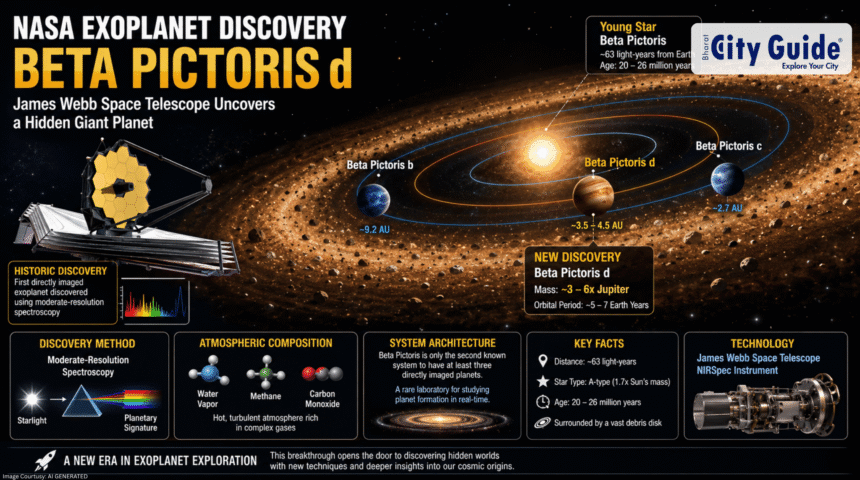
To truly appreciate the significance of the latest nasa exoplanet discovery beta pictoris, one must first understand the system itself. Beta Pictoris is a young, bright star located approximately 63 light-years away from Earth in the southern constellation of Pictor. It is roughly 1.7 times more massive than our Sun and shines significantly brighter. What makes it incredibly special to astronomers is its age. At just about 20 to 26 million years old, Beta Pictoris is an infant in cosmic terms compared to our 4.6-billion-year-old Sun.
Because it is so young, the system is still surrounded by a massive, chaotic disk of gas and dust known as a debris disk. This disk is the leftover material from the star’s formation, and it serves as the breeding ground for new planets. Studying Beta Pictoris is like looking into a time machine that shows what our own Solar System might have looked like during its first few million years of existence.
Over the years, the system has yielded several major discoveries. Before the arrival of the James Webb Space Telescope, astronomers had already confirmed the existence of two massive gas giants in the system: Beta Pictoris b and Beta Pictoris c. These planets were discovered using ground-based telescopes through direct imaging and radial velocity methods. The system also features a vast network of comets and colliding asteroids, making it one of the most dynamic environments observed in the Milky Way galaxy.
The inclusion of a third planet makes Beta Pictoris an elite cosmic specimen. It is now only the second known planetary system in the universe to contain at least three directly imaged planets. This unique architecture provides a rare, real-time look at how multiple giant planets interact with each other and their parent star’s dusty disk during their formative years.
Current Situation: The Discovery of Beta Pictoris d
The current buzz in the astronomical community centers on the official validation of Beta Pictoris d, made possible by the James Webb Space Telescope. According to official data released on the space agency’s portal, a team of international astronomers successfully captured the signature of this hidden giant. The breakthrough was achieved using Webb’s highly sensitive Near-Infrared Spectrograph (NIRSpec) instrument, which allowed scientists to peer through the thick shrouds of dust surrounding the young star.
What makes this development truly historic is the methodology used by the research team. Traditionally, astronomers find exoplanets by watching a star dim as a planet passes in front of it (the transit method) or by looking for a physical wobble in the star’s motion (the radial velocity method). Direct imaging usually relies on blocking out the star’s blinding light completely to snap a faint photo of the planet. However, Beta Pictoris d was detected primarily through moderate-resolution spectroscopy, marking a monumental shift in exoplanet detection techniques.
By analyzing the specific wavelengths of light filtering through the system, the JWST identified the distinct chemical and thermal signature of the planet. The telescope separated the faint light emitted by the planet from the overwhelming glare of its parent star and the surrounding debris disk. This technique allows scientists to confirm a planet’s existence while simultaneously gathering data about its atmospheric composition and temperature.
The scientific community is hailed this as a massive triumph for the engineering capabilities of the JWST. The data confirms that Beta Pictoris d is positioned in an orbit nestled between its two older siblings, creating a tightly packed system of gas giants. Initial reports suggest that the planet’s orbit is stable, though it continues to exert gravitational pressure on the surrounding dust lanes, creating visible ripples in the system’s debris disk.
Why is this Space Discovery Important?
The latest nasa exoplanet discovery beta pictoris holds profound significance for both the scientific community and our broader understanding of the universe. First and foremost, it serves as a proof of concept for an entirely new way of finding planets. By proving that moderate-resolution spectroscopy can directly isolate and identify an exoplanet, NASA has handed astronomers a powerful new tool. This method will undoubtedly lead to the discovery of many more hidden planets in systems that we previously thought we had fully mapped out.
For planetary scientists, this discovery provides an invaluable dataset for testing theories of planet formation. Scientists have long debated exactly how gas giants form. Do they accumulate slowly from a core of rock and ice, or do they form rapidly from the sudden gravitational collapse of a dense cloud of gas? By studying the mass, orbit, and atmospheric makeup of Beta Pictoris d alongside its sister planets, researchers can build highly accurate computer simulations of planetary birth.
Furthermore, this discovery impacts our understanding of our own planetary origins. Because the Beta Pictoris system is a younger mirror of our early Solar System, understanding how these three giant planets interact helps explain why our own outer planets—Jupiter, Saturn, Uranus, and Neptune—settled into their current, stable orbits. It helps us answer a fundamental human question: Is the configuration of our Solar System a rare anomaly, or is it a common outcome across the galaxy?
Finally, the discovery highlights the immense return on investment of space infrastructure like the James Webb Space Telescope. Every new discovery of this scale refines our observational technologies and algorithms. The lessons learned while analyzing Beta Pictoris d will be directly applied to future missions aimed at finding smaller, rocky, Earth-like worlds in the habitable zones of distant stars, bringing us one step closer to finding life beyond Earth.
Key Highlights of the Discovery
- Historic Detection Method: Marks the very first time a directly imaged exoplanet has been discovered primarily through moderate-resolution spectroscopy rather than conventional imaging techniques.
- Elite Planetary Club: Elevates Beta Pictoris to only the second known planetary system in the universe to feature at least three directly imaged planets.
- Massive Gas Giant: Confirmed as a giant exoplanet with a mass several times that of Jupiter, making it a dominant gravitational force in its local system.
- Strategic Orbit: Located within the internal structure of the system’s famous debris disk, sitting between the previously known planets Beta Pictoris b and c.
- JWST Triumph: Utilized the cutting-edge Near-Infrared Spectrograph (NIRSpec) aboard NASA’s James Webb Space Telescope to pierce through dense cosmic dust.
- Insights into Planet Birth: Offers a pristine, real-time look at planetary migration and system dynamics in an infant solar system that is only around 20 million years old.
Detailed Explanation of Planetary Features
Moderate-Resolution Spectroscopy Detection
The standout feature of this discovery is the use of moderate-resolution spectroscopy to isolate the planet. Traditional direct imaging requires completely blocking out a star’s light using a coronagraph, which can sometimes block out inner planets as well. By using spectroscopy, the JWST analyzed the infrared light coming from the system and broke it down into its constituent colors.
This allowed astronomers to see the distinct thermal glow of Beta Pictoris d, separated from the star’s light. The primary benefit of this technique is that it allows for the discovery of planets that are too close to their parent star to be easily separated by standard cameras. It opens up a hidden population of inner gas giants across the Milky Way.
Orbits and System Architecture
Beta Pictoris d occupies a highly compelling position within its home system. It orbits its parent star well within the thick inner ring of the planetary debris disk. This placement means the planet is constantly interacting with dust, pebbles, and planetesimals.
The planetary system’s architecture is incredibly tight, meaning the gravitational pull of Beta Pictoris d influences the orbits of Beta Pictoris b and c. Real-world modeling of these orbits allows scientists to calculate the exact gravitational stability of the system, helping us understand how planetary systems prevent themselves from flying apart during their turbulent youth.
Atmospheric Composition and Heat Signature
Because Beta Pictoris d is incredibly young, it is still glowing with the intense internal heat left over from its violent formation process. The JWST’s spectral data shows a rich atmospheric signature filled with complex gases.
Initial readings indicate the presence of water vapor, carbon monoxide, and methane in its turbulent, cloud-filled sky. Analyzing these atmospheric features allows scientists to determine the planet’s exact carbon-to-oxygen ratio. This ratio is a vital cosmic fingerprint that reveals exactly where in the original dust disk the planet was born before it migrated to its current location.
Technical Specifications of the Beta Pictoris System
To understand the scale of this cosmic environment, it helps to look at the numbers. The table below outlines the core characteristics of the three known planets residing within the Beta Pictoris system based on the latest compiled data from NASA and international astronomical databases.
| Planetary Property | Beta Pictoris b | Beta Pictoris c | Beta Pictoris d (New Discovery) |
|---|---|---|---|
| Discovery Year | 2008 | 2019 | 2026 (Confirmed via JWST) |
| Detection Method | Direct Imaging | Radial Velocity | Moderate-Resolution Spectroscopy |
| Mass (Jupiter Masses) | ~9 to 11 times Jupiter | ~8 times Jupiter | Estimated ~3 to 6 times Jupiter |
| Orbital Period (Years) | ~22 Earth Years | ~3.3 Earth Years | Estimated ~5 to 7 Earth Years |
| Distance from Star (AU) | ~9.2 AU | ~2.7 AU | Estimated ~3.5 to 4.5 AU |
| Atmospheric State | Super-Jupiter, Cloudy | Heavy Gas Giant | Hot, Methane/CO Rich |
The Technology Behind the Discovery: NASA’s JWST
The success of the nasa exoplanet discovery beta pictoris rests entirely on the shoulders of the engineering marvel that is the James Webb Space Telescope. Operating from its vantage point at the Second Lagrange Point (L2), nearly 1.5 million kilometers from Earth, Webb is uniquely shielded from the thermal interference of our own planet. This allows its primary gold-coated mirror to capture incredibly faint infrared light from the deep cosmos.
The specific tool responsible for uncovering Beta Pictoris d is the Near-Infrared Spectrograph, or NIRSpec. NIRSpec is equipped with a revolutionary microshutter array, featuring thousands of tiny windows that can be opened or closed independently to focus on specific targets in the sky while blocking out unwanted background light. In the case of Beta Pictoris, NIRSpec acted like a cosmic prism, separating the incoming light from the system into an incredibly detailed chemical barcode.
Furthermore, Webb’s advanced software data processing algorithms played a crucial role. The raw data transmitted from the telescope is incredibly noisy, filled with artifacts from stellar glare and background cosmic radiation. Scientists used highly sophisticated data-subtraction algorithms to filter out the brilliant light of the star Beta Pictoris, eventually leaving behind the unmistakable spectral signature of the hidden giant planet.
Comparison with Competitor Stellar Systems
When evaluating the importance of Beta Pictoris, it is helpful to compare it to the only other system in the cosmos known to possess a multi-planet configuration that has been directly imaged: the famous HR 8799 system.
HR 8799 vs. Beta Pictoris
The HR 8799 system, located about 133 light-years away, boasts four directly imaged giant planets. However, HR 8799 is a much older system, meaning its planets have cooled significantly, and its primary debris disk has largely cleared out. Beta Pictoris offers a distinct advantage because it is much younger and closer to Earth. This proximity allows the JWST to capture much higher resolution spectral data than can be achieved with the more distant HR 8799 planets.
System Density and Dynamics
While the planets in the HR 8799 system are spaced very far apart in wide, sweeping orbits, the planets in the Beta Pictoris system are tightly packed together. This high density makes Beta Pictoris a much better environment for studying active gravitational interactions, orbital resonances, and the ongoing destruction of comets and asteroids caused by competing planetary gravitational fields.
Advantages of the New Spectroscopy Method
- High Sensitivity to Inner Planets: Allows for the detection of worlds that orbit close to their parent star, an area where traditional direct imaging struggles due to stellar glare.
- Simultaneous Chemical Analysis: The method does not just confirm the presence of a planet; it instantly provides a detailed breakdown of its atmospheric composition and temperature.
- Reduced Reliance on Coronagraphs: Decreases the need for complex physical light-blocking masks, lowering the chances of accidentally blocking out real planets during observation.
- Maximizes Existing Infrastructure: Proves that current instruments like the JWST’s NIRSpec possess hidden capabilities that can be unlocked with creative data processing.
Challenges and Limitations of the Discovery
Despite the overwhelming success of the nasa exoplanet discovery beta pictoris, the observation team still faces notable challenges. Because the planet was discovered via moderate-resolution spectroscopy rather than traditional direct visual imaging, we do not yet possess a standard, high-contrast visual photograph of Beta Pictoris d isolated by itself. The planet’s signature is entirely spectral, meaning its visual appearance must be modeled by computers based on the light data received.
Additionally, because the planet is deeply embedded within a highly active debris disk, separating the light of the planet from the light bouncing off surrounding dust clouds is an incredibly slow and painstaking process. Astronomers must continue to gather data over several orbital cycles to refine their estimates of the planet’s exact mass and orbital path. This means some of the current physical specifications remain subject to minor adjustments as more data pours in.
Who Benefits Most from This Space Update?
Professional Astronomers and Astrophysicists
This group gains a brand-new dataset to refine their long-standing mathematical models of planetary formation, atmospheric dynamics, and planetary migration within young stellar systems.
Students and Educators
The clear, tangible data provided by the JWST serves as an incredible educational resource. It brings textbook theories of physics, spectroscopy, and orbital mechanics to life for students around the globe.
Science Communicators and Space Enthusiasts
For the general public, this discovery provides fresh inspiration. It reinforces the value of deep-space exploration and provides a thrilling glimpse into the hidden wonders of the Milky Way galaxy.
Timeline and Future Observations
The journey to uncovering Beta Pictoris d has been a multi-year effort that culminated in this spectacular validation. Following the initial calibration of the JWST, the Beta Pictoris system was designated as a high-priority target for guaranteed time observations due to its rich history. Over the past several months, deep-space data packets were systematically gathered and analyzed by international research institutions before being officially cleared for public publication.
Looking forward, the timeline for studying this system is far from over. NASA and its partner space agencies have already planned follow-up observation schedules utilizing Webb’s Mid-Infrared Instrument (MIRI). These upcoming observations will peer even deeper into the thermal emissions of Beta Pictoris d, aiming to map out the planet’s weather patterns, cloud structures, and precise atmospheric temperature variations over the next few years.
Future Expectations in Exoplanet Discovery
The long-term implications of this discovery point to a dramatic acceleration in the finding of new exoplanets. Now that the spectroscopic method has been proven effective on a system as complex as Beta Pictoris, astronomers will almost certainly apply this exact technique to dozens of other nearby young stars that possess debris disks. It is highly expected that this will reveal a massive, previously hidden population of inner gas giants across our galactic neighborhood.
Furthermore, this breakthrough lays the groundwork for the next generation of space observatories. Missions currently in development, such as NASA’s Nancy Grace Roman Space Telescope and the Habitable Worlds Observatory, will build directly upon the lessons learned from Webb’s spectroscopy work. These future instruments will attempt to scale this technology down, moving away from giant gas planets to directly image and analyze the atmospheres of small, rocky, potentially habitable worlds.
Frequently Asked Questions (FAQs)
What is the new nasa exoplanet discovery beta pictoris?
The new nasa exoplanet discovery beta pictoris refers to the historic identification of a hidden giant gas planet, named Beta Pictoris d, within the young and highly studied Beta Pictoris planetary system. Discovered using NASA’s James Webb Space Telescope, this finding marks a massive step forward in astronomy. It is the first time a directly imaged exoplanet has been found primarily using moderate-resolution spectroscopy rather than traditional imaging, adding a third confirmed planet to this iconic, infant solar system.
How far away is the Beta Pictoris system from Earth?
The Beta Pictoris planetary system is located approximately 63 light-years away from Earth in the southern constellation of Pictor. In cosmic terms, this is considered our relatively immediate galactic backyard. Because it is so close to us and exceptionally bright, it has been one of the most heavily studied stellar systems for scientists researching the early stages of planetary system formation and evolution over the last several decades.
What instrument did the James Webb Space Telescope use for this discovery?
The James Webb Space Telescope utilized its cutting-edge Near-Infrared Spectrograph, commonly known as NIRSpec, to achieve this discovery. NIRSpec’s advanced design allowed astronomers to split the infrared light coming from the system into an incredibly detailed spectrum. By analyzing this light, scientists successfully isolated the unique thermal and chemical signature of Beta Pictoris d from the overwhelming glare of its parent star and the surrounding dust.
Why is the discovery of Beta Pictoris d considered historic?
This discovery is historic because it marks the first time a directly imaged planet was detected primarily through moderate-resolution spectroscopy. Additionally, it elevates Beta Pictoris to an elite group, making it only the second known planetary system in the entire universe to contain at least three directly imaged planets. The success of this methodology proves that we can discover hidden planets in close orbits around bright stars without relying solely on traditional imaging.
What is the atmosphere of Beta Pictoris d made of?
Based on the rich spectral data captured by the James Webb Space Telescope, the atmosphere of the giant planet Beta Pictoris d contains a complex mixture of gases. Initial analysis indicates significant signatures of water vapor, methane, and carbon monoxide. Because the planet is incredibly young, its atmosphere is highly turbulent, hot, and filled with dense cloud layers, typical of a massive gas giant still cooling down from its formation.
How old is the Beta Pictoris planetary system?
The Beta Pictoris system is incredibly young, with an estimated age of only 20 to 26 million years. By comparison, our own Solar System is roughly 4.6 billion years old. This extreme youth means the system is still actively evolving, with its planets surrounded by a massive, turbulent disk of dust and gas, providing scientists with a perfect laboratory to watch the process of planetary birth.
Can humans live on Beta Pictoris d?
No, humans cannot live on Beta Pictoris d. It is a massive gas giant with a mass multiple times greater than Jupiter, meaning it lacks a solid surface to stand on. Furthermore, the planet possesses an incredibly hot, turbulent atmosphere filled with toxic gases and experiences extreme gravitational forces, making it completely uninhabitable for any form of life as we know it.
Conclusion
The recent nasa exoplanet discovery beta pictoris represents a landmark achievement in modern astronomy. By utilizing the unparalleled infrared sensitivity of the James Webb Space Telescope, humanity has once again pushed the boundaries of what is possible, uncovering a hidden giant planet in a system we thought we already knew well. Beta Pictoris d stands as a testament to human ingenuity, proving that our understanding of the universe is constantly evolving alongside our technological capabilities.
This discovery provides invaluable insights into the chaotic dynamics of infant solar systems. It clarifies how giant planets interact with one another and shape the dusty environments from which they are born. More importantly, by successfully demonstrating the power of moderate-resolution spectroscopy to directly isolate a planet’s signature, NASA has provided a highly potent blueprint for future exoplanet hunts across the Milky Way.
As the James Webb Space Telescope continues its mission in the deep freeze of space, we can confidently expect many more revolutionary discoveries. Each new world we find brings us closer to mapping our galaxy and understanding our own cosmic roots. For now, the Beta Pictoris system shines brighter than ever as an invaluable cosmic laboratory, guiding us forward on our ongoing journey to unravel the deepest secrets of the cosmos.