Introduction
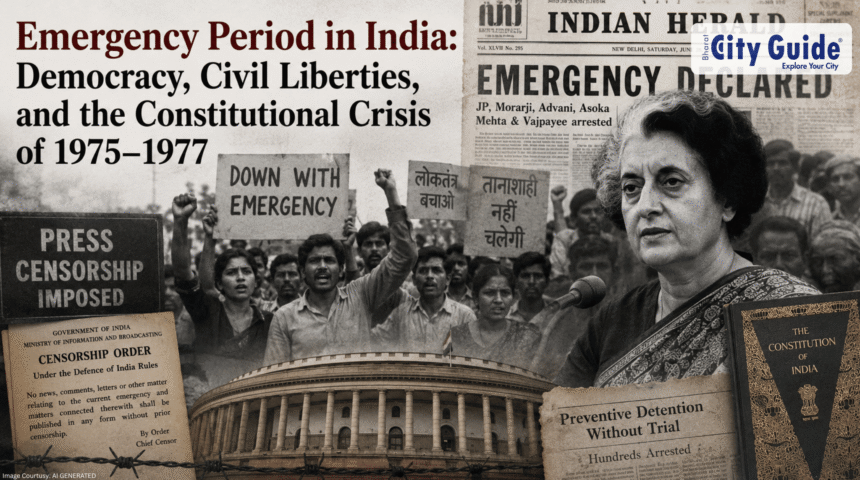
Few events in independent India’s political history have generated as much debate, reflection, and constitutional significance as the Emergency Period in India from 1975 to 1977. Often regarded as one of the greatest tests of Indian democracy, this period represented a dramatic concentration of executive power, suspension of civil liberties, restrictions on press freedom, and a profound challenge to constitutional governance.
- Introduction
- What Was the Emergency Period in India?
- Political Background Leading to the Emergency
- Why the Emergency Was Declared
- Suspension of Civil Liberties
- Press Censorship and Media Control
- Arrests and Political Opposition
- Constitutional and Institutional Changes
- Controversial Policies and Social Programs
- Judiciary During the Emergency
- Public Response and Political Awakening
- The 1977 General Election and End of Emergency
- Long-Term Effects on Indian Democracy
- Impact on Civil Liberties
- Legacy of the Emergency Period in India
- Best Lessons from the Emergency Period
- Frequently Asked Questions About the Emergency Period in India
- Conclusion
Declared on June 25, 1975, by Prime Minister Indira Gandhi under Article 352 of the Constitution, the Emergency was officially justified on grounds of internal disturbance. However, for many critics, scholars, and political observers, it marked a period when democratic institutions faced severe pressure, opposition voices were suppressed, and the balance between state authority and citizen freedom was fundamentally disrupted.
The Emergency Period in India was not simply a temporary political episode—it became a defining lesson in the fragility and resilience of democratic institutions. It raised enduring questions about constitutional safeguards, executive accountability, judicial independence, federalism, media freedom, and the rights of citizens.
Understanding this era is essential not only for historical knowledge but also for appreciating the importance of institutional checks, civil liberties, and democratic vigilance in modern India.
What Was the Emergency Period in India?
The Emergency Period in India refers to the 21-month period from June 25, 1975, to March 21, 1977, when a national Emergency was declared by the Indian government.
Constitutional Basis:
It was proclaimed under Article 352, citing internal disturbance.
Key Features:
- Suspension of civil liberties
- Press censorship
- Political arrests
- Centralization of power
- Expanded executive authority
- Reduced political opposition
Core Historical Significance:
It remains one of the most controversial phases in India’s democratic history.
Political Background Leading to the Emergency
Several political and social developments shaped the context.
Major Factors:
- Political unrest
- Economic challenges
- Inflation
- Opposition mobilization
- Student protests
- Governance pressures
Judicial Trigger:
The Allahabad High Court ruling invalidating Indira Gandhi’s election became a major turning point.
Strategic Context:
Political vulnerability and mass dissent intensified institutional conflict.
Why the Emergency Was Declared
Official Justification:
The government cited:
- Internal instability
- National security
- Governance disruption
Critic Perspectives:
Many argued it was used to:
- Consolidate power
- Control dissent
- Manage political crisis
Historical Debate:
The Emergency remains contested between narratives of order and authoritarian overreach.
Suspension of Civil Liberties
One of the defining characteristics was the curtailment of fundamental freedoms.
Affected Areas:
- Freedom of speech
- Freedom of assembly
- Political activism
- Habeas corpus protections
Key Concern:
The relationship between state power and individual liberty was sharply altered.
Press Censorship and Media Control
Major Measures:
- Pre-publication censorship
- Restrictions on criticism
- Suppression of dissenting journalism
Democratic Impact:
A free press—often considered essential to accountability—faced unprecedented control.
Historical Lesson:
Media independence is central to democratic resilience.
Arrests and Political Opposition
Many opposition leaders, activists, and critics were detained.
Effects:
- Reduced political contestation
- Weakened organized dissent
- Expanded executive control
Strategic Reality:
Political pluralism faced major constraints.
Constitutional and Institutional Changes
The Emergency period saw significant constitutional amendments and governance changes.
Areas of Concern:
- Executive power
- Judicial review
- Institutional autonomy
Broader Question:
How can constitutions protect democracy during crises?
Controversial Policies and Social Programs
The period also included aggressive governance campaigns.
Examples:
- Family planning drives
- Urban clearance efforts
- Administrative centralization
Public Perception:
Some viewed these as modernization; others criticized coercive implementation.
Judiciary During the Emergency
Key Issue:
Judicial independence faced major scrutiny.
Landmark Concern:
The ADM Jabalpur case became symbolic of debates around liberty and constitutional rights.
Long-Term Importance:
Judicial safeguards became a major post-Emergency reform focus.
Public Response and Political Awakening
While opposition was constrained initially, public sentiment evolved.
Key Outcomes:
- Democratic consciousness expanded
- Political accountability debates intensified
- Electoral significance grew
Strategic Lesson:
Democratic resilience often depends on citizen memory.
The 1977 General Election and End of Emergency
When elections were held in 1977:
Major Result:
The ruling government was defeated.
Historic Importance:
This marked a major democratic correction through peaceful electoral means.
Key Insight:
India demonstrated democratic recovery through constitutional process.
Long-Term Effects on Indian Democracy
Positive Institutional Lessons:
- Stronger democratic awareness
- Greater civil liberties discourse
- Constitutional safeguards
- Political pluralism
Ongoing Risks:
- Executive overreach concerns
- Institutional vulnerability
- Rights vigilance
Impact on Civil Liberties
Core Lessons:
- Rights can be fragile
- Institutions matter
- Legal safeguards are essential
- Public vigilance is critical
Democratic Principle:
Civil liberties are foundational, not optional.
Legacy of the Emergency Period in India
Major Historical Themes:
- Constitutional stress test
- Democratic resilience
- Political accountability
- Institutional reform
Broader Historical Significance:
The Emergency became a cautionary chapter in balancing security and liberty.
Best Lessons from the Emergency Period
Strategic Priorities:
- Constitutional safeguards
- Press freedom
- Judicial independence
- Political accountability
- Citizen vigilance
Formula:
Democracy + Rights + Institutions + Accountability
Frequently Asked Questions About the Emergency Period in India
When was the Emergency declared?
June 25, 1975.
When did it end?
March 21, 1977.
Why is it controversial?
Due to civil liberty restrictions, censorship, and concentration of power.
Was democracy suspended?
Elections were delayed and freedoms were curtailed, though constitutional structures formally continued.
What was press censorship?
Government control over media publication.
Why is the Emergency historically important?
It tested democratic institutions and reshaped constitutional discourse.
What was its biggest lesson?
Democracy requires constant institutional and civic protection.
Conclusion
The Emergency Period in India remains one of the most consequential and debated chapters in the nation’s democratic history. It revealed how constitutional systems can face immense strain when executive authority expands beyond normal democratic limits, but it also demonstrated the enduring strength of electoral accountability and institutional recovery.
For India, this period was both a warning and a lesson: democracy is not self-sustaining without vigilant citizens, independent institutions, and robust civil liberties.
By remembering the Emergency, India strengthens its democratic consciousness—recognizing that freedom, accountability, and constitutional integrity must be actively protected in every generation.