Introduction
Labour laws influence your working hours, wages, provident fund (PF), overtime, and workplace protections. For decades, India’s labour regime was a patchwork of 29 central laws, often confusing for both employers and employees.
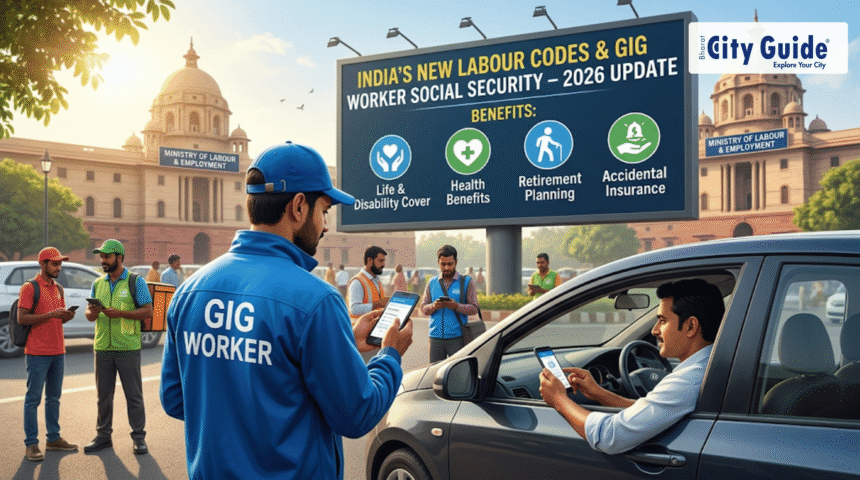
In November 2025, India’s labour reform reached a pivotal moment with the notification of four consolidated Labour Codes, simplifying compliance while modernising protections. At the same time, the Gig Workers Act 2026 operationalises social security for platform and gig workers—drivers, delivery partners, freelancers—who previously lacked a formal safety net.
These reforms reflect the government’s broader aim: to modernise labour law, ensure worker welfare, and adapt to a diverse, technology-driven economy.
Policy Overview
The Four Labour Codes
The Labour Codes consolidate 29 existing laws into a streamlined legal framework:
- Code on Wages, 2019
- Covers wage, bonus payments, and ensures minimum wage enforcement and timely payment.
- Applies across organised and some unorganised sectors.
- Covers wage, bonus payments, and ensures minimum wage enforcement and timely payment.
- Code on Social Security, 2020
- Integrates EPF, ESI, gratuity, maternity benefits, and other welfare laws.
- Explicitly includes gig and platform workers as beneficiaries.
- Integrates EPF, ESI, gratuity, maternity benefits, and other welfare laws.
- Industrial Relations Code, 2020
- Governs trade unions, strikes, dispute resolution, and conditions for layoffs/closures.
- Governs trade unions, strikes, dispute resolution, and conditions for layoffs/closures.
- Occupational Safety, Health and Working Conditions (OSH) Code, 2020
- Consolidates safety and working condition standards across sectors.
- Consolidates safety and working condition standards across sectors.
All four codes are effective from 21 November 2025, though some provisions will be phased in as central and state rules are implemented.
Gig Workers Act 2026
Framed under the Social Security Code, the Gig Workers Act 2026 operationalises social security for app-based platform workers:
- Platforms (ride-hailing, delivery, home services) must contribute to a gig worker welfare fund.
- Eligibility is based on working 90–120 days in a financial year on one or multiple platforms.
- Benefits include:
- Health insurance
- Maternity allowance
- Life cover and other social security measures
- Health insurance
The government is enrolling workers on the e-Shram portal to build a unified database and ensure readiness for FY 2026.
Policy in Simple Terms
- Four Labour Codes: One consolidated rulebook covering wages, social security, industrial relations, and occupational safety.
- Gig Workers Act 2026: Introduces a formal safety net for app-based gig workers for the first time.
Key Objectives and Provisions
Labour Codes – Objectives
- Simplify and harmonise India’s labour law framework.
- Improve ease of doing business with standardised definitions.
- Modernise worker protection for a diverse, formal, and gig-inclusive economy.
Code on Wages
- Establishes common definitions of wages across laws.
- Guarantees minimum wage enforcement and timely payment.
Code on Social Security
- Consolidates EPF, ESI, gratuity, maternity, and other welfare laws.
- Recognises gig and platform workers as eligible for social security schemes funded by state, employers, and aggregators.
Industrial Relations Code
- Sets rules for trade union formation, strikes, and dispute resolution.
- Adjusts layoff/closure thresholds to improve business flexibility while maintaining compensation requirements.
OSH Code
- Standardises occupational safety and health norms.
- Emphasises registration, working conditions, and welfare facilities.
Gig Workers Act 2026 – Provisions
- Aggregator contributions: Platforms finance a welfare fund for eligible workers.
- Eligibility: About 90–120 days of platform work per year.
- Benefits: Health insurance, maternity allowance, life cover.
- Registration: e-Shram portal ensures proper worker tracking.
Who Is Affected and How
Employees in Organised and Unorganised Sectors
- Standardised wage definitions improve transparency and benefit predictability.
- Salary components may be restructured; PF contributions could rise, reducing short-term take-home pay but enhancing long-term security.
Employers and Businesses
- Must adjust HR policies, payroll systems, and compliance processes.
- Benefit from simplified, harmonised laws, though initial implementation may be complex.
Gig and Platform Workers
- For the first time, may receive formal social security.
- Reduces precarity in the gig economy by providing health, maternity, and life insurance.
For citizens, this marks a shift: the line between formal and informal work blurs, extending social security to previously excluded gig workers.
Expected Benefits
From Labour Codes
- Improved ease of doing business: One consolidated law simplifies compliance.
- Greater formalisation: Standardised wage and social security rules encourage formal employment contracts.
- Global competitiveness: Strong labour standards make India a reliable outsourcing and manufacturing hub.
From Gig Workers Act
- Safety net for millions of gig workers previously without benefits.
- Reduces vulnerability and income insecurity in platform-based work.
- Aligns with India’s digital and gig economy growth responsibly.
Concerns, Challenges, or Criticisms
- Uneven implementation: State rules are still evolving; transition may be patchy.
- Take-home pay impact: PF contributions on redefined wages could temporarily reduce salaries.
- Worker protections vs. employer flexibility: IR Code changes may reduce job security.
- Gig worker funding adequacy: Eligibility thresholds, aggregator contributions, and enforcement determine the effectiveness of benefits.
- Administrative capacity: Requires robust digital systems, grievance redressal, and coordination between central, state, and platform stakeholders.
Real-Life or Practical Implications
- Salaried professional: HR may restructure salaries, increase PF contributions, and standardise working hours and leave rules.
- Gig worker: Workdays counted for eligibility on one or more platforms; health insurance, maternity allowance, and life cover become accessible via the e-Shram portal.
- Independent contractors/content creators: Classification (employee vs gig worker vs independent professional) affects entitlements and compliance.
What This Means for Common Citizens
- Workers should verify employment status and understand rights under Labour Codes and Gig Worker rules.
- Gig workers must register on e-Shram and track announcements for welfare schemes.
- Citizens should recognise that inclusive social security and flexible business regulations are both essential for sustainable economic growth.
Future Outlook
- 2026 is a “reforms and recalibration” year, with full operationalisation of rules over the next few years.
- Sectors like IT, manufacturing, and services will adjust to cost and compliance impacts.
- Gig-worker social security rules may evolve as e-Shram data and aggregator contributions mature.
- The true test: whether these reforms deliver protections for workers while fostering a dynamic, competitive labour market.
Conclusion: What Citizens Should Know
India’s Labour Codes and Gig Workers Act 2026 modernise a fragmented labour system, covering salaried, contractual, and platform-based work.
- Workers: Understand employment classification, benefits, and how to claim them.
- Employers/Platforms: Adapt early and transparently to maintain trust and competitiveness.
- Citizens: Acknowledge that balanced reforms are crucial for both worker welfare and business growth.
Key Takeaways
- Labour law consolidation: 29 laws unified into four Labour Codes, effective 21 November 2025.
- Simplified compliance: Clear definitions and harmonised protections across sectors.
- Gig worker protections: Health insurance, maternity allowance, life cover via welfare funds.
- Challenges: Transitional confusion, take-home pay adjustments, job security vs flexibility, and enforcement adequacy.
- Actionable steps: Workers should check employment status, register on e-Shram, and monitor benefit entitlements.
Citizen-Focused Question:
How clearly do you understand your employment status—employee, contractor, or platform worker—and what specific benefits (PF, ESI, insurance, or gig welfare) are you entitled to under the new labour framework?
FAQ
Q1: What are India’s new Labour Codes?
A: Four consolidated laws on wages, social security, industrial relations, and occupational safety, effective from 21 November 2025.
Q2: Who qualifies as a gig worker?
A: Workers on platforms like ride-hailing, delivery, or home services who meet the day thresholds (90–120 days/year).
Q3: What benefits do gig workers get?
A: Health insurance, maternity allowance, life cover, financed partly by platform contributions.
Q4: How do the Codes affect salaried employees?
A: Standardised wage definitions, PF/ESI contributions, leave rules, and workplace safety measures may change payroll structures.
Q5: How do I register as a gig worker?
A: Through the e-Shram portal, which maintains a centralised database for eligibility and benefits.
Q6: Do Labour Codes replace old labour laws?
A: Yes, they consolidate 29 laws, but some provisions and state-level rules are phased in gradually.
Q7: Will gig worker benefits be fully funded?
A: Funding depends on platform contributions, eligibility thresholds, and effective enforcement.
Q8: How can citizens stay informed?
A: Check updates on government portals, e-Shram registration, HR notifications, and news about state-level Labour Code rules.