Introduction
In today’s hyperconnected world, technology is not just a tool—it is the backbone of modern life. From communication and banking to healthcare, transportation, and even basic daily tasks, digital systems quietly power everything around us. We rarely notice this dependence—until something breaks.
- Introduction
- Everyday Over-Reliance: Phones, Apps, and Anxiety
- The Shift From Tools to Cognitive Infrastructure
- Fragile Foundations: Power Grids and Communication Networks
- Solar Storms and Geomagnetic Risk
- Cascading Failure: When One Layer Breaks Another
- Why This Matters: More Than Inconvenience
- Psychological Impact of System Failure
- Building System-Level Resilience
- Personal and Community Resilience
- A Healthier Relationship With Technology
- The Path Forward
- Conclusion
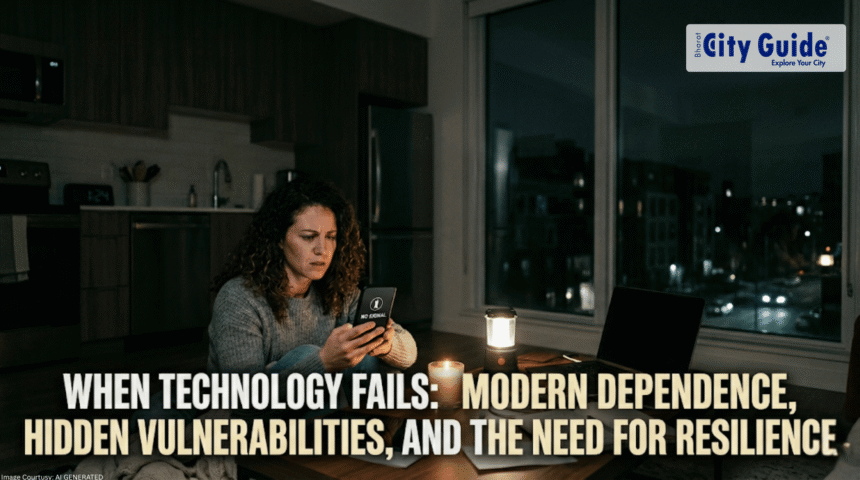
When technology fails, the disruption is immediate and often widespread. Flights are grounded, payments stop working, hospitals face delays, and individuals feel stranded. These moments reveal a crucial truth: while technology has made life more efficient, it has also made us deeply vulnerable.
Everyday Over-Reliance: Phones, Apps, and Anxiety
Smartphones have become the central interface of daily life. Navigation, payments, work communication, health tracking, entertainment, and social connection now flow through a single device. As a result, even short disruptions can feel destabilizing.
For many people, losing connectivity is not just inconvenient, it produces stress, disorientation, or panic. This is especially true for individuals already prone to anxiety. When maps, messaging, calendars, and financial tools vanish at once, people feel suddenly unmoored.
As work, education, and relationships move online, society has adopted an “always on” expectation. Missed messages can feel like missed obligations. A network outage can feel like professional invisibility or social isolation. In earlier eras, being unreachable was normal. Today, it can feel like failure.
This psychological dependency means that technical glitches such as dead batteries, software bugs, or platform outages can have outsized emotional impact compared to their actual severity. The stress response often reflects how deeply digital tools are woven into personal identity and daily functioning.
The Shift From Tools to Cognitive Infrastructure
Technology is no longer just external equipment. It has become cognitive infrastructure. People outsource memory to calendars, orientation to GPS, and social coordination to messaging apps. This delegation frees mental energy, but it also reduces tolerance for disruption.
When tools fail, people are not just inconvenienced. They temporarily lose capabilities they no longer practice regularly, such as navigating without maps, recalling phone numbers, or coordinating plans face to face. This creates a fragile dependency loop where convenience reduces resilience.
Understanding this shift is key to addressing over-reliance without rejecting technology itself.
Fragile Foundations: Power Grids and Communication Networks
Behind every app and device lies a vast physical system: power plants, transmission lines, substations, data centers, fiber-optic cables, cell towers, and satellites. These systems are marvels of engineering, but they are also tightly coupled.
Grid planners increasingly worry about catastrophic threats. Extreme weather events, cyber-physical attacks, equipment aging, and geomagnetic disturbances from solar activity can all trigger widespread outages.
Electricity is the keystone. Without power, communication networks fail. Cell towers lose backup capacity, internet routers shut down, data centers go dark, and cloud services disappear. The digital world collapses quickly when energy stops flowing.
Solar Storms and Geomagnetic Risk
One often overlooked threat comes from space. Solar flares and coronal mass ejections can trigger geomagnetic storms that induce powerful electrical currents in long transmission lines. These currents can damage transformers and overwhelm protective systems.
Analysts warn that a Carrington-level solar event, similar to the one observed in 1859, could cause prolonged power outages in modern grids. Unlike smaller blackouts, transformer damage could take weeks or months to repair, especially if multiple regions are affected simultaneously.
The cascading effects would be severe. Without electricity, communication networks, water treatment systems, fuel pumps, hospitals, and financial services would struggle to operate. This is not science fiction. It is a low-probability but high-impact risk that exposes how interconnected modern systems have become.
Cascading Failure: When One Layer Breaks Another
Efficiency has driven infrastructure toward integration. Power grids rely on digital monitoring. Telecom networks rely on electricity. Cloud services rely on both. When one layer fails, others follow.
This tight coupling creates systemic risk. Failures propagate faster than humans can respond. Redundancy exists, but it is often optimized for cost, not for extreme, long-duration disruptions.
Understanding cascading failure helps explain why modern outages feel chaotic. It is not just the loss of one service. It is the simultaneous loss of many.
Why This Matters: More Than Inconvenience
Major outages are not merely frustrating. They threaten health, safety, and economic stability.
Healthcare systems depend on electricity for life-support equipment, refrigeration of medicines, digital records, and communication. Water treatment plants rely on power for pumping and purification. Fuel distribution requires electricity to operate pumps and logistics systems.
Finance and commerce are equally dependent. Electronic payments, trading platforms, and supply chain coordination all rely on constant connectivity. When networks go down, decision-making slows precisely when clarity is most needed.
Over-reliance means that rare events, such as severe solar storms or coordinated cyberattacks, carry disproportionate consequences. The risk is not frequency, but impact.
Psychological Impact of System Failure
Beyond physical disruption, outages affect mental well-being. Uncertainty, loss of information, and isolation increase stress and fear. People accustomed to constant updates struggle when information channels vanish.
This psychological dimension is often underestimated. Resilience planning must address not only infrastructure, but also human expectations and coping mechanisms.
Building System-Level Resilience
Recognizing dependency is the first step toward resilience. Engineers, policymakers, and utilities are exploring ways to reduce cascading risk.
Distributed Energy and Microgrids
One promising approach is distributed energy. Rooftop solar paired with battery storage and local microgrids can keep critical services running even when the main grid fails. Hospitals, emergency shelters, and water facilities can operate independently during outages.
Hardening Infrastructure
Utilities are investing in protective technologies such as surge arresters, capacitors, and improved grounding to reduce damage from geomagnetic storms. Better forecasting and early-warning systems allow operators to temporarily shut down vulnerable components during extreme events.
Redundancy and Diversity
Resilience frameworks emphasize redundancy and diversity. Multiple communication channels, including satellite, radio, and landline systems, reduce the risk of total information blackout during emergencies.
Personal and Community Resilience
Resilience is not only a top-down responsibility. Individuals and communities can reduce vulnerability and anxiety through simple preparations.
Low-Tech Backups
Paper maps, written contact lists, some cash, and basic supplies reduce dependence on phones for every task. These backups provide confidence during outages.
Psychological Preparedness
Practicing short digital detoxes helps rebuild comfort with being offline. When people know they can function without constant connectivity, outages become less frightening.
Community Coordination
Communities can establish meeting points, phone-tree systems, or local radio plans for emergencies. Social preparedness often matters as much as technical preparedness.
A Healthier Relationship With Technology
Framing the issue as dependency and resilience, rather than “technology is bad,” supports a balanced perspective. Digital tools are powerful and beneficial. The goal is not rejection, but readiness.
Resilient societies use technology fully while planning realistically for failure. They invest in redundancy, practice adaptability, and maintain human skills alongside digital convenience.
The Path Forward
As technology becomes more deeply embedded in daily life, resilience must evolve alongside innovation. This includes:
- Designing systems that fail gracefully
- Educating people about realistic risks
- Normalizing preparedness rather than panic
The question is not whether technology will fail occasionally. It is whether society is prepared when it does.
Conclusion
Modern life’s dependence on digital technology delivers remarkable comfort, but it also creates vulnerability. From smartphone anxiety to grid-wide blackouts, failures reveal how tightly coupled our systems have become.By acknowledging over-reliance and investing in resilience at both system and personal levels, societies can reduce risk without sacrificing progress. A resilient future is not one without technology, but one that uses technology wisely, with foresight and preparedness for when it fails.