Which Is Best for Everyday Indian Cooking in 2026?
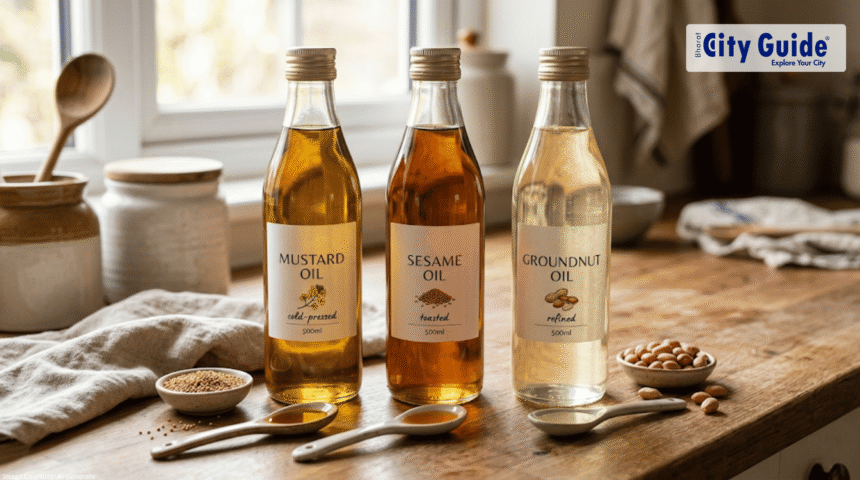
In Indian kitchens, oil is not just a cooking medium—it’s culture, flavour, and tradition. From a spoon of mustard oil in Bengali fish curry to sesame oil in South Indian poriyal or groundnut oil in Gujarati shaak, oils quietly shape both taste and health.
- Which Is Best for Everyday Indian Cooking in 2026?
- Key Features
- Health Strengths
- Best Uses
- Who May Love It Most
- Key Features
- Health Strengths
- Best Uses
- Cultural Edge
- Key Features
- Health Strengths
- Best Uses
- 1) Which oil is best for heart health?
- 2) Can I use only one oil daily?
- 3) Is cold-pressed oil necessary?
- 4) Is deep frying always unhealthy?
- 5) How should oils be stored?
But in 2026, with rising concerns about heart disease, diabetes, and processed foods, many people are asking:
👉 Which oil is actually healthiest for daily Indian cooking?
👉 Should we avoid traditional oils and switch to “modern” ones?
👉 Is cold-pressed oil really better?
The good news? Many traditional Indian oils already align well with modern nutrition science—when used wisely.
This article breaks down the science, myths, and practical use of mustard oil, sesame oil, and groundnut oil in real Indian meals.
Why Oil Choice Matters More Today
Indian diets have changed significantly over the last few decades:
- More packaged and ultra-processed foods
- Higher intake of refined oils
- Repeated reheating of oils for frying
- Lower physical activity
These changes have contributed to:
- Higher cholesterol issues
- More obesity and diabetes
- Increased inflammation-related diseases
Oil is calorie-dense, but it is also essential. The goal is not to fear oil—but to choose and use it intelligently.
What Health Guidelines Suggest About Oils
Global and Indian nutrition guidance broadly agrees on a few key points:
1) Fat Quality Matters More Than Quantity Alone
Healthy diets emphasize:
- More unsaturated fats (MUFA and PUFA)
- Less saturated fat
- Minimal trans fat
General guidance suggests:
- Saturated fat should stay below ~10% of daily energy
- Trans fat should be as low as possible
2) Traditional Oils Can Be Healthy
Contrary to popular belief, traditional Indian oils are not outdated. Many are naturally rich in beneficial fats and bioactive compounds.
Mustard, sesame, and groundnut oils:
- Are rich in monounsaturated fats (MUFA)
- Are relatively heat-stable
- Fit Indian cooking methods like tadka and sautéing
3) The Real Problem Is Overuse and Refinement
Health risks often come from:
- Excess total oil
- Repeated reheating
- Highly refined industrial oils
- Deep frying frequently
So the focus should be:
👉 Quality + moderation
👉 Not elimination
Understanding MUFA, PUFA & Stability (In Simple Terms)
MUFA (Monounsaturated Fat)
- Heart-friendly
- Stable at cooking temperatures
- Found in mustard, sesame, and groundnut oil
PUFA (Polyunsaturated Fat)
- Essential for health
- But less stable at high heat
- Can oxidise if overheated repeatedly
Why Stability Matters
Indian cooking often uses:
- High heat
- Frying
- Tadka
Oils that oxidise easily may form harmful compounds when overheated repeatedly. MUFA-rich oils tend to handle Indian cooking styles better.
Mustard Oil – The Traditional Powerhouse
Mustard oil has been used for centuries in North and East India.
Key Features
- High smoke point (~200–250°C)
- Good heat stability
- Strong flavour
Health Strengths
Mustard oil is:
- Low in saturated fat
- Rich in MUFA
- Contains some omega-3 fats
- Has a favourable omega-6 to omega-3 ratio
These features support:
- Heart health
- Anti-inflammatory balance
- Better lipid profiles when used moderately
Best Uses
✔ Tadka for dal
✔ Sabzi cooking
✔ Khichdi
✔ Pickles (achar)
✔ Fish and traditional curries
Who May Love It Most
- People who enjoy bold flavours
- Traditional North/East Indian cooking
- Those wanting omega-3 support from plant oils
Sesame Oil – The Nutrient-Dense Classic
Sesame oil is deeply rooted in South and Western Indian cuisines.
Key Features
- Smoke point ~210°C
- Naturally stable due to antioxidants
- Distinct nutty aroma
Health Strengths
Sesame oil contains:
- MUFA and PUFA
- Vitamin E
- Lignans (natural antioxidants)
These compounds are associated with:
- Heart health
- Reduced oxidative stress
- Anti-inflammatory benefits
Best Uses
✔ Stir-fried vegetables
✔ Tadka
✔ South Indian dishes
✔ Drizzle on khichdi or salads
✔ Poriyal and thoran
Cultural Edge
In many traditions, sesame oil is considered “nourishing” and is also used in Ayurveda-inspired cooking.
Groundnut Oil – The Versatile Everyday Oil
Groundnut (peanut) oil is popular across Western and Central India.
Key Features
- Smoke point ~220–230°C
- Neutral flavour
- Good stability
Health Strengths
Groundnut oil is:
- MUFA-rich
- Heat-stable
- Suitable for occasional frying
It fits well in balanced diets when used in moderation.
Best Uses
✔ Everyday cooking
✔ Shallow frying
✔ Occasional deep frying
✔ Gujarati and Maharashtrian dishes
Cold-Pressed vs Refined Oils – What’s Better?
Cold-Pressed Oils
- Extracted without high heat
- Retain more natural compounds
- Often more flavourful
Refined Oils
- Processed for longer shelf life
- Neutral taste
- Fewer natural antioxidants
Practical View (2026)
Cold-pressed oils are a good choice when:
- Budget allows
- Quality source is trusted
- Storage is proper
But refined oils are not automatically harmful. The bigger issue is how much and how often oil is used.
How Much Oil Is Reasonable?
A practical everyday guideline:
👉 Around 4–5 teaspoons per adult per day from visible oil sources
(This includes all cooking oil, not just one meal.)
This number varies based on:
- Activity level
- Health conditions
- Professional dietary advice
How to Plug These Oils into Traditional Meals
For a typical Indian thali:
- Grain
- Dal or legume
- Sabzi
- Curd or chaas
- Salad/pickle
Smart Use
✔ Mustard oil for dal tempering
✔ Sesame oil for stir-fried veggies
✔ Groundnut oil for routine cooking
✔ Rotate oils for variety
Rotation improves:
- Fat diversity
- Nutrient intake
- Taste satisfaction
Common Oil Mistakes in Indian Kitchens
❌ Reheating oil repeatedly
❌ Deep frying often
❌ Using excess oil in tadka
❌ Thinking “more oil = more taste”
❌ Relying only on one oil forever
What Most People Misunderstand
“Healthy oil means unlimited use.”
Even the best oil is calorie-dense.
“Modern imported oils are better.”
Not necessarily. Many traditional oils match or exceed them nutritionally.
“Oil causes weight gain.”
Excess calories cause weight gain—not oil alone.
One Simple Habit That Helps
For one week:
👉 Measure oil with a spoon instead of pouring freely.
Small awareness → big difference.
Long-Term Health Impact of Smarter Oil Use
Using oils wisely can:
✅ Support heart health
✅ Improve cholesterol balance
✅ Reduce inflammation
✅ Maintain healthy weight
✅ Support fat-soluble vitamin absorption
Conclusion
Indian kitchens already hold smart solutions.
Mustard, sesame, and groundnut oils:
✔ Fit Indian cooking styles
✔ Provide beneficial fats
✔ Are culturally rooted
✔ Align with modern nutrition science
The real keys are:
👉 Moderation
👉 Rotation
👉 Avoiding repeated reheating
👉 Choosing better quality when possible
You don’t need exotic imported oils for good health.
You need mindful use of the excellent oils you already know.
In 2026, the smartest approach is not extreme restriction—but informed balance.
FAQs
1) Which oil is best for heart health?
Mustard and sesame oils are often highlighted due to favourable fat profiles, but overall diet quality matters more than a single oil.
2) Can I use only one oil daily?
Rotation is better to diversify fat intake and nutrients.
3) Is cold-pressed oil necessary?
Helpful but not mandatory. Moderation matters more.
4) Is deep frying always unhealthy?
Frequent deep frying and reused oil can be harmful. Occasional frying in fresh oil is less concerning.
5) How should oils be stored?
Keep in cool, dark places and avoid long exposure to heat and light.