Introduction
Cardiovascular diseases, stroke, atrial fibrillation, deep vein thrombosis, and prosthetic heart valve disorders are becoming increasingly common in India. As a result, oral anticoagulant therapy has become an essential part of modern medical treatment. Among all anticoagulant medications, Warfarin remains one of the most widely prescribed drugs in Indian healthcare systems. Because Warfarin has a narrow therapeutic range and can cause serious complications if not managed properly, Warfarin Monitoring plays a critical role in patient safety and treatment success.
- Introduction
- Understanding Warfarin Monitoring
- What Is Warfarin?
- Importance of Warfarin Monitoring
- INR Testing and Its Role in Warfarin Monitoring
- What Is INR?
- Oral Anticoagulation Practices in Indian Tertiary Hospitals
- Specialized Anticoagulation Clinics
- Conditions Requiring Warfarin Therapy in India
- Challenges in Warfarin Monitoring in India
- Limited Access to INR Testing
- Side Effects and Complications of Warfarin Therapy
- Bleeding Complications
- Role of Patient Education in Warfarin Monitoring
- Medication Adherence
- Newer Oral Anticoagulants and Changing Practices
- Direct Oral Anticoagulants (DOACs)
- Technology and Digital Advancements in Anticoagulation Care
- Point-of-Care INR Devices
- Role of Pharmacists and Nurses in Anticoagulation Clinics
- Clinical Pharmacists
- Importance of Standardized Anticoagulation Protocols
- Future of Warfarin Monitoring in India
- Frequently Asked Questions (FAQs)
- Conclusion
Indian tertiary hospitals, which provide specialized and advanced healthcare services, handle thousands of patients requiring long-term anticoagulation therapy. Effective Warfarin Monitoring in these hospitals involves regular blood testing, dose adjustments, patient counseling, dietary management, and close medical supervision. Proper monitoring helps reduce the risks of dangerous bleeding or clot formation while improving treatment outcomes.
Despite the availability of newer anticoagulant medications, Warfarin continues to be commonly used in India due to affordability, accessibility, and physician familiarity. However, managing Warfarin therapy remains challenging because its effectiveness can be influenced by food habits, other medicines, liver function, genetic factors, and patient compliance.
This article explores Warfarin Monitoring, oral anticoagulation practices in Indian tertiary hospitals, INR testing, dosing strategies, complications, healthcare challenges, patient education, and the future of anticoagulation care in India.
Understanding Warfarin Monitoring
Warfarin Monitoring refers to the regular medical supervision and blood testing required to safely manage Warfarin therapy.
Warfarin is an oral anticoagulant medicine used to:
- Prevent blood clots
- Reduce stroke risk
- Treat thromboembolic disorders
Because Warfarin affects blood clotting, incorrect dosage may lead to:
- Excessive bleeding
or - Dangerous clot formation
Monitoring ensures the medicine works safely and effectively.
The main test used in Warfarin Monitoring is:
- International Normalized Ratio (INR)
INR measures how long blood takes to clot compared to normal levels.
What Is Warfarin?
Warfarin is a vitamin K antagonist anticoagulant medication.
It works by reducing the activity of clotting factors produced in the liver.
Warfarin is commonly prescribed for:
- Atrial fibrillation
- Deep vein thrombosis (DVT)
- Pulmonary embolism
- Mechanical heart valves
- Stroke prevention
- Certain cardiac disorders
Although newer oral anticoagulants are available, Warfarin remains widely used in India because of:
- Lower cost
- Availability in public hospitals
- Long clinical experience
Importance of Warfarin Monitoring
Warfarin Monitoring is extremely important because small dosage changes can significantly affect clotting.
Preventing Bleeding Complications
Excessive anticoagulation increases bleeding risk.
Severe bleeding may occur in:
- Brain
- Gastrointestinal tract
- Urinary system
Preventing Blood Clots
Insufficient anticoagulation may allow dangerous clots to form.
This may lead to:
- Stroke
- Heart attack
- Pulmonary embolism
Individualized Treatment
Every patient responds differently to Warfarin.
Monitoring helps doctors adjust doses based on:
- Age
- Weight
- Diet
- Other medications
- Liver function
INR Testing and Its Role in Warfarin Monitoring
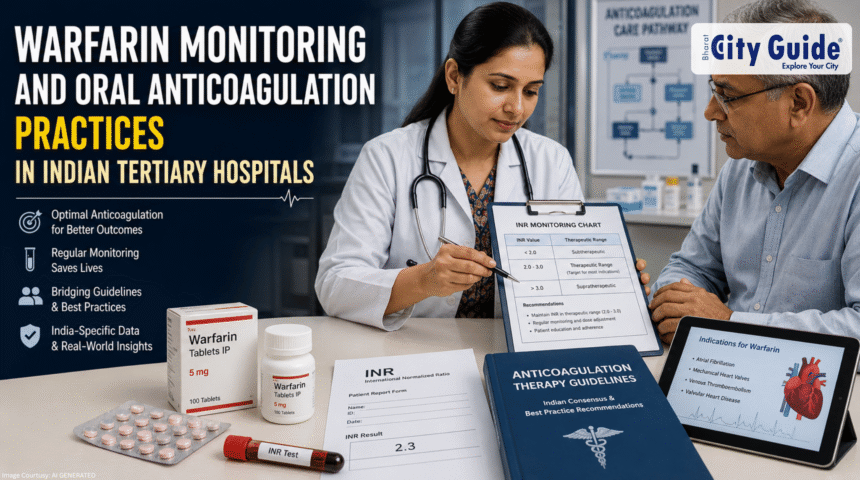
The International Normalized Ratio (INR) is the most important tool in Warfarin Monitoring.
What Is INR?
INR is a standardized blood test measuring clotting time.
A normal person not taking anticoagulants usually has an INR around:
- 1.0
Patients on Warfarin generally require higher INR values depending on medical condition.
Common Target INR Ranges
Typical INR goals include:
- 2.0–3.0 for atrial fibrillation and DVT
- 2.5–3.5 for mechanical heart valves
Frequency of INR Testing
Patients may require:
- Frequent testing during treatment initiation
- Monthly testing once stable
Unstable patients may need more frequent monitoring.
Oral Anticoagulation Practices in Indian Tertiary Hospitals
Indian tertiary hospitals follow structured anticoagulation management protocols.
Specialized Anticoagulation Clinics
Many large hospitals operate dedicated anticoagulation clinics.
These clinics provide:
- INR testing
- Dose adjustments
- Patient counseling
- Follow-up care
Multidisciplinary Care
Care often involves:
- Cardiologists
- Hematologists
- Neurologists
- Pharmacists
- Nurses
Electronic Medical Records
Advanced hospitals increasingly use digital systems for:
- INR tracking
- Medication records
- Appointment scheduling
Patient Education Programs
Hospitals educate patients regarding:
- Medication adherence
- Diet interactions
- Bleeding warning signs
Conditions Requiring Warfarin Therapy in India
Warfarin is commonly prescribed for multiple medical conditions.
Atrial Fibrillation
Irregular heartbeat increases stroke risk due to clot formation.
Mechanical Heart Valves
Patients with artificial heart valves require lifelong anticoagulation.
Deep Vein Thrombosis (DVT)
Warfarin helps prevent clot extension and recurrence.
Pulmonary Embolism
The medicine reduces further clot formation in lungs.
Stroke Prevention
Some patients at high stroke risk receive long-term anticoagulant therapy.
Challenges in Warfarin Monitoring in India
India faces several healthcare challenges in maintaining safe anticoagulation therapy.
Limited Access to INR Testing
Rural areas may lack:
- Laboratories
- Specialist clinics
- Affordable monitoring facilities
Poor Patient Compliance
Some patients:
- Miss follow-up appointments
- Skip doses
- Stop medication without advice
Dietary Variability
Indian diets often vary in vitamin K content.
Foods affecting Warfarin include:
- Spinach
- Fenugreek
- Mustard greens
- Broccoli
Sudden dietary changes can alter INR levels.
Drug Interactions
Many medicines interact with Warfarin, including:
- Antibiotics
- Painkillers
- Herbal supplements
Financial Burden
Repeated INR testing and long-term treatment may become costly for low-income families.
Side Effects and Complications of Warfarin Therapy
Warfarin therapy requires careful risk management.
Bleeding Complications
Major bleeding is the most serious side effect.
Symptoms may include:
- Blood in urine
- Black stools
- Nosebleeds
- Severe bruising
- Vomiting blood
Intracranial Hemorrhage
Brain bleeding is a life-threatening complication requiring emergency care.
Skin Necrosis
Rarely, Warfarin may cause skin tissue damage.
Over-Anticoagulation
Excessively high INR increases dangerous bleeding risks.
Role of Patient Education in Warfarin Monitoring
Patient awareness is essential for treatment success.
Medication Adherence
Patients must take medicine exactly as prescribed.
Understanding INR Reports
Patients should understand:
- Target INR ranges
- Importance of testing
- Risks of abnormal INR
Dietary Guidance
Doctors advise maintaining consistent vitamin K intake rather than avoiding vegetables completely.
Alcohol and Smoking Advice
Alcohol may interfere with Warfarin metabolism and increase bleeding risk.
Emergency Awareness
Patients should immediately seek medical attention for:
- Severe bleeding
- Head injury
- Sudden weakness
- Stroke symptoms
Newer Oral Anticoagulants and Changing Practices
New anticoagulants are gradually changing treatment strategies.
Direct Oral Anticoagulants (DOACs)
Examples include:
- Apixaban
- Rivaroxaban
- Dabigatran
These medicines often require less monitoring.
Advantages of DOACs
Benefits include:
- Fewer food interactions
- Fixed dosing
- Reduced INR testing
Why Warfarin Remains Common in India
Warfarin continues to dominate because:
- DOACs are expensive
- Public hospitals widely stock Warfarin
- Mechanical heart valve patients still require Warfarin
Technology and Digital Advancements in Anticoagulation Care
Technology is improving anticoagulation management.
Point-of-Care INR Devices
Portable devices allow rapid INR testing.
Telemedicine Support
Remote consultations help patients in rural areas receive specialist guidance.
Mobile Health Applications
Apps help patients:
- Track INR values
- Set medication reminders
- Schedule appointments
Artificial Intelligence in Healthcare
Future systems may use AI to predict:
- Dose adjustments
- Bleeding risk
- Treatment complications
Role of Pharmacists and Nurses in Anticoagulation Clinics
Non-physician healthcare workers play an important role.
Clinical Pharmacists
Pharmacists assist with:
- Dose calculations
- Drug interaction screening
- Patient counseling
Nursing Staff
Nurses support:
- INR testing
- Education
- Follow-up management
Team-based care improves patient safety.
Importance of Standardized Anticoagulation Protocols
Indian tertiary hospitals increasingly use evidence-based protocols.
Benefits include:
- Reduced medical errors
- Better INR control
- Lower hospitalization rates
- Improved patient outcomes
Standardized systems improve overall quality of care.
Future of Warfarin Monitoring in India
India’s anticoagulation care system is gradually modernizing.
Future improvements may include:
- Expanded anticoagulation clinics
- Better rural INR access
- Increased telemedicine use
- Affordable DOAC availability
- Personalized medicine approaches
Healthcare policy reforms and digital infrastructure may further strengthen long-term patient management.
Frequently Asked Questions (FAQs)
What is Warfarin Monitoring?
Warfarin Monitoring involves regular INR blood testing and medical supervision to ensure safe anticoagulant therapy.
Why is INR testing important?
INR testing measures blood clotting time and helps doctors adjust Warfarin dosage safely.
What conditions require Warfarin therapy?
Conditions include:
- Atrial fibrillation
- DVT
- Pulmonary embolism
- Mechanical heart valves
How often should INR be checked?
Frequency depends on patient stability, but many stable patients require monthly INR testing.
What foods affect Warfarin?
Foods rich in vitamin K such as spinach and green leafy vegetables can influence INR levels.
What are major side effects of Warfarin?
The main risk is bleeding, including internal bleeding and brain hemorrhage.
Why is Warfarin still widely used in India?
Warfarin remains popular because it is affordable, widely available, and effective for many conditions.
Conclusion
Warfarin Monitoring remains a critical component of oral anticoagulation therapy in Indian tertiary hospitals. Although Warfarin is highly effective in preventing dangerous blood clots and strokes, safe treatment requires regular INR testing, careful dose adjustment, patient education, and long-term medical supervision.
Indian tertiary hospitals have increasingly developed structured anticoagulation services involving multidisciplinary care teams, specialized clinics, and digital monitoring systems. These efforts help reduce complications and improve patient outcomes.
However, challenges such as limited rural healthcare access, financial burden, inconsistent monitoring, and patient awareness gaps continue to affect anticoagulation care across India. The gradual adoption of newer anticoagulants, telemedicine, portable INR testing devices, and digital healthcare technologies may significantly improve future treatment practices.
As cardiovascular disease and aging populations continue to rise in India, strengthening anticoagulation monitoring systems and expanding access to quality care will remain essential for improving patient safety and long-term health outcomes.