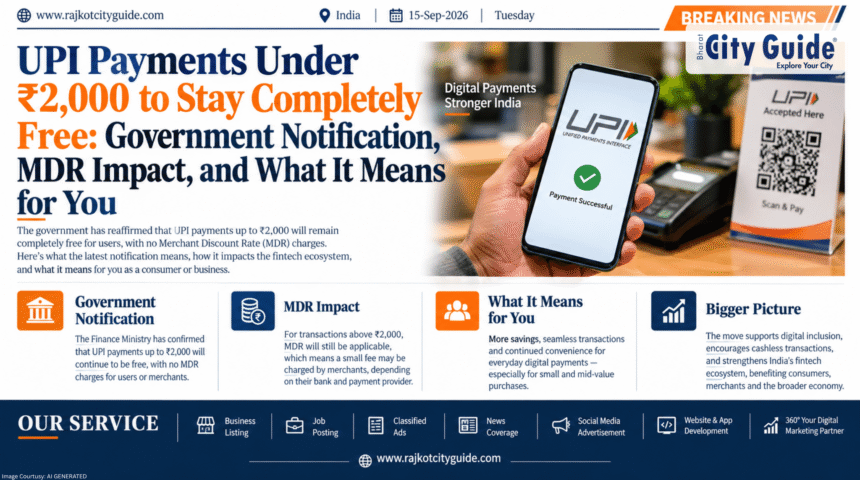
Digital payments in India have undergone an unprecedented transformation over the last decade, with the UPI serving as the backbone of the nation’s cashless economy. Today, whether you are buying fresh vegetables from a local street vendor, settling utility bills, or transferring money to family, the convenience of a quick QR code scan using upi has integrated seamlessly into daily life. However, recent legislative discussions around infrastructural costs and financial sustainability triggered widespread debates on whether everyday digital transfers would soon carry transaction fees.
- What is UPI?
- Current Situation and Latest Updates
- Why is This Regulatory Framework Important?
- Key Highlights of the New Rule
- Technical and Operational Architecture of UPI
- Safety, Security, and Fraud Protection Mechanisms
- Comparison: Free vs. High-Value Commercial Transaction Models
- Advantages of the Revised Regulatory Policy
- Potential Disadvantages and Challenges
- Detailed Explanation of Main Framework Features
- Who is Impacted by These Rules?
- Timeline and Rollout Schedule
- Future Expectations and Market Growth
- Frequently Asked Questions (FAQs)
- Conclusion
Clearing up all speculation, the Central Government issued a formal gazette notification under Section 10A of the Payment and Settlement Systems Act, 2007. The notification explicitly mandates that no bank or payment system provider can impose direct or indirect charges on upi transactions of up to ₹2,000 or on payments made using RuPay debit cards. While small-value transfers remain fully protected, the regulatory framework has opened the door for a potential Merchant Discount Rate (MDR) on higher-value commercial transactions. Understanding the mechanics of these regulatory changes, their impact on consumers and merchants, and the future outlook for digital finance is essential for everyone navigating India’s financial ecosystem.
What is UPI?
The Unified Payments Interface, commonly known as upi, is a real-time, instant payment system developed by the National Payments Corporation of India (NPCI) under the guidance of the Reserve Bank of India (RBI) and the Indian Banks’ Association (IBA). Launched in 2016, upi revolutionized mobile banking by merging multiple bank accounts into a single smartphone application, allowing seamless fund routing and merchant payouts.
Unlike traditional electronic fund transfer systems such as NEFT or RTGS, upi operates 24/7, 365 days a year, enabling instant money transfers using a Virtual Payment Address (VPA) or mobile number without revealing sensitive bank account details. Over the years, the network has evolved to support QR code scans, recurring auto-mandates, offline lite wallets, credit card linkages, and international cross-border remittances. Its zero-cost structure for peer-to-peer and peer-to-merchant transfers helped drive mass adoption across both urban metro hubs and rural tier-3 and tier-4 regions.
                           ┌──────────────────────────┐
                           │      NPCI & RBI Core     │
                           └────────────┬─────────────┘
                                        │
           ┌────────────────────────────┴────────────────────────────┐
           ▼                                                         ▼
┌──────────────────────┐                                  ┌──────────────────────┐
│  P2P Transactions    │                                  │  P2M Transactions    │
│  (Person-to-Person)  │                                  │ (Person-to-Merchant) │
└──────────┬───────────┘                                  └──────────┬───────────┘
           │                                                         │
           ▼                                                         ▼
  Always 100% Free                                          Under ₹2,000: Free
  No Charges Permitted                                     Above ₹2,000: Nom. MDR
Current Situation and Latest Updates
The primary market and digital financial ecosystem received clear direction following the gazette notification published by the Ministry of Finance. This update follows an amendment to Section 10A of the Payment and Settlement Systems Act, 2007, which was passed by Parliament during the Monsoon Session.
The legal amendment severed the older, rigid linkage between Section 10A and Section 269SU of the Income-tax Act, 1961. By granting the Central Government independent statutory authority to specify protected electronic payment modes, the regulatory update established clear guidelines for digital transactions:
- Gazette Directive: Banks, payment gateways, and system providers are legally barred from levying any direct or indirect fees on upi transfers up to ₹2,000 and RuPay debit card payments.
- No Consumer Charges: The government and Union Finance Minister have confirmed that Person-to-Person (P2P) payments will remain 100% free for individual users regardless of the transfer amount.
- Framework for High-Value Transactions: The notification allows for the potential introduction of a nominal Merchant Discount Rate (MDR) on commercial transactions exceeding ₹2,000.
- NPCI Steering Role: The UPI and Services Steering Committee, operating under NPCI, has been designated to evaluate market dynamics and determine appropriate MDR caps for larger commercial tickets.
Why is This Regulatory Framework Important?
The decision to safeguard small-value digital payments while enabling a self-sustaining model for higher-value commercial transactions serves several key strategic objectives.
1. Protection for Small Merchants and Consumers
By capping the fee-free threshold at ₹2,000, the government protects street vendors, local grocery stores, tea stalls, and everyday retail shoppers from added operational expenses. Over 85% of daily volume on upi falls within small-ticket sizes, ensuring that routine consumer habits remain completely undisturbed.
2. Funding System Upgrades and Cyber Security
As transaction volumes grew from 1.78 crore in FY17 to over 24,162 crore in FY26, handling peak loads requires continuous server infrastructure expansion, advanced AI-driven fraud detection systems, and strict cybersecurity compliance. Relying solely on government budgetary subsidies is no longer sufficient to maintain high uptime and system resilience.
3. Promoting FinTech Innovation and Competition
Payment Service Providers (PSPs) and acquiring banks incur significant operational costs to maintain merchant acceptance terminals and QR infrastructure. Introducing a balanced, tiered MDR on large commercial transactions enables fintech companies to build self-sustaining business models, encouraging further investment in payment infrastructure.
Key Highlights of the New Rule
- Zero Fee Guarantee: Absolute prohibition on direct or indirect charges for upi transfers up to ₹2,000.
- RuPay Debit Protection: Complete waiver of merchant charges on all RuPay debit card transactions up to ₹2,000.
- P2P Security: Personal money transfers between friends, family, and bank accounts stay entirely free.
- Commercial Threshold: High-value transactions above ₹2,000 may attract a controlled, nominal MDR payable by merchants, not consumers.
- Regulatory Oversight: NPCI and the RBI retain full oversight to prevent predatory fee structures and ensure transparent implementation.
Technical and Operational Architecture of UPI
The technical framework supporting millions of daily transactions relies on a multi-tiered architecture built for speed and security.
- Core Settlement Engine: Managed directly by the NPCI switch using standardized API endpoints for instant fund clearing between issuing and acquiring banks.
- Authentication Layer: Mandates 2-Factor Authentication (2FA) via a secure, user-set 4-digit or 6-digit PIN entered on device hardware.
- Interoperability Standards: Standardized QR codes (BharatQR and unified merchant QRs) ensure that any compliant application can process payments across any bank ecosystem.
- Scale and Performance: Designed to process tens of thousands of Transactions Per Second (TPS) with near-zero latency and minimal failure rates.
- Wallets and Credit Linkages: Integrates Pre-paid Payment Instruments (PPI) and RuPay Credit Cards onto the network, with specific interchange rules governing credit transactions.
Safety, Security, and Fraud Protection Mechanisms
Security remains a top priority for digital financial networks handling large-scale transaction volumes.
- Device Binding: Payment applications function only when the registered mobile SIM is active inside the primary smartphone device, preventing remote unauthorized logins.
- Virtual Payment Address (VPA): Eliminates the need to share confidential account details, IFSC codes, or debit card numbers during transactions.
- AI-Driven Anomaly Detection: Real-time monitoring systems track transaction velocity, geographic mismatches, and suspicious account activity to flag potential fraud instantly.
- Encrypted Data Streams: End-to-end multi-layer encryption secures transit data between consumer apps, payment service provider servers, and bank switches.
- Dispute Resolution Mechanism (TPAP): Standardized automated in-app dispute tools allow users to flag failed debits or pending transfers for rapid resolution.
Comparison: Free vs. High-Value Commercial Transaction Models
Understanding how upi payment categories compare highlights where charges apply and where free usage is guaranteed.
| Parameter | P2P Transactions (All Amounts) | Small P2M Transactions (Up to ₹2,000) | High-Value P2M Transactions (Above ₹2,000) |
| Transaction Type | Person-to-Person | Person-to-Merchant | Person-to-Merchant |
| Direct Fee for User | ₹0 (100% Free) | ₹0 (100% Free) | ₹0 (100% Free) |
| Merchant MDR Fee | Not Applicable | ₹0 (Statutory Protection) | Nominal MDR Allowed |
| Primary Beneficiary | Individual Users | Kirana Stores & Micro Merchants | High-Volume Retail & E-Commerce |
| Regulatory Status | Fully Protected | Protected under Section 10A | Subject to NPCI Steering Rules |
| Impact on System | High Volume / Social Need | High Volume / Micro Commerce | High Value / Infrastructure Support |
Advantages of the Revised Regulatory Policy
- 100% Protection for Routine Spending: Everyday consumers can continue using digital payments without worrying about unexpected fees on routine purchases.
- Zero Cost for Small Businesses: Micro-entrepreneurs and local merchants maintain their profit margins without added digital payment overheads.
- Long-Term Financial Sustainability: Allows banks and payment gateways to recover processing costs on high-value transactions, ensuring better service quality.
- Enhanced System Security: Reinvested revenues help fund improved cybersecurity, fraud monitoring, and server upgrades.
- Clear Legal Framework: Eliminates market confusion by replacing ambiguous guidelines with a formal gazette notification.
Potential Disadvantages and Challenges
- Merchant Pushback on High-Value MDR: Some large merchants may express concern over added operational costs for sales exceeding ₹2,000.
- Risk of Surcharging by Misinformed Merchants: Unscrupulous retailers might incorrectly attempt to pass MDR costs onto consumers despite clear regulatory prohibitions.
- Operational Complexity for PSPs: Payment service providers must update their billing systems to apply differential rules based on transaction values and merchant categories.
Detailed Explanation of Main Framework Features
Understanding the operational details of the digital payments ecosystem helps clarify how these policy updates affect daily usage.
Person-to-Person (P2P) Transactions
Person-to-Person payments refer to money transferred directly between two individuals using mobile numbers, VPAs, or account credentials.
- Overview: Covers personal bank transfers, splitting meal bills, sending funds to family, or paying rent directly to individual accounts.
- Benefits: Retains total cost-free convenience, driving financial inclusion across all socio-economic strata.
- Technical Details: Processed directly via real-time Immediate Payment Service (IMPS)/National Payments Corporation of India (NPCI) core switches without merchant acquiring nodes.
- Real-World Impact: Users can send any sum to friends or family without worrying about added transaction fees.
Person-to-Merchant (P2M) Small-Value Transactions (Up to ₹2,000)
These represent small commercial purchases made by scanning store QR codes or paying online for groceries, street food, ride-hailing, and micro-retail items.
- Overview: Protected under Section 10A of the Payment and Settlement Systems Act, 2007.
- Benefits: Preserves digital acceptance among small merchants who operate on tight profit margins.
- Technical Details: Zero MDR applies across all participant banks, acquiring handles, and third-party app providers (TPAPs).
- Real-World Impact: Buying a ₹50 coffee or ₹1,500 monthly grocery bill carries no hidden fees for either the customer or the shopkeeper.
Person-to-Merchant (P2M) High-Value Transactions (Above ₹2,000)
Covers larger commercial purchases such as consumer electronics, jewelry, luxury fashion, hospitality, and high-value e-commerce orders.
- Overview: Enables payment system providers to collect a capped Merchant Discount Rate to offset processing costs.
- Benefits: Generates steady revenue to fund server infrastructure, prevent downtime, and improve fraud protection.
- Technical Details: The fee structure is designed to be significantly lower than traditional credit or debit card MDR rates.
- Real-World Impact: Merchants processing large sales contribute a small percentage fee to the processing network, while retail customers pay only the bill amount.
Who is Impacted by These Rules?
- Everyday Consumers: Experience no changes; routine peer-to-peer transfers and micro-purchases remain entirely free.
- Street Vendors and Kirana Stores: Receive full statutory protection, keeping digital payment acceptance zero-cost for bills under ₹2,000.
- Large Retailers and E-Commerce Platforms: Need to account for potential nominal MDR costs on sales over ₹2,000 as NPCI finalizes rate structures.
- Fintechs and Acquiring Banks: Gain a sustainable revenue model to support infrastructure upgrades and expand acceptance networks.
Timeline and Rollout Schedule
- August 13, 2026: Parliament passes the legal amendment to Section 10A of the Payment and Settlement Systems Act, 2007.
- September 14, 2026: Ministry of Finance publishes the formal Gazette Notification specifying zero-charge protections for payments up to ₹2,000.
- Ongoing Implementation: Banks and payment providers update billing logic to ensure small transactions remain completely free.
- Upcoming NPCI Guidelines: The NPCI-led UPI and Services Steering Committee will publish specific MDR caps and category-wise frameworks for high-value commercial transactions.
Future Expectations and Market Growth
The implementation of a balanced financial framework marks a mature phase for digital payments in India. With transaction values expanding rapidly, ensuring that the processing network remains financially self-sustaining without burdening small users establishes a strong foundation for future growth.
Over the next few years, expectation centers around expanded international adoption across Southeast Asia, Europe, and the Gulf region, alongside deeper integration with credit products, soundbox technology, and offline wallet solutions. By pairing free micro-transactions with controlled charges on large commercial activity, the system ensures both long-term infrastructure stability and continued digital adoption.
Frequently Asked Questions (FAQs)
Will I be charged for using upi to pay at local shops?
No, everyday consumers will not pay any transaction charges. The government gazette notification explicitly bars banks and payment system providers from levying direct or indirect charges on upi transactions of up to ₹2,000. Payments at local stores will remain completely free for shoppers.
Is there any charge on sending money to friends or family?
No, Person-to-Person (P2P) transfers remain 100% free. The government has clarified that personal money transfers between individuals will not attract any transaction fees or charges regardless of the transfer amount.
What happens if my upi payment exceeds ₹2,000?
For consumer purchases over ₹2,000, individual buyers still pay no direct transaction fee. However, the revised legal framework allows for a nominal Merchant Discount Rate (MDR) payable by the merchant receiving the payment, as determined by NPCI guidelines.
Can a shopkeeper charge extra if I pay via upi?
No, shopkeepers are legally prohibited from passing MDR costs onto consumers. Regulatory rules require merchants to absorb merchant discount fees as an operational cost, similar to traditional debit card transaction arrangements.
Why did the government introduce this new gazette notification?
The notification updates Section 10A of the Payment and Settlement Systems Act, 2007. It formally guarantees that small payments remain zero-cost while providing a legal framework for payment providers to fund server expansion, cybersecurity upgrades, and infrastructure maintenance through high-value commercial transactions.
Do RuPay debit card payments carry any fees?
RuPay debit card transactions up to ₹2,000 are protected under the exact same zero-charge statutory guarantee as upi payments. Banks cannot charge customers or merchants for processing small-value RuPay debit card transfers.
Who decides the MDR rates for large upi transactions?
The Merchant Discount Rate structures for high-value transactions above ₹2,000 are set by the UPI and Services Steering Committee, led by the National Payments Corporation of India (NPCI) under RBI regulatory oversight.
Conclusion
The government’s gazette notification under Section 10A brings welcome legal clarity to India’s digital payment ecosystem. By permanently barring charges on upi transactions up to ₹2,000 and RuPay debit card payments, the regulatory framework ensures that micro-merchants, street vendors, and everyday consumers continue to enjoy seamless, zero-cost digital transactions.
At the same time, opening a pathway for controlled, nominal MDR on higher-value commercial transactions creates a sustainable revenue model for banks and fintech companies. This balanced approach supports continued investment in server capacity, fraud protection, and cybersecurity without slowing mass digital adoption.
As National Payments Corporation of India (NPCI) rolls out specific guidelines for larger transactions, consumers can continue making routine daily payments with total confidence. The updated framework protects everyday financial habits while building a resilient, future-ready infrastructure for India’s growing digital economy.