Introduction
As the grand festival of Navratri approaches, Gujarat is gearing up for nine nights of intense devotion, rhythmic music, and vibrant traditional Garba celebrations. In Rajkot, one of the premier cultural centers of the Saurashtra region, thousands of commercial organizers, residential societies, and street mandals are finalizing their event arrangements. To balance festive enthusiasm with civic discipline, the Rajkot Police Commissioner has officially released a public notification establishing comprehensive operational guidelines for Garba organizers across the city.
- Introduction
- What is Rajkot Navratri Loudspeaker Rules?
- Why This News is Important
- Background Information
- Key Highlights
- Benefits and Importance of the Rules
- How It Impacts People
- Expert Insights and Legal Perspective
- Detailed Explanation of the Event
- Challenges and Enforcement Considerations
- Frequently Asked Questions (FAQs)
- Conclusion
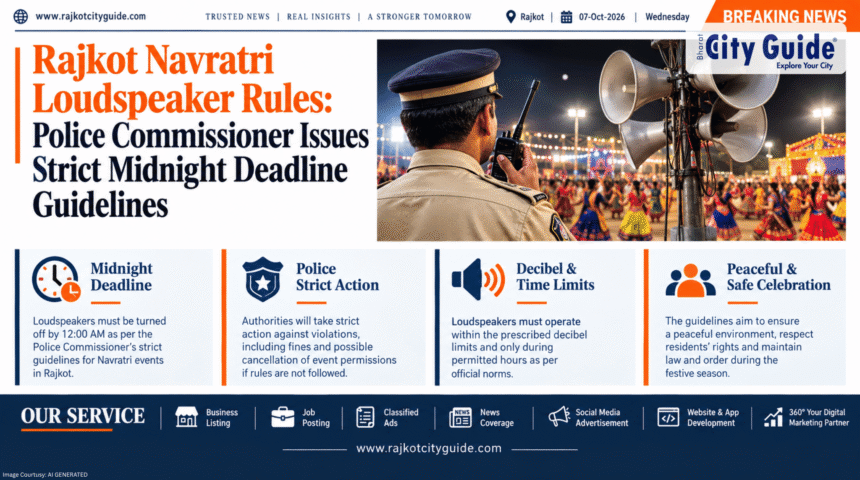
The latest regulatory framework enforces a strict cutoff time for sound systems, prohibiting the operation of loudspeakers, DJ systems, and traditional musical instruments past 12:00 AM (midnight). This decision aligns with the state government’s uniform festive policy under the Noise Pollution (Regulation and Control) Rules. While organizers are granted permission to amplify sound during peak evening hours, strict enforcement will take effect after midnight to maintain public peace and protect residents in nearby residential areas.
The enforcement notice highlights that any violation of these noise control norms will trigger legal action under relevant sections of the Bharatiya Nagarik Suraksha Sanhita (BNSS), the Gujarat Police Act, and the Environment Protection Act. By establishing clear parameters regarding sound limits, mandatory permits, and safety protocols, the city administration aims to ensure a safe, peaceful, and joyful festival for all citizens.
What is Rajkot Navratri Loudspeaker Rules?
The Rajkot Navratri Loudspeaker Rules refer to the official regulatory guidelines and public notification issued by the Rajkot City Police Commissionerate to control noise levels and operational hours during the nine-day Garba festival. These rules govern the use of public address systems, high-decibel DJ consoles, traditional instruments, and amplification equipment at all Garba venues throughout the municipal limits of Rajkot.
Under this legal framework, Garba organizers are granted conditional permission to utilize loudspeakers and sound systems up to 12:00 PM midnight during the festival nights. Beyond this specified deadline, amplifiers must be switched off to ensure that surrounding residential neighborhoods, hospital zones, and educational hubs are not subjected to late-night noise pollution.
Additionally, the guidelines mandate that every commercial and residential Garba committee must obtain formal written permission from the local police station before installing sound systems. The rules also enforce decibel level limits, strictly prohibit high-intensity firecrackers near venues, and forbid the setup of sound gear near designated Silence Zones such as hospitals, courts, and care facilities.
Why This News is Important
The official notification from the Rajkot Police Commissioner carries substantial importance for event management, civic administration, and the general public. Navratri in Rajkot features massive public gatherings, with major commercial grounds hosting thousands of dancers every evening. Establishing a clear 12:00 AM deadline allows organizers to structure their performance schedules efficiently while providing clear expectations to attendees.
Furthermore, this news is critical from a public health and safety perspective. Unchecked, high-decibel music running late into the night can cause severe sleep disruption, elevated stress levels, and health complications for senior citizens, infants, cardiac patients, and working professionals. Enforcing a midnight cutoff ensures that festive joy does not compromise the well-being of non-participating citizens.
Finally, the timely release of these regulations ensures that event managers, sound vendors, and security agencies can implement necessary technical safeguards before the festivities begin. It establishes a transparent accountability mechanism, allowing law enforcement officers to conduct routine night patrols and take immediate action against non-compliant venues.
Background Information
The regulation of public loudspeakers during cultural and religious festivals in India is governed by the Noise Pollution (Regulation and Control) Rules, 2000, framed under the Environment (Protection) Act, 1986. Under standard national guidelines, public address systems are generally restricted between 10:00 PM and 6:00 AM. However, state governments hold discretionary powers to grant exemptions for up to 15 days in a calendar year for major cultural festivals, extending sound permissions up to midnight.
In Gujarat, the state government routinely issues directives enabling district collectors and city police commissioners to grant this two-hour relaxation (from 10:00 PM to 12:00 AM) during Navratri. In accordance with state instructions, the Rajkot Police Commissionerate issues detailed public notices specifying conditions under which sound permissions are granted.
Over recent years, the scale of Garba events in Rajkot has grown exponentially, featuring heavy line-array speaker setups, powerful bass amplifiers, and intricate lighting rigs. This commercial growth made it essential for municipal authorities to introduce strict monitoring protocols, fire safety certifications, CCTV coverage requirements, and firm acoustic guidelines to maintain urban law and order.
Key Highlights
- 12:00 AM Midnight Cutoff: Mandatory cessation of all loudspeakers, sound amplifiers, DJ consoles, and musical instruments across Rajkot at midnight.
- Mandatory Prior Permission: All Garba organizers must secure written sound permissions from their respective jurisdiction’s police station prior to the event.
- Prohibition in Silence Zones: Complete ban on sound amplification equipment within 100 meters of hospitals, educational institutions, courts, and nursing homes.
- Decibel Limit Compliance: Sound levels must remain strictly within prescribed ambient noise standards during approved operational hours.
- Fire Safety & CCTV Mandatory: Major venues must install functional CCTV cameras, emergency exits, and certified fire-fighting equipment.
- CCTV & Security Integration: Organizers must maintain real-time camera monitoring at entry/exit gates and parking zones.
- Strict Penal Action: Violations will attract confiscation of sound equipment and legal prosecution under the Gujarat Police Act and Noise Pollution Rules.
Benefits and Importance of the Rules
The implementation of these structured guidelines brings balanced advantages to the entire urban ecosystem:
1. Protection of Public Health and Sleep Cycles
Restricting high-intensity sound past midnight protects residents from prolonged exposure to extreme decibel levels. Senior citizens, infants, patients recovering at home, and students preparing for examinations benefit directly from a quiet environment during late-night hours.
2. Enhanced Public Safety and Traffic Management
Establishing a uniform cutoff time prevents late-night chaos on city roads. When celebrations conclude at midnight, traffic police can manage the dispersal of crowds effectively, reducing the risk of late-night road accidents and drunk-driving incidents.
3. Prevention of Crime and Unruly Behavior
Garba venues operating late into the early morning hours carry an increased risk of security lapses, rowdy behavior, and eve-teasing. A defined operational window allows police personnel to maintain optimal security coverage across all major intersections and venue perimeters.
4. Preservation of Civic Harmony
By balancing the cultural rights of festival-goers with the peaceful living rights of other citizens, the rules foster mutual respect and civic harmony between different sections of the community.
How It Impacts People
The enforcement of the updated police notification affects various groups across Rajkot in specific ways:
- For Garba Organizers and Sound Vendors: Requires strict event scheduling and time management. Orchestra bands and DJs must start early in the evening to maximize performance time before the midnight shutdown.
- For Garba Dancers (Khelaiyas): Dancers need to adjust their routines to arrive at venues earlier in the evening to enjoy full sessions of traditional Garba within the approved operational window.
- For Local Residents: Offers peace of mind and protection from late-night sleep disruption, ensuring that residential neighborhoods remain quiet after midnight.
- For Emergency Medical Services: Ensures that hospital zones and ambulance movement routes remain clear of excessive noise and traffic congestion during festival nights.
Expert Insights and Legal Perspective
Legal and environmental experts continually emphasize that the right to celebrate cultural festivals must be balanced with the constitutional right to a healthy, noise-free environment under Article 21 of the Constitution of India. Judicial rulings by the Supreme Court of India have repeatedly affirmed that noise pollution poses significant health risks and must be regulated through firm executive action.
Acoustic engineers note that modern line-array sound systems used at large Garba grounds can generate sound levels exceeding 100 to 110 decibels near speaker stacks. Exposure to such volume over extended periods can cause temporary hearing threshold shifts, tinnitus, and elevated blood pressure. Setting clear operational windows and decibel limits is essential to protecting young dancers and venue staff from long-term auditory damage.
Furthermore, public administration specialists praise the proactive issuance of notifications by city police departments. Clear, early communication allows commercial organizers to design their programs responsibly, preventing conflict between law enforcement officers and citizens on festival grounds.
Detailed Explanation of the Event
The execution of the police notification involves multi-departmental coordination across Rajkot’s police divisions, traffic branches, and municipal teams. Prior to the commencement of Navratri, every commercial venue, club, and residential housing society hosting Garba must submit a formal application detailing their venue capacity, sound layout, and safety measures to the local police station.
Upon receiving approval, organizers are permitted to operate sound systems during the evening, provided the sound remains within permissible decibel thresholds. As the clock approaches 12:00 midnight, venue managers and sound engineers are legally required to turn off main amplifiers and public address systems. Police control room vans (PCRs) and night patrolling teams will actively monitor venues across major city zones, including Race Course Ring Road, Kalawad Road, 150 Feet Ring Road, and University Road.
+-----------------------------------------------------------------------+
|                    RAJKOT NAVRATRI SOUND RULES SUMMARY                |
+--------------------------+--------------------------------------------+
| Regulatory Aspect        | Policy Requirement                         |
+--------------------------+--------------------------------------------+
| Standard Sound Window    | Allowed until 12:00 AM Midnight            |
| Sound Cutoff Deadline    | Mandatory shutdown at 12:00 AM             |
| Approval Requirement     | Prior written permit from local police     |
| Silence Zone Distance    | Minimum 100 meters buffer required         |
| Security Measures        | Mandatory CCTV coverage & entry screening  |
| Enforcing Authority      | Rajkot City Police & Executive Magistrates |
| Penalty for Non-Compliance| Equipment seizure & statutory prosecution  |
+--------------------------+--------------------------------------------+
If an event continues to play amplified music past the midnight deadline or operates without proper police permits, field officers are empowered to step in immediately. Enforcement steps include disconnecting power supplies, seizing amplifier units, and filing formal cases against event managers and sound vendors under the relevant provisions of law.
Challenges and Enforcement Considerations
Enforcing noise regulations during a festival as widely celebrated as Navratri presents several operational challenges for city administration:
- Monitoring High Density Venues: Rajkot features hundreds of small street Garbas (Sheri Garbas) alongside large commercial grounds, making simultaneous field monitoring across all residential lanes resource-intensive.
- Pressure on Police Personnel: Law enforcement officers face significant workload demands during Navratri, balancing crowd management, VIP movement, traffic regulation, and noise rule enforcement late into the night.
- Managing Crowd Dispersal: Ending music abruptly at midnight at large venues with thousands of attendees requires careful crowd management by private bouncers and police personnel to prevent rush hour traffic bottlenecks.
- Sound Bleed in Mixed-Use Zones: Differentiating between background ambient noise and specific venue sound in densely populated commercial-residential areas requires calibrated decibel meters and trained inspection staff.
Frequently Asked Questions (FAQs)
What is the deadline for playing loudspeakers during Navratri in Rajkot?
According to the notification issued by the Rajkot Police Commissioner, loudspeakers and sound systems are permitted only until 12:00 AM (midnight).
Do residential housing societies need police permission to host Garba with sound systems?
Yes, all Garba organizers, including commercial event managers, housing societies, and street committees, must obtain prior written permission from their local police station.
Are sound systems allowed near hospitals and healthcare centers?
No, the area within 100 meters of hospitals, nursing homes, educational institutions, and courts is designated as a Silence Zone, where sound amplification equipment is strictly prohibited.
What happens if an organizer plays music past 12:00 AM?
Violating the midnight deadline will result in immediate police intervention, confiscation of sound amplification equipment, and legal prosecution under the Gujarat Police Act and Noise Pollution Rules.
Are traditional musical instruments exempt from the sound deadline?
The notification applies to all high-volume amplification equipment, loudspeakers, public address systems, and DJ setups to prevent public nuisance after midnight.
What safety requirements are mandatory for commercial Garba venues in Rajkot?
Commercial venues must install functional CCTV systems at all entry/exit points, maintain clear emergency escape routes, deploy trained security personnel, and possess valid fire safety clearances.
How can citizens report late-night noise violations during Navratri?
Citizens can report violations by calling the police emergency helpline (112 / 100) or contacting their local police station control room for immediate field action.
Conclusion
The release of the official notification detailing the Rajkot Navratri Loudspeaker Rules underscores the city administration’s commitment to conducting a safe, disciplined, and enjoyable festival. By establishing a clear 12:00 AM midnight deadline, the police commissionerate has balanced festive enthusiasm with the essential need for urban peace and public health.
Successful implementation of these guidelines depends on active cooperation between event organizers, sound vendors, garba enthusiasts, and law enforcement agencies. When venue managers adhere to sound limits and security protocols, the entire city can celebrate without causing unnecessary hardship to fellow citizens.
As Rajkot prepares to immerse itself in nine nights of traditional devotion and music, these well-defined regulations provide a strong foundation for smooth celebrations. Respecting operational deadlines ensures that the true spirit of Navratri—unity, joy, and mutual respect—remains vibrant across every corner of the city.