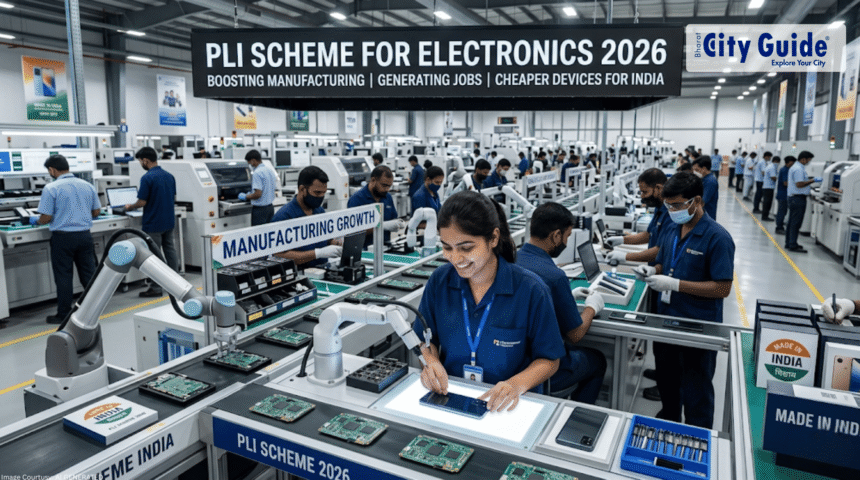
Introduction
India’s technology consumption is booming, with over $100 billion in electronic imports annually. From budget phones to EVs, domestic assembly lags, raising costs for consumers and creating supply vulnerabilities.
The PLI (Production Linked Incentive) Scheme for Electronics, launched in 2020 with an initial ₹40,951 crore investment across five windows, incentivizes large-scale mobile, TV, and IT hardware manufacturing. By 2025, it had already enabled $50 billion in exports, transforming daily tech access, employment, and startup ecosystems.
In 2026, PLI expansion under Budget 2026 aims to link semiconductors, components, and advanced IT hardware, making India a global manufacturing hub while lowering device prices.
Policy Overview
The PLI Scheme for Electronics offers 4–6% incremental sales incentives to firms investing ₹1,500 crore or more in manufacturing.
Key Features
- Eligible Companies: 64 approved firms, including Foxconn, Dixon, Lava, and others
- Production Targets: iPhone assembly grew 10x, reaching 20 crore units in India
- Manufacturing Hubs: Dholera (Gujarat), Sanand (Gujarat), Chennai, Pune
- PLI Windows:
- Mobile Phones & Components – ₹40,000 Cr
- IT Hardware & Servers – ₹17,000 Cr
- Components & Assembly – ₹7,500 Cr
Policy in Simple Terms
PLI is like a cashback for factories: The more devices they manufacture in India, the higher the incentive, generating jobs, exports, and cheaper devices for consumers.
| Window | Outlay | Output |
| Mobile Phones | ₹40,000 Cr | 20 Cr units/year |
| IT Hardware | ₹17,000 Cr | Servers/PCs |
| Components | ₹7,500 Cr | Chips/PCBs |
Key Objectives & Provisions
Objectives
- Achieve $300 billion electronics manufacturing by 2030
- Create 20 lakh jobs across assembly, testing, and supply chains
- Expand global value chain (GVC) participation from 35% to 60% by 2028
- Reduce dependence on imports, especially from China
Provisions
- Incentives tied to annual incremental sales growth
- Minimum investment: ₹1,500 Cr per company for eligibility
- Component PLI: ₹7,500 Cr to boost domestic production of PCBs, connectors, camera modules
- IT Hardware PLI: ₹17,000 Cr for servers, laptops, and tablets
- Support for MSMEs in supply chains via vendor linkage (₹20,000 Cr opportunity)
Who Is Affected and How
- Workers: Foxconn, Dixon, and other factories employ 6 lakh people, with skill-based promotions
- MSMEs: Tier-2 suppliers integrate into domestic electronics supply chains, benefiting from ₹20,000 Cr linkages
- Consumers: Expected 15–20% reduction in device prices, from smartphones to laptops
- Startups: Can prototype locally, reducing import costs for hardware and IoT devices
Real-Life Example:
- A Rajkot resident buys a ₹15,000 phone assembled in India, compared to ₹20,000 imported
- Content creators access affordable laptops and servers, enabling higher productivity
Expected Benefits
Short-Term (2026–2027)
- Exports: Reach $50 billion by 2026
- Jobs: 6–8 lakh new assembly and supply chain jobs
- Investment: ₹40,000–₹50,000 Cr inflow into Dholera/Sanand and associated hubs
Long-Term (2026–2030)
- Domestic electronics manufacturing reaches $300 billion
- Global value chain share rises to 60%
- Imports decline, improving trade balance
- Device prices drop 15–20%, boosting consumption
| Metric | Short-Term | Long-Term |
| Jobs | 6–8 lakh | 20 lakh |
| Manufacturing Output | $50B | $300B |
| GVC Participation | 35% | 60% |
| Device Price Reduction | 15% | 20% |
Concerns, Challenges, or Criticisms
- Component Localization Slow: Only 20% of inputs produced domestically
- China Dominance: Supply chains still reliant on Chinese components
- Clawback Risk: Incentive recouped if companies fail to meet sales
- Skill Gaps: Advanced assembly nodes require highly skilled labor, not always available
- Infrastructure Pressure: Power, water, and logistics for large factories
Real-Life Implications
- Rajkot: Residents access affordable smartphones, increasing digital literacy
- Startups: Local server availability reduces import dependency
- MSMEs: Suppliers benefit from linked PLI orders, increasing revenues by 10–15%
- Content Creators: Access better tech, improving production quality
What This Means for Common Citizens
- Cheaper Devices: Phones, TVs, laptops, and EV components more affordable
- Job Opportunities: Assembly, QA, logistics, and support roles for youth
- Innovation Access: Startups can prototype hardware locally
- Support Domestic Manufacturing: Buying “Made in India” devices strengthens jobs and tech independence
Future Outlook
- PLI 2.0 (Budget 2026): ₹1 lakh Cr expansion across mobiles, IT hardware, semiconductors, and components
- Semiconductor Linkage: Domestic chips integrated with assembly lines for higher GVC participation
- 2028: Target 60% GVC share, expanding exports and supply chain resilience
- 2030 Vision: India as top-5 electronics manufacturer globally, creating millions of jobs
Conclusion: What Citizens Should Know
The PLI Scheme for Electronics is a game-changer for India’s tech economy. Citizens, students, and businesses should:
- Support local manufacturing: Buy “Made in India” devices
- Upskill in assembly, QA, and electronics design for emerging jobs
- Track updates and PLI approvals via MeitY PLI Portal
- Expect cheaper devices and better access to modern electronics by 2026–2030
PLI is not only about corporate incentives, but also about everyday citizens saving money, startups innovating locally, and India achieving self-reliance in electronics.
Key Takeaways
- 4–6% incremental sales incentives for electronics manufacturing
- $50B exports achieved by 2025; $300B target by 2030
- 64 approved companies across mobile, IT hardware, and components
- Benefits: Cheaper devices, jobs, MSME growth, local supply chain
- Challenges: Component localization, skill gaps, clawbacks
- Citizens: Buy Indian, upskill, support local tech ecosystem
- 2026: PLI 2.0 expansion, semiconductor integration
FAQs
Q1: What is the PLI Scheme for Electronics?
A: A government incentive to boost domestic manufacturing of mobiles, TVs, IT hardware, and components, reducing imports and creating jobs.
Q2: How much has been invested in PLI Electronics?
A: ₹40,951 Cr across five windows, with expansions in PLI 2.0 (₹1 lakh Cr) planned for 2026.
Q3: Which companies are approved under PLI Electronics?
A: 64 companies, including Foxconn, Dixon, Lava, and several IT hardware and components firms.
Q4: What are the main benefits for consumers?
A: Cheaper devices (15–20% reduction), better access to technology, and support for startups.
Q5: How does PLI affect job creation?
A: 6–8 lakh direct jobs short-term (2026–2027) and 20 lakh long-term by 2030, across assembly, QA, logistics, and supply chain.
Q6: What challenges does PLI face?
A: Slow component localization (20%), China dependency, incentive clawbacks, skill gaps, and infrastructure needs.
Q7: How can citizens benefit from PLI 2026?
A: Upskill in electronics, support domestic products, track PLI projects on MeitY portal, and explore startup opportunities.
Q8: Will PLI make devices more affordable?
A: Yes, PLI incentivizes local assembly, reducing device prices by 15–20% over 5 years.