Introduction
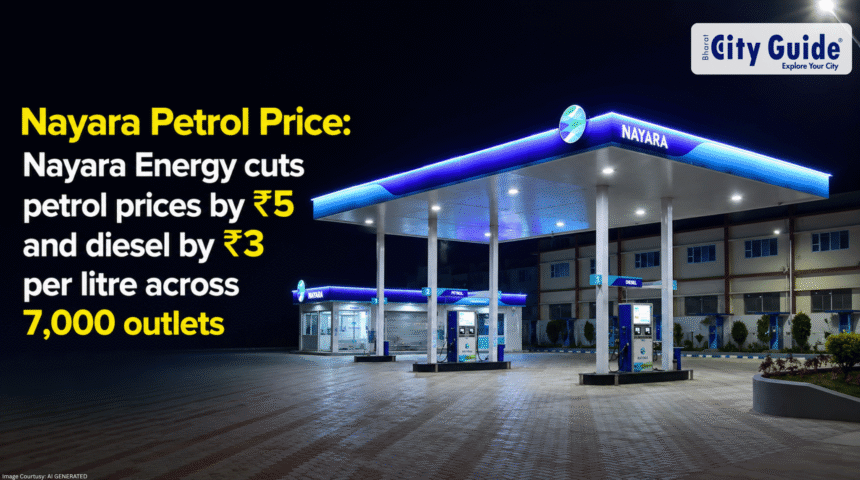
The Indian retail fuel market has just witnessed a massive shake-up that is bound to bring a major sigh of relief to millions of motorists across the country. In a completely unexpected move, private sector fuel retailing giant Nayara Energy has officially announced a sweeping, nationwide reduction in its retail fuel rates, effective July 1, 2026. Drivers looking up the latest nayara petrol price will be delighted to find that the company has slashed the price of petrol by ₹5 per litre and diesel by ₹3 per litre. This major price adjustment has rolled into effect across all of the company’s 7,000+ operational fuel stations nationwide.
- Introduction
- What is Nayara Energy?
- Current Situation and Latest Updates: Why Have Fuel Prices Dropped?
- Why is the Nayara Petrol Price Drop Important?
- Key Highlights of the Fuel Price Revision
- Understanding the Technicalities: How Are Indian Fuel Prices Determined?
- Comparison: Nayara Energy vs. PSU Competitors (IOCL, BPCL, HPCL)
- Advantages of the Nayara Fuel Price Drop
- Disadvantages and Limitations to Keep in Mind
- Who Should Refuel at Nayara Energy Stations?
- Future Expectations and Market Outlook
- Frequently Asked Questions (FAQs)
- Conclusion
For ordinary commuters, commercial transport operators, and logistics businesses struggling with stubborn inflationary pressures, this decision offers an immediate economic breather. This represents the first downward revision in retail fuel prices by any oil marketing firm in more than two years, directly mirroring a substantial softening in international crude oil benchmarks. As a country heavily reliant on fuel for the movement of goods and daily commuting, a price drop of this magnitude by India’s largest private fuel retailer marks a major turn in the domestic energy sector. If you have been wondering how this impacts your daily budget and what it means for the broader fuel retail market in India, this detailed guide breaks down everything you need to know.
What is Nayara Energy?
To fully understand the significance of the latest nayara petrol price cut, it helps to understand who Nayara Energy is and why their retail footprint matters so much to the Indian consumer. Nayara Energy is an integrated downstream energy company that commands a highly formidable presence in India’s fuel refining and retailing landscape. Formerly known as Essar Oil, the company was acquired in 2017 by a high-profile consortium led by Russian energy giant Rosneft alongside global investment platform Kesani Enterprises.
Following this mega-corporate acquisition, the brand was rechristened as Nayara Energy, aiming to redefine the fuel-pumping experience for Indian drivers. Today, the company operates India’s second-largest single-site oil refinery located at Vadinar in Gujarat. This massive, state-of-the-art facility boasts a refining capacity of 20 million tonnes per annum (MTPA), turning crude oil into high-grade petroleum products.
Over the last decade, Nayara has steadily scaled up its retail footprint, expanding aggressively into semi-urban, rural, and highway locations across India. Operating more than 7,000 retail fuel outlets nationwide, the company has broken the traditional monopoly held by state-run oil marketing companies. It delivers international-grade fuels, automated billing, and premium service standards directly to everyday Indian motorists.
Current Situation and Latest Updates: Why Have Fuel Prices Dropped?
The latest update regarding the nayara petrol price drop did not happen in a vacuum. It is the direct result of significant shifts in international geopolitics and global energy supply lines.
Easing of Global Geopolitical Tensions
Historically, private fuel retailers in India tie their pump prices dynamically to international benchmarks. Earlier this year, a sharp flare-up of hostilities in West Asia—specifically involving critical diplomatic standoffs and maritime blockades—sent global crude oil markets into a tailspin. Fears of major supply bottlenecks forced international crude oil prices up, hitting multi-year highs.
However, global crude oil benchmarks have cooled significantly in recent weeks. A major diplomatic breakthrough, highlighted by a freshly signed memorandum of understanding (MoU) between Iran and the US on June 17, 2026, has successfully de-escalated regional hostilities. Most importantly, this development led to the smooth reopening of the Strait of Hormuz—a crucial global maritime trade corridor responsible for the transit of nearly 20% of the world’s liquefied natural gas and crude oil supply. As transport operations returned to normal, the supply anxieties that had built premium margins into global fuel vanished, causing international oil rates to retreat comfortably. Brent crude has eased significantly from its four-year high of $126.41 recorded on April 30 down to around $73 per barrel.
The Reversal of the March Price Hikes
This latest price cut essentially acts as a complete roll-back of a prior price hike implemented by the company. Back on March 26, when the West Asian crisis threatened to choke off supply lines, Nayara Energy was among the first domestic fuel retailers to raise prices, increasing petrol by ₹5 per litre and diesel by ₹3 per litre to shield its refining margins. Now that global crude markets have stabilized and international product costs have cooled, the corporate leadership has decided to pass these direct savings down to the end consumer.
Completion of Refinery Turnaround
Adding to the company’s capability to offer these competitive retail prices, industry sources have confirmed that Nayara Energy has successfully completed a comprehensive, month-long maintenance turnaround at its flagship Vadinar refinery in Gujarat, which had been undergoing maintenance since April 9. The refinery is now firing on all cylinders, operating at full capacity. Being fully geared to meet domestic fuel demand with localized, highly efficient production allows the private retailer to confidently deploy a cheaper pricing structure across its entire network.
Why is the Nayara Petrol Price Drop Important?
When fuel prices shift in India, the economic ripples are felt far and wide. The decision by Nayara Energy to slash retail rates holds immense significance for multiple sectors of the Indian economy.
1. Substantial Consumer Relief
The most immediate benefit lands squarely in the pockets of daily commuters, family vehicle owners, and heavy-use motorists. A reduction of ₹5 per litre on petrol means that filling up a standard 12-litre motorcycle tank instantly becomes ₹60 cheaper, while filling up a 45-litre sedan tank saves a motorist a solid ₹225 per tankful. For families navigating everyday household budgets, these cumulative monthly savings are highly meaningful.
2. Easing Commercial Transport and Logistics Overhead
Diesel is the absolute lifeblood of the Indian commercial transport sector, powering everything from heavy-duty freight trucks and interstate buses to agricultural tractors and backup power generators. A ₹3 per litre slash in diesel prices provides direct operational relief to logistics businesses, supply chain operators, and fleet managers. Lowering the input cost of transport directly helps in cooling down the secondary transport-led inflation of essential commodities like fruits, vegetables, and manufactured goods.
3. A Disruptive Corporate Shift in Fuel Retailing
What makes this development incredibly fascinating is the stark divide it creates between private and public sector players. While Nayara Energy has aggressively slashed its rates, public sector undertaking (PSU) oil marketing giants—including Indian Oil Corporation (IOCL), Bharat Petroleum Corporation Limited (BPCL), and Hindustan Petroleum Corporation Limited (HPCL)—have chosen to keep their respective retail fuel prices completely unchanged.
Because state-owned corporations command over 90% of the domestic fuel retailing space across India’s 100,000+ fuel stations, Nayara’s solo move represents a major competitive play. Private retailers have spent the last few years operating at a slight pricing premium or battling uneven playing fields against subsidized PSU pricing. By dropping prices below or perfectly level with PSU rates depending on local taxation, Nayara is directly positioning its 7,000 stations as highly attractive options for budget-conscious consumers.
Key Highlights of the Fuel Price Revision
- Petrol Price Slashed: A nationwide flat reduction of ₹5 per litre on petrol.
- Diesel Price Slashed: A nationwide flat reduction of ₹3 per litre on diesel.
- Effective Date: The revised, lower pricing structure is fully operational starting July 1, 2026.
- Widespread Coverage: The new rates apply universally across all 7,000+ Nayara Energy retail outlets.
- Refinery Readiness: Backed by full-capacity operations at the 20-MTPA Vadinar refinery post-maintenance.
- Market Contrast: Public sector oil companies (IOCL, BPCL, HPCL) have kept their fuel rates locked and unchanged.
- Broader Energy Shifts: Coincides with the central government slashing commercial LPG cylinder prices by ₹183.50 and cutting domestic Aviation Turbine Fuel (ATF) by ₹5 per litre.
Understanding the Technicalities: How Are Indian Fuel Prices Determined?
To understand how the nayara petrol price can change independently of state-run companies, we have to look behind the curtain at how fuel pricing functions in the modern Indian economy.
The Deregulation Reality
India technically deregulated petrol prices in 2010 and diesel prices in 2014. In theory, this means that oil marketing companies are legally free to set retail prices based on market factors rather than relying on government mandates. However, public sector retailers often maintain stable pricing over long horizons to support economic stability and shield consumers from wild geopolitical shocks.
Private vs. Public Pricing Models
Private retailers like Nayara Energy, Reliance-BP, and Shell operate on more agile, market-tied corporate mechanisms. When global crude oil prices skyrocket, private companies do not have the massive fiscal cushioning of state backings, forcing them to raise pump prices quicker to avoid selling at a steep loss. Conversely, when international crude benchmarks soften—as they have recently—private entities possess the operational flexibility to quickly pass those market discounts down to consumers to capture market share.
The Impact of Local State Taxes
It is critical for consumers to recognize that while the corporate price cut is a flat, uniform reduction (₹5 for petrol, ₹3 for diesel) from corporate headquarters, the final price you see on the digital display board at a pump will still vary from state to state. This variation exists because retail fuel pricing in India is subject to ad-valorem Value Added Tax (VAT) and freight charges levied by individual state governments. Therefore, a Nayara pump in Gurugram, Haryana will display a slightly different final price per litre compared to a Nayara pump in Lucknow, Uttar Pradesh or Ahmedabad, Gujarat.
Comparison: Nayara Energy vs. PSU Competitors (IOCL, BPCL, HPCL)
This bold move by Nayara Energy establishes a very intriguing competitive dynamic for Indian motorists looking to refuel. Let’s look at how refueling at a private Nayara station now stacks up against a standard state-run PSU outlet:
| Metric / Feature | Nayara Energy Stations | PSU Stations (IOCL, BPCL, HPCL) |
| Petrol Price Action | Reduced by ₹5 per Litre | Unchanged / Stable |
| Diesel Price Action | Reduced by ₹3 per Litre | Unchanged / Stable |
| Pricing Strategy | Highly dynamic, market-responsive | Long-term price stability focus |
| Network Footprint | 7,000+ stations (Strong highway/semi-urban presence) | 90,000+ stations (Massive urban and rural saturation) |
| Station Experience | High level of automation, premium service focus | Standardized public service utility model |
| Value Proposition | Competitive premium fuels with direct price relief | Broad accessibility and uniform pricing safety |
The Competitive Edge
For the last few months, motorists often had to pay a minor premium at certain private retail pumps because private firms were absorbing high international raw material costs. For example, before this cut, Nayara’s rates were up to ₹5 higher on petrol and ₹3 higher on diesel than state-run alternatives in some cities. With this corporate adjustment, Nayara has completely eliminated that private-sector premium. In many micro-markets and specific states, the newly adjusted nayara petrol price has effectively dropped to level with, or in some instances marginally below, the rigid pricing of public sector pumps. For instance, in Gurugram, petrol drops to ₹102.76 per litre at Nayara pumps, tightly rivaling the IOCL retail rate of ₹102.12 per litre in Delhi. This makes seeking out a Nayara station an exceptionally smart move for maximum fuel economy.
Advantages of the Nayara Fuel Price Drop
- Direct Household Savings: Instantly reduces the cost of daily commuting, leaving more disposable income for families.
- Lower Operational Cost for Logistics: Small business owners running delivery vans, intra-city trucks, and commercial transport fleets see an immediate drop in running expenses.
- Premium Fuel Quality at Standard Rates: Nayara pumps are well-regarded for maintaining strict fuel quality controls and advanced fuel additives. Drivers can now access this high-quality product without paying a premium price.
- Reduced Agricultural Overhead: Farmers utilizing diesel-powered tractors, harvesting equipment, and water pumps for irrigation will benefit from reduced seasonal crop production costs.
- Spur for Market Competition: Nayara’s bold price cut could eventually put pressure on other private and public sector fuel retailers to reconsider their pricing structures, potentially triggering wider relief for Indian consumers down the line.
Disadvantages and Limitations to Keep in Mind
While the price cut is overwhelmingly positive, consumers should keep a few practical limitations in mind:
- Uneven Geographical Accessibility: While 7,000 stations nationwide is an impressive number, Nayara’s network is heavily concentrated along major national highways, state corridors, and specific semi-urban clusters. Drivers deep within core metropolitan city centers might still find it difficult to locate a nearby station compared to the omnipresent PSU pumps.
- State Tax Variances: Because individual state governments levy highly distinct localized taxes and VAT percentages, the full extent of the ₹5 and ₹3 price drop might feel slightly muted in high-tax states compared to lower-tax regions.
- Vulnerability to Market Volatility: Because Nayara’s pricing model is tightly linked to international market developments, these lower prices are highly dependent on global peace and smooth shipping logistics continuing through the Strait of Hormuz. If global tensions unexpectedly flare up again, private rates could adjust upward just as quickly.
Who Should Refuel at Nayara Energy Stations?
The newly reduced nayara petrol price structure makes these pumps an incredibly smart destination for several specific categories of Indian road users:
- Daily Highway Commuters: If your everyday office commute or business routine involves driving along major national highways or peripheral expressways, routing your refueling stops through Nayara stations will yield significant weekly savings.
- Commercial Fleet Operators: Truck drivers, logistics startup operators, and tourist taxi fleet owners should actively map out corporate fueling stops at Nayara stations to shave thousands of rupees off their primary operational diesel bills.
- Budget-Conscious Two-Wheeler Riders: Given that two-wheelers make up the vast majority of personal transport in semi-urban India, a ₹5 per litre drop on petrol offers highly visible relief to students, delivery riders, and lower-middle-class working professionals.
- Long-Distance Road Trippers: If you are planning an extended family road trip across state lines, utilizing a private retail network like Nayara guarantees automated, highly accurate dispensing alongside cost-effective tank fill-ups.
Future Expectations and Market Outlook
Looking ahead into the remaining quarters of 2026, the big question on every expert’s mind is whether this price cut will trigger a domino effect across the rest of the Indian oil and gas sector.
Industry analysts expect that if international crude oil benchmarks manage to sustain their current lower levels—hovering comfortably around stable margins thanks to consistent maritime shipping flows—public sector oil marketing companies might face increasing public and competitive pressure to follow Nayara’s lead. For now, state-run firms are leveraging the lower crude prices to recoup past under-recoveries from periods when they kept prices artificially frozen despite soaring global costs.
Furthermore, as Nayara Energy scales back up to 100% operational output post-refinery maintenance, its aggressive retail presence will likely force other private fuel brands to roll out strategic promotional discounts, loyalty point schemes, or matching price revisions. Simultaneously, the Indian government’s adjustment of windfall taxes on petroleum exports—increasing the levy on petrol exports to ₹4 per litre while slashing duties on diesel and ATF exports—indicates active policy tuning to prioritize domestic fuel availability. The overarching outlook points toward a highly stable and far more consumer-friendly fuel market for Indian drivers moving forward.
Frequently Asked Questions (FAQs)
1. What is the latest update on the nayara petrol price in India?
Nayara Energy has officially announced a major nationwide price reduction for its retail fuels, taking effect on July 1, 2026. The company has slashed the price of petrol by ₹5 per litre and diesel by ₹3 per litre. This welcome price cut has been rolled out across its entire network of over 7,000 retail stations across India, making it the first fuel retailer in the country to pass international crude oil savings directly down to retail consumers in over two years.
2. Why did Nayara Energy decide to cut petrol and diesel prices?
The primary reason behind the downward revision of the nayara petrol price is a significant softening of international crude oil benchmarks. Following a successful de-escalation of geopolitical tensions in West Asia, an MoU between the US and Iran, and the smooth reopening of the critical Strait of Hormuz shipping channel, global oil supply anxieties have eased. Additionally, Nayara has successfully completed a scheduled maintenance turnaround at its 20-MTPA Vadinar refinery, allowing it to run at peak domestic capacity.
3. Will the final nayara petrol price be exactly the same across every state?
No, the exact price per litre will vary depending on your location. While Nayara Energy has applied a uniform, flat corporate reduction of ₹5 per litre for petrol and ₹3 per litre for diesel, the final pump price is heavily influenced by localized state factors. Individual state governments impose varying rates of Value Added Tax (VAT), local cesses, and localized transportation freight costs, which create price variations between cities.
4. Have government oil companies like IOCL, BPCL, and HPCL also reduced their fuel prices?
No, as of the latest market updates, state-owned public sector oil marketing companies (OMCs) like Indian Oil Corporation, Bharat Petroleum, and Hindustan Petroleum have kept their retail fuel prices completely unchanged. These state-run entities, which manage more than 90% of India’s fuel stations, have chosen a cautious approach, leaving Nayara Energy as the sole mover offering direct price cuts to motorists.
5. Are there any specific conditions or digital payment rules required to get this price cut?
No, this is a direct, flat revision of the base retail price at the pump. Unlike previous localized promotional discount campaigns or specific digital banking tie-ups (such as the company’s past WhatsApp-based voucher schemes), this ₹5 and ₹3 price drop applies automatically to all customers. It does not matter whether you choose to pay via cash, credit cards, debit cards, or standard UPI mobile applications.
6. How can I easily find a Nayara Energy petrol pump near my location?
Locating an authorized pump to take advantage of the discounted nayara petrol price is incredibly straightforward. Motorists can download the official mobile application or utilize the interactive “Pump Locator” tool available on Nayara Energy’s official corporate website. Alternatively, typing “Nayara petrol pump near me” into Google Maps will instantly map out active stations along your current route.
7. Is the quality of fuel at Nayara stations safe for premium cars and modern bikes?
Absolutely. Nayara Energy operates one of the most technologically advanced oil refineries in the world at Vadinar, Gujarat. The fuel dispensed at their stations complies strictly with India’s stringent BS-VI (Bharat Stage 6) emission and quality mandates. The company uses advanced automated dispensing systems and strict quality-assurance testing, ensuring that the cheaper fuel is highly safe and efficient for all modern high-performance engines.
Conclusion
In summary, Nayara Energy’s aggressive decision to cut petrol prices by ₹5 per litre and diesel by ₹3 per litre marks an incredibly positive milestone for Indian road users. By acting swiftly on the stabilization of international crude oil markets and leveraging the full capacity of its recently upgraded Vadinar refinery, the private energy giant has effectively broken a long-standing pricing freeze in the Indian fuel market. While state-run oil companies are maintaining a cautious, status-quo stance on their pump rates, Nayara has chosen to prioritize direct consumer relief and strategic market disruption.
For everyday drivers, fleet managers, and long-distance commuters, the current situation presents a clear, actionable opportunity to optimize travel budgets. If you have a Nayara station located along your daily driving route or highway path, refuelling there is highly recommended to instantly unlock maximum savings per tankful without compromising on fuel quality. Looking ahead, as global supply chains settle into a peaceful, predictable rhythm, consumers can cross their fingers and hope that this bold corporate move eventually inspires a broader, market-wide fuel price correction across all public and private pumps in India.