Introduction
Maa Shailaputri is worshipped as the first form of Goddess Durga among the nine divine manifestations known as Navadurga. She holds a special place in Hindu religious traditions because her worship marks the beginning of the nine sacred days of Navratri. Revered as the daughter of the mighty Himalayan mountains, Maa Shailaputri represents strength, purity, devotion, stability, and the power to begin a new spiritual journey. Her name itself carries a beautiful meaning: the Sanskrit word “Shaila” means mountain, while “Putri” means daughter. Together, the name Shailaputri means “Daughter of the Mountain.” According to Hindu mythology, she is the reborn form of Goddess Sati, the first wife of Lord Shiva, who was born again as the daughter of Himavan, the king of the Himalayas. The story of Maa Shailaputri teaches devotees about divine love, unwavering faith, courage, and the eternal nature of Shakti, the feminine cosmic energy. On the first day of Navratri, millions of devotees offer prayers to Maa Shailaputri and seek her blessings for peace, prosperity, strength, and spiritual growth.
- Introduction
- Who Is Maa Shailaputri?
- The Meaning and Origin of the Name Maa Shailaputri
- The Complete Story of Maa Shailaputri: From Goddess Sati to the Daughter of the Himalayas
- The Divine Appearance of Maa Shailaputri
- The Symbolism of Maa Shailaputri’s Trident, Lotus, Bull, and Crescent Moon
- Why Is Maa Shailaputri Worshipped on the First Day of Navratri?
- Maa Shailaputri Puja Vidhi: How to Worship Her at Home
- Maa Shailaputri Mantra and Its Meaning
- What Is the Favourite Offering of Maa Shailaputri?
- Which Colour Is Associated with Maa Shailaputri?
- Spiritual Significance and Blessings of Maa Shailaputri
- Maa Shailaputri and the Message of Nature
- The Difference Between Maa Shailaputri, Goddess Sati, and Goddess Parvati
- Conclusion
Who Is Maa Shailaputri?
Maa Shailaputri is the first manifestation of Goddess Durga in the traditional Navadurga sequence. She is also associated with Goddess Parvati, the divine consort of Lord Shiva. According to Hindu tradition, the Goddess appeared in this form after her previous incarnation as Sati ended during the tragic episode involving her father, King Daksha.
Maa Shailaputri is considered a symbol of the natural strength and stability represented by mountains. Just as a mountain stands firm through changing seasons and difficult conditions, the Goddess inspires devotees to remain patient, courageous, and spiritually grounded during life’s challenges.
Her worship begins the Navratri spiritual journey. The first day encourages devotees to establish a strong foundation of faith before progressing through the other eight forms of the Divine Mother. Her peaceful appearance, powerful symbolism, and connection with the Himalayan landscape make her one of the most revered manifestations of Goddess Durga.
The Meaning and Origin of the Name Maa Shailaputri
The name Maa Shailaputri comes from two Sanskrit words: “Shaila,” meaning mountain, and “Putri,” meaning daughter. The name therefore identifies her as the daughter of the mountain king, Himavan.
In Hindu mythology, Himavan personifies the Himalayan mountains, which are regarded as sacred in many Indian spiritual traditions. His daughter, Shailaputri, is worshipped as a divine manifestation of Adi Shakti, the primordial feminine power believed to sustain the universe.
Her name also reflects her association with nature. Mountains symbolize firmness, endurance, elevation, and the ability to withstand adversity. Through her identity as the mountain’s daughter, Maa Shailaputri represents the importance of developing a strong character, remaining connected to one’s values, and approaching spiritual life with patience.
Devotees believe that remembering her name with sincere devotion helps them cultivate inner strength and a peaceful mind.
The Complete Story of Maa Shailaputri: From Goddess Sati to the Daughter of the Himalayas
The traditional story of Maa Shailaputri begins with Goddess Sati, the daughter of Prajapati Daksha and the first wife of Lord Shiva. This account is part of the broader Hindu mythological tradition concerning Sati, Shiva, and the later birth of Parvati.
Goddess Sati and Her Marriage to Lord Shiva
According to Hindu mythology, Goddess Sati was deeply devoted to Lord Shiva. Despite Shiva’s extraordinary spiritual power, simple lifestyle, and unconventional appearance, Sati recognized his divine nature and wished to marry him.
Her father, Prajapati Daksha, did not approve of Shiva. Daksha was associated with royal status, ritual authority, and worldly prestige, whereas Shiva lived as an ascetic, detached from material possessions and social expectations.
Despite her father’s opposition, Sati married Lord Shiva. Their union represented the relationship between Shakti, the feminine divine energy, and Shiva, the consciousness with which that energy is associated in Hindu philosophy.
Their marriage became an important part of the Goddess’s mythology. However, Daksha’s hostility toward Shiva eventually led to a tragic event that changed the course of the story.
The Yajna of King Daksha
The most important episode in Sati’s story concerns the grand yajna, or sacred fire ritual, organized by Prajapati Daksha. According to the traditional account, Daksha invited many gods and distinguished guests but deliberately excluded Lord Shiva.
When Goddess Sati learned about the ceremony, she wished to attend her father’s gathering. Shiva expressed concern because she had not received an invitation and Daksha’s attitude toward him was hostile. Nevertheless, Sati went to the yajna, hoping to visit her family.
Upon arriving, she discovered that Shiva was being disrespected. Daksha spoke insultingly about him, and Sati was deeply distressed by her father’s conduct.
For Sati, the humiliation of Shiva was not simply a family disagreement. It represented a rejection of the divine being whom she loved and respected. She could not accept the dishonour directed toward her husband in the sacrificial gathering.
Goddess Sati’s Sacrifice
According to the well-known version of the legend, Sati, overcome by grief and indignation, gave up her physical body through yogic power in connection with the sacrificial fire. Some popular retellings describe this event as her entering the yajna fire.
Her death caused immense sorrow and anger. When Lord Shiva learned what had happened, he was overcome with grief. The subsequent events of the Daksha yajna story are associated with Shiva’s fierce response, the destruction or disruption of the sacrifice, and the eventual restoration of cosmic order.
This episode is remembered as one of the most emotionally powerful stories in Hindu mythology. It highlights the consequences of pride, disrespect, and the misuse of authority. It also establishes the background for understanding why the Goddess later appears in another birth.
The Divine Rebirth as Maa Shailaputri
After the end of her life as Sati, the Goddess was reborn as the daughter of Himavan, the king of the Himalayas, and his queen, commonly known as Maina or Menavati in traditional retellings. In this new birth, she became known as Parvati, and her mountain-born identity is celebrated through the name Maa Shailaputri.
Her rebirth signifies renewal rather than the end of divine power. Although Sati’s physical life had ended, the Goddess’s spiritual identity remained eternal. She appeared again in a new family and a new setting, continuing her divine purpose.
As Parvati, she grew up with a profound spiritual connection to Lord Shiva. Traditional accounts describe her determination and devotion in seeking union with him once again. Through her dedication and austerities, she ultimately reunited with Shiva and became his consort again.
The story of Maa Shailaputri therefore represents continuity, transformation, and the enduring power of divine Shakti. It reminds devotees that difficult endings can become the beginning of a new chapter and that sincere dedication can remain strong even after hardship.
The Divine Appearance of Maa Shailaputri
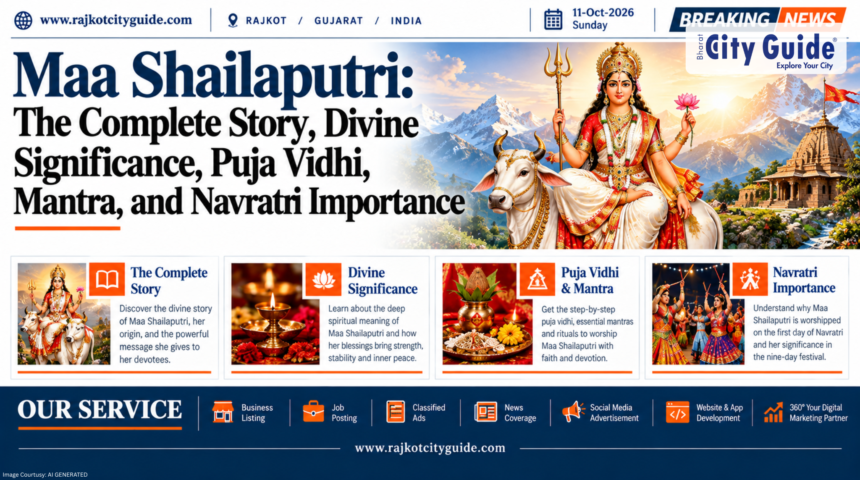
Maa Shailaputri is traditionally depicted as a beautiful and serene Goddess with two arms, seated upon or riding a white bull named Nandi. She holds a trident in one hand and a lotus flower in the other. A crescent moon is often shown adorning her forehead or crown.
Her appearance combines gentleness with divine authority. She does not need an aggressive expression to communicate power; her calm posture and sacred symbols represent the strength of a Goddess who is firmly established in her divine nature.
The traditional depiction of Maa Shailaputri is significant because each element conveys a spiritual message. The bull represents strength and steadiness, the trident signifies divine power, and the lotus represents purity and spiritual awakening. Together, these symbols provide a visual introduction to the values associated with her worship on the first day of Navratri.
The Symbolism of Maa Shailaputri’s Trident, Lotus, Bull, and Crescent Moon
The Trident
The trident, known as the trishul, is one of the most recognizable symbols associated with Goddess Durga and her manifestations. In devotional interpretations, it represents divine strength, protection, and the power to overcome negative influences.
The three points of the trident are sometimes interpreted as representing the three gunas—sattva, rajas, and tamas—or different dimensions of existence. These interpretations vary among traditions, but the central message is that divine power can guide devotees toward balance and righteousness.
The Lotus Flower
The lotus is a symbol of purity, spiritual beauty, and inner awakening in Hindu religious imagery. It grows in muddy water yet produces a beautiful flower, making it an enduring symbol of remaining pure and devoted despite difficult surroundings.
The lotus in Maa Shailaputri’s hand reminds devotees to maintain good intentions, practise self-discipline, and preserve inner peace even when facing worldly challenges.
The White Bull Nandi
Maa Shailaputri’s vehicle is a bull, traditionally identified with Nandi, who is also closely associated with Lord Shiva. The bull represents physical strength, steadiness, patience, and disciplined action.
Its association with the Goddess emphasizes that spiritual progress requires a stable foundation. Faith becomes meaningful when it is accompanied by sincere effort, responsibility, and perseverance.
The Crescent Moon
The crescent moon is another important element in traditional depictions of Maa Shailaputri. The moon is associated with calmness, changing cycles, and the mind in several Hindu symbolic traditions.
Its presence connects her imagery with the broader iconography of Lord Shiva and reinforces the idea of maintaining composure and balance amid life’s changing circumstances.
Why Is Maa Shailaputri Worshipped on the First Day of Navratri?
Navratri is a Hindu festival dedicated to the worship of the Divine Mother through nine sacred forms. In the widely followed Navadurga tradition, the first day is dedicated to Maa Shailaputri.
The first day is associated with Pratipada, the opening lunar day of the festival. Many families begin their observances with Ghatasthapana, also called Kalash Sthapana, a ritual that marks the beginning of the Navratri worship period.
Maa Shailaputri is worshipped first because she represents the foundation of the spiritual journey. Her mountain-born identity expresses firmness, patience, and readiness to begin. Devotees seek her blessings before proceeding to worship the other forms of Navadurga.
The nine forms are traditionally named Maa Shailaputri, Maa Brahmacharini, Maa Chandraghanta, Maa Kushmanda, Maa Skandamata, Maa Katyayani, Maa Kalaratri, Maa Mahagauri, and Maa Siddhidatri. Each form is associated with distinctive qualities and devotional meanings.
Worshipping Maa Shailaputri at the beginning of Navratri helps devotees focus their minds on faith, discipline, and positive intentions for the days ahead.
Maa Shailaputri Puja Vidhi: How to Worship Her at Home
Devotees can worship Maa Shailaputri at home with a simple, respectful ritual. Customs vary by family, region, and religious tradition, so worshippers may follow their household practices or the guidance of a knowledgeable priest.
Step 1: Clean the Puja Area
Clean the place where the Goddess will be worshipped. Place an image or idol of Maa Shailaputri on a clean altar and arrange the necessary puja items.
Step 2: Perform Ghatasthapana, Where Practised
Many devotees begin Navratri by performing Ghatasthapana or Kalash Sthapana. The ritual involves establishing a sacred pot according to the family’s tradition and the appropriate local religious calendar. Because the prescribed timing can vary by location and year, consult a reliable local Panchang for the correct muhurta.
Step 3: Light a Diya
Light a lamp as an offering of devotion. Incense may also be offered if it is part of the household’s custom. Maintain a clean and peaceful atmosphere during the prayer.
Step 4: Offer Flowers and Bhog
Offer fresh flowers, water, and suitable devotional offerings. Pure ghee is commonly associated with Maa Shailaputri’s first-day worship, although offerings can vary according to regional customs and family traditions.
Step 5: Chant the Mantra
Recite the traditional mantra of Maa Shailaputri with concentration and respect. Devotees may repeat it several times according to their personal practice.
Step 6: Read the Story and Perform Aarti
Read or listen to the story of Maa Shailaputri, offer prayers, and perform the aarti. Conclude the worship with a prayer for peace, wisdom, strength, and the well-being of family members.
The essential purpose of puja is sincere devotion. Elaborate arrangements are not necessary for every household; a respectful prayer offered with a pure heart is central to devotional practice.
Maa Shailaputri Mantra and Its Meaning
The traditional mantra commonly recited in worship of Maa Shailaputri is:
Om Devi Shailaputryai Namah
Sanskrit: ॐ देवी शैलपुत्र्यै नमः
Meaning: Salutations to Goddess Shailaputri, the Divine Mother and daughter of the mountain.
Devotees chant this mantra to express reverence for the Goddess and seek her blessings. It can be recited during morning prayers, meditation, or the first-day Navratri puja.
Some devotional traditions also use the mantra:
Om Aim Hreem Kleem Shailaputryai Namah
This is a longer devotional mantra used in certain worship practices. Mantra traditions can differ, so devotees may follow the form recommended by their family tradition or spiritual teacher.
The purpose of mantra chanting is to focus the mind, strengthen devotion, and create a peaceful atmosphere for prayer. Devotees may chant the mantra 11, 21, or 108 times, depending on their practice and available time.
What Is the Favourite Offering of Maa Shailaputri?
Pure ghee is commonly mentioned as a traditional bhog offering for Maa Shailaputri on the first day of Navratri. Devotees may offer a small quantity as part of the puja, following their family’s customs.
Fresh flowers, fruits, and other simple vegetarian offerings may also be used. The exact items differ among regions and households, and there is no need to assume that every community follows precisely the same ritual.
In devotional belief, an offering expresses gratitude, respect, and surrender to the Divine Mother. Cleanliness, sincerity, and a peaceful attitude are important parts of the worship.
Which Colour Is Associated with Maa Shailaputri?
Orange is associated with Maa Shailaputri in many popular Navratri colour calendars. Devotees may wear orange clothing or use orange flowers and decorations as a symbolic expression of enthusiasm, energy, and devotion.
However, Navratri colour traditions can vary according to region, calendar, and local practice. The colour is a devotional custom rather than a requirement that determines the value of a person’s worship.
Those who choose not to follow a particular colour tradition can still participate meaningfully in prayer and other religious observances.
Spiritual Significance and Blessings of Maa Shailaputri
Maa Shailaputri is revered as a source of strength, steadiness, purity, and devotion. Her worship encourages devotees to build a firm spiritual foundation and approach life’s difficulties with patience.
Strength and Courage: The mountain symbolism inspires people to remain determined when facing personal or professional challenges.
Stability and Balance: Her association with the bull represents steadiness, reminding devotees of the importance of disciplined and responsible action.
Purity of Intention: The lotus symbolizes the ability to preserve good values while navigating difficult circumstances.
Faith and Devotion: Her connection with Sati and Parvati highlights the enduring place of devotion in the Goddess’s traditional story.
New Beginnings: As the first of the Navadurga, Maa Shailaputri represents the start of a spiritual journey. Her worship encourages people to set positive intentions and approach new responsibilities with sincerity.
In Hindu devotional belief, worshippers seek the Goddess’s blessings for peace, prosperity, family well-being, and spiritual progress. These are religious beliefs and expressions of faith rather than scientifically guaranteed outcomes.
Maa Shailaputri and the Message of Nature
The identity of Maa Shailaputri as the daughter of the Himalayas creates a strong connection between her story and the natural world. Mountains have long served as places of pilgrimage, meditation, and spiritual retreat in Indian traditions.
Her association with the mountains encourages devotees to reflect on endurance, humility, and the importance of a stable foundation. Mountains may appear still, but they endure changing weather and the passage of time. In a similar way, a person can cultivate inner steadiness while adapting to life’s circumstances.
Her lotus and bull add further dimensions to this message. The lotus represents purity, while the bull represents strength and discipline. Together, these symbols invite devotees to combine good intentions with practical responsibility.
Respect for nature can also be a meaningful expression of gratitude for the world associated with the Divine Mother. Caring for the environment, avoiding unnecessary waste during festivals, and treating living beings responsibly are ways to put values of respect and stewardship into practice.
The Difference Between Maa Shailaputri, Goddess Sati, and Goddess Parvati
Maa Shailaputri, Goddess Sati, and Goddess Parvati are closely connected in Hindu mythology, but their names refer to different stages or aspects of the same divine story.
Goddess Sati is remembered as the daughter of Daksha and the first wife of Lord Shiva. Her story centres on her devotion to Shiva and the tragic Daksha yajna episode.
Maa Shailaputri is the name associated with the Goddess’s rebirth as the daughter of Himavan, the king of the Himalayas. The name emphasizes her mountain-born identity and her place as the first form of Navadurga worshipped during Navratri.
Goddess Parvati is the name widely associated with her later life as Himavan’s daughter, her devotion to Lord Shiva, and their reunion. Parvati is also revered as the mother of Lord Ganesha and Lord Kartikeya in Hindu traditions.
These names are not generally understood as unrelated goddesses in this narrative. Instead, they express the Goddess’s divine continuity through different episodes of sacred mythology.
Conclusion
Maa Shailaputri holds a sacred position as the first form of Navadurga and the Goddess worshipped at the beginning of Navratri. Her story, which connects the life of Goddess Sati with her rebirth as the daughter of the Himalayan king Himavan, expresses the enduring power of divine Shakti, devotion, and renewal. Her traditional appearance with a trident, lotus, crescent moon, and the bull Nandi communicates important spiritual values, including strength, purity, discipline, and stability. Through the first-day puja, mantra chanting, devotional offerings, and remembrance of her story, devotees begin Navratri with faith and positive intentions. The message of Maa Shailaputri extends beyond ritual: it encourages people to stand firmly by their values, remain patient during difficult times, and approach every new beginning with courage and sincerity. For devotees seeking a deeper understanding of Navratri, learning about Maa Shailaputri provides an important starting point for exploring the nine forms of the Divine Mother and the spiritual meaning of this revered Hindu festival.