Introduction
Maa Katyayani is one of the most powerful and widely worshipped forms of Goddess Durga. She is revered as the sixth manifestation of Navdurga, the nine divine forms of the Goddess worshipped during Navratri. Known for her courage, strength, protective nature, and determination to destroy evil, Maa Katyayani represents the victory of righteousness over injustice. Her divine story is closely connected with the sage Katyayana and the defeat of the buffalo demon Mahishasura, one of the most famous episodes in Hindu goddess mythology.
- Introduction
- Who Is Maa Katyayani?
- The Meaning and Origin of the Name Maa Katyayani
- The Real Mythological Story of Maa Katyayani
- Maa Katyayani and the Gopis of Vrindavan
- The Divine Appearance and Symbols of Maa Katyayani
- Why Is Maa Katyayani Worshipped on the Sixth Day of Navratri?
- Maa Katyayani Puja Vidhi: How to Worship at Home
- Maa Katyayani Mantra and Its Meaning
- Maa Katyayani’s Favourite Bhog and Offerings
- Which Colour Is Associated with Maa Katyayani?
- Spiritual Significance and Blessings of Maa Katyayani
- Frequently Asked Questions About Maa Katyayani
- Conclusion
Maa Katyayani is traditionally worshipped on the sixth day of Sharadiya Navratri, which falls on Shashthi according to the Hindu lunar calendar. Devotees pray to her for courage, wisdom, protection, spiritual growth, and harmony in their lives. She is also associated with the prayers of the young gopis of Vrindavan, who worshipped Katyayani seeking Lord Krishna as their husband. This connection makes her significant in both Shakta traditions, which honour the Divine Mother, and Vaishnava traditions devoted to Lord Krishna.
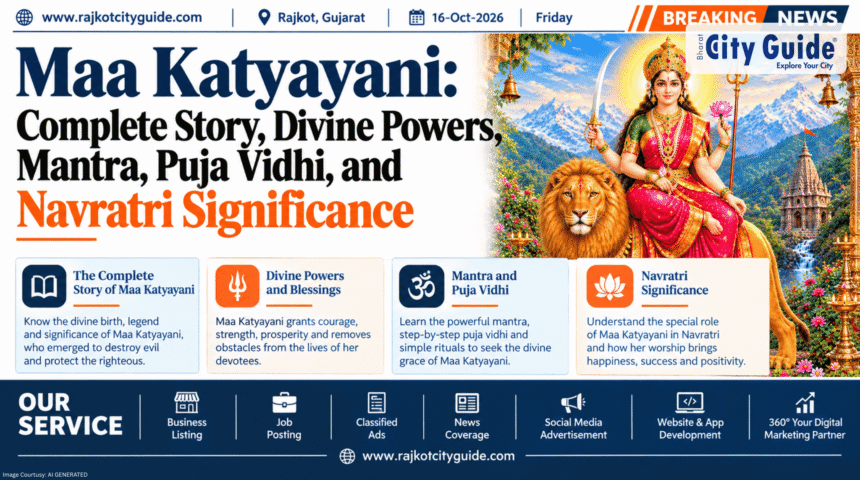
The divine appearance of Maa Katyayani is often depicted with four arms, a sword, a lotus, and a lion as her vehicle. Her form combines powerful warrior energy with divine compassion. Her story teaches that strength should be used to protect the innocent, overcome injustice, and restore balance. Understanding the story of Maa Katyayani, her symbolism, mantra, puja vidhi, offerings, and spiritual significance helps devotees appreciate why she holds such an important place in Hindu religious traditions.
Who Is Maa Katyayani?
Maa Katyayani is the sixth form of Navdurga and is recognised as a warrior manifestation of Goddess Durga. She is associated with the destruction of Mahishasura and the restoration of peace and order in the universe. Her name is traditionally linked to Sage Katyayana, who prayed for the Goddess to appear as his daughter.
In Hindu mythology, Maa Katyayani represents divine power in its active and protective form. While some manifestations of the Goddess are especially associated with meditation, nourishment, or maternal care, Katyayani is remembered for confronting destructive forces directly. She symbolises the courage required to challenge wrongdoing and the determination needed to protect dharma, or righteous conduct.
Maa Katyayani is not simply a symbol of physical power. Her divine character also represents self-control, clarity, justice, and compassion. The sword in her hand symbolises the removal of ignorance and harmful influences, while the lotus represents purity and spiritual awakening. Her lion represents fearlessness and strength.
For devotees, Maa Katyayani is a reminder that difficult circumstances can be faced with courage and faith. Her worship encourages people to act responsibly, stand against injustice, and use their abilities for the benefit of others. Her story is particularly meaningful during Navratri, when devotees reflect on the many forms through which the Divine Mother protects and guides the world.
The Meaning and Origin of the Name Maa Katyayani
The name Katyayani is traditionally associated with Sage Katyayana. According to a popular devotional account, the sage performed intense penance and prayed for the Goddess to be born in his family. Pleased with his devotion, the Divine Mother manifested as his daughter. She therefore became known as Katyayani, meaning the Goddess associated with Katyayana or his daughter.
Accounts of the Goddess’s origin vary across Hindu texts and traditions. In another well-known account, the gods’ combined divine energy manifests as the warrior Goddess who defeats Mahishasura. These accounts are often understood together in devotional tradition: the Goddess is both the divine power invoked by the sage and the cosmic protector who appears when the world needs her strength.
The name Maa Katyayani therefore carries associations with devotion, divine grace, protection, and the power to restore balance. Her identity is rooted in the belief that the Divine Mother responds to the suffering of the world and manifests to protect righteousness.
Her story also highlights the importance of devotion and determination. Sage Katyayana’s penance represents sincere spiritual effort, while the Goddess’s warrior form represents the power that emerges to confront injustice. Together, these themes make Maa Katyayani an important figure in the worship of Navdurga.
The Real Mythological Story of Maa Katyayani
The story of Maa Katyayani is best understood as a sacred Hindu mythological tradition rather than a modern historical event. Different Puranic and devotional accounts describe her manifestation in slightly different ways, but two central themes are consistently associated with her: her connection with Sage Katyayana and her role in defeating Mahishasura.
The Penance of Sage Katyayana
According to a popular traditional account, Sage Katyayana was a devoted sage who wished to receive the blessing of the Divine Mother. He performed intense penance and worshipped Goddess Durga with deep faith. Pleased with his devotion, the Goddess granted his wish and manifested as his daughter. Because of her association with the sage, she became known as Maa Katyayani.
In another widely told version, the gods were suffering under the oppression of Mahishasura, a powerful demon who had defeated them and threatened the balance of the universe. Unable to defeat him alone, the gods sought divine assistance. Their combined spiritual power gave rise to a radiant and formidable manifestation of the Goddess.
Sage Katyayana is connected with this divine appearance in the traditional narrative, and the Goddess came to be known as Katyayani. Although details vary among retellings, the central message is that divine power manifests when righteousness is threatened and protection becomes necessary.
The Rise of Mahishasura
Mahishasura is described in Hindu mythology as a powerful demon who could assume the form of a buffalo. Through intense penance, he obtained a boon from Lord Brahma that made him extremely difficult to defeat. In the commonly told account, he believed that no man would be able to kill him and did not consider a woman a serious threat.
With this confidence, Mahishasura became arrogant and began attacking the gods. He challenged their authority, disrupted the celestial order, and caused widespread suffering. The gods were forced from their positions and sought a way to end his oppression.
Their prayers led to the manifestation of the Divine Mother as a powerful warrior Goddess. Maa Katyayani’s appearance represented the combined divine strength needed to confront Mahishasura. Her story demonstrates that arrogance can lead to downfall and that power without responsibility can become destructive.
The Battle Between Maa Katyayani and Mahishasura
Maa Katyayani confronted Mahishasura in a fierce battle. The demon used his strength and changing forms to fight against the Goddess, but she remained determined and powerful. In the familiar tradition, Mahishasura repeatedly changed forms during the battle, including taking the form of a buffalo.
The Goddess fought with extraordinary courage and ultimately defeated him. This victory is part of the wider Hindu tradition of Goddess Durga as Mahishasuramardini, the slayer of Mahishasura. Some devotional accounts closely associate this victory with Maa Katyayani, while other tellings describe the battle through the broader form of Durga. The traditions share the same central theme: the Divine Mother destroys evil and restores cosmic balance.
The defeat of Mahishasura is more than a story of a battle between divine and demonic forces. Spiritually, the demon can be understood as representing arrogance, uncontrolled desire, cruelty, and the misuse of power. Maa Katyayani’s victory symbolises the ability of truth, courage, and disciplined strength to overcome these destructive qualities.
Her story reminds devotees that injustice should not be accepted simply because it appears powerful. With courage, clear judgment, and commitment to what is right, harmful forces can be challenged and balance can be restored.
Maa Katyayani and the Gopis of Vrindavan
Maa Katyayani also holds a special place in traditions associated with Lord Krishna. According to the Bhagavata Purana, the young unmarried gopis of Vraja observed a vow during the month of Margashirsha and worshipped Goddess Katyayani. They bathed in the Yamuna River and prayed to the Goddess, seeking Lord Krishna as their husband.
The traditional prayer begins with an invocation to Katyayani, the great Goddess, asking her to fulfil their wish. This episode is significant in Vaishnava devotion because it expresses the gopis’ intense love and dedication to Krishna. It also shows that Maa Katyayani is worshipped in traditions beyond the stories of her warrior form.
Devotees often connect this account with prayers for marriage and a suitable life partner. In popular religious practice, unmarried women may worship Maa Katyayani with the hope of finding a compatible spouse and building a happy married life. These are devotional beliefs, not guaranteed outcomes.
The story also conveys the importance of sincerity and dedication. The gopis’ worship reflects a wholehearted spiritual longing, while Maa Katyayani represents the divine presence to whom they turn in prayer. Her role across these different traditions shows the breadth of her significance: she is both the courageous warrior who confronts evil and the compassionate Goddess who receives the prayers of devotees.
The Divine Appearance and Symbols of Maa Katyayani
Maa Katyayani is commonly depicted with four arms and a radiant appearance. She is often shown riding a lion, which represents fearlessness, strength, and royal authority. Her appearance combines the qualities of a warrior with the blessings of a protective mother.
The sword: The sword represents courage, decisive action, and the destruction of ignorance and injustice. Spiritually, it reminds devotees to distinguish right from wrong and to act with integrity.
The lotus flower: The lotus symbolises purity, spiritual awareness, and the ability to remain virtuous in difficult circumstances. It reflects the Goddess’s divine grace alongside her warrior strength.
The blessing gesture: One of her hands is commonly shown in Varada Mudra, a gesture associated with blessings and generosity. It represents the Goddess’s compassionate nature and the hope that devotees will receive spiritual guidance.
The fearlessness gesture: Another hand may display Abhaya Mudra, a gesture symbolising protection and freedom from fear. It reassures devotees that courage and faith can help them face life’s challenges.
The lion: The lion represents strength, determination, and the ability to confront destructive forces. As the Goddess’s vehicle, it reflects her command over powerful energies and her readiness to protect righteousness.
Some depictions and regional traditions vary in the objects held by the Goddess and the precise arrangement of her hands. The central symbolism remains the same: Maa Katyayani embodies strength guided by divine purpose, compassion, and justice.
Why Is Maa Katyayani Worshipped on the Sixth Day of Navratri?
Navratri is a Hindu festival dedicated to the nine forms of Goddess Durga, known collectively as Navdurga. Each day honours a particular manifestation and provides devotees with an opportunity to reflect on the qualities associated with that form.
Maa Katyayani is traditionally worshipped on the sixth day of Navratri, known as Shashthi in this context. She follows Maa Skandamata, the fifth form of Navdurga, and represents courage, protective strength, and the destruction of evil.
On this day, devotees may visit temples, perform puja at home, recite mantras, observe a fast according to their family traditions, and offer flowers and food to the Goddess. Many pray for protection, strength during challenging circumstances, harmony in family life, and progress on their spiritual path.
Her worship also encourages devotees to examine their own conduct. The victory over Mahishasura can be understood as an invitation to overcome personal negativity, including anger, pride, selfishness, and dishonesty.
The exact date of the sixth day changes each year according to the Hindu lunar calendar. Devotees should consult a reliable local panchang or temple announcement for the relevant tithi and puja timings.
Maa Katyayani Puja Vidhi: How to Worship at Home
Devotees can worship Maa Katyayani at home through a simple and respectful puja. Rituals may differ according to regional customs, family traditions, and temple practices. The following steps describe a commonly followed method.
- Clean the puja area: Prepare a clean place for the image or idol of Maa Katyayani.
- Begin with personal cleanliness: Bathe, wear clean clothes, and sit peacefully before the Goddess.
- Light a diya: Light an oil or ghee lamp if customary in your household, and offer a prayer for wisdom, courage, and protection.
- Offer flowers: Present fresh flowers, such as red or yellow flowers, according to availability and family tradition.
- Apply tilak and offer akshat: Offer kumkum, sandalwood paste, or unbroken rice if these form part of your customary worship.
- Offer bhog: Present fruit, honey, or a homemade sweet as a devotional offering.
- Chant the mantra: Recite the Maa Katyayani mantra with concentration and sincerity.
- Read a devotional prayer: You may recite a Durga stotra, Durga Chalisa, or another prayer traditionally used in your household.
- Perform aarti: Conclude the main worship with aarti and a prayer for the well-being of your family and community.
- Distribute prasad: Share the offered food respectfully with family members and others.
Fasting is optional and should follow your health needs and family customs. The purpose of worship is to express devotion and reflect on the Goddess’s qualities, not to feel pressured to perform every ritual. A simple prayer offered sincerely is also a meaningful way to honour Maa Katyayani.
Maa Katyayani Mantra and Its Meaning
Mantra chanting is an important part of Navratri worship. Devotees chant Maa Katyayani’s name to focus their minds, express gratitude, and remember the qualities she represents.
Maa Katyayani Mantra:
ॐ देवी कात्यायन्यै नमः॥
Transliteration: Om Devi Katyayanyai Namah.
Meaning: I bow to Goddess Katyayani.
This short mantra is widely used in Navdurga worship. Devotees may recite it 11, 21, or 108 times according to their personal practice. There is no need to rush; the focus is on devotion and understanding the meaning of the prayer.
Another traditional prayer verse associated with Maa Katyayani is:
चन्द्रहासोज्ज्वलकरा शार्दूलवरवाहना। कात्यायनी शुभं दद्याद्देवी दानवघातिनी॥
Transliteration: Chandrahāsōjjvala-karā, śārdūla-vara-vāhanā; Katyāyanī śubham dadyād, devī dānava-ghātinī.
Meaning: May Goddess Katyayani, whose hand shines with a divine sword and who rides a powerful tiger, grant auspiciousness and protect devotees from destructive forces.
The exact wording and pronunciation of devotional verses may vary between traditions. Those who prefer a simple practice can chant the short name mantra with sincerity.
Maa Katyayani’s Favourite Bhog and Offerings
Food offerings are a customary part of worshipping Maa Katyayani. Honey is frequently mentioned as a bhog associated with her, while fruits, sweets, and other offerings may be included according to local and family traditions.
Common offerings include:
- Honey: A well-known offering associated with Maa Katyayani in many Navratri worship guides.
- Fresh fruit: Seasonal fruits are a simple and respectful devotional offering.
- Homemade sweets: Families may prepare traditional sweets according to their customs.
- Fresh flowers: Red or yellow flowers are often used in her worship, though other clean flowers are also suitable.
- Water: Clean water may be included as part of the puja.
After worship, the food offering is generally distributed as prasad. The significance of bhog lies in gratitude and devotion rather than the cost or quantity of the items. Devotees should follow the practices of their household or temple where these differ from general descriptions. Honey is highlighted as a customary offering in several contemporary Maa Katyayani worship guides.
Which Colour Is Associated with Maa Katyayani?
Colours associated with the forms of Navdurga can vary by regional custom and by the calendar used for a particular year. Red is commonly associated with Maa Katyayani in devotional imagery because it represents strength, energy, courage, and auspiciousness. Some Navratri colour calendars assign a different colour to the sixth day, so there is no single colour rule followed by every community.
Devotees may wear red or another clean, comfortable colour while worshipping. The important part of the observance is the devotion, respect, and spiritual reflection behind the ritual rather than a particular outfit.
Spiritual Significance and Blessings of Maa Katyayani
Maa Katyayani represents courage, protection, justice, and the strength to overcome obstacles. Devotees seek her blessings for spiritual growth, family well-being, and confidence during difficult times.
She is also widely worshipped by those praying for marriage and a compatible life partner, a tradition often associated with the gopis’ worship of Katyayani in the Bhagavata Purana. These blessings are matters of religious faith rather than guaranteed results.
Her story also has a wider spiritual message. Mahishasura’s arrogance and abuse of power represent qualities that can damage individuals and communities. Maa Katyayani’s victory reminds devotees to resist injustice, control harmful impulses, and act with courage and responsibility.
Her worship can therefore inspire practical actions: speaking truthfully, helping vulnerable people, treating others fairly, and making thoughtful decisions. These are ways to bring the values represented by the Goddess into daily life.
Frequently Asked Questions About Maa Katyayani
1. Who is Maa Katyayani?
Maa Katyayani is the sixth form of Navdurga, worshipped during Navratri. She is known as a powerful warrior manifestation of Goddess Durga and is closely associated with the defeat of Mahishasura.
2. What is the mantra of Maa Katyayani?
A commonly recited mantra is “Om Devi Katyayanyai Namah” (ॐ देवी कात्यायन्यै नमः). Devotees chant it with devotion during Navratri and other forms of Goddess worship.
3. What bhog is offered to Maa Katyayani?
Honey is a commonly mentioned offering, along with fresh fruit, flowers, and traditional sweets. Offerings can vary according to family customs and regional traditions.
Conclusion
Maa Katyayani is a powerful manifestation of Goddess Durga who symbolises courage, protection, justice, and the victory of righteousness over evil. Worshipped as the sixth form of Navdurga on the sixth day of Navratri, she is associated with the devotion of Sage Katyayana and the mythological defeat of Mahishasura. Her story teaches that destructive power and arrogance cannot permanently overcome righteousness, and that strength becomes meaningful when it is used to protect others and restore balance.
The divine appearance of Maa Katyayani, with her sword, lotus, blessing gestures, and lion, conveys a message of fearlessness combined with compassion. Her connection with the gopis of Vrindavan also highlights her importance in devotional traditions centred on Lord Krishna. Through mantras, puja, aarti, and offerings such as honey and fruit, devotees express their faith and seek spiritual guidance.
Beyond religious rituals, Maa Katyayani inspires people to face challenges with determination, act honestly, and stand against injustice. Her worship encourages devotees to overcome pride, anger, and negativity while developing patience, wisdom, and self-discipline. By remembering Maa Katyayani during Navratri and throughout the year, devotees can reflect on the enduring values of courage, compassion, devotion, and responsibility that her divine story represents.