Introduction: Why GST Still Shapes India’s Economy
When the Goods and Services Tax (GST) in India rolled out in 2017, it was pitched as a bold reset. One nation, one tax. Nearly a decade later, GST has become deeply woven into everyday business life.
- Introduction: Why GST Still Shapes India’s Economy
- What Is GST and Why Was It Introduced?
- Key Benefits of GST in India (Pros)
- Challenges and Criticism of GST (Cons)
- GST’s Economic Contribution and FY26 Outlook
- GST Pros and Cons at a Glance
- FAQs: GST in India Explained
- Conclusion: A Reform Still in Progress
By FY25, GST collections touched a record ₹21.36 lakh crore, underlining its role as a cornerstone of public finance. For businesses, GST has meant fewer checkpoints, more digital compliance, and faster refunds. At the same time, complaints around rate complexity, input tax credit (ITC) blocks, and portal dependency haven’t gone away.
As India heads into FY26 with 7.4% GDP growth expectations, it’s worth asking: has GST delivered on its promise, and where does it still fall short?
What Is GST and Why Was It Introduced?
GST replaced a maze of 17+ central and state indirect taxes, including excise duty, service tax, VAT, octroi, and entry tax.
The core objective was simple:
- Eliminate cascading taxes
- Create a unified national market
- Improve compliance through technology
In practice, GST turned taxation into a largely invoice-driven, digital system, changing how businesses account, price, and plan.
(Internal-link friendly anchor text suggestion: “India’s indirect tax reforms explained”)
Key Benefits of GST in India (Pros)
1. Unified Market and Seamless Trade
GST removed state-level tax barriers that once slowed trucks and inflated costs.
Key outcomes include:
- Seamless interstate trade using e-way bills
- Reduced logistics time and fuel costs
- Easier expansion for MSMEs across state borders
For many businesses, GST turned India from a patchwork of markets into one large marketplace.
2. Digital Compliance and Faster Refunds
GST is often called a “technology tax,” and for good reason.
Major digital benefits:
- Auto-populated returns using invoice matching
- 90% automatic GST refunds for exporters and MSMEs
- Real-time status tracking via the GST portal
Exporters who once waited months for refunds now often receive funds in days, improving cash flow.
3. Revenue Growth and Formalization
GST has significantly strengthened India’s tax base.
- FY25 collections: ₹21.36 lakh crore
- Contribution to GDP: 11–12%
- Formalization of 50%+ informal sector activity
As more firms register and transact digitally, tax leakages shrink and compliance widens.
4. Transparency and Fairer Competition
Invoice matching and data analytics have:
- Reduced tax evasion
- Curbed fly-by-night operators
- Created a level playing field for compliant businesses
For small firms, the composition scheme offers simplified compliance and predictable tax liability.
Challenges and Criticism of GST (Cons)
GST’s design is ambitious—but not frictionless.
1. Complex Rate Structure
India’s GST has multiple slabs ranging from 0% to 28%, plus cess.
This has led to:
- Classification disputes
- Frequent rate changes
- A growing litigation backlog
Businesses often joke that “decoding GST rates needs a tax consultant on speed dial.”
2. Input Tax Credit (ITC) Bottlenecks
While GST promises seamless credits, reality can differ.
Common pain points:
- Blocked credits on certain goods/services
- Dependency on supplier compliance
- Delays that strain MSME working capital
For smaller firms, ITC issues can feel like money stuck in limbo.
3. Inflationary Impact and Enforcement Gaps
In the early years, GST triggered short-term price hikes, especially in services.
Concerns remain around:
- Inconsistent anti-profiteering enforcement
- Pass-through of tax benefits to consumers
While inflation has stabilized, perception still matters in public discourse.
4. Heavy Reliance on Technology
GST assumes reliable digital access—something not universal.
Challenges include:
- Rural and small-town connectivity issues
- Portal downtime during peak filing dates
- Rising cybersecurity risks
For digitally savvy firms, GST is smooth. For others, it can feel unforgiving.
GST’s Economic Contribution and FY26 Outlook
GST’s broader economic role goes beyond tax collection.
Macroeconomic Impact
- Adds 0.5–1% annually to GDP growth through efficiency gains
- Supports exports via timely refunds
- Funds infrastructure and capital expenditure
FY26 Projections
With economic expansion expected around 7.4%, GST collections are projected at:
- ₹24–25 lakh crore in FY26
This positions GST as a key engine for financing India’s growth ambitions.
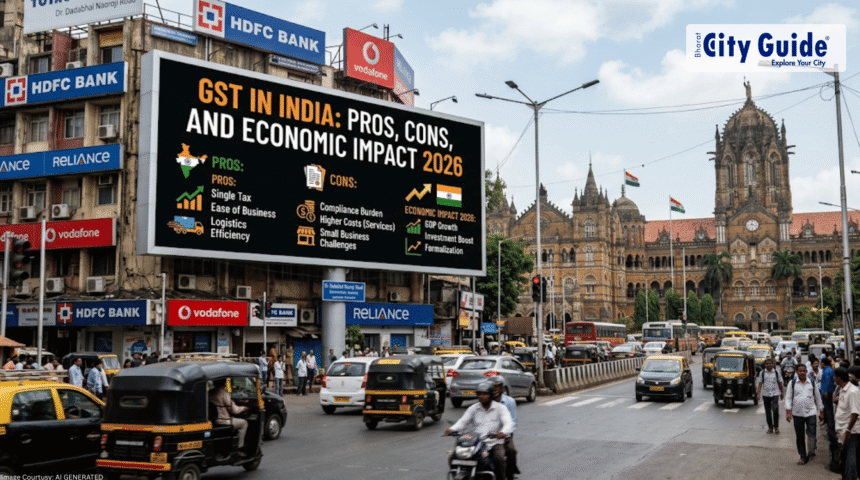
GST Pros and Cons at a Glance
| Aspect | Pros | Cons |
| Compliance | Digital processes, auto-refunds | High burden for small firms |
| Economy | ~11% GDP contribution | Rate disputes, litigation |
| Transparency | Reduced evasion | Portal dependency |
FAQs: GST in India Explained
Why is GST considered important for India’s economy?
GST formalizes the economy, boosts revenue, and improves efficiency across supply chains.
What is the biggest challenge with GST today?
Rate complexity and input tax credit delays remain the most cited issues.
How has GST helped exporters?
Through faster, largely automated refunds that improve liquidity.
Will GST rates be simplified in the future?
Policy discussions suggest rationalization, but timelines remain uncertain.
Conclusion: A Reform Still in Progress
GST isn’t perfect—but it’s transformational.
It has modernized India’s tax system, expanded the formal economy, and strengthened government finances. At the same time, rate rationalization, simpler compliance for MSMEs, and stronger IT systems remain unfinished tasks.As India targets higher growth and global competitiveness, GST’s next phase won’t be about introduction—it’ll be about refinement. And how well that happens will shape business confidence well beyond 2026.