Introduction
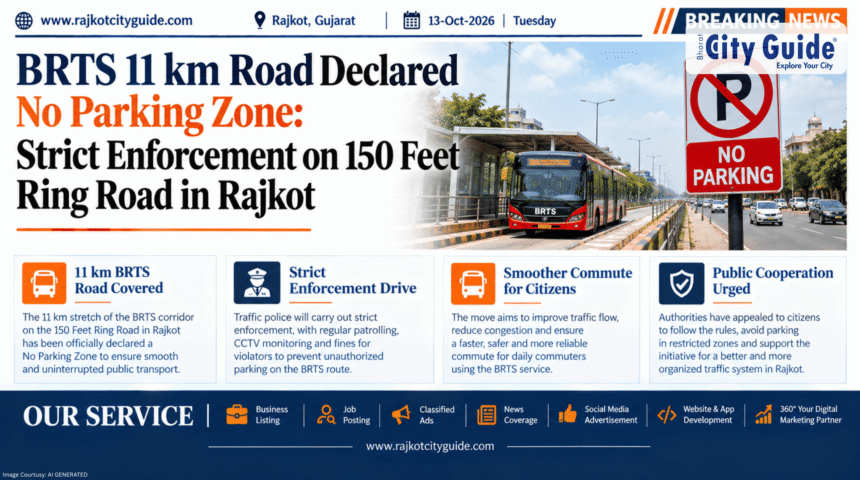
In a major administrative move to decongest urban arterial traffic and ensure the smooth, uninterrupted operation of public transit, the Rajkot City Police Traffic Branch, in close coordination with the Rajkot Municipal Corporation (RMC), has officially enforced a strict directive: the BRTS 11 km Road Declared No Parking Zone. Spanning the highly congested 150 Feet Ring Road corridor, this notification covers the entire stretch from Gondal Road Chowkdi all the way to Madhapar Chowkdi.
- Introduction
- What is BRTS 11 km Road Declared No Parking Zone?
- Why This News is Important
- Background Information
- Key Highlights
- Detailed Explanation of the Event
- Benefits and Importance of the Decision
- How It Impacts People
- Expert Insights and Urban Transport Perspective
- Challenges and Key Considerations
- Frequently Asked Questions (FAQs)
- Conclusion
The 150 Feet Ring Road is widely regarded as the commercial backbone of Rajkot, serving as the central transit vein for tens of thousands of daily commuters, city buses, commercial vehicles, and shoppers. Over recent years, unauthorized roadside parking by two-wheelers, four-wheelers, auto-rickshaws, and commercial delivery vehicles along the service roads and outer lanes had drastically narrowed the navigable carriageway. This chronic illegal parking frequently resulted in severe traffic bottlenecks during peak morning and evening hours.
To restore traffic discipline, police authorities and civic enforcement teams have designated both main carriageways and service corridors along this 11-kilometer BRTS track as zero-tolerance parking zones. With specialized towing cranes, wheel-locking squads, and digital e-challan systems deployed in full force, the administration aims to clear bottlenecks, enhance commuter safety, and dramatically cut down travel times along Rajkot’s busiest transit corridor.
What is BRTS 11 km Road Declared No Parking Zone?
The BRTS 11 km Road Declared No Parking Zone is a statutory traffic regulation order issued under the Gujarat Police Act and Motor Vehicles Act by the Rajkot City Traffic Police in partnership with the Rajkot Municipal Corporation. The order prohibits all unauthorized vehicular parking, temporary stopping, loading/unloading of commercial goods, and roadside staging along the 11-kilometer stretch of the 150 Feet Ring Road housing the Bus Rapid Transit System (BRTS) dedicated lane.
Geographically, this stretch runs from Gondal Road Chowkdi, passing through major urban intersections—including Mavdi Chowkdi, Nana Mava Chowk, Raiya Circle, Indira Circle, and Kalawad Road Junction—before terminating at Madhapar Chowkdi on the Morbi Highway link.
Under this legal notification, parking any class of motor vehicle—whether two-wheelers, private cars, commercial vans, or auto-rickshaws—on the main carriageways, service lanes, junctions, or pedestrian footpaths along this 11 km stretch is strictly illegal. Violators face immediate vehicle towing, wheel-clamp locking, and heavy financial fines issued directly via physical challans or digital automated traffic surveillance cameras.
Why This News is Important
The strict enforcement of a No Parking Zone along Rajkot’s primary transit artery carries immense civic, economic, and public safety significance for the entire city. First, the 150 Feet Ring Road handles the highest volume of daily vehicular traffic in Saurashtra. When illegally parked vehicles block one or two lanes of the carriageway, available road space shrinks significantly, transforming high-speed multi-lane roads into frustrating urban bottlenecks.
Second, maintaining an unobstructed BRTS corridor directly impacts the efficiency of Rajkot’s mass transit system. The BRTS and RMTS city bus services transport thousands of daily commuters, office workers, and students across the city. Clearing roadside obstructions ensures that buses can merge into and out of dedicated lane corridors safely, maintaining precise schedules without getting caught in general traffic gridlocks.
Finally, the initiative creates a vital safety buffer for pedestrians and emergency service vehicles. Open, obstruction-free roads allow fire tenders, ambulances moving toward major medical hubs, and police patrol vehicles to navigate peak-hour traffic quickly without being blocked by double-parked personal cars or delivery vehicles.
Background Information
The 150 Feet Ring Road was developed as a modern peripheral bypass to route intra-city and inter-district traffic efficiently around Rajkot. With the introduction of the Bus Rapid Transit System (BRTS), a dedicated, central bus lane was constructed along an 11-kilometer stretch, flanked by general traffic lanes and service corridors intended for local property access.
However, rapid commercial development along the Ring Road—including the opening of major shopping malls, commercial complexes, corporate offices, restaurants, and showrooms—led to an exponential increase in vehicular footfall. Many commercial buildings failed to provide adequate basement parking facilities or allowed their basement spaces to be used illegally for storage, forcing visitors and employees to park their vehicles along the public road.
+-----------------------------------------------------------------------+
|                 BRTS 11 KM NO PARKING ZONE AT A GLANCE                |
+--------------------------+--------------------------------------------+
| Total Corridor Length    | 11 Kilometers (Both Directions)            |
| Key Transit Belt         | 150 Feet Ring Road, Rajkot                 |
| Coverage Extent          | Gondal Road Chowkdi to Madhapar Chowkdi    |
| Key Circles Covered      | Mavdi, Nana Mava, Raiya, Indira & Kalawad  |
| Enforcing Authorities    | Rajkot Traffic Police & RMC Enforcement    |
| Enforcement Tools        | Towing Cranes, Wheel Clamps & E-Challans   |
+--------------------------+--------------------------------------------+
Over time, informal parking encroached upon up to 40% of the active roadway along specific junctions like Raiya Circle and Nana Mava Chowk. Following repeated traffic congestion complaints and safety audits, municipal and police leadership took the decisive step to classify the entire 11 km BRTS route as an enforced No Parking Zone.
Key Highlights
- 11 Km Continuous Corridor: Covers the entire 11-kilometer stretch of 150 Feet Ring Road from Gondal Road Chowkdi to Madhapar Chowkdi.
- Zero-Tolerance Enforcement: Absolute prohibition of parking for two-wheelers, four-wheelers, auto-rickshaws, and commercial delivery vehicles.
- Joint Task Force Deployment: Dedicated teams from Rajkot Traffic Police and RMC enforcement wings patrolling the corridor continuously.
- Heavy Financial Penalties: Immediate levying of towing charges, wheel-clamp fines, and automated camera-based e-challans against offending vehicles.
- Targeting Commercial Encroachments: Strict action against commercial shopkeepers, showrooms, and street vendors using road margins as private parking or display zones.
- Focus on Emergency Routes: Ensuring unobstructed transit corridors for ambulances, fire engines, and BRTS public transport buses.
Detailed Explanation of the Event
The implementation of the No Parking notification along the 11-kilometer BRTS corridor involves a multi-pronged enforcement strategy designed to achieve long-term compliance rather than temporary deterrence. Traffic Police teams, led by Assistant Commissioners of Police (ACP Traffic) and local precinct inspectors, have deployed dedicated towing cranes and motorized patrol squads along the entire route.
Special focus is directed toward high-density commercial hubs along the 150 Feet Ring Road, such as the areas surrounding Imperial Heights, Big Bazaar/Crystal Mall junction, Raiya Telephone Exchange circle, and Mavdi main road intersection. In these zones, enforcement officers utilize hydraulic wheel clamps to immobilize illegally parked vehicles instantly, requiring owners to pay steep administrative fines before release.
+-----------------------------------------------------------------------+
|                    ENFORCEMENT & TRAFFIC CLEARANCE MAP                |
+--------------------------+--------------------------------------------+
| Focus Zone               | Enforcement Action                         |
+--------------------------+--------------------------------------------+
| Main BRTS Carriageway    | Zero stopping; immediate camera e-challan  |
| Outer Service Lanes      | Towing of unauthorized double-parked cars  |
| Commercial Junctions     | Wheel-clamping & clearing illegal rickshaws|
| Pedestrian Footpaths     | Complete removal of parked two-wheelers    |
+--------------------------+--------------------------------------------+
Simultaneously, the Rajkot Municipal Corporation (RMC) Town Planning and Estate departments are conducting audits of commercial buildings along the 11-kilometer corridor. Property owners who have blocked or converted mandatory basement parking spaces into commercial shops or godowns are being served legal notices, forcing them to open basement parking facilities for visitors.
Benefits and Importance of the Decision
Declaring the 11 km BRTS road a No Parking Zone delivers far-reaching traffic, economic, and environmental benefits to Rajkot:
1. Drastic Reduction in Peak-Hour Congestion
Clearing illegally parked vehicles reclaims up to two extra lanes of navigable roadway in each direction, allowing traffic to flow smoothly without constant lane-merging bottlenecks at major intersections.
2. Improved Public Transit Efficiency and Ridership
An unhindered BRTS corridor enables city buses to maintain high operational speeds, adhere to digital arrival schedules, and offer a reliable commuting alternative to private vehicles, encouraging public transit adoption.
3. Enhanced Road Safety and Reduced Accidents
Encroached road margins force two-wheeler riders and pedestrians into fast-moving center lanes, increasing collision risks. Clearing the kerbside restores safe sightlines at intersections and provides clear paths for pedestrians.
4. Reduced Fuel Consumption and Emissions
Eliminating stop-and-go gridlocks along the 11 km corridor reduces idling fuel waste for thousands of vehicles daily, lowering vehicular carbon emissions and improving air quality along the urban ring road.
How It Impacts People
This strict traffic enforcement order creates a direct impact on various segments of society across Rajkot:
- For Daily Commuters: Offers significantly faster travel times, reduced driving stress, and smoother transit across the city along the 150 Feet Ring Road.
- For BRTS and City Bus Passengers: Guarantees faster, more reliable bus transit without getting delayed by general traffic congestion at junction bottlenecks.
- For Commercial Shopkeepers and Visitors: Requires a shift in habit toward using designated basement parking or off-street pay-and-park facilities rather than parking on main roads.
- For Traffic Authorities: Provides a clear, unambiguous legal mandate to enforce road discipline, clear bottlenecks, and manage urban traffic flow efficiently.
Expert Insights and Urban Transport Perspective
Urban transport planners and traffic engineering experts strongly support the decision to establish strict No Parking corridors along major transit arteries. According to urban mobility analysts, arterial ring roads are designed for continuous mobility, not vehicular storage. Allowing private vehicles to occupy valuable public road space for free parking represents an inefficient use of urban infrastructure.
Traffic experts point out that for a No Parking Zone to remain successful over the long term, enforcement must be paired with clear parking alternatives. Cities that successfully maintain clear transit corridors typically combine strict towing mechanisms with smart off-street parking facilities, clear directional signage, and strict enforcement of mandatory basement parking laws in commercial complexes.
Furthermore, civic governance observers note that transforming the 150 Feet Ring Road into a clear transit corridor aligns with modern smart city objectives, establishing a template for traffic management that can be replicated across other busy thoroughfares in Gujarat.
Challenges and Key Considerations
While the No Parking declaration is a necessary urban intervention, sustaining its success involves managing several operational challenges:
- Providing Adequate Alternative Parking: Ensuring that nearby off-street parking lots and commercial building basements have sufficient capacity to absorb thousands of displaced vehicles daily.
- Preventing Parking Encroachment in Nearby Residential Lanes: Monitoring internal residential streets branching off the 150 Feet Ring Road to prevent motorists from dumping vehicles in narrow neighborhood lanes.
- Maintaining Continuous Enforcement: Avoiding “enforcement fatigue” by ensuring that towing crews and traffic police maintain constant vigilance week after week rather than dropping guard after initial drives.
- Addressing Commercial Delivery Logistics: Establishing clear, designated off-peak hours (such as early mornings or late nights) for commercial shops to load and unload goods without disrupting daytime traffic flow.
Frequently Asked Questions (FAQs)
Which specific road stretch in Rajkot has been declared a No Parking Zone?
The entire 11-kilometer stretch of the 150 Feet Ring Road, carrying the BRTS corridor from Gondal Road Chowkdi to Madhapar Chowkdi, has been declared a strict No Parking Zone.
Who issued the No Parking order for the 11 km BRTS road?
The regulation was jointly issued and enforced by the Rajkot City Traffic Police and the Rajkot Municipal Corporation (RMC).
What happens if someone parks their vehicle along the 11 km BRTS road?
Illegally parked vehicles face immediate towing, hydraulic wheel-clamp locking, and heavy financial fines issued through physical police challans or automated digital e-challans.
Does the No Parking rule apply to both main roads and service lanes?
Yes, the prohibition applies to the main BRTS carriageways, general traffic lanes, outer service roads, junction corners, and pedestrian footpaths along the entire 11 km stretch.
Why was this specific stretch chosen for strict No Parking enforcement?
The 150 Feet Ring Road is Rajkot’s busiest commercial and transit corridor. Unauthorized roadside parking was causing severe traffic gridlocks, blocking BRTS buses, and creating safety hazards for commuters.
Where should shoppers and visitors park their vehicles when visiting shops on the 150 Feet Ring Road?
Visitors must utilize designated commercial building basement parking lots, authorized off-street pay-and-park facilities, or designated municipal parking zones nearby.
What action is being taken against commercial buildings with closed basement parking?
The RMC Estate and Town Planning departments are serving legal notices to commercial property owners who have illegally closed or repurposed mandatory basement parking spaces, forcing them to reopen them for public use.
Conclusion
The decision to declare the BRTS 11 km Road Declared No Parking Zone along Rajkot’s 150 Feet Ring Road marks a vital step forward in modern urban traffic management. By taking firm, systematic action against roadside parking encroachments from Gondal Road Chowkdi to Madhapar Chowkdi, the Rajkot City Police and Municipal Corporation are prioritizing smooth public transit and commuter safety.
Reclaiming valuable road space along this 11-kilometer commercial artery ensures that traffic moves efficiently, public transit buses stay on schedule, and emergency vehicles navigate peak hours without delay.
As enforcement teams continue daily patrols and commercial buildings reopen mandatory basement parking spaces, the benefits of clear, open roads will become increasingly evident to all residents. Sustained administrative discipline paired with civic compliance will ensure that Rajkot’s primary transit corridor remains a safe, rapid, and modern thoroughfare for years to come.