Introduction
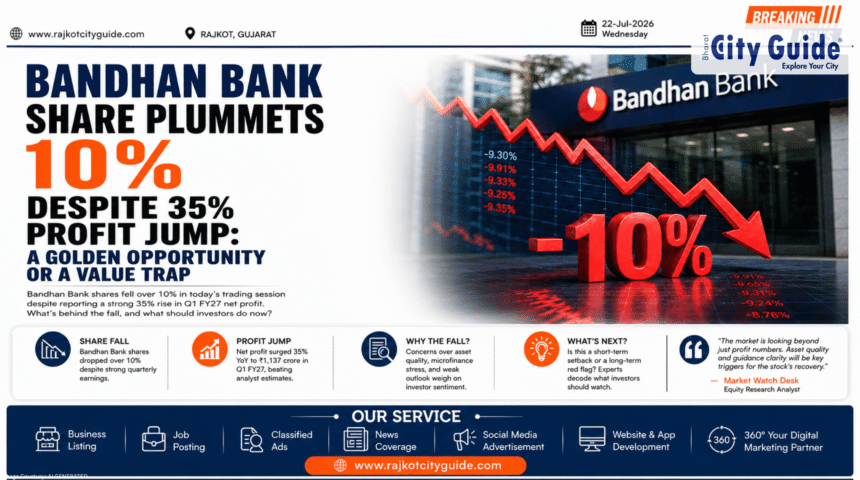
The Indian banking sector frequently throws surprises at retail investors, but few events stir the market as much as a double-digit price movement after an earnings announcement. Recently, the bandhan bank share became the talk of Dalal Street when its stock price plummeted by over 10% in a single trading session. What makes this crash particularly intriguing is that it happened right after the private lender reported a stellar 35% year-on-year jump in its net profit for the first quarter of the financial year.
- Introduction
- What is Bandhan Bank?
- Current Situation and Latest Market Update
- Why is This Development Important for Investors?
- Key Highlights of Q1 Financial Results
- Detailed Analysis of Core Operational Metrics
- Financial Health and Performance Parameters
- Segment-Wise Growth Outlook
- The Rising Cost of Deposits and Funding Challenges
- Comparison with Banking Competitors
- Advantages and Strengths of Bandhan Bank
- Disadvantages and Core Concerns
- Who Should Consider Investing in This Stock?
- Future Expectations and Target Trajectory
- Frequently Asked Questions (FAQs)
- Conclusion
For retail investors and market observers, this sharp contrast raises critical questions. How can a company’s stock experience a massive sell-off when its bottom line is growing at such a rapid pace? The answer lies deep within the bank’s core operational metrics, shifting growth targets, and a revised forward-looking guidance that caught institutional investors off guard.
Understanding the dynamics behind the bandhan bank share movement is essential for anyone looking to navigate the banking space today. This detailed analysis breaks down the bank’s latest Q1 financial results, dissects the reasons behind the market’s sudden negative reaction, and evaluates whether this drop presents a long-term buying opportunity or a warning signal to stay away.
What is Bandhan Bank?
Bandhan Bank Ltd is one of India’s prominent commercial banks, having transitioned from a major microfinance institution (MFI) into a full-fledged private sector bank in 2015. Headquartered in Kolkata, West Bengal, the bank historically carved out a unique niche for itself by focusing primarily on underbanked and unbanked segments, particularly in Eastern and Northeastern India. Its core strength lies in its Emerging Entrepreneurs Business (EEB) segment, which caters to micro-loans and rural banking.
Over the last decade, the bandhan bank share has been a volatile yet closely watched asset in the financial market. The bank’s primary mission was to bridge the gap between formal banking channels and rural entrepreneurs. As it scaled up, it actively attempted to diversify its book into non-EEB segments, including retail housing loans, commercial vehicle financing, and micro-MSME loans to reduce its geographic and segment-specific risks.
Understanding the unique operational structure of Bandhan Bank is vital to analyzing its stock performance. Because a significant portion of its loan book consists of unsecured microfinance loans, its profitability is highly sensitive to macroeconomic shifts, regional disruptions, and changes in borrower repayment capacities. Consequently, the bandhan bank share reacts sharply to any changes in asset quality or strategic pivots announced by the management.
Current Situation and Latest Market Update
The immediate trigger for the massive slide in the bandhan bank share was the announcement of its financial results for the June quarter. At first glance, the standalone net profit numbers looked highly impressive. Bandhan Bank reported a standalone net profit of Rs 502 crore for the quarter ended June, marking a substantial 35% growth compared to the Rs 372 crore reported in the corresponding quarter of the previous fiscal year.
However, the broader market chose to look past the superficial profit growth to analyze the operational engine driving it. A closer look at the income statement reveals that the profit jump was heavily aided by a sharp reduction in provisions. Provisions dropped significantly to Rs 683 crore from Rs 1,147 crore a year ago. While lower provisions generally indicate a stabilizing credit environment, institutional investors were quick to notice that the operational revenue momentum was relatively muted.
The net interest income (NII) grew by a modest 6% year-on-year to Rs 2,921 crore. While the net interest margin (NIM) remained sequentially steady at 6.2%, the bank’s forward-looking announcements caused widespread concern. Brokerages remained deeply divided on the lender’s recovery prospects after management formally lowered its exit FY27 Return on Assets (RoA) guidance by 40 basis points to a conservative 1.2%–1.4%. This lowering of long-term profitability targets triggered an immediate wave of institutional selling, dragging the bandhan bank share down by over 10%.
Why is This Development Important for Investors?
This sharp correction in the bandhan bank share serves as a crucial case study for market participants, emphasizing that stock prices are driven by future expectations rather than past performance. When a company slashes its long-term guidance, it forces analysts to re-rate the stock, adjust their discounted cash flow models, and lower their target prices.
For the Indian banking industry, Bandhan Bank’s cautious outlook highlights the ongoing challenges within the low-income and microfinance lending ecosystems. The bank noted that the cost of funds and deposits is expected to increase going forward due to intense competition in the banking sector for systemic liquidity. This pressure on deposits means that maintaining net interest margins will require squeezing higher yields out of loans, which carries inherent credit risks.
Furthermore, the divergence in growth strategies between the bank’s traditional microfinance book (EEB) and its diversified book (non-EEB) signals a major structural shift. With the bank guiding for a modest 5%–10% growth in the EEB segment while aiming for a robust 20%+ growth in the non-EEB segment, it is evident that management is actively trying to de-risk its portfolio. Investors looking at the bandhan bank share must carefully weigh whether this transition will successfully shield the bank from future asset quality shocks or dilute its historic high-margin advantage.
Key Highlights of Q1 Financial Results
To get a clearer picture of the financial health impacting the bandhan bank share, let us look at the core performance metrics from the June quarter:
- Net Profit Surge: Standalone net profit witnessed a 35% year-on-year increase, rising to Rs 502 crore against Rs 372 crore in the previous year’s matching quarter.
- Modest Revenue Growth: Net Interest Income (NII) experienced a subdued growth of 6% year-on-year, arriving at Rs 2,921 crore.
- Steady Margins: The bank successfully managed to keep its Net Interest Margin (NIM) steady at 6.2% on a sequential basis.
- Asset Quality Improvement: Gross Non-Performing Assets (NPA) declined to 3.15% from 3.27% in the previous quarter, while Net NPA eased down to 0.93% from 0.97%.
- Provision Reduction: Total provisions for the quarter fell sharply to Rs 683 crore, down from Rs 1,147 crore in the June quarter of the previous year.
- Guidance Downgrade: The bank cut its exit FY27 Return on Assets (RoA) target by 40 basis points, setting the new expectation at 1.2%–1.4%.
- Segmental Growth Disparity: Management projected a conservative 5%–10% growth for the Emerging Entrepreneurs Business (EEB) and a much higher 20%+ growth for non-EEB portfolios.
Detailed Analysis of Core Operational Metrics
Net Interest Margin (NIM) Stability
The ability of a bank to sustain its profitability relies heavily on its Net Interest Margin. During the June quarter, Bandhan Bank maintained its NIM at 6.2% sequentially. While a 6.2% margin is visually superior to many large-cap commercial banks, it is important to remember that microfinance lending naturally commands much higher yields to compensate for higher default risks. The bank’s guidance to maintain the NIM around this 6.2% level indicates that it is working hard to balance the rising cost of deposits against its shifting loan mix.
Asset Quality and NPA Trajectory
One of the bright spots in the earnings release that temporarily comforted investors of the bandhan bank share was the improvement in asset quality metrics. The Gross NPA dropped from 3.27% to 3.15% sequentially, while the Net NPA came down to a comfortable 0.93%. This improvement demonstrates that the bank’s recovery mechanisms and write-off strategies are functioning well. However, because the microfinance sector is highly vulnerable to seasonal issues like floods, elections, and regional stress, analysts remain cautious about whether this asset quality improvement can be sustained through the upcoming quarters.
Provisioning and Credit Cost Guidance
The significant boost to the bank’s net profit came directly from the reduction in provisions, which dropped by nearly 40% year-on-year. Bandhan Bank maintained its credit cost guidance at 1.6%–1.8% for the fiscal year. Lower provisioning indicates that the bank did not encounter fresh, unexpected bad loans during the quarter. However, critics argue that relying on lower provisions to show net profit growth is not a sustainable long-term strategy if the core net interest income growth remains sluggish at 6%.
Financial Health and Performance Parameters
When assessing the long-term value of the bandhan bank share, analyzing the balance sheet and operational efficiency metrics is crucial. The table below outlines the core financial performance variables comparing the current June quarter with the previous year’s performance:
| Performance Metric | Q1 Current Quarter | Q1 Previous Fiscal Year | Year-on-Year (YoY) / Sequential Change |
| Standalone Net Profit | Rs 502 Crore | Rs 372 Crore | Up 35% YoY |
| Net Interest Income (NII) | Rs 2,921 Crore | Rs 2,756 Crore | Up 6% YoY |
| Net Interest Margin (NIM) | 6.2% | 6.2% | Steady Sequentially |
| Gross NPA Ratio | 3.15% | 3.27% (Previous Qtr) | Improved by 12 bps |
| Net NPA Ratio | 0.93% | 0.97% (Previous Qtr) | Improved by 4 bps |
| Provisions | Rs 683 Crore | Rs 1,147 Crore | Down 40.4% YoY |
| Credit Cost Guidance | 1.6% – 1.8% | 1.6% – 1.8% | Maintained |
| Exit FY27 RoA Guidance | 1.2% – 1.4% | 1.6% – 1.8% (Old Target) | Lowered by 40 bps |
Segment-Wise Growth Outlook
Emerging Entrepreneurs Business (EEB)
The EEB portfolio consists largely of group loans and micro-advances given to rural and semi-urban women entrepreneurs. Historically, this has been the primary engine driving the bandhan bank share higher during bullish phases. However, acknowledging stress in the rural pockets and intense competitive pressures, the bank has slowed down its growth projections for this sector. The management has guided for a modest growth of just 5%–10% in the EEB segment. This conservative approach is intended to ensure that loan underwriting remains stringent and does not lead to a future spike in bad loans.
Non-EEB Portfolio Expansion
To evolve into a diversified commercial banking entity, Bandhan Bank is shifting its focus heavily toward non-EEB assets. Management is aggressively targeting a growth rate of more than 20% in this category. The non-EEB portfolio includes housing loans, retail asset products, and corporate lending. While this diversification lowers the risk profile of the loan book, non-EEB loans are secured and highly competitive, meaning they offer significantly lower yields than microfinance loans. This shift explains why the bank had to lower its long-term Return on Assets (RoA) guidance.
The Rising Cost of Deposits and Funding Challenges
A significant concern that weighed heavily on the bandhan bank share post-earnings was the bank’s commentary regarding its liability profile. Across the Indian banking ecosystem, securing low-cost Current Account Savings Account (CASA) deposits has become increasingly difficult as retail investors divert their money into the booming capital markets and mutual funds.
Bandhan Bank explicitly noted that it expects its cost of funds and deposits to rise in the coming quarters. To attract depositors, the bank will likely have to keep its fixed deposit rates elevated. When the cost of deposits rises faster than the yields a bank can earn on its advances, its margins face severe compression. Although the management expressed confidence in maintaining its net interest margin at 6.2%, institutional investors remain skeptical, choosing to de-risk their portfolios by selling the stock.
Comparison with Banking Competitors
To assess whether the bandhan bank share is fairly valued after its 10% fall, it helps to compare its positioning with other microfinance-focused lenders and mid-sized private banks like IDFC First Bank and Ujjivan Small Finance Bank.
- Net Interest Margins: Bandhan Bank’s NIM of 6.2% remains significantly higher than mainstream commercial lenders like IDFC First Bank (which hovers around 4.5%–4.8%), but it is comparable to specialized small finance banks.
- Asset Quality: With a Net NPA of 0.93%, Bandhan Bank is currently in a stable position. However, its historical volatility in Gross NPAs during cyclical downturns makes investors view it as a higher-risk option compared to larger, diversified private banks.
- Return Profile: The core reason for the recent sell-off was the downgrade in the exit FY27 RoA guidance to 1.2%–1.4%. In comparison, top-tier private banks consistently deliver RoAs above 1.5%–2.0% with much lower asset volatility, making Bandhan Bank look less attractive to conservative institutional funds.
Advantages and Strengths of Bandhan Bank
Despite the immediate market correction, the bank possesses several structural advantages that could support the bandhan bank share in the long run:
- Strong Rural Footprint: The bank has an unmatched distribution network in rural India, giving it direct access to millions of unbanked customers.
- High Margin Potential: Maintaining a 6.2% NIM is an impressive feat that provides a significant buffer against operational costs when credit cycles are benign.
- Proactive De-risking: The management’s strategic shift toward growing the non-EEB book at 20%+ shows a long-term commitment to reducing vulnerability to regional microfinance crises.
- Improved Capital Cushion: A cleaner balance sheet with declining NPA ratios ensures that the bank has adequate capital to support its structural transition without needing urgent equity dilution.
Disadvantages and Core Concerns
Investors looking at the bandhan bank share must closely evaluate the following structural headwinds:
- Growth Slowdown in Core Segment: Limiting EEB growth to 5%–10% means the bank’s highest-yielding engine is slowing down.
- Guidance Downgrade Impact: The 40 basis point cut in exit FY27 RoA guidance indicates that structural profitability will remain lower than previously estimated for the next few years.
- Liability Pressures: Rising deposit costs could easily pressure margins if the bank fails to pass on the higher costs to its retail and corporate borrowers.
- Geographic Concentration: Despite expansion efforts, a significant portion of its business remains concentrated in Eastern India, leaving it exposed to regional weather or regulatory disruptions.
Who Should Consider Investing in This Stock?
The current valuation of the bandhan bank share makes it a polarizing asset, appealing to different types of investors based on their risk tolerance.
- Risk-Tolerant Value Seekers: Investors who have a long-term investment horizon of 3–5 years and are willing to withstand high volatility might find this correction an attractive entry point, betting on a successful non-EEB transition.
- Contra Investors: Those who believe the market has overreacted to the downward guidance revision may view the 10% drop as a classic value opportunity.
- Not Suitable for Conservative Investors: Retail investors looking for stable, predictable dividend income and low-volatility compounding should steer clear of this stock and focus instead on large-cap private banking institutions.
Future Expectations and Target Trajectory
The future path of the bandhan bank share will depend entirely on how effectively the management executes its dual strategy of controlling credit costs while scaling up the non-EEB book. If the bank manages to deliver more than 20% growth in its secure retail loan book without letting its Gross NPAs slide backward, the stock will likely experience a steady re-rating.
Over the next few quarters, the market will closely monitor the bank’s deposit growth numbers. If Bandhan Bank can accumulate low-cost CASA deposits despite intense systemic competition, it will protect its 6.2% NIM guidance. However, if credit costs rise past the guided 1.6%–1.8% range due to unforeseen stress in the rural sector, the stock could face further downward pressure before finding a structural floor.
Frequently Asked Questions (FAQs)
1. Why did the bandhan bank share price fall by 10% despite a 35% jump in its net profit?
The bandhan bank share price witnessed a sharp 10% decline because institutional investors focused on the bank’s future outlook rather than its past quarter’s profit. The 35% net profit jump was largely driven by a significant 40% reduction in loan provisions rather than strong core revenue growth. Furthermore, the management lowered its exit FY27 Return on Assets (RoA) guidance by 40 basis points to 1.2%–1.4%, which prompted brokerages to downgrade the stock’s long-term earnings potential.
2. What are the current asset quality trends for Bandhan Bank?
Bandhan Bank reported an improvement in its core asset quality metrics during the June quarter. The bank’s Gross Non-Performing Assets (NPA) ratio decreased to 3.15% from 3.27% in the previous quarter. Similarly, its Net NPA ratio eased down to 0.93% from 0.97% sequentially. While these numbers indicate a clean reporting quarter, the market remains cautious about the bandhan bank share due to the structural volatility often associated with unsecured microfinance portfolios.
3. What growth guidance has Bandhan Bank management given for the future?
The management has provided a divergent growth strategy across its primary business segments. To mitigate structural risks, the bank has guided for a conservative growth rate of 5%–10% in its traditional Emerging Entrepreneurs Business (EEB) microfinance portfolio. Conversely, the bank is aggressively targeting a growth rate of over 20% in its non-EEB segments, which include diversified retail assets, housing loans, and commercial lending products.
4. How is the Net Interest Margin (NIM) expected to behave for Bandhan Bank?
During the June quarter results, Bandhan Bank successfully maintained its Net Interest Margin (NIM) steady at 6.2% on a sequential basis. The management has stated that it aims to defend and maintain this 6.2% NIM target going forward. However, achieving this could become challenging as the bank explicitly warned about an impending rise in the cost of funds and deposits due to intense competition in the domestic financial ecosystem.
5. What does the downgrade in exit FY27 RoA guidance imply for retail investors?
When a bank lowers its Return on Assets (RoA) guidance, it means the bank expects to generate less profit for every rupee of assets it manages. Bandhan Bank cut its exit FY27 RoA guidance by 40 basis points to a new range of 1.2%–1.4%. For investors holding the bandhan bank share, this indicates a structurally prolonged recovery timeline and lower medium-term profitability, which directly leads to lower stock valuation multiples by institutional research firms.
6. Is the drop in the bandhan bank share a buying opportunity?
Whether the current drop in the bandhan bank share is a buying opportunity depends entirely on your risk profile. For aggressive, long-term investors, the steep price correction lowers the valuation entry barrier, offering a reasonable risk-reward ratio if the bank successfully diversifies into a secure commercial lender. However, for conservative investors, the lowered profitability targets and rising funding costs suggest it may be safer to observe from the sidelines until operational consistency returns.
Conclusion
The recent double-digit correction in the bandhan bank share perfectly highlights how the stock market prices in future expectations rather than celebrating past achievements. While a 35% increase in quarterly net profit is highly commendable on paper, the market was quick to realize that this growth was largely supported by lower provisions, while the bank’s core net interest income grew by a modest 6%. The management’s decision to lower its exit FY27 RoA guidance by 40 basis points signals that the bank’s structural transition toward a diversified, lower-yield loan book will take longer to deliver top-tier profitability.
In the near term, the bandhan bank share is likely to consolidate as the market absorbs the revised growth projections and monitors the rising cost of deposits. The bank’s improving asset quality and its deliberate strategy to limit high-risk microfinance growth are positive steps toward building a more stable balance sheet.
For patient investors who believe in the long-term growth story of India’s semi-urban and rural banking sectors, this sharp drop could serve as a viable entry point. However, keeping a close eye on the bank’s ability to maintain its 6.2% NIM guidance amid rising funding costs will be critical in the upcoming quarters.