Introduction
Agriculture is the backbone of India’s economy, and farmers play a crucial role in ensuring food security for millions of people. However, rising prices of fertilizers, pesticides, seeds, and labor have significantly increased farming costs over the past few years. Many farmers are struggling to maintain profitability while also ensuring healthy crop production.
- Introduction
- Understanding Agricultural Scientists Guidance to Farmers
- Why Farmers Need Scientific Agricultural Guidance Today
- Key Messages from Agricultural Scientists Guidance to Farmers
- Modern Agricultural Technologies Recommended for Farmers
- Natural Farming Practices Suggested by Agricultural Experts
- Benefits of Combining Technology and Natural Farming
- Practical Recommendations Given to Farmers
- Challenges Farmers May Face During Transition
- Role of Agricultural Scientists in Future Farming
- Government Support for Sustainable Agriculture
- Economic Impact of Scientific Farming Practices
- Future of Agriculture in India
- Frequently Asked Questions (FAQs)
- Conclusion
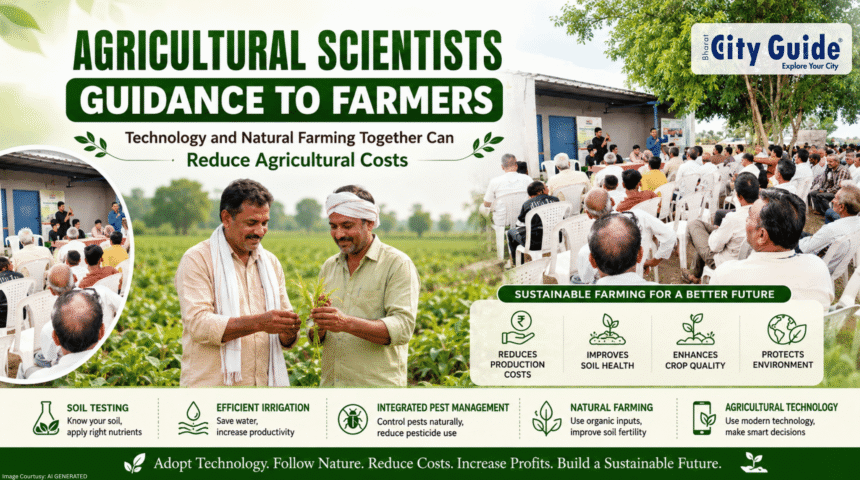
Recently, a significant awareness and guidance program highlighted how modern technology and natural farming practices can work together to help farmers reduce costs and improve productivity. During this initiative, Agricultural Scientists Guidance to Farmers focused on practical solutions for reducing dependence on expensive chemical fertilizers and pesticides while improving soil health and crop quality.
The event emphasized that sustainable farming is no longer just an environmental choice but an economic necessity. Agricultural experts encouraged farmers to adopt scientific farming techniques, precision agriculture, and natural farming methods to achieve long-term success.
Understanding Agricultural Scientists Guidance to Farmers
Agricultural scientists are experts who study crops, soil, water management, plant diseases, agricultural technology, and sustainable farming systems. Their primary objective is to provide farmers with scientifically proven solutions that improve agricultural productivity and profitability.
The recent Agricultural Scientists Guidance to Farmers program focused on educating farmers about:
- Efficient fertilizer usage
- Soil health management
- Integrated pest management
- Precision farming technologies
- Natural farming techniques
- Water conservation methods
- Cost reduction strategies
- Sustainable crop production
By combining traditional agricultural knowledge with modern scientific advancements, farmers can make better decisions and achieve improved yields without unnecessary expenses.
Why Farmers Need Scientific Agricultural Guidance Today
The agricultural sector is facing numerous challenges that directly affect farm income and productivity.
Rising Input Costs
Farmers are spending more money on:
- Chemical fertilizers
- Pesticides
- Herbicides
- Irrigation
- Seeds
- Farm machinery
As input costs increase, profit margins become smaller.
Soil Degradation
Continuous use of chemical fertilizers can:
- Reduce soil fertility
- Destroy beneficial microorganisms
- Lower organic matter content
- Increase soil acidity
Healthy soil is essential for sustainable agriculture.
Climate Change Challenges
Farmers are experiencing:
- Irregular rainfall
- Extreme temperatures
- Drought conditions
- Unexpected pest outbreaks
Scientific guidance helps farmers adapt to changing weather patterns.
Pest and Disease Management
New pests and crop diseases continue to emerge, making traditional management practices less effective. Agricultural scientists provide updated recommendations based on current research.
Key Messages from Agricultural Scientists Guidance to Farmers
One of the most important messages delivered by agricultural experts was that farmers should not rely solely on chemical inputs. Instead, they should adopt a balanced approach that combines technology with natural farming methods.
Technology and Natural Farming Must Work Together
Experts explained that sustainable agriculture requires:
- Scientific planning
- Soil testing
- Precision nutrient management
- Natural farming inputs
- Organic matter enhancement
- Efficient irrigation systems
This integrated approach can significantly reduce production costs while maintaining crop quality.
Reduce Unnecessary Fertilizer Usage
Many farmers apply fertilizers without understanding the actual nutrient requirements of their soil.
Agricultural scientists advised farmers to:
- Conduct regular soil testing
- Apply nutrients based on soil reports
- Avoid over-fertilization
- Use organic manure whenever possible
This practice can reduce fertilizer expenses while improving soil health.
Minimize Pesticide Dependence
Instead of excessive pesticide spraying, experts recommended:
- Pest monitoring
- Biological control methods
- Integrated pest management
- Natural pest repellents
These methods help reduce chemical costs and environmental damage.
Modern Agricultural Technologies Recommended for Farmers
The Agricultural Scientists Guidance to Farmers program highlighted several technologies that can increase efficiency and reduce farming expenses.
Soil Testing Technology
Soil testing helps determine:
- Nutrient levels
- Soil pH
- Organic carbon content
- Micronutrient deficiencies
Benefits include:
- Accurate fertilizer recommendations
- Reduced input costs
- Improved crop growth
- Better yields
Precision Farming
Precision farming uses technology to optimize resource usage.
Key benefits:
- Reduced fertilizer waste
- Efficient irrigation
- Better crop monitoring
- Increased productivity
Drip Irrigation Systems
Water scarcity is becoming a major concern in agriculture.
Drip irrigation offers:
- Water savings up to 50%
- Improved crop growth
- Reduced weed growth
- Lower labor costs
Mobile-Based Agricultural Advisory Services
Farmers can now receive:
- Weather updates
- Pest alerts
- Crop management advice
- Market information
through mobile applications and digital platforms.
Natural Farming Practices Suggested by Agricultural Experts
Natural farming is gaining popularity because it reduces production costs and improves environmental sustainability.
Use of Organic Manure
Organic manure improves:
- Soil fertility
- Water retention
- Microbial activity
- Nutrient availability
Examples include:
- Farmyard manure
- Compost
- Vermicompost
- Green manure
Bio-Fertilizers
Bio-fertilizers contain beneficial microorganisms that help plants absorb nutrients naturally.
Advantages:
- Lower fertilizer expenses
- Improved soil health
- Environmentally friendly farming
Natural Pest Control
Agricultural scientists recommended:
- Neem-based solutions
- Biological pesticides
- Beneficial insects
- Herbal formulations
These alternatives help reduce chemical pesticide usage.
Crop Rotation
Crop rotation helps:
- Improve soil fertility
- Break pest cycles
- Reduce disease incidence
- Increase long-term productivity
Benefits of Combining Technology and Natural Farming
The primary focus of the Agricultural Scientists Guidance to Farmers initiative was integrating modern technology with traditional sustainable practices.
Reduced Production Costs
Farmers can save money through:
- Lower fertilizer use
- Reduced pesticide expenses
- Efficient water management
- Better resource utilization
Improved Soil Health
Combining scientific and natural methods:
- Enhances soil structure
- Increases organic matter
- Promotes beneficial microorganisms
- Improves nutrient availability
Better Crop Quality
Consumers increasingly prefer crops produced using environmentally friendly methods.
Benefits include:
- Better taste
- Higher nutritional value
- Reduced chemical residues
- Increased market demand
Environmental Protection
Sustainable farming practices help:
- Reduce pollution
- Conserve water
- Protect biodiversity
- Improve ecosystem health
Practical Recommendations Given to Farmers
Agricultural scientists shared several practical recommendations that farmers can implement immediately.
Conduct Regular Soil Testing
Before applying fertilizers:
- Test soil nutrient levels
- Follow scientific recommendations
- Avoid guesswork
Use Balanced Fertilization
Farmers should:
- Apply nutrients according to crop needs
- Avoid excessive nitrogen usage
- Include organic matter
Adopt Integrated Pest Management
Integrated Pest Management (IPM) involves:
- Monitoring pest populations
- Using biological controls
- Applying pesticides only when necessary
Improve Water Management
Recommended techniques include:
- Drip irrigation
- Mulching
- Rainwater harvesting
- Scheduled irrigation
Keep Farm Records
Maintaining records helps farmers:
- Track expenses
- Monitor yields
- Evaluate farming practices
- Improve decision-making
Challenges Farmers May Face During Transition
Although sustainable farming offers many benefits, transitioning from conventional practices may present some challenges.
Initial Learning Curve
Farmers may need training on:
- New technologies
- Natural farming techniques
- Soil management practices
Mindset Change
Many farmers are accustomed to traditional chemical-based approaches.
Adopting new methods requires:
- Patience
- Experimentation
- Continuous learning
Availability of Resources
Some areas may have limited access to:
- Soil testing facilities
- Agricultural experts
- Organic inputs
- Technical support
However, government programs and agricultural institutions are increasingly providing support.
Role of Agricultural Scientists in Future Farming
Agricultural scientists will continue to play a vital role in transforming agriculture.
Their contributions include:
Research and Innovation
Scientists develop:
- Improved crop varieties
- Sustainable farming practices
- Climate-resilient technologies
Farmer Education
Training programs help farmers:
- Adopt new technologies
- Improve productivity
- Increase profitability
Sustainable Development
Agricultural experts support:
- Environmental conservation
- Food security
- Rural development
Climate Change Adaptation
Scientists help farmers prepare for:
- Drought conditions
- Extreme weather
- Emerging pests and diseases
Government Support for Sustainable Agriculture
Governments and agricultural institutions are actively promoting sustainable farming practices.
Key support measures include:
Subsidies
Farmers may receive subsidies for:
- Drip irrigation systems
- Organic farming inputs
- Agricultural equipment
Training Programs
Various organizations conduct:
- Farmer awareness camps
- Demonstration projects
- Skill development workshops
Digital Agriculture Initiatives
Digital platforms provide:
- Real-time agricultural advice
- Weather forecasts
- Market information
These resources help farmers make informed decisions.
Economic Impact of Scientific Farming Practices
Scientific farming can significantly improve farm profitability.
Lower Input Costs
Reduced expenditure on:
- Fertilizers
- Pesticides
- Water
- Labor
Higher Productivity
Better resource management often leads to:
- Increased crop yields
- Improved crop quality
- Better market prices
Long-Term Sustainability
Healthy soil and efficient farming practices support consistent productivity for future generations.
Future of Agriculture in India
The future of Indian agriculture depends on adopting sustainable and scientifically guided farming methods.
Key trends include:
- Precision agriculture
- Digital farming
- Natural farming
- Climate-smart agriculture
- Resource-efficient technologies
The combination of technology and traditional wisdom can help farmers achieve economic stability while protecting natural resources.
Frequently Asked Questions (FAQs)
What was the main objective of the Agricultural Scientists Guidance to Farmers program?
The program aimed to educate farmers about reducing fertilizer and pesticide costs through scientific farming techniques, technology adoption, and natural farming practices.
How can soil testing help farmers save money?
Soil testing identifies nutrient deficiencies and prevents unnecessary fertilizer application, reducing overall input costs.
Why are agricultural scientists promoting natural farming?
Natural farming improves soil health, reduces chemical dependency, lowers production costs, and supports environmental sustainability.
What is Integrated Pest Management (IPM)?
IPM is a scientific approach that combines biological, cultural, and chemical methods to manage pests effectively while minimizing pesticide use.
Can technology and natural farming work together?
Yes. Agricultural scientists recommend combining modern agricultural technology with natural farming methods for better productivity and sustainability.
How does drip irrigation benefit farmers?
Drip irrigation reduces water wastage, improves crop growth, lowers labor requirements, and helps save irrigation costs.
What is the biggest benefit of sustainable agriculture?
The biggest benefit is long-term profitability through improved soil health, reduced production costs, and environmental conservation.
Conclusion
The recent Agricultural Scientists Guidance to Farmers initiative delivered an important message for the farming community: the future of agriculture lies in the balanced integration of technology and natural farming practices. With rising fertilizer and pesticide costs, farmers need practical, science-based solutions that improve productivity without increasing expenses.
Agricultural experts emphasized that soil testing, precision farming, integrated pest management, efficient water usage, and natural farming techniques can help farmers reduce costs while maintaining healthy crop production. By adopting these recommendations, farmers can improve profitability, protect soil health, and ensure long-term agricultural sustainability.
As agriculture continues to face challenges from climate change, resource scarcity, and increasing input costs, scientific guidance and sustainable farming practices will become even more important. Farmers who embrace innovation while respecting nature will be better positioned to succeed in the future.