Introduction
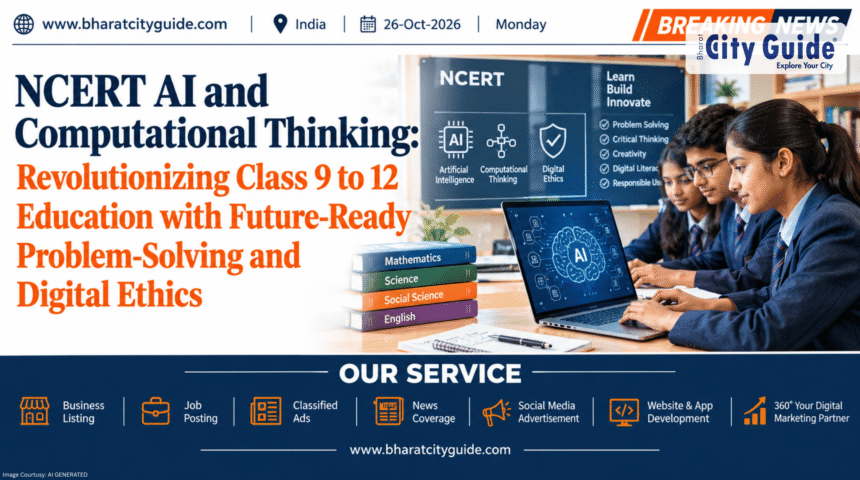
In a transformative leap for India’s school education ecosystem, the National Council of Educational Research and Training (NCERT) has officially introduced an innovative NCERT AI and Computational Thinking learning module for students in Classes 9 to 12. Designed under the vision of the National Education Policy (NEP) 2020, this 20-hour introductory curriculum equips secondary and senior secondary students with systematic problem-solving skills, artificial intelligence literacy, and digital ethics. The curriculum addresses the growing presence of generative AI, automated decision-making, and digital algorithms in daily life, ensuring that Indian students evolve from passive technology consumers into critical, responsible digital thinkers.
- Introduction
- What is NCERT AI and Computational Thinking?
- Why This News is Important
- Background Information
- Key Highlights
- Detailed Breakdown of the Curriculum Structure
- Benefits and Importance of the New Curriculum
- How It Impacts Students, Teachers, and Parents
- Expert Insights and Educational Perspective
- Challenges and Implementation Strategy
- Frequently Asked Questions (FAQs)
- Conclusion
The official launch of this module marks a major shift from traditional computer science teaching toward modern, activity-based computational logic. Developed to require no prior programming or computer science knowledge, the curriculum introduces students to the core principles of artificial intelligence, machine learning, data privacy, and algorithmic bias. Crucially, the module emphasizes that artificial intelligence should serve as a supportive tool—a “helper stance”—rather than a replacement for human critical thinking, creativity, and moral judgment.
This educational framework addresses the opportunities and challenges of the 21st-century digital world. By embedding practical activities like privacy policy dissections, AI hallucination hunts, and prompt engineering exercises directly into school learning, NCERT bridges the gap between theoretical classroom study and real-world technology. As schools across Gujarat and India prepare to integrate this curriculum, the initiative promises to empower millions of students with the logical and ethical foundation needed to navigate an AI-driven global economy.
What is NCERT AI and Computational Thinking?
The NCERT AI and Computational Thinking module is a specialized, 20-hour educational framework developed by NCERT under the Ministry of Education for students enrolled in Classes 9, 10, 11, and 12. Rather than teaching complex coding syntax or advanced software engineering, the curriculum focuses on Computational Thinking (CT)—a structured methodology for decomposing complex problems, recognizing patterns, abstracting essential information, and designing step-by-step algorithmic solutions.
The curriculum combines computational logic with practical Artificial Intelligence (AI) literacy. It guides students through five core learning units: recognizing AI in daily life, understanding how machines learn from datasets, identifying AI errors and hallucinations, protecting personal data privacy, and mastering prompt engineering using modern AI tools.
+-----------------------------------------------------------------------+
|             NCERT AI & COMPUTATIONAL THINKING AT A GLANCE             |
+--------------------------+--------------------------------------------+
| Developing Body          | NCERT (Ministry of Education, Govt.)       |
| Target Grades            | Secondary & Senior Secondary (Classes 9-12)|
| Course Duration          | 20-Hour Module (Flexible Delivery)         |
| Prerequisites            | None (No prior coding/math required)       |
| Primary Focus            | Logic, Data Privacy, Ethical AI & Verification|
| Learning Approach        | Experiential, Plugged & Unplugged Activities|
| Alignment                | National Education Policy (NEP) 2020       |
+--------------------------+--------------------------------------------+
Importantly, the framework is designed to be accessible across diverse educational settings. It incorporates both “plugged” (computer-based) and “unplugged” (offline, paper-and-pencil) classroom activities, allowing resource-constrained rural schools and high-tech urban institutes to deliver the curriculum effectively without requiring expensive hardware infrastructure.
Why This News is Important
The introduction of artificial intelligence and computational thinking into mainstream secondary school textbooks represents a crucial policy update for Indian education. First, the rapid adoption of generative AI tools like ChatGPT, Gemini, and image generators means that students interact with AI daily. Teaching students how these tools operate, where they fail, and why they generate inaccurate information (hallucinations) prevents blind trust in automated outputs and fosters healthy digital skepticism.
Second, the curriculum directly addresses urgent digital safety concerns, including data privacy, online consent, and algorithmic bias. By teaching students how mobile applications collect, retain, and share personal data, the module builds digital awareness, equipping young citizens to safeguard their digital footprints.
Finally, this initiative aligns national school education with evolving global workforce needs. By cultivating systematic problem-solving, logical reasoning, and creative thinking during formative high school years, NCERT prepares students for higher technical education, multidisciplinary careers, and digital citizenship in an automated world.
Background Information
The integration of artificial intelligence into school education stems directly from the recommendations of the National Education Policy (NEP) 2020 and the National Curriculum Framework for School Education (NCF-SE). NEP 2020 emphasizes moving away from rote memorization toward conceptual understanding, mathematical thinking, and early exposure to contemporary technologies.
Previously, computer education in Indian schools focused primarily on basic digital literacy, office software applications, and introductory programming languages like HTML, C++, or Python. However, the global explosion of machine learning, deep neural networks, and generative AI highlighted the need for an updated pedagogical approach.
+-----------------------------------------------------------------------+
|                    THE 5 UNITS OF THE NCERT AI MODULE                 |
+--------------------------+--------------------------------------------+
| Unit Structure           | Core Learning Theme & Key Activity         |
+--------------------------+--------------------------------------------+
| Unit 1: Everyday AI      | Distinguishing rules-based systems vs. AI  |
| Unit 2: Machine Learning | How machines learn from data & fail        |
| Unit 3: AI Limitations   | Fact-checking AI outputs & 5-Step Checks   |
| Unit 4: Data Privacy     | Dissecting app terms & data rights         |
| Unit 5: Prompting Tools  | Mastering the "Helper Stance" in AI use    |
+--------------------------+--------------------------------------------+
To address this need, NCERT developed a balanced, 20-hour modular framework that can be integrated into existing school timetables. By combining cognitive problem-solving with ethical technology guidelines, NCERT established a modern curriculum framework that serves as a benchmark for state education boards across India.
Key Highlights
- 20-Hour Specialized Module: Designed for flexible implementation across Classes 9, 10, 11, and 12.
- Zero Prerequisites Needed: Open to all academic streams (Science, Commerce, and Humanities) without requiring prior coding experience.
- Activity-Based Experiential Learning: Uses discussions, hands-on experiments, verification checklists, and privacy audits instead of rote learning.
- Equal Access via Unplugged Activities: Designed to work in offline classrooms without computers or internet access, ensuring equity for rural schools.
- Focus on Ethical AI and Privacy: Teaches students data protection rights, bias recognition, and source verification techniques.
- The “Helper Stance” Philosophy: Emphasizes that AI should assist human intellect rather than replace independent human thinking.
Detailed Breakdown of the Curriculum Structure
The NCERT AI and Computational Thinking module is organized into five structured units, guiding students through progressive levels of technological understanding and logical reasoning.
Unit 1: AI Is Already in Your Life
This foundational unit teaches students to identify artificial intelligence in daily technologies—such as recommendation engines, spam filters, predictive text, and facial recognition. Students learn to distinguish between ordinary rule-based automation (like an automatic washing machine) and true AI systems that adapt based on data patterns.
- Key Activity: The AI Diary — Students log and analyze every AI interaction they encounter throughout a typical day.
Unit 2: How Machines Learn from Examples
Students explore the fundamentals of supervised machine learning without complex mathematics. The lesson illustrates how algorithms analyze training datasets, identify statistical patterns, and make predictions on new data.
- Key Activity: Train-and-Break Log — Students train a simple image classifier model and deliberately test edge cases to observe where and why the model fails.
Unit 3: When AI Gets It Wrong
Focused on critical thinking and information literacy, this unit explores AI hallucinations, algorithmic bias, and automated errors. Students learn not to accept AI outputs blindly, mastering NCERT’s “Five Checks” framework: verifying the Source, analyzing the Claim Type, Comparing multiple references, Pausing personal bias, and evaluating Confidence.
- Key Activity: Hallucination Hunt — Students fact-check generated essays, cross-referencing citations against reliable primary sources.
+-----------------------------------------------------------------------+
|                    THE NCERT "FIVE CHECKS" FOR AI TRUTH               |
+--------------------------+--------------------------------------------+
| Verification Check       | Student Action & Analytical Question       |
+--------------------------+--------------------------------------------+
| 1. Source Check          | Where did the AI claim to source this data?|
| 2. Claim Type            | Is this a verifiable fact or opinion?      |
| 3. Cross-Compare         | Do independent primary sources agree?      |
| 4. Pause Bias            | Am I accepting this because I want to?     |
| 5. Confidence Audit      | Is the AI sounding confident without proof?|
+--------------------------+--------------------------------------------+
Unit 4: Your Data, Your Rights, Your Responsibility
Addressing digital safety and ethics, this unit teaches students how personal data fuels commercial AI models. Students analyze digital privacy, user consent, data retention policies, and digital footprint management.
- Key Activity: Privacy Policy Dissection — Students review real-world terms of service agreements to identify data collection and sharing practices.
Unit 5: Working with Modern AI Tools — Prompts and the Helper Stance
The final unit focuses on practical interaction with modern generative AI interfaces. It introduces structured prompt engineering—providing clear context, defining roles, specifying constraints, and iteratively refining outputs. It contrasts the “Replacement Stance” (letting AI think for you) with the recommended “Helper Stance” (using AI to support human intellect).
- Key Activity: Prompt Library Construction — Students build and document optimized prompt structures for study assistance and creative projects.
Benefits and Importance of the New Curriculum
Integrating computational thinking and AI literacy into high school education offers significant benefits for students, teachers, and society:
1. Developing Higher-Order Cognitive Skills
Computational thinking exercises strengthen core mental capabilities—including logical deduction, pattern recognition, abstraction, and problem decomposition. These skills enhance performance across mathematics, science, humanities, and everyday decision-making.
2. Safeguarding Against Online Misinformation
Teaching students to critically evaluate AI outputs, verify citations, and identify hallucinations protects young minds from automated misinformation, deepfakes, and biased digital content.
3. Promoting Equal Access Across the Digital Divide
By offering “unplugged” physical activities that do not require high-speed internet or expensive computer labs, NCERT ensures that students in rural and government schools receive the same quality technology education as those in urban private schools.
4. Protecting Personal Privacy and Youth Digital Rights
Understanding how mobile apps gather, track, and monetize personal data empowers teenagers to adjust privacy settings, safeguard their personal information, and practice responsible digital citizenship.
How It Impacts Students, Teachers, and Parents
This educational update introduces positive, practical changes across the school ecosystem:
- For High School Students: Builds digital confidence and practical skills, helping them use AI tools responsibly for research and study while protecting their personal privacy and developing independent critical thinking.
- For Teachers and Educators: Provides a structured, activity-based 20-hour curriculum complete with offline lesson plans, reducing teacher prep time and enabling interactive classroom engagement.
- For Parents and Families: Delivers peace of mind knowing that teenagers are learning digital safety, privacy awareness, and responsible technology habits directly within the school curriculum.
- For Higher Education and Industry: Creates a tech-literate pool of high school graduates prepared for university studies in computer science, data analytics, engineering, and multidisciplinary fields.
Expert Insights and Educational Perspective
Education policy experts, child psychologists, and technology leaders have welcomed National Council of Educational Research and Training (NCERT) balanced curriculum framework. According to pedagogy specialists, the module’s greatest strength lies in its explicit rejection of “cognitive offloading”—the tendency for students to delegate thinking and writing entirely to automated AI platforms.
Child safety advocates also praise the curriculum’s strong emphasis on data privacy and critical verification. In an era dominated by rapid AI content generation, teaching high school students how to dissect privacy policies and fact-check automated responses instills essential digital habits early in life.
Furthermore, educational sociologists highlight the importance of the unplugged learning design. Allowing schools to teach core computational concepts through paper-based logic puzzles and group role-play activities ensures that technological education remains inclusive and accessible to every student, regardless of socio-economic background.
Challenges and Implementation Strategy
To successfully deliver this curriculum across thousands of schools nationwide, education authorities are addressing several practical implementation requirements:
- Comprehensive Teacher Upskilling: Conducting statewide teacher training workshops to help educators across all subjects comfortably deliver AI ethics and computational thinking lessons.
- Language Translation into Regional Media: Translating NCERT module textbooks into Gujarati, Hindi, Marathi, Tamil, and other regional languages to support state board schools.
- Integrating with Existing Timetables: Fitting the 20-hour module into academic schedules without overloading students preparing for board examinations.
- Continuous Updates for Evolving Tech: Regularly updating curriculum examples and privacy case studies to keep pace with rapid developments in generative AI.
Frequently Asked Questions (FAQs)
What is the new NCERT AI and Computational Thinking module?
It is a 20-hour introductory educational framework developed by NCERT to teach Class 9 to 12 students computational problem-solving, AI principles, data privacy, and ethical technology use.
Which student grades will study this new NCERT module?
The curriculum is specifically designed for secondary and senior secondary students enrolled in Classes 9, 10, 11, and 12 across all academic streams.
Is prior computer coding knowledge required to study this module?
No, the module assumes zero prior knowledge of computer programming, coding, or advanced mathematics.
Can schools teach this AI module without computers or internet access?
Yes, NCERT designed the curriculum with “unplugged” activity options, allowing offline schools without digital infrastructure to teach computational logic using paper-and-pencil exercises.
What are the “Five Checks” taught in the NCERT AI module?
The Five Checks are a fact-checking framework used by students to verify AI outputs: checking the Source, analyzing Claim Type, Cross-Comparing references, Pausing personal bias, and auditing Confidence levels.
What is the difference between the “Helper Stance” and “Replacement Stance”?
The “Helper Stance” uses AI as a supportive tool while human intellect drives the thinking, whereas the “Replacement Stance” uncritically relies on AI to do the thinking in place of the student.
How does this module benefit students preparing for future careers?
It builds critical thinking, logical reasoning, data literacy, and ethical awareness, preparing students for success in higher education and a tech-driven workforce.
Conclusion
The introduction of the NCERT AI and Computational Thinking module for Classes 9 to 12 represents a forward-looking milestone for school education in India. By combining practical logic with digital ethics, data privacy awareness, and hands-on verification techniques, NCERT has created an educational framework that prepares students for the modern digital world.
This 20-hour curriculum ensures that technology serves human intellect rather than replacing independent thought, maintaining the central role of human judgment, creativity, and moral responsibility.
As classrooms across India adopt this interactive curriculum, students will gain the tools needed to think logically, evaluate digital information critically, and navigate emerging technologies safely. This initiative provides a strong foundation for building a future-ready, ethically conscious, and technologically empowered generation.