Introduction
Maa Mahagauri is one of the most beloved forms of Goddess Durga in Hinduism. Worshipped as the eighth manifestation of Navadurga, the nine divine forms of the Goddess, she represents purity, peace, compassion, forgiveness, and spiritual renewal. Her name is associated with extraordinary radiance and a spotless, luminous appearance. According to a popular Hindu devotional story, Goddess Parvati performed intense penance to attain Lord Shiva as her husband. During her long period of austerity, her body became darkened by the elements, but after Shiva was pleased with her devotion, her radiance was restored through the sacred waters of the Ganga. She came to be revered as Maa Mahagauri, the great radiant Goddess. Devotees worship her on the eighth day of Navratri, also known as Durga Ashtami in many traditions, and seek her blessings for peace, happiness, wisdom, and harmony in family life. Her divine form reminds devotees that difficulties can lead to spiritual growth and that sincere devotion, patience, and purity of intention are important parts of the spiritual journey. Understanding the story of Maa Mahagauri, her divine appearance, religious significance, mantras, and puja rituals helps reveal the timeless values she represents in Hindu tradition.
- Introduction
- Who Is Maa Mahagauri?
- The Divine Story of Maa Mahagauri
- Why Is Maa Mahagauri Worshipped on the Eighth Day of Navratri?
- The Divine Appearance and Symbolism of Maa Mahagauri
- Spiritual Significance of Maa Mahagauri
- Maa Mahagauri Puja Vidhi: How to Worship the Goddess
- Powerful Maa Mahagauri Mantra and Its Meaning
- Bhog and Favourite Offerings for Maa Mahagauri
- Kanya Puja and Maa Mahagauri
- Maa Mahagauri and Marriage: Traditional Beliefs
- The Difference Between Maa Kalaratri and Maa Mahagauri
- Important Lessons We Can Learn from Maa Mahagauri
- Frequently Asked Questions About Maa Mahagauri
- Conclusion
Who Is Maa Mahagauri?
Maa Mahagauri is the eighth form of Goddess Durga in the traditional Navadurga sequence. She is revered as a peaceful and compassionate manifestation of the Divine Mother, associated with purity, serenity, and auspiciousness.
The name Mahagauri is commonly explained through two Sanskrit elements: Maha, meaning great, and Gauri, meaning fair, bright, or radiant. Together, the name conveys the idea of the great radiant Goddess.
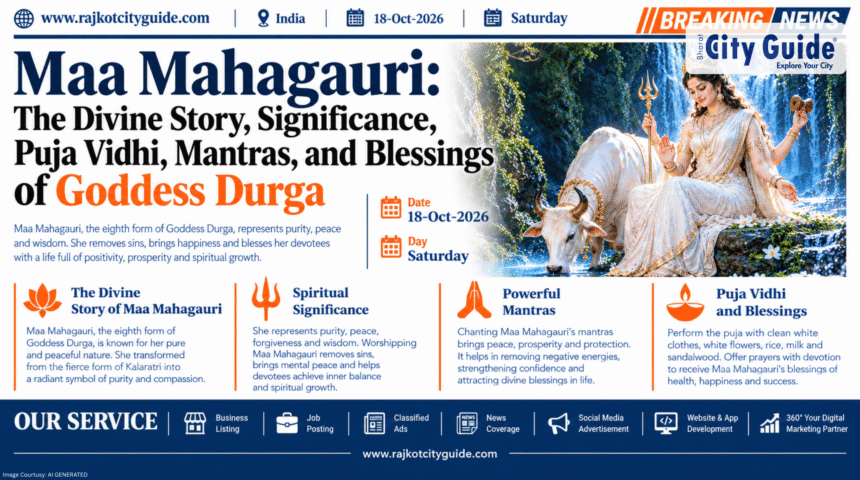
Maa Mahagauri is generally depicted with a luminous complexion, white garments, four arms, and a calm expression. She rides a white bull, traditionally associated with strength and righteousness. In her hands, she may carry a trident and a damaru, the small drum associated with Lord Shiva, while the remaining hands display gestures of protection and blessing.
She is worshipped on the eighth day of Navratri, when devotees pray for inner peace, purification of the mind, and spiritual progress. In many households, her worship is also associated with family well-being and the observance of Kanya Puja.
Maa Mahagauri is not merely a symbol of external beauty. Her deeper significance lies in the purity of thought, speech, and action. She reminds devotees that a peaceful heart, sincere intentions, and compassionate behaviour are essential qualities of a meaningful life.
The Divine Story of Maa Mahagauri
The most widely told traditional story of Maa Mahagauri is connected with Goddess Parvati’s intense penance to attain Lord Shiva as her husband.
According to Hindu devotional tradition, Parvati was born as the daughter of Himavan, the king of the mountains, and his wife, Maina. From an early age, she was devoted to Lord Shiva and wished to marry him. However, Shiva was deeply absorbed in meditation and lived a life of ascetic discipline.
Determined to fulfil her spiritual aspiration, Parvati undertook severe penance. She meditated for long periods, endured difficult weather, and remained devoted to Shiva despite physical hardships. Her dedication is celebrated as an example of patience, self-discipline, and unwavering faith.
During this prolonged austerity, the elements, dust, and difficult conditions darkened her complexion in the popular retelling of the story. Nevertheless, Parvati remained steadfast in her devotion.
Eventually, Lord Shiva was pleased with her sincere penance and accepted her as his consort. In one commonly told version, Shiva bathed Parvati with the sacred waters of the Ganga, restoring her radiant, luminous complexion. Because of this extraordinary radiance, she became known as Maa Mahagauri.
This story is especially important in Navratri worship because it portrays the Goddess as both a devoted spiritual seeker and a divine mother who embodies purity and grace.
The details of the story vary across devotional retellings, and the transformation of Parvati’s complexion should be understood as part of religious mythology rather than a verifiable historical event. Its spiritual message, however, is clear: perseverance, faith, and inner strength can help a person move through hardship toward renewal.
Why Is Maa Mahagauri Worshipped on the Eighth Day of Navratri?
Navratri is a sacred Hindu festival dedicated to the worship of the nine forms of Goddess Durga. Each day of the traditional Navadurga sequence is associated with a particular manifestation of the Divine Mother.
Maa Mahagauri is worshipped on the eighth day, known as Ashtami. In many communities, this day is celebrated as Durga Ashtami or Maha Ashtami and holds special importance in the Navratri festival.
Devotees worship Maa Mahagauri to express gratitude and seek spiritual purity, peace, harmony, and divine guidance. Her serene form provides a contrast to the fierce warrior manifestations that precede her in the Navadurga sequence.
During this day, devotees may visit temples, perform puja at home, chant mantras, offer flowers and sweets, and participate in Kanya Puja according to their family or regional traditions.
Some devotees observe a fast, while others perform a special meal offering or conclude their Navratri worship on Ashtami. Practices differ among regions and households, and some families perform Kanya Puja on Navami instead.
The central purpose of Maa Mahagauri’s worship is to honour the Divine Mother and reflect on the importance of purity, kindness, discipline, and spiritual renewal.
The Divine Appearance and Symbolism of Maa Mahagauri
Maa Mahagauri’s traditional appearance is filled with symbolic meaning. Her white garments, radiant complexion, four arms, and white bull distinguish her from the other forms of Navadurga.
White complexion: Her luminous appearance symbolizes purity, peace, clarity, and spiritual awakening. It reflects the cleansing of negative thoughts and the renewal of inner strength.
White garments: White clothing is traditionally associated with tranquillity, simplicity, and purity. Maa Mahagauri’s white garments reflect her calm and compassionate nature.
The white bull: Her vehicle is generally identified as a bull, often called Vrishabha. It symbolizes strength, stability, and disciplined power. The bull also connects her iconography with Lord Shiva.
The trident: The trident represents divine strength and the power to overcome harmful influences. In devotional interpretations, it can also symbolize mastery over destructive tendencies.
The damaru: The small drum associated with Shiva represents the rhythm of creation and the movement of cosmic energy.
The blessing gestures: One hand may display abhaya mudra, which represents fearlessness and protection, while another may display varada mudra, the gesture of generosity and blessings.
Together, these symbols communicate the essence of Maa Mahagauri: strength guided by peace, power balanced by compassion, and purity expressed through righteous conduct.
Spiritual Significance of Maa Mahagauri
Maa Mahagauri holds a special place in Hindu devotion because she represents the possibility of renewal after hardship. Her traditional story and peaceful form offer several important spiritual lessons.
1. Purity of Mind and Heart
Maa Mahagauri symbolizes purity in thoughts, words, and actions. Her worship encourages devotees to practise honesty, kindness, and respect in their daily lives.
2. Peace and Emotional Balance
Her serene appearance reminds devotees of the importance of calmness. During difficult situations, patience and a balanced mind can help people make better decisions.
3. Forgiveness and Renewal
The Goddess is associated in devotional traditions with forgiveness and the release of past burdens. Her symbolism encourages people to acknowledge their mistakes, learn from them, and begin again with sincere intentions.
4. Devotion and Perseverance
Parvati’s penance demonstrates the importance of dedication and patience. Her story encourages devotees to remain committed to worthwhile goals even when progress seems slow.
5. Compassion and Harmony
Maa Mahagauri’s gentle form inspires compassion toward family members, friends, and the wider community. Her worship reminds devotees that kindness and understanding are essential to harmonious relationships.
These spiritual values make Maa Mahagauri’s worship meaningful throughout the year, not only during Navratri.
Maa Mahagauri Puja Vidhi: How to Worship the Goddess
Maa Mahagauri can be worshipped at home or in a temple with devotion and respect. The rituals may differ according to regional customs, but the following steps provide a simple traditional approach.
Step 1: Clean the puja area. Clean the place of worship and arrange a picture or idol of Maa Mahagauri on a clean platform.
Step 2: Prepare yourself for worship. Bathe, wear clean clothes, and sit peacefully before the Goddess. Take a moment to focus your mind on prayer.
Step 3: Light a diya. Light an oil or ghee lamp safely. Incense may also be offered according to your household’s tradition.
Step 4: Offer flowers and water. Offer fresh flowers, water, and other customary puja items. White flowers are often chosen because they reflect the Goddess’s association with purity.
Step 5: Offer bhog. Coconut is a commonly associated offering to Maa Mahagauri. Fruits, sweets, and other vegetarian preparations may also be offered.
Step 6: Chant the sacred mantra. Recite the Maa Mahagauri mantra with concentration and devotion. Some devotees repeat it 11, 21, or 108 times according to their personal practice.
Step 7: Read a devotional prayer. Recite a Navadurga prayer, a suitable hymn, or passages from the Durga Saptashati if that is part of your tradition.
Step 8: Perform aarti. Sing or recite the aarti dedicated to the Goddess and pray for peace, wisdom, and the well-being of your family.
Step 9: Offer prasad. Conclude the puja with gratitude and distribute the blessed offering among family members or devotees, where appropriate.
The most important part of worship is sincerity. Devotees can follow a simple ritual according to their circumstances and family customs without feeling that elaborate arrangements are necessary.
Powerful Maa Mahagauri Mantra and Its Meaning
Mantra chanting is an important part of Maa Mahagauri worship. Devotees recite sacred prayers to express their devotion and seek the blessings of the Divine Mother.
1. Maa Mahagauri Namah Mantra
Mantra:
ॐ देवी महागौर्यै नमः॥
Transliteration: Om Devi Mahagauryai Namah.
Meaning: I bow to Goddess Mahagauri, the divine Mother associated with purity, peace, and auspiciousness.
This is a simple mantra that devotees may chant during daily worship or on the eighth day of Navratri.
2. Maa Mahagauri Beej Mantra
Mantra:
ॐ ऐं ह्रीं क्लीं महागौर्यै नमः॥
Transliteration: Om Aim Hreem Kleem Mahagauryai Namah.
This mantra is used in some devotional traditions to invoke the divine energy of Maa Mahagauri. Devotees may chant it during meditation and worship according to their customary practice.
3. Maa Mahagauri Dhyana Shloka
Sanskrit:
श्वेते वृषे समारूढा श्वेताम्बरधरा शुचिः।
महागौरी शुभं दद्यान्महादेवप्रमोददा॥
Transliteration:
Shwete Vrishesamarudha Shwetambaradhara Shuchih,
Mahagauri Shubham Dadyan Mahadeva Pramodada.
Meaning: May the pure Goddess Mahagauri, who rides a white bull and wears white garments, bestow auspiciousness and bring joy to Mahadeva, Lord Shiva.
This traditional verse describes the Goddess’s peaceful appearance and her connection with Shiva.
Devotees should focus on the meaning of the prayer as well as its recitation. Pronunciation and wording may vary slightly across devotional sources and regional traditions.
Bhog and Favourite Offerings for Maa Mahagauri
Offering bhog is a traditional way of expressing gratitude and devotion to Maa Mahagauri. Different households follow different customs, but several offerings are commonly associated with her worship.
- Coconut: Coconut is widely associated with Maa Mahagauri and is offered during Navratri worship in many traditions.
- White flowers: These reflect the Goddess’s association with purity and peace.
- Fresh fruits: Seasonal fruits are a simple and respectful offering.
- Milk-based sweets: Kheer and other vegetarian sweets may be offered according to family customs.
- Water: Water is a customary part of Hindu puja.
- A diya: A lamp symbolizes devotion and spiritual clarity.
After the puja, offerings may be distributed as prasad among family members and other devotees.
The significance of bhog lies in the devotion with which it is offered. A simple offering presented with sincerity is meaningful within the spirit of Hindu worship.
Kanya Puja and Maa Mahagauri
Kanya Puja, also known as Kanjak Puja in some regions, is an important Navratri tradition associated with the worship of the Divine Feminine. It is commonly performed on Ashtami or Navami, depending on the family’s customs.
During this ritual, young girls are honoured as manifestations of the Goddess. Families may invite girls to their homes, wash their feet as a gesture of respect, offer food, and present small gifts according to their means and traditions.
The meal commonly served in some North Indian households includes puri, kala chana, and halwa. The precise menu and ritual sequence vary by region.
The deeper meaning of Kanya Puja is reverence for feminine divinity and respect for girls. The ritual reminds devotees that the Goddess should be honoured not only through images and prayers but also through respectful treatment of women and girls in everyday life.
When performing Kanya Puja, families should ensure that children participate willingly, are treated with dignity, and are never pressured into religious activities.
Maa Mahagauri and Marriage: Traditional Beliefs
Maa Mahagauri is associated with Goddess Parvati, whose devotion to Lord Shiva is central to her traditional story. Because of this connection, some devotees worship her while praying for a suitable life partner, a harmonious marriage, and peace within the family.
Her story emphasizes patience, dedication, and sincerity. These values are relevant to relationships because lasting partnerships require mutual respect, understanding, and a willingness to work through difficulties.
Devotees may offer prayers to Maa Mahagauri for happiness in married life and for strength when facing family challenges. Her peaceful form also reminds people to approach disagreements with compassion rather than anger.
These beliefs are part of religious tradition and should not be understood as guarantees of a particular marriage outcome. Prayer can provide spiritual comfort and direction, while healthy relationships also depend on communication, mutual consent, respect, and responsible choices.
The Difference Between Maa Kalaratri and Maa Mahagauri
Maa Kalaratri and Maa Mahagauri are two distinct forms in the Navadurga sequence, each representing a different aspect of divine power.
Maa Kalaratri is worshipped on the seventh day of Navratri and is associated with the destruction of fear, ignorance, and harmful forces. Her dark complexion and fierce appearance represent formidable protective energy.
Maa Mahagauri is worshipped on the eighth day and is associated with purity, serenity, forgiveness, and spiritual renewal. Her luminous appearance and white garments symbolize peace and clarity.
In the traditional Navadurga sequence, the two forms illustrate complementary qualities of the Divine Mother. Maa Kalaratri represents the courage required to confront darkness, while Maa Mahagauri represents the serenity and renewal that devotees seek after overcoming challenges.
Both forms teach that strength and compassion are not opposites. They are different expressions of divine protection and spiritual wisdom.
Important Lessons We Can Learn from Maa Mahagauri
The story of Maa Mahagauri offers several lessons that can guide people in everyday life.
Practise patience: Parvati’s long penance teaches that meaningful goals often require persistence and discipline.
Keep your intentions pure: Maa Mahagauri’s symbolism encourages honesty, kindness, and sincerity in personal and professional relationships.
Learn from past mistakes: Spiritual renewal involves acknowledging errors and making a genuine effort to improve.
Choose peace over unnecessary conflict: Her calm appearance reminds devotees to approach difficulties thoughtfully and avoid acting in anger.
Respect others: The Goddess’s association with compassion encourages respect for family members, women, girls, and all people.
Remain hopeful during hardship: Her story is often understood as a reminder that difficult periods can lead to growth and renewed strength.
These teachings allow devotees to carry the spirit of Maa Mahagauri beyond the temple or festival and into their daily conduct.
Frequently Asked Questions About Maa Mahagauri
1. Who is Maa Mahagauri?
Maa Mahagauri is the eighth form of Goddess Durga among the Navadurga. She represents purity, peace, compassion, forgiveness, and spiritual renewal.
2. Why is Maa Mahagauri worshipped on the eighth day of Navratri?
She is traditionally worshipped on Ashtami, the eighth day of Navratri, when devotees seek her blessings for peace, spiritual growth, and family well-being.
3. What is the main mantra of Maa Mahagauri?
Her commonly recited mantra is “ॐ देवी महागौर्यै नमः॥” (Om Devi Mahagauryai Namah).
4. What is the story behind Maa Mahagauri’s name?
According to a popular devotional story, Parvati’s complexion darkened during her prolonged penance. After Shiva was pleased with her devotion, her radiance was restored, and she became known as Mahagauri, meaning the great radiant Goddess.
5. Which offering is commonly associated with Maa Mahagauri?
Coconut is a commonly associated offering. Devotees may also offer white flowers, fruits, and vegetarian sweets according to their family traditions.
Conclusion
Maa Mahagauri is a beautiful and compassionate manifestation of Goddess Durga who represents purity, peace, forgiveness, and spiritual transformation. As the eighth form of Navadurga, she is worshipped on the eighth day of Navratri, when devotees seek her blessings for happiness, wisdom, harmony, and spiritual growth. Her traditional story describes Goddess Parvati’s unwavering devotion to Lord Shiva, her long period of penance, and the restoration of her radiant appearance through sacred waters. This story offers a powerful reminder that patience, dedication, and faith can help people move through difficult circumstances and begin anew. Her white garments, radiant complexion, four arms, and white bull carry symbolic meanings connected with purity, strength, protection, and auspiciousness. Through traditional puja rituals, sacred mantras, coconut offerings, and Kanya Puja, devotees express their love and reverence for the Divine Mother. Beyond religious ceremonies, Maa Mahagauri teaches the importance of maintaining pure intentions, forgiving mistakes, respecting others, and choosing peace over unnecessary conflict. Her association with renewal reminds devotees that personal growth begins with self-awareness and a willingness to improve. By worshipping Maa Mahagauri with sincerity and practising the values represented by her divine form, devotees can nurture inner peace, strengthen their faith, and approach life’s challenges with patience, compassion, and hope.