Introduction
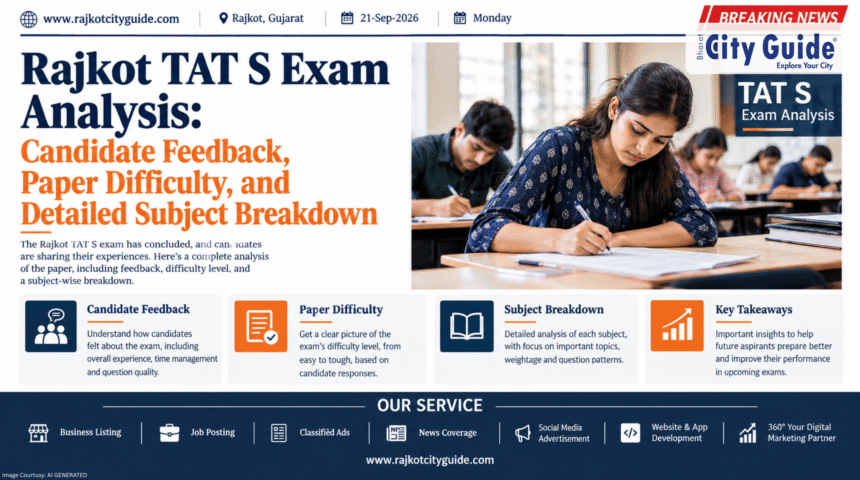
The State Examination Board (SEB), Gujarat, successfully conducted the Teacher Aptitude Test – Secondary (TAT-S) across multiple designated centers in the state, including major educational hubs like Rajkot. Designed to evaluate candidates seeking teaching positions for Classes 9 and 10 in government and grant-in-aid secondary schools across Gujarat, the competitive exam witnessed enthusiastic participation from thousands of teaching aspirants. Reports from examination venues across Rajkot confirmed that the overall test was administered in a smooth, well-organized, and peaceful environment, supported by strict invigilation and municipal security arrangements.
- Introduction
- What is Rajkot TAT S Exam Analysis?
- Why This News is Important
- Background Information
- Key Highlights
- Detailed Explanation of the Event
- Benefits, Features, and Importance
- How It Impacts People
- Expert Insights and Industry Perspective
- Challenges and Limitations
- Future Outlook
- Frequently Asked Questions (FAQs)
- Conclusion
Following the conclusion of both exam shifts, detailed candidate reactions provided valuable insights into the structure and difficulty of the test. According to candidate reviews gathered from various Rajkot test centers, the first paper aligned closely with standard preparation expectations and previous years’ trend lines. However, candidate feedback on the second paper was more nuanced, with many describing it as moderately complex and unexpectedly lengthy due to subject-specific detailed questions. This comprehensive Rajkot TAT S Exam Analysis breaks down candidate feedback, paper structure, section-wise weightage, scoring expectations, and competitive implications for secondary educator recruitment in Gujarat.
What is Rajkot TAT S Exam Analysis?
The Rajkot TAT S Exam Analysis refers to the systematic evaluation of candidate feedback, question paper difficulty, time management dynamics, and syllabus coverage for the Teacher Aptitude Test – Secondary (TAT-S) held across examination centers in Rajkot, Gujarat.
+--------------------------------------------------------------------------------+
|                     SEB GUJARAT TAT-S EXAM STRUCTURAL BREAKDOWN                |
+--------------------------------------------------------------------------------+
                                         |
    +------------------------------------+------------------------------------+
    |                                    |                                    |
    v                                    v                                    v
[ PAPER 1: GENERAL APTITUDE ]  [ PAPER 2: SPECIALIZED CONTENT ]  [ OVERALL EVALUATION ]
- Marks: 100 Objective Questions- Marks: 100 (80 Content + 20 Method)- Moderate overall difficulty
- Pedagogy, GK, Logic, Languages- Lengthy subject-specific questions - Negative marking: -0.25 marks
- Rated: Expected & Manageable  - Rated: Moderately Lengthy       - Key factor: Time management
Administered under the supervision of the State Examination Board, Gandhinagar, the examination evaluates whether aspiring educators possess the foundational pedagogical knowledge, logical reasoning, language proficiency, and specialized subject mastery necessary to teach secondary school students. An exam analysis synthesizes direct candidate experiences from key Rajkot centers to help aspirants calculate projected cutoff scores and assess performance relative to state-level competitive benchmarks.
Why This News is Important
The smooth execution and preliminary analysis of the TAT-S examination carry significant weight for Gujarat’s public education framework:
- Benchmark for Quality Educator Recruitment: The TAT-S exam serves as the primary screening gateway for selecting qualified secondary school teachers across government and registered grant-in-aid institutions.
- Fair and Transparent Testing Environment: Conducting the exam peacefully without malpractices ensures equal opportunity and boosts confidence among thousands of hardworking candidates.
- Insights into Evolving Question Patterns: Candidate feedback regarding lengthy subject-specific questions provides future aspirants with clear guidance on time management strategies for upcoming recruitment cycles.
Background Information
In Gujarat’s state education hierarchy, securing a teaching position in secondary (Classes 9–10) or higher secondary (Classes 11–12) schools requires passing the Teacher Aptitude Test (TAT). The State Examination Board (SEB) regularly updates syllabus frameworks and examination formats to ensure that selected educators meet modern pedagogical standards. Candidates who hold a Bachelor’s degree along with a Bachelor of Education (B.Ed.) qualification are eligible to sit for the TAT-Secondary (TAT-S) examination.
[Degree: Graduation + B.Ed.] ➔ [SEB TAT-S Prelims Exam] ➔ [TAT-S Mains Writing Stage] ➔ [Merit List & School Placement]
The TAT selection process typically spans two main phases: a Preliminary Objective Examination (comprising Paper 1 General Studies and Paper 2 Subject Content) followed by a Descriptive Mains Examination for qualifying candidates. The exam uses a standard 1/4th (0.25) negative marking system for wrong answers in the objective phase, rewarding conceptual clarity while penalizing random guessing. Consequently, exam analyses are highly anticipated by candidates eager to gauge their relative performance before official answer keys are published.
Key Highlights
- Peaceful Administration: The TAT-S examination was conducted across all designated exam centers in Rajkot without administrative disruptions or reported irregularities.
- Paper 1 Meets Expectations: Aspirants overwhelmingly reported that Paper 1 (General Knowledge, Pedagogy, Logical Reasoning, and Language Skills) was balanced and aligned well with syllabus guidelines.
- Paper 2 Described as Lengthy: Candidate feedback highlighted that Paper 2 (Subject Content and Teaching Methods) was time-consuming, with detailed sub-questions requiring extra reading time.
- Strict Time Constraints: Many candidates in Rajkot noted that while Paper 2 was not excessively difficult conceptually, completing 100 subject-specific questions within the allotted time required sharp time management.
- Positive Atmosphere: Returning candidates expressed general satisfaction with center facilities, seating arrangements, and strict invigilation standards maintained by local authorities.
Detailed Explanation of the Event
1. Peaceful Execution Across Rajkot Exam Centers
From early morning, candidates gathered at designated examination venues across Rajkot. Center administrators implemented multi-layered identity verification, seating layout guidance, and security measures to ensure a smooth testing environment. Invigilators maintained strict adherence to SEB regulations, allowing candidates to complete both exam papers without administrative hiccups.
2. Paper 1 Review: General Knowledge and Pedagogy
Paper 1 consisted of 100 objective-type questions divided across key foundational domains: General Knowledge & Educational Trends (20 marks), Teacher Eligibility & Child Psychology (35 marks), Logical Aptitude (15 marks), Gujarati Language Proficiency (15 marks), and English Language Skills (15 marks).
Candidates interviewed outside Rajkot centers noted that the child psychology and teaching methodology sections featured familiar scenario-based questions. Current affairs questions focused on state and national educational policies, while the grammar and logical reasoning sections were straightforward for candidates who had thoroughly reviewed past years’ question papers.
3. Paper 2 Review: Subject Content and Methodologies
Paper 2 focused directly on the candidate’s chosen academic discipline (such as Mathematics-Science, Social Science, Gujarati, English, Hindi, or Computer Science), carrying 80 marks for core subject content and 20 marks for subject-specific teaching methods.
Feedback across subject streams revealed a common theme: the questions were thoroughly aligned with the Class 9 and 10 Gujarat State Board (GSEB) curriculum, but the formulation of options and multi-statement questions made the paper noticeably lengthy. Aspirants noted that analyzing complex options left little time for revision at the end of the shift.
Benefits, Features, and Importance
1. Transparent Evaluation Framework
The structured two-paper objective format used in the TAT-S preliminary stage allows SEB Gujarat to evaluate candidates impartially across both general teaching aptitude and specialized subject knowledge.
2. Alignment with Board Curriculum Standards
By anchoring Paper 2 directly to the Class 9 and 10 state textbook curriculum, the examination ensures that prospective teachers possess strong command over the exact concepts they will teach in secondary classrooms.
3. Clear Feedback for Future Aspirants
Detailed reviews from current test-takers provide actionable guidance for future aspirants, emphasizing that mastering speed, accuracy, and subject-specific reading comprehension is just as vital as theoretical preparation.
How It Impacts People
| Stakeholder Group | Direct Impact & Operational Outcomes |
| Teaching Candidates | Gain clarity on paper difficulty, enabling better estimation of qualifying marks and preparation for the Mains stage. |
| Secondary Schools | Benefit from a rigorous screening system that selects educators with strong subject knowledge and pedagogical skills. |
| Education Authorities | Reaffirm operational readiness by conducting large-scale state examinations peacefully across major urban districts. |
| Coaching Institutes & Mentors | Receive real-world data to refine mock tests and teaching strategies for future TAT-S exam batches. |
Expert Insights and Industry Perspective
Educational experts and test-prep mentors analyzing the Rajkot TAT S Exam Analysis note that the exam structure reflects a modern shift toward evaluating higher-order thinking skills. Rather than testing simple rote memorization, Paper 1 and Paper 2 increasingly feature scenario-based pedagogy problems and analytical subject questions.
Mentors highlight that when Paper 2 is described as “lengthy,” it usually indicates a higher density of multi-statement questions, matching-type grids, or analytical problems. Experts advise candidates awaiting results to cross-check their answers against official provisional answer keys released by SEB Gandhinagar rather than relying solely on unofficial memory-based solution keys.
Challenges and Limitations
Despite the successful administration of the exam, candidates face specific strategic and operational hurdles:
- Managing Negative Marking: With a 0.25 negative marking deduction for incorrect answers, candidates who guessed blindly on lengthy Paper 2 questions face potential score penalties.
- Time Allocation Pressure: Balancing 100 questions within the allotted shift duration requires continuous focus, leaving minimal room for re-reading complex questions.
- Subject Stream Variation: Difficulty levels can vary slightly across different subject streams in Paper 2 (e.g., Mathematics-Science vs. Language subjects), requiring normalized merit list processing.
Future Outlook
Following the completion of the objective test, the State Examination Board (SEB), Gujarat, is scheduled to release the official provisional answer key on its web portal. Candidates will be provided a dedicated window to submit formal objections regarding any discrepancies in the answer keys.
Once objections are reviewed and resolved, SEB will announce the final TAT-S preliminary results alongside the official cutoff scores. Candidates who clear the qualifying benchmark will advance to the descriptive Mains Examination stage, bringing them one step closer to securing secondary school teaching positions across Gujarat.
Frequently Asked Questions (FAQs)
What is the full form of the TAT-S exam in Gujarat?
TAT-S stands for Teacher Aptitude Test – Secondary, conducted by the State Examination Board (SEB), Gujarat, for secondary school teaching positions.
How was the overall difficulty level of the TAT-S exam in Rajkot?
Candidates reported that Paper 1 met expectations with a moderate difficulty level, while Paper 2 was subject-aligned but noticeably lengthy.
Is there negative marking in the Gujarat TAT-S preliminary exam?
Yes, the TAT-S preliminary examination includes a 1/4th (0.25 marks) negative marking deduction for every incorrect answer.
What subjects were covered in Paper 1 of the TAT-S exam?
Paper 1 covered General Knowledge & Educational Trends, Teacher Eligibility & Pedagogy, Logical Aptitude, Gujarati Language, and English Language.
What was the structure of Paper 2 in the TAT-S exam?
Paper 2 consisted of 100 objective questions: 80 marks dedicated to core subject content (Classes 9–10 level) and 20 marks focused on subject teaching methodology.
Where can candidates check the official TAT-S provisional answer key?
Candidates can download the official provisional answer key and submit objections on the official SEB website (sebexam.org or ojas.gujarat.gov.in).
Conclusion
The feedback gathered in this Rajkot TAT S Exam Analysis underlines a successful, peacefully conducted examination that effectively tested both general teaching aptitude and specialized subject mastery. While Paper 1 provided a smooth start for most test-takers, the time-consuming nature of Paper 2 rewarded candidates who practiced disciplined time management and possessed deep conceptual clarity in their chosen subjects. As candidates across Rajkot await the release of official answer keys and merit benchmarks, this exam cycle marks another positive step toward elevating secondary education standards across Gujarat.