Introduction
Urbanization across Gujarat is accelerating at an unprecedented rate, transforming traditionally rural and semi-industrial clusters into densely populated economic hubs. Among these rapidly developing regions, the Shapar-Veraval belt near Rajkot stands out as one of Saurashtra’s most critical industrial engines. Housing thousands of manufacturing units, engineering workshops, foundries, and a vast migrant workforce, Shapar and Veraval have long outgrown the administrative capacity of basic Gram Panchayats. Managing municipal services such as waste collection, street lighting, road infrastructure, and underground drainage for a thriving industrial hub requires specialized urban local body structures.
- Introduction
- What is the Rajkot District Panchayat?
- Why This News is Important
- Background Information
- Key Highlights
- Detailed Explanation of the Event
- Benefits and Importance of Converting to a Nagarpalika
- How It Impacts Different Audiences
- Expert Insights and Administrative Perspective
- Challenges and Considerations During the Transition
- Future Outlook
- Frequently Asked Questions (FAQs)
- Conclusion
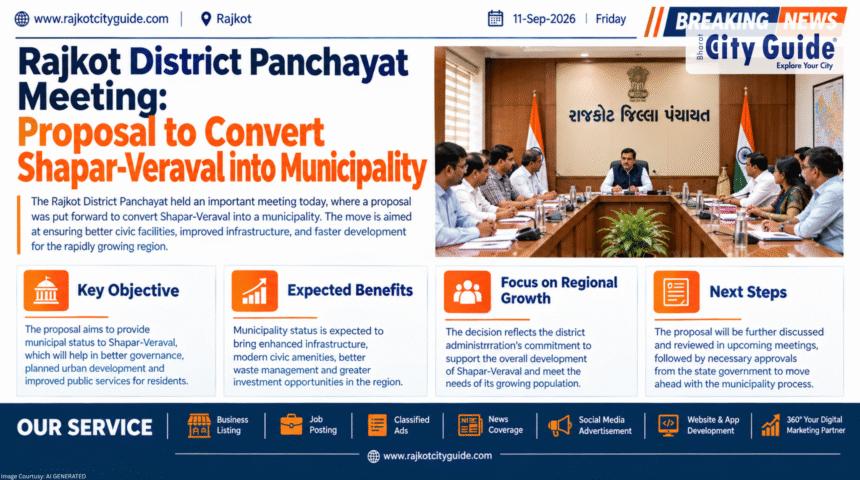
Addressing this long-standing administrative requirement, the Rajkot District Panchayat has scheduled its crucial general body meeting for September 21. A central item on the agenda is a official proposal to merge and upgrade the Shapar and Veraval Gram Panchayats into a unified Nagarpalika (Municipality). Once approved by the general body, this resolution will be formally forwarded to the Urban Development Department of the Government of Gujarat for official notification and implementation.
This decision by the Rajkot District Panchayat marks a major milestone in regional governance. Transitioning from a rural Gram Panchayat framework to a full-fledged Nagarpalika will unlock dedicated state and central urban development funds, streamline civic services, and establish modern infrastructure tailored to the needs of both residents and industrial enterprise owners.
What is the Rajkot District Panchayat?
The Rajkot District Panchayat is the apex body of rural local self-governance (Panchayati Raj) in Rajkot district, Gujarat. It oversees rural administration, regional infrastructure, primary health centers, rural education, and socio-economic development across various Taluka Panchayats and Gram Panchayats under its jurisdiction.
+--------------------------------------------------------------------------+
|                  GUJARAT PANCHAYATI RAJ GOVERNANCE STRUCTURE             |
+--------------------------------------------------------------------------+
                                     |
                                     v
                  [ RAJKOT DISTRICT PANCHAYAT (Apex Level) ]
                                     |
                   +-----------------+-----------------+
                   |                                   |
                   v                                   v
        [ TALUKA PANCHAYATS ]                 [ URBAN UPGRADE PATH ]
   (e.g., Kotda Sangani, Gondal)         (Gram Panchayats -> Nagarpalika)
                   |                                   |
                   v                                   v
          [ GRAM PANCHAYATS ]                 [ SHAPAR-VERAVAL NAGARPALIKA ]
     (Shapar, Veraval, etc.)                  (Proposed Urban Local Body)
As an administrative intermediary between local rural bodies and the state government, the District Panchayat possesses the constitutional authority to pass resolutions regarding territorial adjustments, upgrading local bodies, and submitting structural administrative reforms to the state government.
Why This News is Important
The upcoming general body meeting and its primary resolution hold immense significance for civic administration, industrial growth, and urban planning in Saurashtra:
1. Addressing Unprecedented Industrial and Population Growth
Shapar-Veraval is no longer a quiet rural area; it is a major industrial estate generating thousands of jobs. Treating this dense industrial-residential ecosystem as a simple Gram Panchayat has created severe administrative bottlenecks in civic service delivery.
2. Access to Urban Development Grants
Gram Panchayats receive limited grants tailored primarily for rural welfare. Upgrading to a Nagarpalika opens doors to substantial urban infrastructure funding under state schemes like the Swarnim Jayanti Mukhya Mantri Urban Development Scheme and national urban renewal missions.
3. Systematic Civic Services and Governance
A Nagarpalika brings structured urban planning, dedicated municipal staff, professional waste management systems, organized fire safety infrastructure, and systematic town planning schemes that rural Panchayats cannot maintain independently.
Background Information
Located along the Rajkot-Gondal National Highway, Shapar and Veraval developed rapidly over the last three decades into a dominant industrial cluster in Saurashtra. The region accommodates over 2,500 to 3,000 industrial units specializing in diesel engines, auto parts, machine tools, plastics, and foundries.
[ Rural Agricultural Land ]
            |
            v
[ Industrial Cluster Expansion (1990s–2010s) ]
            |
            v
[ Massive Population & Workforce Influx ]
            |
            v
[ Civic Strain on Gram Panchayat Infrastructure ]
            |
            v
[ Rajkot District Panchayat Resolution (Sept 21 Meeting) ]
            |
            v
[ State Government Approval & Nagarpalika Notification ]
However, civic management remained tied to two distinct Gram Panchayats—Shapar Gram Panchayat and Veraval Gram Panchayat. Due to constrained tax collection frameworks, limited administrative personnel, and meager budget allocations, these Gram Panchayats struggled to maintain internal roads, clear industrial waste, handle street lighting, or build underground sewage systems.
Industrial associations and local residents have repeatedly demanded municipal status. By putting this proposal on the September 21 meeting agenda, the Rajkot District Panchayat is acting on long-standing demands to transition the area into an organized urban local body.
Key Highlights
- General Body Meeting Scheduled: The Rajkot District Panchayat will convene its general board meeting on September 21.
- Municipality Proposal: A formal resolution will be presented to merge Shapar and Veraval Gram Panchayats and convert them into a unified Nagarpalika.
- Submission to State Government: Following approval by the elected representatives of the District Panchayat, the proposal will be forwarded to the Gujarat Urban Development Department.
- Civic Infrastructure Boost: The upgrade will bring dedicated urban funds for roads, drainage, solid waste management, and drinking water pipelines.
- Relief for Industrialists and Residents: Over thousands of industrial unit owners and thousands of local workers and residents stand to benefit from streamlined municipal governance.
Detailed Explanation of the Event
The decision to call the general body meeting of the Rajkot District Panchayat on September 21 comes at a crucial time. Elected members from across the district will gather at the Panchayat headquarters to discuss and pass resolutions on key administrative agenda items.
+--------------------------------------------------------------------------+
|                  PROPOSED LEGISLATIVE & ADMINISTRATIVE PROCESS           |
+--------------------------------------------------------------------------+
| Stage                  | Action Item                                     |
+------------------------+-------------------------------------------------+
| Agenda Inclusion       | Shapar-Veraval Nagarpalika proposal tabled      |
| September 21 Meeting   | General Body discussion and voting by members   |
| Official Resolution    | Passing of unified resolution for urban upgrade |
| Government Referral    | Forwarding dossier to State Urban Department     |
| Final Notification     | Gazette notification establishing Nagarpalika   |
+------------------------+-------------------------------------------------+
The primary focus of the meeting will be the resolution concerning Shapar and Veraval. The proposal outlines that given the continuous urban and industrial sprawl between Shapar and Veraval, running them as separate rural entities is no longer viable. The resolution seeks to combine the geographical jurisdictions of both Gram Panchayats into a single municipal body.
Once the general board approves the motion on September 21, the District Development Officer (DDO) and Panchayat President will submit the official paperwork to the state capital, Gandhinagar. The state cabinet and Urban Development Department will then complete the formal delimitation and issue a gazette notification constituting the new Shapar-Veraval Nagarpalika.
Benefits and Importance of Converting to a Nagarpalika
Upgrading Shapar-Veraval from rural Panchayats to an urban municipality offers multi-dimensional advantages for all local stakeholders:
1. Modern Infrastructure & Urban Planning
A Nagarpalika can implement Town Planning (TP) schemes, ensuring organized road widening, reserved spaces for public amenities, parks, commercial centers, and designated transport hubs.
2. Scientific Waste Management
Industrial estates generate significant solid waste and industrial byproducts. A Nagarpalika setup includes dedicated sanitation staff, automated garbage collection fleets, and scientific processing sites, replacing informal dumping practices.
3. Dedicated Fire Safety & Emergency Services
Industrial areas handling metals, chemicals, and heavy machinery require quick emergency responses. A municipality can establish local fire stations, reducing reliance on fire tenders dispatched from Rajkot city.
4. Underground Drainage and Water Supply
Rural Panchayats lack the capital to build integrated underground sewage networks. A municipality can access large state infrastructure grants to build underground drainage networks and dedicated clean drinking water networks.
How It Impacts Different Audiences
| Stakeholder Group | Direct Impact & Long-Term Benefits |
| Industrialists & Business Owners | Better roads, reduced logistics friction, improved fire safety, organized waste disposal, and streamlined local permissions. |
| Local Residents & Migrant Workers | Improved sanitation, clean drinking water, street lighting, better healthcare facilities, and well-maintained interior roads. |
| Real Estate & Property Developers | Higher property values, clearer urban building codes, and increased demand for residential housing projects. |
| District Administration | Efficient revenue collection, structured urban governance, and reduced administrative strain on rural development funds. |
Expert Insights and Administrative Perspective
Governance experts and urban planners view the transition of heavy industrial clusters into municipalities as a necessary step for sustainable regional development.
“When an area transitions from an agrarian economy to a heavy manufacturing hub, maintaining a Gram Panchayat governance structure becomes unsustainable. Upgrading industrial belts like Shapar-Veraval into a Nagarpalika provides the legal, financial, and administrative machinery required to support high-density industrial growth and human habitation.”
Local industry leaders from the Shapar-Veraval Industrial Association have also welcomed the move, noting that a dedicated municipal body will help attract fresh investments and improve the overall working environment for thousands of laborers.
Challenges and Considerations During the Transition
While the upgrade brings significant benefits, administrative transitions also involve temporary challenges that must be carefully navigated:
- Tax Structure Revision: Property taxes and commercial assessments will be restructured from rural rates to municipal slabs, which may require clear communication with local property owners.
- Staffing and Administrative Restructuring: Merging two Gram Panchayats into a unified Nagarpalika requires creating new administrative departments, hiring municipal officers, and setting up a centralized office.
- Delimitation and Ward Formation: Forming electoral wards and balancing population distribution requires careful survey work before holding the first municipal elections.
Future Outlook
Following the September 21 meeting of the Rajkot District Panchayat, the timeline for transforming Shapar-Veraval into a full Nagarpalika will accelerate:
- State Approval: Upon receiving the Panchayat resolution, the Government of Gujarat will review the demographic and financial data to issue an official notification creating the Nagarpalika.
- Appointment of Administrator: Pending the first official municipal elections, the state government will appoint a Chief Officer or Administrator to oversee civic affairs.
- Budget Allocation: The new municipality will receive dedicated funds in the state budget for urban road development, water pipelines, and drainage networks.
- First Municipal Elections: Electoral wards will be carved out, paving the way for the first municipal council elections to elect local ward councillors and a Nagarpalika President.
Frequently Asked Questions (FAQs)
1. When is the Rajkot District Panchayat meeting scheduled?
The general body meeting of the Rajkot District Panchayat is scheduled for September 21.
2. What is the main proposal regarding Shapar-Veraval on the agenda?
The main proposal is to merge the Shapar and Veraval Gram Panchayats and officially convert them into a unified Nagarpalika (Municipality).
3. Why is Shapar-Veraval being converted into a Nagarpalika?
Due to rapid industrial growth, population density, and expanded housing, the existing Gram Panchayats lack the resources and administrative setup to provide proper urban civic amenities.
4. What happens after the Rajkot District Panchayat passes the resolution?
Once approved by the general body, the proposal will be sent to the Urban Development Department of the Government of Gujarat for official review and gazette notification.
5. How will industrialists benefit from this municipal upgrade?
Industrialists will gain access to better infrastructure, including wider industrial roads, organized solid waste management, dedicated fire safety setups, and streamlined civic approvals.
6. Will property taxes change after becoming a Nagarpalika?
Yes, local tax structures will be updated from rural Panchayat rates to municipal tax slabs to fund enhanced civic services and urban development projects.
7. Who currently manages local governance in Shapar and Veraval?
Currently, local governance is handled by two separate bodies: the Shapar Gram Panchayat and the Veraval Gram Panchayat, under the broader supervision of the District Panchayat.
Conclusion
The upcoming September 21 general body meeting of the Rajkot District Panchayat represents a decisive step forward for the administrative evolution of Saurashtra’s industrial heartland. Converting the Shapar-Veraval cluster into a Nagarpalika resolves a decades-long civic challenge, equipping the region with the resources needed to match its economic importance.
By submitting this proposal to the state government, the Rajkot District Panchayat is laying the groundwork for improved infrastructure, organized urban planning, and better living conditions for thousands of workers, residents, and business owners across Shapar and Veraval.