Introduction
Planning a wedding in India is a milestone filled with excitement, meticulous planning, and significant financial commitments. However, it also comes with unpredictable challenges. From sudden family emergencies and health issues to unexpected astrological date adjustments (Shubh Muhurat) or weather disruptions, event dates frequently need to be shifted. Historically, changing a venue reservation was a administrative nightmare that resulted in steep cancellation fees, lost security deposits, and complicated paperwork.
- Introduction
- What is RMC Marriage Hall Booking Date Modification?
- Why This News is Important
- Background Information
- Key Highlights
- Detailed Explanation of the Event and Policy Mechanics
- Benefits, Features, and Importance
- How It Impacts Different Segments of Society
- Expert Insights and Industry Perspective
- Challenges and Possible Limitations
- Future Outlook
- Frequently Asked Questions (FAQs)
- Conclusion
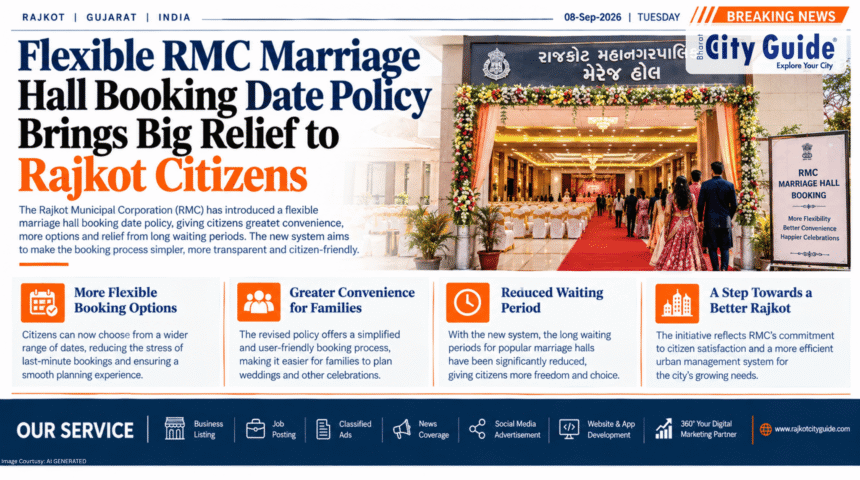
For middle-class and working-class families relying on civic infrastructure, lost venue fees can severely strain wedding budgets. Recognizing these operational friction points, local governing authorities have stepped in with citizen-centric policy reforms. The Rajkot Municipal Corporation (RMC) introduced a massive policy overhaul regarding public venue reservations. Under the newly updated regulations, citizens who reserve municipal venues no longer face rigid penalties when event schedules shift.
This comprehensive guide breaks down everything you need to know about the updated RMC marriage hall booking date policy, how it works, why it matters, and how families across Rajkot can take full advantage of this civic amenity.
What is RMC Marriage Hall Booking Date Modification?
The RMC marriage hall booking date modification system is an administrative framework managed by the Rajkot Municipal Corporation through its e-governance portal and Civic Facilitation Centers (Civic Centers). It allows applicants who have reserved a municipal community hall, auditorium, or party plot for weddings, engagements, or cultural ceremonies to alter their reserved function date.
Previously, if a family needed to change their function date after securing an official receipt, they were forced to forfeit a significant portion of their booking deposit or cancel the entire reservation and pay fresh fees for a new slot. Under the refreshed policy guidelines, applicants can modify their function dates multiple times without losing their principal rent, provided the newly requested date is available in the RMC central reservation database.
This civic innovation merges digital governance with compassionate administration, making municipal infrastructure far more adaptable to real-life contingencies.
Why This News is Important
This administrative change is a major victory for urban public service delivery. Municipal halls are the primary choice for public gatherings, social events, and family functions across Rajkot’s various zones. On average, around 70 families every month experience scheduling conflicts or unforeseen postponements that require changing their hall reservation details.
By eliminating punitive rescheduling costs, the Rajkot Municipal Corporation is directly protecting the savings of local households. In an era where private banquet halls demand non-refundable advances and impose harsh rescheduling terms, RMC’s progressive stance sets a positive benchmark for municipal corporations across Gujarat and India.
Background Information
To understand the significance of this update, it helps to look at how public hall bookings previously operated in Rajkot. The Rajkot Municipal Corporation manages dozens of community halls, party lawns, and auditoriums across its East, West, and Central zones. These halls offer affordable event venues compared to private hotels and commercial banquets.
The Old System
Under the old operational framework:
- Applicants could reserve halls up to several months in advance through the RMC online portal or at Civic Centers.
- If an event was postponed due to illness, bereavement, venue conflicts, or changes in priest-guided auspicious dates, modifying the date was treated similarly to a fresh cancellation.
- Applicants faced severe financial deductions from their security deposits and rental advances.
- Re-booking required starting the process over, filling out manual requests, and waiting for refund processing.
The Driving Force for Reform
Public feedback, elected representatives, and citizen grievance petitions highlighted that rigid rescheduling policies punished families for circumstances beyond their control. Given that municipal halls are designed as welfare-oriented public goods, enforcing commercial-style penalties contradicted their core purpose. Responding to these needs, municipal leadership streamlined the rules to offer flexible, unlimited date modifications subject to venue availability.
Key Highlights
- Unlimited Date Changes: Citizens can modify their RMC marriage hall booking date multiple times without forfeiting their base rental fees.
- Direct Monthly Benefit: Approximately 70 families per month directly benefit from this administrative relief.
- Seamless Availability Check: Date modifications can be requested online or at local Civic Facilitation Centers based on real-time calendar availability.
- Deposit Security: Security deposits remain protected and transferrable to the updated booking date, subject to standard terms.
- Broad Coverage: Applies across RMC-managed community halls, auditoriums, and civic event spaces throughout Rajkot.
- Digital Integration: Fully integrated into the RMC e-governance hall booking module for transparent tracking.
Detailed Explanation of the Event and Policy Mechanics
The core reform revolves around how the RMC e-governance portal handles slot transfers. When a citizen books a community hall, the system generates a unique transaction ID and booking receipt.
Under the updated policy framework:
1. Verification of Availability
When an applicant requests a change to their RMC marriage hall booking date, the system checks the master schedule for the selected hall. If the requested new date is unreserved, the reservation moves to the new slot.
2. Processing Fee vs. Rental Forfeiture
Instead of charging full cancellation fees or forcing the forfeiture of daily rent, RMC applies a minimal administrative processing charge (where applicable) while carrying forward the full rental credit.
3. Procedure for Date Modification
Citizens can execute date modifications through two straightforward pathways:
- Online Method: Log into the official RMC e-governance portal (
egov.rmc.gov.in), navigate to the Hall Booking section, enter the original Application/Receipt number and registered mobile number, select the new desired date from the live calendar, and submit the modification request. - Offline Method: Visit any designated RMC Civic Center with the original booking receipt, photo ID proof (Aadhaar Card, PAN Card, or Election Card), and a written application stating the reason for rescheduling.
+-------------------------------------------------------------------+
|               RMC HALL BOOKING DATE CHANGE PROCESS                |
+-------------------------------------------------------------------+
                                  |
                                  v
           [ Identify Need for Event Reschedule ]
                                  |
                                  v
       [ Check Live Availability on RMC Portal / Civic Center ]
                                  |
                                  v
            +---------------------+---------------------+
            |                                           |
            v                                           v
    (Online Portal)                             (In-Person Visit)
 Log in with Receipt No.                     Visit nearest Civic Center
 & Registered Mobile No.                     with original receipt & ID
            |                                           |
            +---------------------+---------------------+
                                  |
                                  v
               [ Select New Function Date & Submit ]
                                  |
                                  v
              [ Instant Confirmation & Revised Receipt ]
Benefits, Features, and Importance
Financial Safety Net
Weddings involve thousands of rupees in non-refundable vendor advances for catering, photography, and decoration. Saving citizens from losing venue rent offers direct financial relief to middle-class households.
Stress Reduction During Emergencies
Unforeseen events like medical emergencies or sudden weather disruptions cause significant emotional stress. Knowing that the venue reservation can be moved without friction provides much-needed peace of mind.
Enhanced Asset Utilization for RMC
When an applicant postpones early rather than abandoning a booking due to penalty concerns, the vacated date opens up in the public portal. Other citizens looking for last-minute venues can book the newly freed slot, improving municipal venue utilization rates.
Elimination of Middlemen and Corruption
Automating date modification rules on the digital portal reduces the need for manual discretionary approvals. This minimizes corruption risks, ensures equal treatment for all applicants, and makes the system fully transparent.
How It Impacts Different Segments of Society
| Stakeholder Group | Primary Impact & Benefits |
| Middle-Income Families | Prevents budget overruns caused by venue forfeiture; allows easy re-alignment with auspicious dates. |
| Wedding Planners & Vendors | Enables better calendar coordination for caterers, decorators, and photographers without losing venue access. |
| Municipal Administration | Streamlines hall scheduling, improves e-governance adoption, and reduces citizen grievances. |
| Senior Citizens & Vulnerable Groups | Simplified offline processing at local Civic Centers ensures accessible service without technical hurdles. |
Expert Insights and Industry Perspective
Urban planning and public administration experts consistently highlight that civic infrastructure should focus on usability and accessibility rather than revenue generation.
Public policy analysts note that municipal community halls are funded by taxpayers to support social welfare. Implementing rigid commercial cancellation policies undermines their core public purpose. By adopting flexible reservation rules, the Rajkot Municipal Corporation aligns its civic operations with modern, citizen-centric service standards seen in progressive global smart cities.
Furthermore, event management professionals point out that post-pandemic event planning demands greater scheduling flexibility. Weather unpredictability and evolving family preferences mean rigid booking rules are increasingly obsolete. RMC’s proactive policy adjustments reflect an understanding of modern social dynamics.
Challenges and Possible Limitations
While the updated policy offers clear benefits, a few operational considerations remain:
- High-Demand Peak Season Scarcity: During major wedding months (such as Dev Uthan Ekadashi, Vasant Panchami, or winter marriage dates), municipal halls are often fully booked months in advance. Finding an open slot for a rescheduled date during peak season can still be difficult.
- Last-Minute Rescheduling Limits: To keep schedule management orderly, RMC requires date change requests to be submitted a minimum number of days before the original event date. Extremely late requests (e.g., 24-48 hours prior) may still trigger operational penalties to prevent empty venues.
- Electricity & Variable Utility Adjustments: While base rental fees carry forward, variable utility charges or security deposit adjustments may apply if the event moves across different operational tiers or seasons.
Future Outlook
The success of this flexible hall booking policy is expected to encourage additional digital governance enhancements across Rajkot. Looking ahead, citizens can anticipate:
- Integrated Vendor Portals: Future updates to the RMC hall portal may let users book municipal caterers, sound systems, and decoration packages alongside their venue reservation.
- Replication in Other Gujarat Municipalities: Municipal corporations in Ahmedabad, Surat, Vadodara, and Bhavnagar may adopt similar citizen-friendly date modification frameworks based on Rajkot’s model.
- Automated Refund & Transfer Systems: Further updates to the e-governance engine could enable instant automated adjustments to security deposits directly through UPI and net-banking channels.
Frequently Asked Questions (FAQs)
1. How many times can I change my RMC marriage hall booking date?
Under the updated RMC policy guidelines, applicants can modify their function date multiple times without forfeiting their base rental amount, provided the new date is vacant in the official system calendar.
2. Is there any extra charge for changing the booking date?
While you do not forfeit your principal hall rent, a nominal administrative processing fee may apply depending on how close to the event date the request is made.
3. Can I change my booking date online?
Yes, date modification requests can be submitted online via the official RMC e-governance hall booking portal (egov.rmc.gov.in) or in person at any RMC Civic Facilitation Center.
4. What happens if my new preferred date is not available?
Date modifications depend entirely on venue availability. If your preferred date is already booked by another applicant, you must choose another available open slot from the live RMC calendar.
5. What documents are needed to request a hall booking date change offline?
You will need your original RMC hall booking receipt, a valid photo identity proof (Aadhaar Card, Election Card, or PAN Card) of the primary applicant, and a simple written application detailing the request.
6. Does this date change policy apply to all RMC community halls?
Yes, the policy covers all public community halls, auditoriums, and party spaces managed directly by the Rajkot Municipal Corporation.
7. How far in advance can I select a new date for my event?
You can select any available date within the open booking window established by RMC rules (typically up to several months in advance).
Conclusion
The decision by the Rajkot Municipal Corporation to offer flexible, unlimited date changes for community hall reservations is a welcome, citizen-first administrative reform. By removing harsh financial penalties and simplifying the rescheduling process, the corporation directly supports around 70 families every month during unexpected event changes.
Whether you are organizing a wedding, an engagement, or a cultural event, understanding the rules surrounding your RMC marriage hall booking date ensures a smooth, stress-free experience. As Rajkot continues to modernize its civic services, this balanced policy stands out as a clear example of how e-governance can make daily life easier for urban citizens.