Introduction
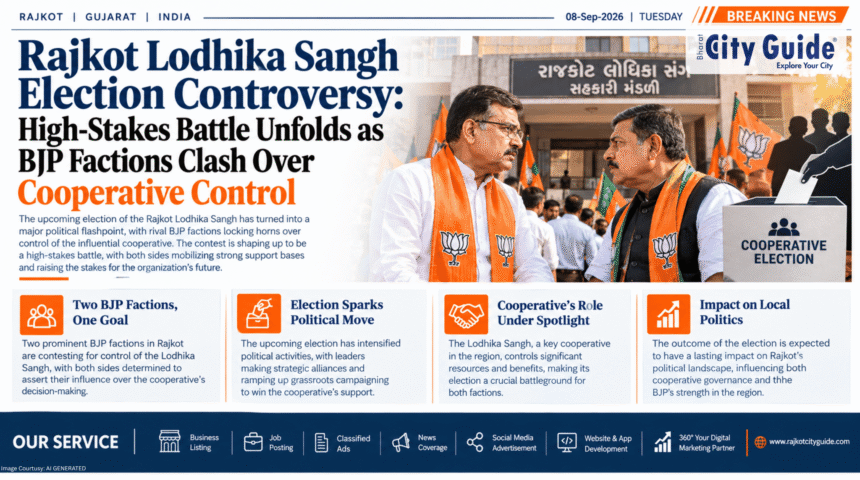
The cooperative political landscape of Saurashtra is witnessing intense friction as the Rajkot Lodhika Sangh Election Controversy reaches a boiling point. Voting has officially commenced for five contested director seats in the prestigious Rajkot-Lodhika Sahakari Kharid Vechan Sangh Limited. What was originally expected to be a routine cooperative election has turned into a high-stakes political showdown, featuring BJP members competing directly against fellow BJP candidates.
- Introduction
- What is Rajkot Lodhika Sangh Election Controversy?
- Why This News is Important
- Background Information
- Key Highlights
- Detailed Explanation of the Event
- Benefits, Features, and Importance
- How It Impacts People
- Expert Insights / Industry Perspective
- Challenges and Limitations
- Future Outlook
- Frequently Asked Questions (FAQs)
- Conclusion
The conflict stems from an internal rift between two influential regional leadership factions—represented by prominent leaders Jayesh Radadiya and Prashant Korat. Despite repeated reconciliation efforts by senior state party leaders and the formal issuance of an official party whip, consensus could not be reached on the final five seats. Out of the total 10 seats that were declared uncontested earlier, these remaining seats have drawn candidate lineups from within the party ranks, forcing an open voting process.
The political tension escalated further when candidate Vijay Sakhiya sought police protection due to safety concerns, leading to an intervention by the Gujarat High Court to mandate safe and fair voting conditions. This article provides a comprehensive overview of the Rajkot Lodhika Sangh election, examining the mechanics of cooperative politics in Gujarat, the key players involved, the candidates contesting each seat, and the broader implications for the region’s agricultural ecosystem.
What is Rajkot Lodhika Sangh Election Controversy?
The Rajkot Lodhika Sangh Election Controversy refers to the political clash and internal party friction surrounding the election for the board of directors at the Rajkot-Lodhika Sahakari Kharid Vechan Sangh Limited. Known as one of Asia’s largest cooperative purchase and sales unions operating at the taluka and district levels, the entity plays a crucial role in agricultural procurement, fertilizer distribution, crop marketing, and credit facilitation for farmers across Rajkot and Lodhika talukas.
┌───────────────────────────────────────────────────────────────────────────────┐
│              RAJKOT LODHIKA SAHAKARI KHARID VECHAN SANGH PROFILE              │
├───────────────────────────────────────────────────────────────────────────────┤
│  ENTITY TYPE            : Farmers' Cooperative Purchase & Sales Union         │
│  GEOGRAPHIC SCOPE       : Rajkot & Lodhika Talukas, Gujarat                   │
│  TOTAL BOARD SEATS      : 15 Director Seats                                   │
│  UNCONTESTED SEATS      : 10 Seats (Declared Unopposed)                       │
│  CONTESTED SEATS        : 5 Seats (Voting Active)                             │
│  CORE CONFLICT          : Internal BJP Factional Clash & Cross-Contest        │
│  KEY ISSUES             : Official Party Whip Violation, High Court Security │
└───────────────────────────────────────────────────────────────────────────────┘
The controversy is characterized by the following developments:
- Failure of Consensus Building: Top party strategists failed to broker a compromise between rival local factions, resulting in parallel candidate slates.
- Defiance of Official Whip: Despite an official whip directing voters toward specific party-backed candidates, rival BJP members filed nomination papers to contest the election directly.
- High Court Security Intervention: Legal proceedings led the Gujarat High Court to order police protection for candidate Vijay Sakhiya to prevent voter intimidation and ensure peaceful polling.
- Micro-Voter Base Dynamics: With a restricted electoral roll of just 21 voters deciding the outcome of these five seats, each individual vote carries significant sway.
Why This News is Important
The developments surrounding the Rajkot Lodhika Sangh election carry political and economic weight across Gujarat’s cooperative domain:
- Barometer of Regional Cooperative Power: Cooperative unions in Gujarat control substantial agricultural capital, distribution networks, and rural outreach. Controlling the Lodhika Sangh offers direct sway over regional agrarian policy and institutional management.
- High-Profile Factional Rift: The rivalry brings long-standing internal party rivalries out into the open, challenging traditional central party discipline.
- Precedent for Official Party Whips: The election tests the enforceability and binding nature of political party whips within autonomous cooperative bodies.
- Judicial Intervention in Local Polls: High Court orders granting police protection highlight the security challenges and intense pressures associated with small-voter cooperative elections.
Background Information
The Rajkot-Lodhika Sahakari Kharid Vechan Sangh has long served as a cornerstone of the rural economy in Saurashtra. Established to protect farmers from market exploitation by providing fair prices for crops, supplying subsidized fertilizers, and maintaining agricultural warehouses, the union holds considerable financial assets and institutional influence.
                [ EVOLUTION OF THE COOPERATIVE ELECTION CONFLICT ]
                                       │
 ┌─────────────────────────────────────┼─────────────────────────────────────┐
 ▼                                     ▼                                     ▼
Cooperative Power Base               10 Seats Unopposed                     5 Seats Disputed
(Key Agricultural Body)             (Consensus Reached Early)             (BJP Factions Clash)
 └─────────────────────────────────────┬─────────────────────────────────────┘
                                       │
                                       ▼
             Official Whip Issued ──► High Court Security Mandate ──► Final Voting
In previous election cycles, party leaders typically mediated selection processes behind closed doors, securing unanimous or uncontested panels to preserve organizational unity. However, during the current election cycle, while 10 seats were successfully negotiated to be uncontested, agreement broke down across five key geographical seats: Kuwadva, Madhapar, Khokhadad, Tramba, and Halenda.
As competing camps led by regional stalwarts refused to yield nominations, the ruling party issued a formal whip endorsing its primary candidates. Despite this, opposing leaders maintained their candidacies, setting up a direct head-to-head contest.
Key Highlights
- Direct Voting Underway: Polling is active for 5 contested seats at the Old Collector Office polling station in Rajkot, running from 9:00 AM to 2:00 PM, with vote counting scheduled for the following morning.
- BJP vs BJP Face-Off: All 10 candidates standing for the 5 open director seats belong to the BJP, turning the contest into an internal factional battle.
- Small Electoral College: A tight group of 21 eligible voters holds the decision-making power for these contested seats, making every single vote critical.
- Official Party Whip Mandate: The BJP leadership issued a strict whip backing Arvind Raiyani (Kuwadva), Prithvisinh Jadeja / Ghoghubha (Madhapar), Babu Nasit (Khokhadad), Nitin Raiyani (Tramba), and Mahesh Asodariya (Halenda).
- Judicial Security Directive: Candidate Vijay Sakhiya secured a Gujarat High Court directive ordering Rajkot police and election officers to ensure strict protection and a neutral voting environment.
Detailed Explanation of the Event
1. Breakdown of the 5 Contested Seats and Candidates
The election features five direct head-to-head battles across key regional sectors. Each seat pits an official whip-backed candidate against a strong internal challenger:
                                [ HEAD-TO-HEAD CANDIDATE MATCHUPS ]
                                                │
 ┌──────────────────────┬───────────────────────┼───────────────────────┬──────────────────────┐
 ▼                      ▼                       ▼                       ▼                      ▼
Kuwadva Seat          Madhapar Seat           Khokhadad Seat          Tramba Seat            Halenda Seat
Arvind Raiyani        Prithvisinh Jadeja      Babu Nasit              Nitin Raiyani          Mahesh Asodariya
       vs                    vs                      vs                      vs                     vs
Nitin Chovatiya       Vijay Sakhiya           Harjibhai Pipadiya      Aniruddhsinh Jadeja    Dhirubhai Rokad
- Kuwadva Seat: Former State Minister Arvind Raiyani faces a tough challenge from Nitin Chovatiya.
- Madhapar Seat: Incumbent leader Prithvisinh Jadeja (Ghoghubha) contests against Vijay Sakhiya.
- Khokhadad Seat: Official nominee Babu Nasit is challenged by Harjibhai Pipadiya.
- Tramba Seat: Party-backed candidate Nitin Raiyani goes up against Aniruddhsinh Jadeja.
- Halenda Seat: Nominated candidate Mahesh Asodariya faces opposition from Dhirubhai Rokad.
2. High Court Action and Security Measures
Fearing voter coercion and personal safety risks during the campaign, candidate Vijay Sakhiya initially approached the Rajkot City Police Commissioner requesting police protection at his own expense. When immediate relief was not provided, Sakhiya filed an urgent petition before the Gujarat High Court.
Recognizing the sensitivity of the cooperative election, the High Court instructed the Rajkot police administration and returning officers to provide security to the candidate and ensure the entire voting and counting process remains transparent, neutral, and free from intimidation.
Benefits, Features, and Importance
The table below outlines the key operational aspects and institutional significance of the Lodhika Sangh governance structure:
| Structural Aspect | Operational Detail | Institutional Importance |
| Governance Body | 15-Member Board of Directors | Oversees management, crop procurement policies, and financial allocations. |
| Electoral Mechanics | Primary Member Society Voting | Ensures grassroots representation from primary agricultural credit societies. |
| Asset Base | Warehouses, Processing Facilities, Credit Lines | Provides vital infrastructure support for regional cotton, groundnut, and grain farmers. |
| Political Alignment | Cooperative-State Policy Integration | Facilitates smooth execution of government procurement programs and subsidy distribution. |
How It Impacts People
For Farmers and Agricultural Producers
The ultimate control of the Lodhika Sangh directly affects thousands of local farmers. Board leadership determines the efficiency of crop procurement centers, the timely distribution of high-grade seeds and fertilizers, and fair pricing mechanisms during harvest seasons.
For Primary Credit Societies and Local Delegates
Primary agricultural cooperative societies rely on a stable, transparent union leadership to secure credit limits, warehouse access, and financial dividends for their rural members.
For Regional Political Cadres
The election outcome signals the relative strength of competing political camps within Saurashtra’s cooperative network. It demonstrates how grassroots workers navigate internal party discipline versus local factional loyalties.
Expert Insights / Industry Perspective
Cooperative banking and agricultural policy experts observe that Gujarat’s cooperative sector has grown increasingly intertwined with mainstream party politics over recent decades.
Political analysts point out that while party whips are standard in parliamentary and municipal proceedings, applying them to autonomous cooperative bodies often creates complex legal and organizational dynamics. Because voting members in cooperative elections represent independent rural societies, local relationships and personal credibility often carry as much weight as party directives.
Legal scholars note that swift High Court interventions in cooperative elections help protect the democratic integrity of local institutions, ensuring that small electoral groups can vote without fear of external pressure.
Challenges and Limitations
Conducting high-intensity cooperative elections with restricted voter pools involves distinct operational challenges:
- High Vulnerability to Voter Pressure: With only 21 voters deciding five seats, individual electors face intense campaigning and pressure from competing camps.
- Post-Election Organizational Friction: Intense primary-style battles between party members can leave lasting personal and political divisions that complicate future governance.
- Enforcement of Cooperative Whips: Verifying compliance with party directives in secret-ballot cooperative elections remains technically and legally complex.
Future Outlook
Following the conclusion of voting, attention shifts to the official counting process and the subsequent election of the Sangh’s Chairman and Vice-Chairman. Key future developments include:
- Vote Counting and Result Declaration: Official counting will determine which faction secures a working majority across the 15-member board.
- Chairman and Vice-Chairman Selection: The newly constituted board will convene to elect its top executive officers, shaping the union’s operational direction.
- Organizational Reconciliation: Party leadership will likely address whip compliance and work to rebuild unity ahead of upcoming broader electoral cycles.
- Focus on Farmer Welfare: The incoming board will need to quickly turn its focus to operational priorities, including monsoon crop procurement and fertilizer supply readiness.
Frequently Asked Questions (FAQs)
1. What is the central cause of the Rajkot Lodhika Sangh Election Controversy?
The controversy stems from an internal clash between competing BJP leadership factions over five director seats after consensus negotiations failed, leading to party members contesting directly against official whip-backed candidates.
2. How many total seats exist in the Rajkot Lodhika Sangh board?
The board consists of 15 director seats, 10 of which were previously settled uncontested, leaving 5 seats subject to active voting.
3. Who are the primary leaders involved in the factional rivalry?
The election has highlighted an internal power struggle involving regional stalwarts, including prominent figures Jayesh Radadiya, Prashant Korat, and former state minister Arvind Raiyani.
4. Why did candidate Vijay Sakhiya approach the Gujarat High Court?
Vijay Sakhiya petitioned the High Court seeking police protection and directives to ensure a fair, transparent, and intimidation-free voting environment.
5. How many voters are participating in this election?
A small, targeted electoral college of 21 eligible voting delegates is casting ballots to decide the 5 contested seats.
6. What role does the official party whip play in this cooperative poll?
The party issued a whip directing voting delegates to support its official candidates; however, rival party members maintained their candidacies, leading to an open electoral contest.
Conclusion
The Rajkot Lodhika Sangh Election Controversy underscores the intense political dynamics shaping Gujarat’s cooperative sector. As voting concludes across the five contested seats under High Court-mandated security, the outcome will not only determine the leadership of one of the region’s largest agricultural unions but also recalibrate political influence within Saurashtra’s rural economy. Moving forward, the incoming board’s primary responsibility will be to set political rivalries aside and focus on strengthening crop procurement, credit access, and agricultural support for thousands of local farmers.