Introduction
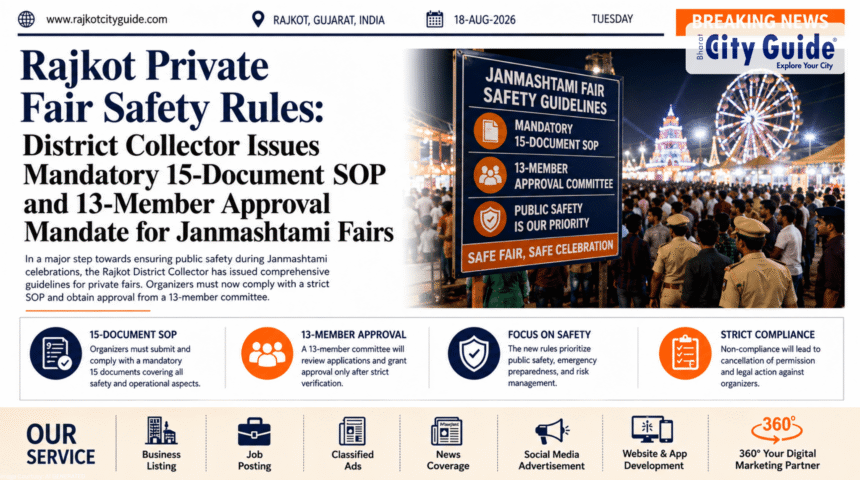
In a major initiative to bolster public safety during festive celebrations, the Rajkot District Administration has announced strict Rajkot Private Fair Safety Rules ahead of the annual Janmashtami festivities. Following comprehensive safety evaluations, the Rajkot District Collector has introduced a stringent Standard Operating Procedure (SOP) mandating that private fair (Lok Mela) organizers submit 15 distinct structural, electrical, and operational clearance documents before securing official event permission.
- Introduction
- What is Rajkot Private Fair Safety Rules?
- Why This News is Important
- Background Information
- Key Highlights
- Detailed Explanation of the Event
- Benefits, Features, and Importance
- How It Impacts People
- Expert Insights and Industry Perspective
- Challenges and Limitations
- Future Outlook
- Frequently Asked Questions (FAQs)
- Conclusion
Janmashtami fairs are a major cultural tradition across Saurashtra, drawing hundreds of thousands of local citizens, pilgrims, and families to mechanical rides, commercial stalls, and food courts. However, recent safety incidents in gaming zones and public amusement spots across Gujarat have prompted local administrative bodies to transform event safety protocols. Under the updated framework, no private fair operator in Rajkot city or rural talukas will be allowed to operate without explicit clearance from a specialized 13-member multi-departmental safety committee.
Furthermore, the new directive mandates that every amusement ride operator place a prominent 5×5 foot safety information board at entry points. These boards must explicitly state fitness certifications, daily inspection logs, age/height restrictions, and maximum rider capacities. This complete overhaul under the Rajkot Private Fair Safety Rules establishes a accountable model for public safety during high-footfall festive gatherings.
What is Rajkot Private Fair Safety Rules?
The Rajkot Private Fair Safety Rules represent a comprehensive administrative framework designed to regulate temporary amusement parks, private carnivals, and cultural fairs (Lok Melas) across Rajkot district.
                    ┌──────────────────────────────────────────────┐
                    │      RAJKOT PRIVATE FAIR SAFETY RULES        │
                    │       District Administration Guidelines     │
                    └──────────────────────┬───────────────────────┘
                                           │
        ┌──────────────────────────────────┼──────────────────────────────────┐
        ▼                                  ▼                                  ▼
┌────────────────────────┐      ┌────────────────────────┐      ┌────────────────────────┐
│  15-DOCUMENT MANDATE   │      │ 13-MEMBER COMMITTEE    │      │ DISPLAY BOARD & LOGS   │
│ • Structural Stability │      │ • Multi-agency review  │      │ • Mandatory 5x5 ft     │
│ • Fire, Electrical &   │      │   (Police, RMC, R&B,   │        ride boards            │
│   NDRF Compliance      │      │    PGVCL, Fire, Health)│      │ • Daily testing logs   │
└────────────────────────┘      └────────────────────────┘      └────────────────────────┘
This regulation transitions private fair setups from basic single-window NOC checks to a multi-tiered clearance regime. Organizers must prove that every temporary structure, electrical line, and high-speed mechanical ride complies with state structural engineering codes, fire safety guidelines, and emergency management standards before the public enters the premises.
Why This News is Important
The enforcement of these updated safety rules carries immense public significance for residents, event operators, and civic authorities:
- Prevention of Amusement Ride Accidents: Enforcing structural integrity checks and third-party mechanical engineer audits significantly reduces the risk of ride collapses or mechanical failures.
- Enhanced Transparency for Visitors: The mandatory 5×5 foot ride display boards empower parents and visitors to verify whether a ride holds valid fitness certificates before purchasing tickets.
- Accountability Among Event Organizers: Requiring 15 verifiable documents prevents unauthorized or sub-standard operators from setting up high-risk rides without official oversight.
- Multi-Agency Oversight: Establishing a 13-member approval committee ensures that fire safety, electrical load distribution, structural stability, and traffic management are reviewed collectively by specialized experts.
Background Information
Saurashtra’s Janmashtami celebrations are world-renowned, with the iconic Rajkot Lok Mela on the Race Course Ground serving as the centerpiece. Alongside the primary government-hosted fair, dozens of private fair operators organize commercial carnivals across private plots, open grounds, and suburban townships throughout Rajkot district.
                      [ EVOLUTION OF FAIR SAFETY GOVERNANCE ]
                                         │
  ┌──────────────────────────────────────┼──────────────────────────────────────┐
  ▼                                      ▼                                      ▼
[Legacy Approval System]              [Safety Review Initiatives]            [Current Integrated SOP]
 • Basic single-agency NOC             • Mandated third-party audits          • 15 Mandatory clearances
 • Manual site checks                  • Heightened fire inspection           • 13-Member committee review
                                                                              • Mandatory 5x5 ft ride logs
Historically, temporary fairs faced criticism over inadequate emergency exits, loose electrical wiring running along pedestrian paths, non-standardized ride operator training, and missing fire-fighting infrastructure. In response to heightened judicial scrutiny and public health imperatives across Gujarat, the Rajkot District Collectorate established an updated SOP framework. This standard brings temporary event structures under regulatory standards similar to permanent commercial establishments.
Key Highlights
- 15 Mandatory Documents: Organizers must submit 15 verified certificates covering structural stability, land title clearance, fire safety, electrical inspection, and insurance coverage.
- 13-Member Approval Committee: Final operating licenses will only be granted after joint verification and approval by a specialized 13-member inter-departmental committee.
- Mandatory 5×5 Foot Signboards: Every mechanical ride must feature a 5×5 foot board at its entrance detailing operator credentials, fitness expiry dates, and passenger safety limits.
- Third-Party Structural Audits: Mechanical rides must be certified by registered structural and mechanical engineers before operational testing.
- Daily Inspection Logbooks: Ride operators are required to maintain daily mechanical test logs signed by qualified engineers before opening rides to the public each morning.
- Emergency Evacuation Corridors: Fairs must maintain wide, unobstructed evacuation routes, dedicated fire tender passages, and on-site medical first-aid stations.
Detailed Explanation of the Event
Under the newly issued directives, the administrative pipeline for setting up a private fair in Rajkot has been restructured into an end-to-end verification process.
                           [ COMPLIANCE & PERMISSION WORKFLOW ]
                                          │
  Submit 15 Core Clearance Docs ──► 13-Member Committee On-Site Audit ──► Issue 5x5 ft Display License
                                                                                 │
  Daily Engineer Log Validation ◄── Joint Fire & Electrical Re-Check ◄────────────┘
The 15 Mandatory Document Submissions
Organizers applying for private fair permissions must upload and submit fifteen specific legal and technical documents to the collectorate:
- Land Ownership / NOC Letter: Proof of land title or explicit lease agreement from the landowner.
- Site Plan Map: Architect-approved layout detailing stall positioning, ride spacing, and emergency exits.
- Structural Stability Certificate: Issued by a certified structural engineer for all temporary stages, platforms, and sheds.
- Mechanical Ride Fitness Certificates: Individual safety clearance for every mechanical ride from an authorized engineer.
- Fire Safety No-Objection Certificate (NOC): Clearance from the Rajkot Municipal Corporation (RMC) or regional fire authority.
- Electrical Safety Inspection Report: Approval from Paschim Gujarat Vij Company Limited (PGVCL) and the Electrical Inspectorate.
- Public Liability Insurance: Comprehensive insurance cover protecting visitors against unexpected accidents.
- Sound Permit Compliance: Authorization for public address systems adhering to ambient noise limits.
- Traffic & Parking Clearance: Plan approved by the Rajkot City Traffic Police for vehicle management.
- Sanitation & Health Certificate: Approval for clean drinking water, temporary toilets, and hygienic food stall practices.
- Disaster Management & Evacuation Plan: Documented emergency response strategy including crowd control protocols.
- Generator Set (DG) Safety Certificate: Operational clearance for back-up power equipment.
- CCTV Surveillance Deployment Plan: Layout showing continuous camera coverage over entrance/exit gates and main paths.
- Operator Qualification Proof: Verifiable identity and experience certificates for all ride controllers.
- Self-Declaration Affidavit: Legally binding undertaking by the fair organizer accepting full responsibility for safety compliance.
Function of the 13-Member Committee
The approval committee comprises officials from diverse public safety sectors, including the Resident Additional Collector (RAC), City Police Department, RMC Executive Engineers, Roads & Buildings (R&B) Department, PGVCL Electrical Engineers, Chief Fire Officer, District Health Officer, and Disaster Management specialists.
The committee conducts physical inspections of the fairgrounds to verify that the ground layout matches the submitted blueprints, test-run rides under full electrical load, and confirm that emergency exits remain unobstructed.
Benefits, Features, and Importance
The implementation of the Rajkot Private Fair Safety Rules delivers widespread structural benefits:
| Regulatory Feature | Standard SOP Requirement | Direct Impact on Public Safety |
| 5×5 Ft Display Boards | Mounted at every ride entrance with clear details | Informs passengers of ride capacity, age limits, and validity of safety certificates. |
| 13-Member Review | Multi-agency physical ground inspection | Eliminates single-point inspection oversights and improves cross-departmental coordination. |
| Daily Test Logs | Signed morning mechanical checks by engineers | Ensures early detection of mechanical wear, brake faults, or loose structural bolts. |
| Wide Safety Corridors | Minimum 6-meter main walkways and clear exit paths | Prevents stampedes and permits immediate entry for ambulances and fire engines. |
| Mandatory Insurance | Valid Third-Party Public Liability Policy | Guarantees financial compensation and medical care coverage for visitors in case of mishaps. |
How It Impacts People
The updated guidelines affect various community groups in distinct ways:
- Fair Visitors & Families: Parents can take their children on amusement rides with greater peace of mind, knowing that rides have undergone mandatory mechanical audits and daily safety checks.
- Private Fair Organizers: Event managers must adopt professional planning procedures, allocate larger safety budgets, and initiate paperwork weeks in advance of the festival.
- Amusement Ride Vendors: Ride contractors are required to upgrade equipment maintenance, replace worn components, and hire qualified technical personnel.
- Local Authorities & First Responders: Police, fire fighters, and municipal health workers gain structured control over event grounds, making crowd management and emergency responses more efficient.
Expert Insights and Industry Perspective
Safety engineering experts and public event planners strongly support the new directives, highlighting that temporary amusement setups often pose higher operational risks than permanent theme parks due to rapid assembly and disassembly cycles.
Engineers emphasize that mechanical rides experience dynamic stress loads during high-volume festive periods. Requiring daily inspection logs alongside 5×5 foot public display boards establishes dual accountability: technical teams must sign off on safety every morning, while informed visitors can verify credentials before boarding.
Challenges and Limitations
Despite its merits, implementing the stringent SOP presents operational challenges:
- Tight Timelines for Organizers: Gathering 15 separate departmental clearances within short pre-festival windows can create administrative backlogs for event planners.
- Increased Compliance Costs: Hiring certified structural engineers, installing high-capacity fire prevention systems, and purchasing comprehensive liability insurance raise initial operating costs for small-scale fair operators.
- Rigorous Ground Enforcement: Ensuring that small vendors consistently maintain daily inspection logs and keep display boards updated throughout multi-day fairs requires continuous spot-checks by administration teams.
Future Outlook
The rollout of the Rajkot Private Fair Safety Rules sets a updated precedent for public event management across Saurashtra and the broader state of Gujarat:
- Standardized State-Wide Blueprint: The 15-document framework and 13-member approval process may serve as a model for other municipal corporations managing large-scale cultural and religious gatherings.
- Digital Portal Verification: Future iterations could streamline permissions through a centralized digital portal, allowing organizers to upload documents online and track clearances in real time.
- Professionalization of Event Operations: The strict SOP encourages smaller, informal fair setups to consolidate under professional event management companies equipped to handle modern safety protocols.
Frequently Asked Questions (FAQs)
1. What are the Rajkot Private Fair Safety Rules?
They are a set of safety directives issued by the Rajkot District Administration requiring private fair organizers to secure 15 distinct departmental clearances and obtain approval from a 13-member safety committee before opening during festivals like Janmashtami.
2. How many documents are mandatory to obtain permission for a private fair?
Organizers must submit 15 mandatory documents, covering structural stability, fire safety NOC, electrical inspection, land title, traffic plans, and public liability insurance.
3. What is the requirement for the 5×5 foot board at fair rides?
Every amusement ride entry gate must feature a prominent 5×5 foot signboard displaying the ride’s fitness certificate validity, qualified operator details, maximum capacity, and age/height safety restrictions.
4. Who comprises the 13-member approval committee?
The committee includes officials from the District Collectorate, City Police, Rajkot Municipal Corporation (RMC), Roads & Buildings (R&B) Department, PGVCL (Electrical), Fire Department, Health Department, and Disaster Management authorities.
5. Are daily safety checks required for mechanical rides during the fair?
Yes. Operators must perform daily mechanical test runs and maintain an inspection log signed by a qualified engineer before opening rides to the public each day.
6. Can a fair operate while safety approvals are pending?
No. Operating a private fair or amusement ride without explicit final written clearance from the 13-member safety committee is strictly prohibited and subject to legal shutdown.
7. How do these rules benefit people visiting Janmashtami fairs?
The rules help protect visitors by enforcing structural stability standards on high-speed rides, ensuring clear emergency exit routes, establishing fire safety protocols, and making safety certifications transparent.
Conclusion
The introduction of the Rajkot Private Fair Safety Rules marks a crucial advancement in public safety management for festive celebrations across Saurashtra. By requiring a thorough 15-document clearance process, establishing oversight through a 13-member multi-departmental committee, and mandating transparent 5×5 foot ride display boards, the Rajkot District Administration has raised the standard for public event safety. As Janmashtami celebrations draw near, these proactive guidelines ensure that citizens can enjoy traditional Lok Melas with confidence, backed by rigorous safety standards.