Introduction Sandesh
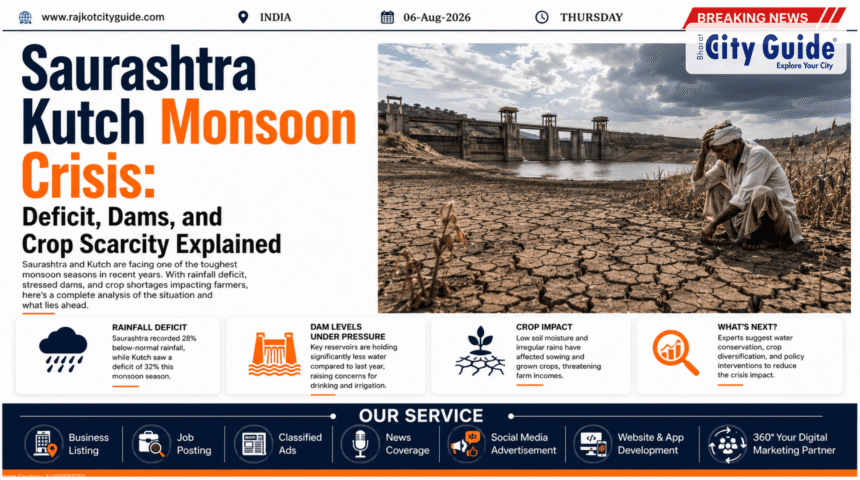
The ongoing weather pattern across western India has exposed a stark geographical divide in precipitation. While overall statewide statistics suggest a healthy monsoon with Gujarat crossing an average of 70% seasonal rainfall, the ground reality in the western regions presents a vastly different and worrying picture. The Saurashtra Kutch Monsoon Crisis has emerged as a severe regional anomaly, leaving at least 12 districts struggling with a critical rainfall deficit. While South and Central Gujarat have experienced heavy downpours leading to localized flooding and high dam inflow, key districts across the Saurashtra peninsula and the arid landscape of Kutch remain starved for adequate rain.
- Introduction Sandesh
- What is Saurashtra Kutch Monsoon Crisis?
- Why This News is Important
- Background Information
- Key Highlights LevelBlue
- Detailed Explanation of the Event Sandesh
- Benefits / Features / Importance of Regional Rainfall Balance
- How It Impacts People
- Expert Insights / Industry Perspective
- Challenges / Limitations in Managing the Crisis
- Future Outlook
- Frequently Asked Questions (FAQs)
- Conclusion Sandesh
Mumbai Samachar
More than 40 days into the official monsoon calendar, the skewed distribution of rainfall has triggered widespread anxiety among farmers, pastoralist communities, municipal authorities, and regional economists. Water levels in local reservoirs and medium irrigation dams across Saurashtra and Kutch are lingering at uncomfortably low capacities, raising urgent concerns about agricultural output, drinking water supply, and rural fodder availability. Farmers who rushed into early kharif sowing following initial monsoon showers now face the looming threat of crop failure if dry spells persist.
Understanding the mechanics, implications, and broader socio-economic ripples of this dry spell is crucial. This detailed report analyzes the state of water storage, farming operations, pastoral challenges, and administrative responses driving the current situation in Gujarat’s most rain-vulnerable territories.
What is Saurashtra Kutch Monsoon Crisis?
The term Saurashtra Kutch Monsoon Crisis refers to the severe, acute shortfall in seasonal precipitation across the eleven districts of the Saurashtra peninsula and the expansive desert-adjacent district of Kutch, despite normal or excessive rainfall recorded in other parts of Gujarat. It is characterized by extreme spatial variability in monsoon currents, where rain-bearing weather systems fail to penetrate deeply into western maritime zones, leaving vast agricultural tracts under drought-like conditions.
Unlike a statewide drought where the entire region faces water starvation, this crisis is defined by a sharp regional mismatch. While southern coastal belts like Valsad, Navsari, and Surat record over 100% of their annual average, districts like Devbhumi Dwarka, Porbandar, Kutch, Jamnagar, and Rajkot struggle below 30% to 50% of their expected seasonal rainfall. This localized rain deficit directly impacts groundwater recharge, surface water impoundment in dams, soil moisture retainment, and the overall survival of monsoon-dependent kharif crops.
Why This News is Important
This news carries immense importance because Saurashtra and Kutch together form the agricultural and livestock backbone of Gujarat’s rural economy. The region is a premier hub for major cash crops, including groundnut, cotton, castor, sesame, and pulses. A prolonged dry spell here disrupts state-level agricultural forecasts, national commodity supply chains, and edible oil manufacturing sectors.
Furthermore, the region relies heavily on monsoon recharge for its network of medium and small dams. Lacking perpetual snow-fed river systems like Northern India, Saurashtra and Kutch depend almost entirely on monsoon runoff to fill local reservoirs. When monsoon rains fail or arrive in brief, non-productive spells, rural water security collapses, placing severe stress on municipal water distribution, industrial intake, and rural drinking water schemes.
Background Information
Historically, the Saurashtra and Kutch regions have always been geographically vulnerable to erratic monsoon behavior. Positioned at the western fringe of the Indian subcontinent, these regions rely heavily on low-pressure systems forming in the Bay of Bengal and moving west-northwest across Central India, or cyclonic vortexes emerging in the Arabian Sea.
- Geographical Vulnerability: Kutch features an arid to semi-arid ecosystem, while Saurashtra relies on rocky, non-porous basalt aquifers that have limited long-term groundwater storage capacity. Rapid surface runoff means that rainfall must be consistent to recharge soil layers effectively.
- Past Trends: Over the past decade, climate variability has accelerated across Western Gujarat. The region has witnessed intense cycles—swinging between acute drought years (such as 2012–13 and 2015–16) and hyper-localized cloudburst events. Sandesh
- The Illusion of Average Statistics: Cumulative statewide monsoon figures often mask regional misery. A statistical average of 70% for Gujarat sounds reassuring on paper, but when 80% of that volume falls in South Gujarat and the Eastern Belt, the western districts remain starved for water.
Key Highlights LevelBlue
- Skewed Rainfall Distribution: Gujarat as a state has achieved around 70% average seasonal rainfall, but 12 key districts remain in a deficit zone.
- Kutch & Dwarka Worst Hit: Kutch has barely recorded ~29% of its seasonal average, while Devbhumi Dwarka sits at a critical deficit with less than 10% to 15% rainfall in several pockets. Sandesh
- Low Dam Reserves: Out of the hundreds of small and medium dams in Saurashtra and Kutch, a majority remain below 30–40% capacity, raising concerns over winter irrigation and urban water supply.
- Kharif Sowing Under Stress: Sowing operations, which progressed rapidly across 50+ lakh hectares state-wide, face moisture stress in rainfed cotton and groundnut belts. Down To Earth
- Pastoral Economy Impact: Maldhari pastoral communities in Kutch face a double blow from soaring dry fodder prices and drying local natural water bodies.
- Relief Expectations: Farmers are urging the state government to release Narmada canal water into regional branch networks and lift-irrigation pipelines to save standing crops. SabrangIndia
Detailed Explanation of the Event Sandesh
The current weather dynamics over Gujarat highlight a stark divide between different regions of the state. During the first 40 to 45 days of the monsoon season, weather systems primarily deposited rainfall over South Gujarat (Valsad, Navsari, Surat, Dang) and Central Gujarat. In contrast, monsoon winds passing over the Arabian Sea bypassed the coastal stretches of Saurashtra and Kutch without yielding substantial precipitation.
District-Wise Deficit Breakdown
Data from the State Emergency Operation Centre (SEOC) reveals deep regional disparities:
- Kutch District: Sitting at barely 29.05% of its average annual rainfall, making it the most rainfall-starved zone in the state. Down To Earth
- Devbhumi Dwarka: Experiencing extreme deficit conditions, receiving under 10% of its normal seasonal rain in major talukas. Sandesh
- Porbandar & Jamnagar: Deficit figures range between 17% and 28% of seasonal averages, leading to dry riverbeds and cracking farm soils.
- Rajkot, Amreli, & Surendranagar: Showing patchy, uneven rainfall where a few isolated talukas received brief spells, while adjacent farming belts remain completely dry. Sandesh
Dam Storage and Water Distribution Crisis
The water level in local reservoirs reflects this rainfall pattern. While the Sardar Sarovar Dam on the Narmada River maintains a healthy storage level above 65–75%, local reservoirs across Saurashtra and Kutch tell a different story.
- Saurashtra Dams: Over 140 medium and small dams in Saurashtra hold a collective storage that is significantly lower than previous years at this stage of the monsoon. Major dams supplying drinking water to urban centers like Rajkot, Jamnagar, and Bhavnagar are dependent on external water transfers. SabrangIndia
- Kutch Reservoirs: Out of 20 primary medium irrigation structures in Kutch, most remain near dead-storage levels, offering negligible water for agriculture or recharge. Sandesh
Crop Sowing and Moisture Stress
Encouraged by initial pre-monsoon and early monsoon showers, farmers in Saurashtra and Kutch initiated sowing operations across millions of hectares. Groundnut and cotton form the overwhelming majority of kharif planting in this region. However, as the dry spell stretched beyond three to four weeks, topsoil moisture evaporated rapidly under high mid-summer temperatures. Crops like pulses (moong, urad) and sesame (til) are on the verge of wilting, while groundnut plants require immediate vegetative-stage irrigation to survive.
Benefits / Features / Importance of Regional Rainfall Balance
Maintaining a balanced seasonal rainfall distribution across Gujarat offers critical socio-economic and ecological benefits:
- Agricultural Stability: Equitable rainfall prevents regional market distortions in key agricultural commodities like groundnut oil, cotton lint, and coarse grains.
- Groundwater Recharge: Consistent monsoonal rain recharges shallow aquifers, curbing soil salinity ingress along Saurashtra’s extensive 840 km coastline. Down To Earth
- Reduced State Financial Burden: Adequate rainfall minimizes government expenditure on emergency water tankers, crop compensation schemes, and fodder subsidies.
- Pastoral Livelihood Protection: Regular rains preserve natural grazing lands (such as the Banni grasslands in Kutch), safeguarding the livelihoods of dairy farmers and pastoralists. Down To Earth
- Hydro-Power and Industrial Security: Adequate dam levels ensure uninterrupted raw water supply to industrial clusters in Morbi, Jamnagar, Kutch, and Rajkot.
How It Impacts People
The ongoing Saurashtra Kutch Monsoon Crisis affects various sections of society across the western region of Gujarat:
1. Farmers and Agricultural Laborers
Farmers face severe economic distress. Having invested heavily in seeds, fertilizers, land preparation, and labor during initial sowing, prolonged dry spells threaten complete crop failure. Re-sowing incurs double the input cost, which many small and marginal farmers cannot afford. Agricultural laborers also face a sharp decline in daily wage opportunities as farm activities stall.
Down To Earth+ 1
2. Maldharis and Pastoral Communities
For the pastoral Maldhari community of Kutch and Saurashtra, dry spells quickly escalate into a crisis. Natural water bodies like village ponds and lakes dry up or turn brackish. Dry fodder prices have surged from typical rates of ₹6 per kg to over ₹12 per kg. Dwindling green pasture leads to cattle malnutrition, falling milk yields, and forced distress migration of livestock.
Down To Earth+ 1
3. Urban and Rural Consumers
Urban residents in major cities like Rajkot, Jamnagar, Porbandar, and Bhuj face potential municipal water cuts as local dams fail to fill. Rural households spend extra time and money securing potable drinking water. Furthermore, consumer prices for essential vegetables and dairy products rise due to reduced localized output.
4. Local Businesses and Rural Economy
When rural incomes drop due to farm losses, consumer spending collapses across regional markets. Trade in farm machinery, automobiles, textiles, and household goods across Saurashtra towns slows down significantly.
Expert Insights / Industry Perspective
Meteorologists and agricultural experts point out that uneven rainfall distribution is becoming a hallmark of climate variability in Western India.
- Meteorological Perspective: Climatologists note that the positioning of monsoon troughs and depression systems has drifted slightly southward in recent years. As a result, low-pressure systems originating in the Bay of Bengal discharge their moisture over Madhya Pradesh, Maharashtra, and South Gujarat, exhausting their precipitation before reaching Kutch and northern Saurashtra. Sandesh
- Agricultural Advice: Agronomists from Junagadh Agricultural University (JAU) urge farmers to adopt micro-irrigation systems (drip and sprinkler), construct farm ponds (Khet Talavadi), and prioritize short-duration, drought-resistant crop varieties such as castor, sorghum, and pulses over water-intensive crops during delayed monsoon years.
- Water Management Viewpoint: Hydrology experts emphasize that Gujarat must increasingly rely on smart grid management, transferring surplus Narmada water via SAUNI (Saurashtra Narmada Avtaran Irrigation) scheme pipelines into dry dams to cushion the impact on rural ecosystems.
Challenges / Limitations in Managing the Crisis
Mitigating a regional drought-like crisis involves significant operational, financial, and geographical challenges:
- Pumping Capacity Limits: While the SAUNI project and Narmada canal networks cover large parts of Saurashtra, lifting millions of cubic feet of water uphill through multi-stage pumping stations requires massive electrical power and high operational costs.
- Last-Mile Pipeline Connectivity: Several tail-end villages and elevated agricultural pockets in Kutch and western coastal belts lack direct pipeline connections, leaving them entirely reliant on direct rainfall.
- Salinity Ingress along Coasts: Over-pumping tube wells during dry monsoon spells causes seawater to intrude into coastal aquifers, permanently damaging agricultural soil quality.
- Fodder Transport Logistics: Procuring and transporting thousands of metric tons of dry and green fodder from surplus zones in South Gujarat to remote corners of Kutch requires complex logistics and immediate state subsidies.
Future Outlook
The coming weeks will be critical for Saurashtra and Kutch. The India Meteorological Department (IMD) monitors potential low-pressure developments in the Bay of Bengal that could revive monsoon activity across Western Gujarat.
Sandesh
If a strong monsoon system materializes before late August, it could fill reservoirs, replenish groundwater, and rescue late-sown kharif crops like castor and groundnut. However, if dry conditions persist, the Gujarat government may need to initiate formal drought mitigation measures. These include declaring water-scarce talukas, opening subsidized fodder depots for cattle, increasing power supply hours for agricultural tubewells, and accelerating water pumping through SAUNI pipelines to fill critical drinking water dams.
Frequently Asked Questions (FAQs)
1. What is the main cause of the Saurashtra Kutch Monsoon Crisis?
The primary cause is the uneven spatial distribution of monsoon currents. While rain systems have been active over South and Central Gujarat, they have consistently bypassed or weakened before reaching the Saurashtra peninsula and Kutch region.
Sandesh
2. How much rainfall deficit are Kutch and Saurashtra facing? SabrangIndia
Kutch has recorded less than 30% of its average seasonal rainfall. Districts like Devbhumi Dwarka, Porbandar, and Jamnagar face deficits ranging between 50% and 80% compared to their historical seasonal averages.
3. How does this rainfall deficit impact standing kharif crops? SabrangIndia
Early-sown crops such as groundnut, cotton, sesame, and pulses are suffering from moisture stress. Prolonged dry spells during crucial vegetative growth stages can lead to stunted growth, reduced yields, or total crop wilting.
Sandesh
4. What is the current condition of dams in Saurashtra and Kutch?
While statewide dam storage looks high due to full reservoirs in South Gujarat and Narmada, local dams across Saurashtra and Kutch remain low, with many medium and small reservoirs holding under 30% of their total capacity.
5. How are pastoralists (Maldharis) coping with the dry spell?
Maldharis face severe fodder and water shortages. Prices of dry fodder have doubled, natural grazing pastures in regions like Banni have dried up, and local lakes are drying out or turning brackish.
Down To Earth
6. What measures is the government taking to support dry districts?
The government is monitoring dam storage and utilizing water grid infrastructure like the SAUNI project and Narmada branch canals to supply drinking water and emergency agricultural irrigation to deficit areas.
7. Can late August rains still save the crop season in Gujarat?
Yes, hardy crops like castor, cotton, and sorghum can recover significantly if widespread rainfall occurs by mid-to-late August. Rain during this period would also recharge local aquifers and fill regional reservoirs for the upcoming winter (rabi) season.
Conclusion Sandesh
The Saurashtra Kutch Monsoon Crisis underscores the ongoing vulnerability of Western India’s agrarian and pastoral economies to changing climate patterns. While macro statistics showing a 70% average rainfall across Gujarat offer a positive headline, they conceal deep regional distress across 12 deficit districts. From thirsty groundnut fields in Dwarka and Rajkot to fodder-deprived pastoral tracts in Kutch, the need for immediate, targeted water management and administrative support is clear. As the state looks toward the remainder of the monsoon season, a combination of targeted canal transfers, micro-irrigation, and structural relief will be vital to safeguard livelihoods and ensure water security across Gujarat’s most rain-starved regions.