Introduction
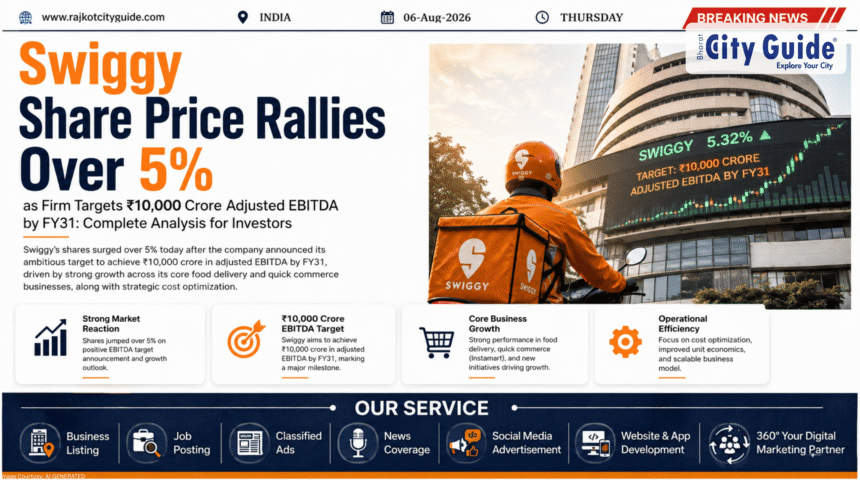
The Indian stock market witnessed significant momentum in new-age technology stocks, with the swiggy share price surging over 5.2% to hit an intraday high of ₹305 per share on the National Stock Exchange (NSE). This sudden upward movement came on the back of major corporate disclosures made during Swiggy Limited’s highly anticipated Capital Markets Day 2026. During the event, top leadership outlined a bold strategic roadmap for the next five years, projecting a consolidated Adjusted EBITDA target of ₹10,000 crore by Fiscal Year 2031 (FY31).
- Introduction
- What is Swiggy Limited?
- Current Situation and Latest Updates
- Why is This Update Important for Investors?
- Key Highlights of Swiggy’s FY31 Financial Roadmap
- Detailed Breakdown of Swiggy’s Core Business Segments
- Financial Metrics and Targets Comparison
- Business Model and Monetization Strategy
- Comparison with Competitors
- Key Advantages and Growth Drivers
- Potential Risks and Disadvantages
- Who Should Invest in Swiggy Shares?
- Timeline and Future Expectations (FY26 to FY31)
- Frequently Asked Questions (FAQs)
- Conclusion and Investor Outlook
Investors and institutional analysts responded positively to the management’s commentary, which provided clear visibility into path-to-profitability for quick commerce, food delivery, and out-of-home dining segments. Prior to this announcement, the market had been closely scrutinizing Swiggy’s ability to trim cash burn in its quick commerce arm, Instamart, while maintaining top-line expansion against intense competition. The strategic blueprint presented during the Capital Markets Day alleviated major margin concerns, triggering a buying spree across domestic and foreign institutional desks.
At the time of writing, the swiggy share price is trading around ₹297.20 per share on the NSE, reflecting a solid gain of 2.52% for the trading session. With the company committing to more than triple its consolidated Gross Order Value (GOV) to nearly ₹2.5 lakh crore by FY31, retail investors are asking whether this stock represents a compelling long-term buy.
This comprehensive guide breaks down everything you need to know regarding the latest swiggy share price rally, financial targets, segment-wise projections, key risks, competitive landscape, and future growth drivers to help you make an informed investment decision.
What is Swiggy Limited?
Swiggy Limited is one of India’s premier consumer technology platforms operating at the intersection of food delivery, quick commerce, and dining out. Founded in 2014 as a hyper-local food delivery marketplace, Swiggy revolutionized the Indian food tech sector by building a nationwide logistics infrastructure and partnering with hundreds of thousands of restaurant partners. Over the past decade, the platform evolved into an all-in-one convenience super-app offering several core service verticals:
- Food Delivery: Connecting millions of monthly active users with local, regional, and national restaurant brands.
- Instamart (Quick Commerce): Delivering groceries, fresh produce, electronics, home essentials, and personal care items in under 10 to 15 minutes through a network of strategically located dark stores.
- Dineout & Out-of-Home: Facilitating restaurant table reservations, discovery, and digital payment discounts across dining establishments nationwide.
- Swiggy Genie & Pick-up/Drop: Offering point-to-point courier and errand fulfillment services for urban consumers.
The company went public through a high-profile Initial Public Offering (IPO), attracting massive attention from retail, HNI, and global institutional investors. Understanding the swiggy share price dynamic requires analyzing its evolution from a high-growth, loss-making startup to a disciplined public entity prioritizing profitability, operational efficiency, and margin expansion across all business arms.
Current Situation and Latest Updates
The recent surge in the swiggy share price stems directly from key financial and operational disclosures released during the company’s Capital Markets Day 2026. The management presented a aggressive long-term target that significantly exceeded street expectations regarding long-term EBITDA generation.
Key Strategic Highlights Unveiled at Capital Markets Day 2026:
- FY31 EBITDA Vision: Target to reach ₹10,000 crore in consolidated Adjusted EBITDA by FY31, translating to an Adjusted EBITDA margin of roughly 4% as a percentage of overall Gross Order Value (GOV).
- Massive GOV Scale-Up: Aiming to scale consolidated GOV from ₹67,734 crore in FY26 to over ₹2,50,000 crore (₹2.5 lakh crore) by FY31, implying a compound annual growth rate (CAGR) exceeding 30%.
- Instamart Breakeven Achieved: Official confirmation that Instamart, Swiggy’s quick commerce vertical, achieved absolute contribution margin breakeven in May 2026, marking a pivotal milestone in proving quick commerce economics.
- Intraday Stock Movement: On Thursday, August 6, the swiggy share price surged by 5.2% to touch a high of ₹305 on the NSE before settling around ₹297.20 per share.
- Segment Profitability Breakdown: Management expects Food Delivery to generate ₹5,000 crore, Instamart to contribute ₹4,000 crore, and Dineout/Out-of-Home to deliver ₹1,000 crore toward the ₹10,000 crore Adjusted EBITDA target by FY31.
This clear, quantified path toward profitability provided much-needed comfort to investors who were previously cautious about quick commerce cash burn and aggressive marketing expenditures.
Why is This Update Important for Investors?
The Capital Markets Day announcement carries structural importance for anyone tracking the swiggy share price or broader Indian technology stock valuations. For years, platform companies in India were valued purely on revenue multiples and GMV/GOV growth rates, with little regard for bottom-line earnings. However, public markets demand sustainable free cash flow generation.
By setting concrete profit milestones, Swiggy has shifted the investment narrative from loss-making growth to disciplined margin expansion. The fact that Instamart crossed contribution margin breakeven in May 2026 proves that quick commerce is not merely a capital sink, but a structurally viable business capable of positive unit economics at scale.
For equity markets, this clarity reduces the equity risk premium attached to the swiggy share price, opening doors for long-term institutional capital, pension funds, and mutual funds to build strategic positions.
Key Highlights of Swiggy’s FY31 Financial Roadmap
Below is a summary of the major targets defined by Swiggy’s leadership team:
- Consolidated GOV Target: ₹2,50,000 crore+ by FY31 (up from ₹67,734 crore in FY26).
- Consolidated Adjusted EBITDA Target: ₹10,000 crore by FY31.
- Implied GOV CAGR: Over 30% annualized growth from FY26 through FY31.
- Consolidated EBITDA Margin Target: Approximately 4% of GOV by FY31.
- Instamart Contribution Breakeven: Successfully achieved in May 2026.
- Food Delivery EBITDA Projection: ₹5,000 crore by FY31 (4.5%–5% of GOV).
- Instamart EBITDA Projection: ₹4,000 crore by FY31.
- Dineout/Out-of-Home EBITDA Projection: ₹1,000 crore by FY31.
Detailed Breakdown of Swiggy’s Core Business Segments
To analyze whether the target supporting the swiggy share price momentum is achievable, we must evaluate each primary business segment independently.
1. Food Delivery Segment
Overview:
Food delivery remains Swiggy’s core cash cow, generating consistent operating profits and cash flows that support investments in newer verticals. The company operates in hundreds of Indian cities, utilizing dynamic pricing algorithms, customer subscription passes (Swiggy One), and restaurant partner commissions.
Financial Performance & FY31 Goal:
- EBITDA Target: ₹5,000 crore by FY31.
- Margin Target: 4.5% to 5.0% Adjusted EBITDA as a percentage of Food Delivery GOV.
- Growth Drivers: Expansion into Tier-2 and Tier-3 cities, increasing Monthly Transacting Users (MTUs), premium gourmet dining offerings, higher average order values (AOV), and rising restaurant ad monetization.
Real-World Impact:
As food delivery order frequencies rise among urban households, Swiggy benefits from operational leverage. Higher order density reduces delivery cost per order while increasing platform fee realization, directly aiding the swiggy share price trajectory.
2. Quick Commerce (Swiggy Instamart)
Overview:
Instamart allows consumers to order groceries, fresh produce, meat, beauty products, electronics, and household goods, delivering them in 10 to 15 minutes through neighborhood dark stores.
Financial Performance & FY31 Goal:
- EBITDA Target: ₹4,000 crore by FY31.
- Key Milestone: Reached contribution margin breakeven in May 2026, dropping contribution losses down to -0.2% in Q1 FY27 before turning fully positive.
- Growth Drivers: Dark store network optimization, SKU expansion into higher-margin non-grocery categories (apparel, electronics, seasonal goods), improved vendor terms, advertising revenues from FMCG brands, and reduced supply chain losses.
Real-World Impact:
Quick commerce is rapidly transforming urban retail habits in India. Crossing contribution breakeven proves that dark store economics work when scale and order density reach critical mass, removing a major overhang on the swiggy share price.
3. Out-of-Home Consumption & Dineout
Overview:
Swiggy Dineout enables users to discover restaurants, book tables, and settle bills using digital payments to receive flat discounts.
Financial Performance & FY31 Goal:
- EBITDA Target: ₹1,000 crore by FY31.
- Operational Status: Turned profitable on a full-year basis in FY26, achieving a 0.6% EBITDA margin with over 53,000 active restaurant partners.
- Growth Drivers: Growth in out-of-home dining spending among middle-class Indian households, integration with Swiggy One membership benefits, and monetization through event ticketing and restaurant marketing services.
Financial Metrics and Targets Comparison
To understand how Swiggy’s operational performance translates into valuation, let us review the company’s baseline operational metrics and its future targets:
| Metric | FY26 Actual / Baseline | FY31 Target / Projection |
| Consolidated Gross Order Value (GOV) | ₹67,734 Crore | ₹2,50,000 Crore+ |
| Consolidated Adjusted EBITDA | Negative (Cash Burn Phase) | ₹10,000 Crore |
| Adjusted EBITDA Margin (% of GOV) | Negative | ~4.0% |
| Food Delivery EBITDA | ~₹1,200 Crore (Annualized) | ₹5,000 Crore |
| Instamart Contribution Margin | Turning Positive (Breakeven May ’26) | Strongly Positive Positive Margin |
| Instamart EBITDA | Negative | ₹4,000 Crore |
| Dineout EBITDA | ~₹50-100 Crore | ₹1,000 Crore |
| GOV CAGR (FY26–FY31) | N/A | > 30% |
This table demonstrates the steep operational trajectory Swiggy plans to execute over the next 5 years, providing fundamental support for the swiggy share price.
Business Model and Monetization Strategy
Swiggy operates an asset-light, platform-based business model that monetizes hyper-local transactions through multiple income streams:
- Transaction Commissions: Charged to restaurant partners and FMCG brands as a percentage of total order value (ranging between 15% to 25% for food delivery).
- Delivery Fees & Surge Pricing: Fees collected directly from customers based on distance, order value, weather conditions, and peak demand hours.
- Advertising Services: Sponsored listings, search placements, and brand placement banner ads inside the Swiggy and Instamart apps. High-margin ad revenue is a primary driver for EBITDA margin expansion.
- Subscription Pass (Swiggy One): A recurring subscription program offering members free delivery and exclusive discounts across Food, Instamart, and Dineout, driving user retention and higher order frequency.
- Platform Fees: Fixed platform charges applied to orders, directly contributing to net operating margin expansion.
Comparison with Competitors
When analyzing the swiggy share price, stock market investors evaluate how Swiggy compares against its chief competitors, primarily Eternal (Zomato / Blinkit) and private quick commerce player Zepto.
1. Swiggy vs. Zomato (Food Delivery)
- Market Share: Food delivery in India is a duopoly divided between Zomato and Swiggy. While Zomato holds a slight market share lead in certain regions, Swiggy exhibits strong customer loyalty in major metros like Bengaluru, Mumbai, and Hyderabad.
- Profitability: Zomato achieved overall net profitability earlier due to faster quick-commerce rationalization, but Swiggy is rapidly closing the margin gap in food delivery with a target of 4.5%–5% EBITDA margin as a percentage of GOV.
2. Swiggy Instamart vs. Blinkit vs. Zepto (Quick Commerce)
- Dark Store Density: Blinkit and Zepto have scaled rapidly in top metro cities, but Instamart boasts a highly diversified product catalog including electronics and apparel, boosting overall Average Order Values (AOVs).
- Margin Profiles: Instamart achieving contribution margin breakeven in May 2026 puts it on an equal footing with major quick commerce rivals, proving that unit economics in quick commerce can stabilize across all leading platforms.
Key Advantages and Growth Drivers
Investors closely tracking the swiggy share price highlight several fundamental strengths backing the stock:
- Integrated Super-App Ecosystem: Single customer acquisition cost (CAC) leveraged across multiple services—Food Delivery, Instamart, Dineout, and Genie.
- Rapidly Improving Quick Commerce Unit Economics: Instamart’s milestone of reaching contribution breakeven reduces quarterly cash burn significantly.
- Strong Balance Sheet & Liquidity: Healthy cash reserves and capital allocation discipline ensure Swiggy can fund store expansion without excessive dilution.
- High Advertising Monetization Potential: Ad revenues from FMCG and restaurant partners carry near-100% gross margins, serving as a powerful profit driver.
- Favorable Indian Urban Demographics: Rising disposable incomes, increasing urban smartphone penetration, and changing consumer habits favor multi-vertical hyper-local convenience platforms.
Potential Risks and Disadvantages
Despite the bullish outlook surrounding the swiggy share price rally, prospective investors should keep the following risks in mind:
- Intense Competition: Quick commerce and food tech remain highly competitive, with players competing aggressively on delivery times, free delivery thresholds, and discounts.
- Execution Risk on FY31 Targets: A 30%+ GOV CAGR over five years requires continuous flawless execution without macro headwinds or consumer spending slowdowns.
- Gig Economy & Labor Regulations: Potential regulatory shifts regarding delivery partner minimum wages, social security benefits, or labor compliance could elevate delivery cost per order.
- Margin Compression in Quick Commerce: Price wars or aggressive dark store expansion by emerging competitors could delay full EBITDA profitability.
Who Should Invest in Swiggy Shares?
An analysis of the current market environment suggests that Swiggy shares are suitable for specific investor profiles:
- Growth-Oriented Investors: Investors seeking exposure to India’s fast-growing internet consumption economy, quick commerce expansion, and hyper-local delivery trends.
- Long-Term Investors (3 to 5-Year Horizon): Those willing to ride out short-term stock volatility to reap potential benefits as Swiggy executes its FY31 ₹10,000 crore EBITDA roadmap.
- Institutional & Portfolio Investors: High-net-worth individuals (HNIs) and institutional managers looking to diversify equity portfolios with leading technology platforms.
Note: Risk-averse retail investors seeking steady dividend yields or immediate value investing metrics may find high-growth technology stocks more volatile than mature traditional sector stocks.
Timeline and Future Expectations (FY26 to FY31)
To track the progress of the swiggy share price, market participants will monitor key execution milestones across the next five fiscal years:
- FY26 (Baseline Year): Consolidated GOV reported at ₹67,734 crore. Instamart achieves absolute contribution margin breakeven in May 2026.
- FY27 Expectation: Instamart transitions into positive contribution margins across all major operating clusters. Food delivery EBITDA margin scales toward 3.5%–4% of GOV.
- FY28–FY29 Target: Consolidated Adjusted EBITDA expected to reach company-wide breakeven, with quick commerce delivering positive operating profits.
- FY31 Long-Term Goal: Consolidated GOV hits ₹2.5 lakh crore, with ₹10,000 crore in consolidated Adjusted EBITDA (~4% GOV margin).
Frequently Asked Questions (FAQs)
1. What caused the recent rally in the swiggy share price?
The swiggy share price surged over 5% after Swiggy unveiled its FY31 growth vision during its Capital Markets Day 2026. Key highlights included a target of ₹10,000 crore in consolidated Adjusted EBITDA, tripling consolidated Gross Order Value (GOV) to ₹2.5 lakh crore, and announcing that quick commerce vertical Instamart reached contribution margin breakeven in May 2026.
2. What is Swiggy’s FY31 Adjusted EBITDA target?
Swiggy has targeted ₹10,000 crore in consolidated Adjusted EBITDA by FY31. Segment-wise, management expects the Food Delivery business to generate ₹5,000 crore, Instamart to contribute ₹4,000 crore, and Dineout/Out-of-Home consumption to deliver ₹1,000 crore in Adjusted EBITDA.
3. Has Swiggy Instamart become profitable?
Swiggy officially announced that Instamart reached absolute contribution margin breakeven in May 2026. While full EBITDA profitability for the quick commerce segment will take longer as dark store network expansion continues, achieving positive contribution margins proves that unit economics per order are viable.
4. What is the projected GOV growth rate for Swiggy?
Swiggy aims to scale its consolidated Gross Order Value (GOV) from ₹67,734 crore in FY26 to over ₹2,50,000 crore (₹2.5 lakh crore) by FY31. This ambitious expansion represents a compound annual growth rate (CAGR) of over 30% across the five-year period.
5. How does the swiggy share price compare with Zomato?
Investors evaluate the swiggy share price relative to Zomato based on market share, revenue growth, and EBITDA margins in food delivery and quick commerce. While Zomato achieved net profitability earlier, Swiggy’s new financial roadmap shows a accelerated margin expansion trajectory that narrows the valuation discount between the two tech giants.
6. Where is the swiggy share price currently trading?
Following the Capital Markets Day announcements, the swiggy share price touched an intraday high of ₹305 on the NSE before trading around ₹297.20 per share, marking a daily gain of approximately 2.5% to 5% depending on trading session updates.
7. What are the major risk factors for swiggy share price investors?
The primary risks affecting the swiggy share price include intense competition from quick commerce rivals like Blinkit and Zepto, potential delivery cost increases due to gig economy labor regulations, execution risks in achieving 30%+ GOV growth, and shifts in consumer spending.
8. Is Swiggy a good long-term stock to buy?
Swiggy presents an attractive opportunity for long-term growth investors who believe in India’s digital consumption story. The company’s clear target to generate ₹10,000 crore in Adjusted EBITDA by FY31 provides a fundamental backstop, though short-term stock volatility should be expected.
Conclusion and Investor Outlook
The recent surge in the swiggy share price reflects renewed market confidence in the company’s long-term business strategy and financial discipline. By establishing a quantified target of ₹10,000 crore in Adjusted EBITDA by FY31 and delivering contribution breakeven in Instamart, Swiggy has clearly demonstrated that it can balance aggressive revenue growth with operational efficiency.
While market competition remains stiff across food delivery and quick commerce, Swiggy’s multi-service super-app ecosystem, expanding dark store footprint, and high-margin advertising revenues position it strongly to capture India’s urban consumption boom. For long-term investors seeking tech-enabled consumer exposure, tracking execution against these FY31 milestones will be key to gauging future stock performance.