Introduction
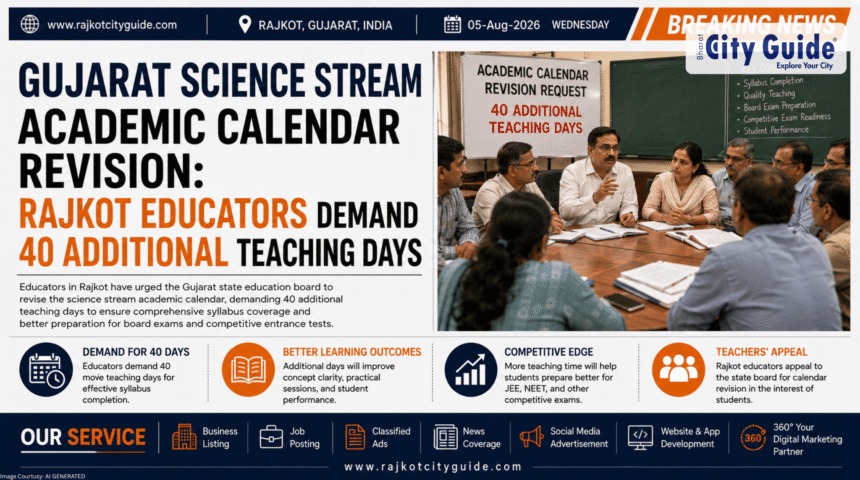
In the highly competitive landscape of secondary and higher secondary education across Gujarat, the academic schedule plays a pivotal role in determining student performance in national and state-level competitive examinations. Recently, a prominent representation was submitted to the Minister of Education by school administrators in Rajkot, calling for an urgent Gujarat Science Stream Academic Calendar Revision. The core issue highlighted by educators centers on an acute deficit in actual teaching days available for Class 11 and Class 12 Science stream students under the current academic framework.
- Introduction
- What is Gujarat Science Stream Academic Calendar Revision?
- Why This News is Important
- Background Information
- Key Highlights
- Detailed Explanation of the Event
- Benefits, Features, and Importance
- How It Impacts People
- Expert Insights and Industry Perspective
- Challenges and Limitations
- Future Outlook
- Frequently Asked Questions (FAQs)
- Conclusion
According to school management representatives, the current distribution of official working days, combined with extended Diwali and summer vacations, public holidays, and early examination schedules, results in a shortage of approximately 40 crucial instructional days. For students enrolled in the demanding Science stream—where mastering extensive physics, chemistry, mathematics, and biology concepts is non-negotiable—this compressed timeline creates enormous academic stress. Teachers are often forced to rush through complex theoretical modules and practical laboratory sessions to complete the syllabus before state board and competitive tests commence.
To mitigate this operational imbalance, Rajkot school management officials have formally requested the state education department to shorten traditional vacation periods, specifically Diwali and summer breaks, for higher secondary science sections. By restructuring the annual academic schedule, schools aim to recover lost instructional hours, provide thorough classroom instruction, and properly prepare students for high-stakes examinations such as the GSEB Board exams, NEET, JEE, and GUJCET.
What is Gujarat Science Stream Academic Calendar Revision?
The term Gujarat Science Stream Academic Calendar Revision refers to the proposed structural restructuring of the annual academic schedule mandated by the Gujarat Secondary and Higher Secondary Education Board (GSEB) for Class 11 and Class 12 Science streams. Currently, the state board issues a standardized uniform academic calendar applicable to all secondary and higher secondary schools across Gujarat. This calendar designates fixed dates for the start of the academic year, mid-term examinations, Diwali vacation, preliminary exams, board practicals, final board theory exams, and summer vacation.
While a standardized calendar works adequately for general streams where the curriculum density is relatively manageable, school leaders argue that the Science stream requires a customized schedule. The Higher Secondary Science curriculum follows the rigorous National Council of Educational Research and Training (NCERT) framework, requiring hundreds of hours of dedicated classroom teaching, numerical problem-solving sessions, and hands-on laboratory practicals.
When the prescribed 220-day general academic calendar is reduced by public holidays, local observational breaks, sports events, and exam administration periods, the actual teaching days available for science classrooms often drop to around 160–170 days. The proposed calendar revision seeks to decouple the Science stream’s operational schedule from general primary and secondary schools, selectively trimming holiday durations to restore a minimum of 200–210 active, uninterrupted teaching days dedicated strictly to curriculum delivery.
Why This News is Important
The representation made by Rajkot school administrators to the Gujarat Education Minister addresses a systemic issue affecting tens of thousands of science students across the state every year. Understanding why this demand has gained significant traction requires examining several critical factors:
1. High Syllabi Load vs. Compressed Timeframe
The syllabus for Std 11 and 12 Science is notoriously vast. Covering two years of advanced Physics, Chemistry, Mathematics, and Biology concepts in a compressed timeframe compromises conceptual depth. When time is scarce, teachers are compelled to focus on superficial coverage rather than deep problem-solving.
2. Alignment with Competitive Exam Timelines
Students in Gujarat’s Science stream do not merely prepare for the GSEB Class 12 Board examinations; they simultaneously compete in national tests like JEE Main, JEE Advanced, NEET-UG, and the state-level GUJCET. Because national entrance tests take place early in the calendar year (often starting in January and April), any delay or shortage in regular school teaching forces students to rely heavily on private coaching institutes.
3. Mental Health and Burnout Among Students
When 40 days of instructional time are missing from the academic year, the workload does not diminish—it simply compresses into fewer days. Students face grueling daily schedules, back-to-back extra classes on weekends, and inadequate time for self-study, leading to severe academic anxiety and physical exhaustion.
4. Equitable Access for Non-Coaching Students
Students from rural or economically weaker backgrounds who cannot afford expensive private coaching rely entirely on school classroom instruction. A deficit in school teaching days disproportionately impacts these students, creating an uneven playing field in competitive rankings.
Background Information
For years, the Gujarat Secondary and Higher Secondary Education Board (GSEB) has issued a unified annual calendar that governs all government, grant-in-aid, and self-financed schools throughout the state. Historically, this calendar includes:
- A 21-day Diwali Vacation (usually falling between October and November).
- A 35-day to 45-day Summer Vacation (spanning May and June).
- Periodic public holidays, festival breaks, and local administrative closures.
+--------------------------------------------------------------------------+
|                  CURRENT ACADEMIC CALENDAR STRUCTURE                     |
+--------------------------------------------------------------------------+
| Total Nominal Days in Year               : 365 Days                      |
| Standard Vacations (Diwali + Summer)    : ~60 to 65 Days                |
| Sundays and Public Holidays             : ~55 to 60 Days                |
| Exam Administration & Sports Days       : ~20 to 25 Days                |
+--------------------------------------------------------------------------+
| ACTUAL EFFECTIVE TEACHING DAYS REMAINING : ~160 to 170 DAYS              |
| ESTIMATED REQUIRED TEACHING DAYS         : ~200 to 210 DAYS              |
| INSTRUCTIONAL DEFICIT                    : ~40 DAYS                      |
+--------------------------------------------------------------------------+
While this schedule aligns well with primary and lower-secondary developmental needs, the introduction of the NCERT curriculum for Class 11 and 12 Science significantly escalated the academic volume. Furthermore, over the last few academic cycles, GSEB shifted its Board Examination schedules earlier into late February or early March to align with national entrance exam dates.
Consequently, while the examination dates moved forward by several weeks, the academic start dates and vacation lengths remained largely unchanged. This structural discrepancy created the 40-day teaching gap that school administrators in Rajkot are now urging the state government to fix.
Key Highlights
The main points raised in the official representation by Rajkot school managers include:
- Identification of a 40-Day Teaching Deficit: School administrators calculated that Class 11 and 12 Science students lose approximately 40 effective learning days under the existing calendar.
- Proposal to Shorten Vacations: A formal request was submitted to the Gujarat Education Minister to curtail the 21-day Diwali break and long summer vacations specifically for higher secondary science sections.
- Customized Calendar Demand: Calling for a dedicated academic calendar for the Science stream, separate from the primary, middle, and general secondary school calendars.
- Emphasis on Conceptual Mastery: Highlighting that extra classroom days will eliminate the need for rushed syllabus completion, allowing teachers to conduct thorough numerical practice and laboratory experiments.
- Reducing Dependence on Private Tuition: A revised calendar would strengthen main-school instruction, reducing student reliance on external commercial coaching centers.
- Stress Reduction for Science Aspirants: Spreading the vast NCERT curriculum across more calendar days will reduce daily academic pressure on teenagers.
Detailed Explanation of the Event
The recent representation submitted to Gujarat’s Education Department originated from a collective meeting of school management executives and senior science educators in Rajkot. After analyzing classroom completion metrics from previous academic sessions, administrators observed a recurring problem: every year, science teachers were forced to conduct early morning classes, evening extension sessions, and mandatory Sunday lectures just to finish the prescribed syllabus before board practicals.
+-----------------------------------------------------------------------+
|                PROPOSED CALENDAR RESTRUCTURING MODEL                  |
+-----------------------------------------------------------------------+
                                    |
                                    v
+-----------------------------------------------------------------------+
|             REVISED SCIENCE STREAM ACADEMIC CALENDAR                  |
+-----------------------------------------------------------------------+
        |                                   |                   |
        v                                   v                   v
+-----------------------+   +-----------------------+   +-----------------------+
| Shortened Diwali Break|   | Reduced Summer Break  |   | Stream-Specific Sched.|
| - Trimmed to 7-10 days|   | - Trimmed by 2 weeks  |   | - Independent from    |
| - Recovers ~10 days   |   | - Recovers ~15 days   |   |   Primary/General     |
+-----------------------+   +-----------------------+   +-----------------------+
        |                                   |                   |
        +-----------------------------------+-------------------+
                                    |
                                    v
+-----------------------------------------------------------------------+
|           RESULT: +35 to 40 RESTORED INSTRUCTIONAL DAYS               |
+-----------------------------------------------------------------------+
The Root Cause of the 40-Day Gap
When Class 11 students enter the science stream in June or July following Class 10 results, their actual academic term begins later than established classes. By the time foundational concepts in Physics and Chemistry are established, the three-week Diwali vacation arrives. In the second term, which runs from November to February, the effective working period is extremely short because:
- Board practical examinations for Class 12 commence as early as January or early February.
- Preliminary school examinations consume two to three weeks of potential teaching time.
- Class 11 final examinations are conducted earlier to allow an early transition into Class 12 material.
When these factors are combined, the actual calendar days spent on direct, unhurried classroom teaching drop significantly below the threshold required to cover the NCERT syllabus effectively.
Proposed Solutions Submitted to the Minister
To resolve this issue without compromising the overall quality of education, Rajkot school administrators submitted specific suggestions:
- Truncated Diwali Vacation: Reduce the 21-day Diwali vacation to 7–10 days for Class 11 and 12 Science streams, allowing schools to resume second-term teaching earlier.
- Targeted Summer Break Adjustments: Reallocate a portion of the 35-day summer break into active instructional days, particularly for students transitioning from Class 11 to Class 12.
- Stream-Specific Board Guidelines: Authorize schools to operate flexible academic schedules tailored specifically to the pace of higher secondary science education.
Benefits, Features, and Importance
Restructuring the academic calendar for Gujarat’s Science stream offers several distinct benefits for the state’s educational ecosystem:
+-----------------------------------------------------------------------+
|                   BENEFITS OF CALENDAR REVISION                       |
+-----------------------------------------------------------------------+
|  1. PACED LEARNING      | Eliminates rushed syllabus coverage         |
|  2. PRACTICAL DRILLS    | Gives dedicated time for lab experiments    |
|  3. EQUAL OPPORTUNITY   | Helps non-coaching rural students compete   |
|  4. WELLNESS & SLEEP    | Reduces weekend extra classes and fatigue   |
|  5. BETTER BOARD SCORES | Enhances conceptual depth for GSEB/GUJCET   |
+-----------------------------------------------------------------------+
Major Advantages
- Paced and Thorough Syllabus Coverage: Adding 35 to 40 teaching days allows educators to explain complex scientific concepts, derivation steps, and numerical problems systematically without skipping chapters.
- Enhanced Laboratory Practice: Science subjects require hands-on experimentation. Additional working days ensure students spend adequate time in physics, chemistry, and biology laboratories rather than rushing through demonstrations.
- Stronger Preparation for Competitive Exams: Thorough classroom coverage directly translates into better performance in GUJCET, NEET, and JEE, as students gain a firmer grasp of fundamental principles.
- Lower Financial Stress on Families: When schools have sufficient time to teach the complete syllabus effectively, parental reliance on expensive external coaching classes decreases.
- Improved Student Mental Health: Spreading academic requirements over a longer operational window reduces daily burnout, late-night cramming, and physical fatigue.
How It Impacts People
The proposed Gujarat Science Stream Academic Calendar Revision holds major implications for various educational stakeholders:
Class 11 and Class 12 Science Students
Students stand to gain the most from a revised calendar. Instead of enduring high-stress environments where 2-3 chapters are covered per week, students can experience a steady, balanced learning curve. More classroom days mean more time for doubt-solving, revision, and mock testing within school hours.
Science Teachers and Educators
Teachers currently bear immense pressure to complete dense syllabi within restricted timeframes. A revised calendar eliminates the need to schedule mandatory Sunday lectures or late-afternoon extra classes, allowing educators to prepare better lesson plans and deliver higher quality instruction.
Parents and Families
For parents, a streamlined school schedule provides financial and emotional relief. It restores faith in regular school education and reduces the financial burden of enrolling children in supplementary coaching programs. However, parents will need to adapt family travel and holiday plans around shorter Diwali and summer breaks.
School Management and Administrators
School administrators will gain the operational flexibility needed to run their academic programs efficiently. They can structure mock board exams, revision workshops, and practical assessments without compromising regular syllabus delivery.
Expert Insights and Industry Perspective
Education experts, child psychologists, and veteran academic directors have long debated the structure of school calendars in India. Most experts agree that the traditional uniform academic calendar—which treats primary school children and higher secondary competitive exam aspirants identically—is outdated.
                       +-------------------------+
                       |    THREE PILLARS OF     |
                       | MODERN SCIENCE EDUCATION|
                       +-------------------------+
                                    |
          +-------------------------+-------------------------+
          |                         |                         |
          v                         v                         v
+-------------------+     +-------------------+     +-------------------+
| Conceptual Depth  |     | Lab Experimentation|    | Paced Testing     |
| Moving away from  |     | Dedicated hours   |     | Regular revision  |
| rote learning to  |     | for hands-on      |     | without last-     |
| problem-solving   |     | scientific work   |     | minute cramming   |
+-------------------+     +-------------------+     +-------------------+
Educational planners highlight several core considerations:
- Differentiated Scheduling for Senior Secondary Levels: Modern education models internationally utilize specialized calendars for upper-secondary students. Senior students pursuing specialized stem tracks require higher instructional hours than junior students.
- Quality over Speed: Rushing through a science syllabus to meet a calendar deadline leads to surface-level memorization rather than true problem-solving ability, which ultimately harms student performance in national entrance exams.
- Balancing Rest and Academic Continuity: While vacations are essential for mental rejuvenation, excessively long breaks in the middle of a continuous two-year scientific curriculum can cause learning loss, requiring weeks of review when classes resume.
Challenges and Limitations
While the demand for an academic calendar revision is backed by sound educational logic, implementing it presents several practical challenges:
- Resistance to Shorter Vacations: Students and parents accustomed to long traditional Diwali and summer breaks may initially resist shortened holiday schedules.
- Teacher Fatigue and Burnout: Increasing working days requires careful management to ensure teachers receive adequate rest and professional support throughout the year.
- Infrastructure and Climate Constraints: Running classes during summer months in Gujarat requires proper climate control (fans, coolers, or air conditioning) in classrooms to maintain a comfortable learning environment during hot weather.
- Administrative Complexity: Operating two different academic calendars within the same school—one for general/primary streams and another for senior science streams—requires careful coordination of school transport, administrative staff, and shared campus facilities.
Future Outlook
The representation submitted by Rajkot school managers has sparked a wider conversation within the Gujarat Education Department regarding the structure of higher secondary education. Looking ahead, several outcomes are possible:
- Statewide Policy Review: The Education Ministry may form a special committee composed of GSEB officials, academic experts, and school principals to evaluate instructional hour requirements across all streams.
- Pilot Implementation: The state government might grant pilot approval allowing self-financed and grant-in-aid science schools the flexibility to adjust vacation days autonomously, provided minimum instructional hours are met.
- Stream-Specific Academic Frameworks: Gujarat could move toward a permanent dual-calendar system, maintaining standard vacation schedules for primary and general streams while operating an extended, high-intensity academic calendar for Higher Secondary Science.
- Integration of Blended Learning: To complement physical classroom days, the state may expand digital learning platforms, allowing students to complete introductory modules during breaks without losing valuable classroom time.
Frequently Asked Questions (FAQs)
Q1: What is the main demand made by Rajkot school administrators regarding the Gujarat Science Stream?
A: Rajkot school administrators have requested the Education Minister to revise the academic calendar for Std 11 and 12 Science streams by shortening Diwali and summer vacations to recover approximately 40 missing teaching days.
Q2: Why is there a deficit of 40 teaching days in the current Science stream schedule?
A: The deficit occurs because the current uniform academic calendar includes long vacation periods, public holidays, and early examination dates, leaving only 160–170 actual teaching days compared to the 200+ days required to cover the dense NCERT science curriculum.
Q3: How does shortening Diwali vacation help science students?
A: Trimming the 21-day Diwali break down to 7–10 days gives schools an extra 10–12 operational days in the second term, allowing teachers to cover difficult Physics, Chemistry, Mathematics, and Biology topics without rushing.
Q4: Does this proposal apply to all school grades in Gujarat?
A: No. The proposal specifically targets Class 11 and Class 12 Science streams, where the curriculum volume and competitive exam pressure (NEET, JEE, GUJCET) require significantly more instructional time.
Q5: How will a calendar revision reduce student stress?
A: Spreading the vast NCERT syllabus over more working days eliminates the need for daily extra classes, weekend sessions, and last-minute cramming, giving students a balanced daily schedule and time for self-study.
Q6: How does this proposed change benefit students who do not attend private coaching?
A: Students who rely solely on school education gain complete, in-depth syllabus coverage and practical lab experience directly in their classrooms, levelling the playing field against peers attending expensive coaching institutes.
Q7: Has the Gujarat Education Ministry officially changed the calendar yet?
A: As of now, a formal representation has been submitted by school managers to the Education Minister. The department is reviewing the proposal to decide on potential policy updates.
Q8: What are the main competitive exams taken by Gujarat 12th Science students?
A: Gujarat Class 12 Science students primarily take the GSEB Board Exams, GUJCET (Gujarat Common Entrance Test) for state engineering and pharmacy admissions, NEET-UG for medical admissions, and JEE Main/Advanced for national engineering admissions.
Conclusion
The demand for a Gujarat Science Stream Academic Calendar Revision highlights a critical operational gap in the state’s higher secondary education framework. By identifying a 40-day instructional deficit, educators in Rajkot have shed light on why so many science students struggle with syllabus compression, academic anxiety, and heavy reliance on private coaching.
Shortening traditional vacation breaks and establishing a dedicated, stream-specific academic schedule offers a practical solution to restore balance to science education. As the Gujarat Education Department considers this representation, adopting a flexible, student-centered calendar could significantly enhance academic quality, improve competitive exam performance, and create a healthier learning environment for young science aspirants across Gujarat.