Introduction
The monsoon season of 2026 has taken a severe turn across Western India, placing the state of Gujarat on a knife-edge. A massive weather development has triggered a critical Rajkot Heavy Rain Alert, forcing the local district administration and state disaster management bodies to switch to full emergency operations. Following an alarming meteorological forecast indicating exceptionally heavy downpours, flash flood risks, and strong gusty winds, the Rajkot administration has initiated massive precautionary measures to ensure zero casualties.
- Introduction
- What is the Rajkot Heavy Rain Alert?
- Why This News is Important
- Background Information
- Key Highlights
- Detailed Explanation of the Event
- Importance of Proactive Disaster Planning
- How It Impacts People
- Expert Insights & Industry Perspective
- Challenges and Limitations
- Future Outlook
- Frequently Asked Questions (FAQs)
- Conclusion
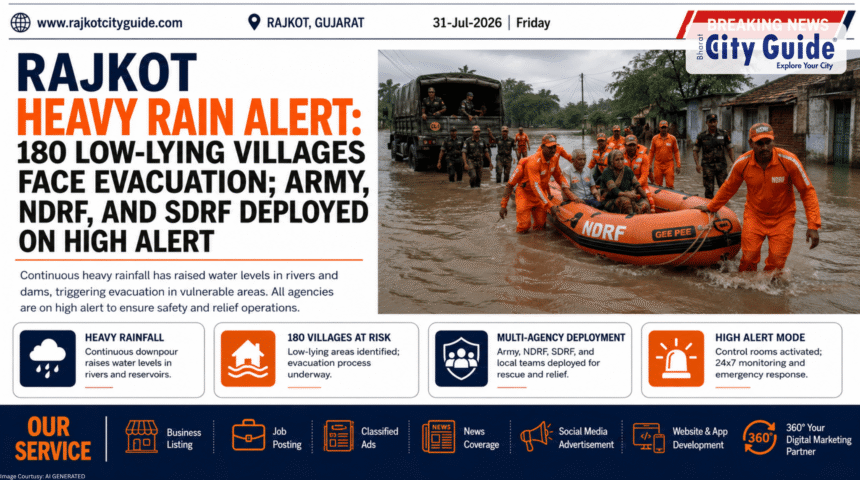
At the heart of this emergency strategy is the mandatory evacuation blueprint covering approximately 170 to 180 low-lying and flood-prone villages positioned along swelling rivers and downstream of overflowing dams. Recognizing the potential intensity of the oncoming deluge, local authorities have not only mobilized regional assets but have also actively requisitioned the Indian Army, working in absolute tandem with the National Disaster Response Force (NDRF) and the State Disaster Response Force (SDRF).
To safeguard human lives, structural shutdowns have been quickly implemented, including the declaration of holidays across all primary schools, secondary schools, colleges, and technical institutions. With urban centers and rural belts still trying to dry out from previous monsoon downpours, this fresh alert represents a high-stakes test of Gujarat’s modern disaster management mechanisms. For citizens, travelers, and businesses, understanding the depth of this weather disruption is critical as the state navigates a perilous 48-to-72-hour window.
What is the Rajkot Heavy Rain Alert?
The Rajkot Heavy Rain Alert is an official severe weather emergency declaration issued by the India Meteorological Department (IMD) and enforced by the Rajkot District Collectorate, led by Collector Om Prakash. It is categorized primarily under an Orange to Red Alert framework, warning of heavy, very heavy, and isolated extremely heavy precipitation bands capable of dropping massive water volumes within short timeframes.
This alert is not merely a forecast of standard seasonal rain; it represents an advanced warning system for flash floods, rapid inundation of urban catchments, dangerous river overflows, and structural hazards brought on by sustained wind speeds ranging between 40 to 50 km/h. The alert mandates immediate defensive and rescue preparations across the entire district machinery. This includes setting up round-the-clock emergency control rooms, freezing the leaves of all government personnel, deploying rescue boats and dewatering pumps, and setting up staging areas for military and paramilitary rescue teams.
Why This News is Important
This emergency news holds immense significance due to its scale and the vulnerability of the Saurashtra region. Millions of lives, vast acres of agricultural land, and critical public infrastructure are directly in the path of this extreme weather system.
First, the decision to evacuate 180 villages highlights that the administration expects major overflowing events at key dams and reservoirs. Failing to act proactively could result in catastrophic water logging and loss of life.
Second, calling in the Indian Army alongside specialized forces like the NDRF and SDRF signals that the potential disaster scale could surpass civilian rescue limits. When military intervention is prepared in advance, it indicates that airlifting, deep-water tracking, and large-scale logistical rescue operations are expected.
Finally, shutting down educational institutions and canceling all administrative leaves across the board ensures that the civilian population remains indoors, drastically cutting down on traffic-related strandings, structural accidents, and accidental electrocutions.
Background Information
To fully understand the severity of the current situation, one must look at the macro-meteorological patterns affecting India in late July 2026. According to IMD Director Ashok Kumar Das, a highly potent Deep Depression originated over the Bay of Bengal, travelled across the landmass of Madhya Pradesh and Chhattisgarh, and is steadily tracking in a west-northwest direction straight toward Gujarat. While such systems typically lose moisture over land, this specific Deep Depression is being reinforced by an active monsoon trough, a highly energized atmospheric shear zone, and a synchronized Western Disturbance coming from the north.
Additionally, Gujarat is coming off a brutal week of relentless rainfall. Just days ago, neighboring districts and parts of Saurashtra experienced extensive flooding, with cities like Ahmedabad logging historic single-day downpours. Because the ground is already fully saturated and local reservoirs, rivers, and drainage channels are filled to capacity, any fresh rainfall will trigger immediate surface runoff. The lack of soil absorption means that even moderate rainfall could lead to flash floods, making this new deep depression incredibly dangerous.
Key Highlights
- Massive Evacuation Plan: Over 170 to 180 low-lying villages located near river banks and downstream dam zones have been mapped for immediate evacuation.
- Tri-Force Deployment: The Indian Army, National Disaster Response Force (NDRF), and State Disaster Response Force (SDRF) have been placed on high alert and stationed at strategic locations.
- Educational Lockdowns: All schools, colleges, ITIs, and coaching centers across the district face complete operational closure to protect students.
- Administrative Zero-Leave: All government officials, local talatis, and civic engineers have had their leaves canceled, with orders to remain at their designated headquarters.
- Temporary Relief Hubs: Primary school buildings and robust public halls located on high ground have been converted into relief shelters equipped with food, drinking water, and first-aid kits.
- Utility Protection: Special directives have been issued to the Paschim Gujarat Vij Company Ltd (PGVCL) to ensure uninterrupted power supply to critical healthcare hubs while quickly isolating waterlogged transformers to prevent electrocution.
Detailed Explanation of the Event
As the deep depression advances closer to the Saurashtra coast, Rajkot’s district administration has turned its operational blueprints into active ground strategies. District Collector Om Prakash has taken charge, establishing a centralized command center that syncs data from the Indian Meteorological Department with real-time dam telemetry.
The Rural Evacuation Protocol
The identification of the 180 vulnerable villages followed a detailed review of water discharge limits from primary regional reservoirs. When dams open their floodgates to handle the massive incoming flow from the deep depression, downstream villages bear the brunt. Local village administrators (Talatis) have been ordered to carry out door-to-door awareness campaigns, utilizing local loudspeakers to instruct villagers to move to higher ground. Primary schools located outside the flood zones have been stocked with dry rations, water purifiers, and essential medicines.
Armed Forces Integration
Past monsoon seasons have shown that rural areas can become quickly cut off when approach bridges are submerged by raging floodwaters. To prevent villages from becoming isolated, the Indian Army’s engineering and rescue wings have been integrated into the state’s regional plans. While the SDRF and NDRF focus on immediate boat-based rescues and water extractions in urban hotspots like Gondal, Jetpur, and Rajkot city, the Army stands ready to deploy heavy-duty amphibian vehicles, build temporary bridges, and execute helicopter-led air rescues if the weather takes a catastrophic turn.
Urban Resilience Measures
Within Rajkot City and surrounding municipalities, the Rajkot Municipal Corporation (RMC) has deployed heavy dewatering pumps across hundreds of low-lying waterlogging hotspots. Fire brigade teams have checked their rescue boats, tree-pruning crews are clearing weak branches that could snap under 50 km/h winds, and structural engineers are reviewing old, dilapidated buildings to prevent sudden collapses. Furthermore, the city’s extensive CCTV network is being used to track water accumulation at critical underpasses and transit points.
Importance of Proactive Disaster Planning
The implementation of the Rajkot Heavy Rain Alert protocols highlights the evolution of India’s approach to natural disasters—shifting from reactive relief to proactive mitigation.
[IMD Advanced Weather Warning]
              │
              ▼
[Pre-emptive Evacuation of 180 Villages] ──► [Zero Casualty Goal]
              │
              ▼
[Tri-Force Mobilization: Army + NDRF + SDRF]
By tracking the weather system early, the government has given itself a vital window to evacuate people before the rain even starts. Moving vulnerable citizens to solid concrete structures before roads flood significantly reduces the chaos of midnight rescue operations.
Additionally, advising families with heavily pregnant women to check into medical facilities early avoids the logistical nightmare of navigating flooded streets during a medical emergency. Stocking critical supplies like snake-bite antivenoms, clean drinking water, and chlorine tablets beforehand also prevents the outbreak of waterborne illnesses following the flood.
How It Impacts People
Students and Academic Institutions
Students face immediate changes as all local schools, colleges, and educational hubs shut down. While this breaks up academic schedules, it keeps young children from getting stranded in flooded school buses or struggling through deep water on their way home. Higher education institutions are also shifting to online spaces or rescheduling exams to keep everyone safe.
Citizens and Rural Commuters
For everyday citizens, the alert means adapting to strict safety measures. Daily wage earners, agricultural workers, and local traders face temporary financial disruptions as markets close down. For the rural population in the 180 designated villages, the impact is profound; they must leave behind their homes and crops, moving their families and livestock away from the path of rising floodwaters.
Travelers and Transport Logistics
Saurashtra’s transportation networks face serious delays. State transport buses are altering their routes to bypass vulnerable low-lying bridges, and trains running through the Rajkot division are operating at reduced speeds or facing short-terminations. Travelers are strongly urged to postpone all non-essential road trips, especially along rural state highways where flash floods can wash away roads without warning.
Expert Insights & Industry Perspective
Disaster management professionals and seasoned meteorologists emphasize that the complex nature of the 2026 monsoon demands advanced, tech-driven responses. Climate scientists note that the compounding behavior of weather systems—where a deep depression interacts with an active shear zone—is becoming more common due to warming atmospheric conditions over the Indian subcontinent.
Urban planning experts point out that while rural evacuations protect human lives, modern cities require continuous upgrades to their drainage systems to handle high-density rainfall events. Industry leaders in logistics and insurance suggest that proactive shutdowns, while costly in the short term, prevent massive asset losses, vehicle damage, and workplace accidents, proving that early warnings are essential for modern financial resilience.
Challenges and Limitations
Despite thorough preparations, managing an emergency of this scale presents clear logistical challenges:
- Reluctance to Evacuate: Many rural villagers hesitate to leave their homes, fearing property theft or worrying about leaving behind heavy farm equipment and livestock.
- Urban Inundation: Older parts of Rajkot feature narrow, dense streets where large dewatering pumps cannot easily enter, leading to persistent local flooding.
- Communication Breakdowns: Sustained 50 km/h winds can damage overhead power lines and local mobile towers, making real-time coordination difficult if backup satellite systems fail.
- Resource Strain: Managing simultaneous high alerts across multiple districts in Gujarat tests the limits of available NDRF and SDRF teams, requiring smart, strategic distribution of rescue assets.
Future Outlook
Looking ahead, the next 72 hours are critical for Rajkot and the broader Saurashtra region. The deep depression is expected to pass directly over central Gujarat before shifting toward North Gujarat and the arid zones of Kutch by the weekend. Once the main storm system exits into the Arabian Sea, the risk shifts from heavy downpours to regional drainage management, as water from upstream catchments continues to flow into local rivers and dams.
In the long run, this event will likely prompt state planners to invest more heavily in automated dam gate systems, construct resilient high-level bridges across flood-prone rural routes, and further refine early warning digital networks to protect vulnerable communities.
Frequently Asked Questions (FAQs)
1. What does the current Rajkot Heavy Rain Alert mean for local residents?
The alert indicates that a powerful Deep Depression is moving toward the region, bringing heavy to extremely heavy rainfall, strong winds up to 50 km/h, and high flash flood risks. Residents are strongly advised to stay indoors and avoid all unnecessary travel.
2. Which areas are being evacuated under this rain alert?
The district administration has mapped out 170 to 180 low-lying, flood-prone villages situated near major riverbeds and downstream from vulnerable reservoirs and dams.
3. Are schools and colleges closed in Rajkot due to the heavy rains?
Yes, the district administration has declared an official holiday for primary schools, secondary schools, colleges, ITIs, and other educational institutions to keep students safe.
4. Why is the Indian Army being deployed alongside the NDRF and SDRF?
The Indian Army is on high alert to provide essential backup for complex rescue operations, such as handling deep-water extractions, setting up temporary transit options, or executing air rescues if local areas become completely cut off.
5. What temporary shelter arrangements have been made for evacuees?
The government has converted solid public halls and local primary school buildings on high ground into emergency shelters, fully stocking them with clean drinking water, food packets, medical kits, and necessary blankets.
6. How should pregnant women handle medical needs during this alert?
Following official medical advisories, families with pregnant women expecting deliveries over the next two to three days should arrange for them to admit into nearby hospitals early to avoid travel issues on flooded roads.
7. Who should I contact in Rajkot during a flood-related emergency?
Citizens can reach out to the 24/7 dedicated District Disaster Management Control Room or contact local municipal helplines. The administration has stationed active officers across all talukas to coordinate quick responses.
Conclusion
The current Rajkot Heavy Rain Alert highlights the intense power of the 2026 monsoon season and underscores the vital importance of early, organized disaster planning. By moving quickly to protect vulnerable communities, planning the evacuation of 180 villages, closing schools, and coordinating the strengths of the Indian Army, NDRF, and SDRF, the local administration has built a strong defense to protect human lives.
As the deep depression moves across Gujarat, the safety of the region relies on both the hard work of emergency teams and the cooperation of everyday citizens. By staying informed, following official evacuation orders, and avoiding floodwaters, residents can help the community weather this storm safely and emerge resilient.