Introduction
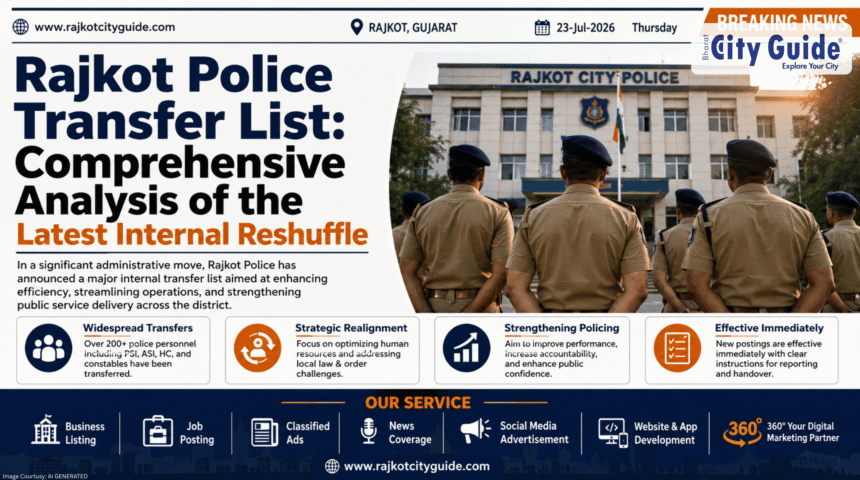
The internal administration of urban law enforcement requires structural auditing to maintain transparency, public trust, and operational efficiency. In a major administrative development, the Gujarat Police Department has executed a sweeping reshuffle within the city of Rajkot. According to official reports, the newly issued Rajkot Police Transfer List details the immediate shifting of 49 police personnel to the city’s police headquarters. This decisive move forms part of a broader policy objective targeting personnel who have been stationed at a single police station, branch, or operational desk for a continuous period of three or more years.
- Introduction
- What is the Rajkot Police Transfer List?
- Why This News is Important
- Background Information and Context
- Key Highlights of the Transfer Directive
- Detailed Explanation of the Event
- Strategic Benefits and Institutional Importance
- How It Impacts the Citizens of Rajkot
- Expert Insights and Industry Perspective
- Challenges and Administrative Limitations
- Future Outlook
- Frequently Asked Questions (FAQs)
- Conclusion
Administrative updates indicate that this initial wave is only the beginning of a larger institutional restructuring plan. Authorities have confirmed that a secondary, extensive Rajkot Police Transfer List involving more than 150 additional police personnel is currently under review and scheduled for implementation in the near future. Under the strict supervision of senior administrative heads, including the Police Commissioner, these transfers aim to dismantle localized stagnation, eliminate entrenched interests, and inject new operational energy into grassroots policing across the city’s various police stations.
For the citizens of Rajkot and observers of regional governance, this massive structural realignment marks a critical milestone. It underscores the home department’s renewed focus on tightening law and order frameworks following periods of intense institutional scrutiny. This article provides a comprehensive, deep-dive analysis into the strategic motives, legal guidelines, and operational impacts of the ongoing changes in Rajkot’s law enforcement architecture.
What is the Rajkot Police Transfer List?
The Rajkot Police Transfer List is an official administrative directive issued by the senior command of the Rajkot City Police and the Gujarat Home Department. It serves as a formal roster specifying the relocation, reassignment, and shuffling of police personnel across different operational zones, specialized branches, and police stations within the municipal limits of Rajkot. These lists are periodically compiled based on departmental service records, tenure durations, performance metrics, and administrative exigencies.
In the context of the latest development, the list explicitly names 49 police personnel—ranging from constables and head constables to assistant sub-inspectors—who have been detached from their long-held local postings and reassigned to the Police Headquarters (HQ). The primary criteria dictating inclusion in this specific list is the “three-year rule,” a standard administrative policy mandating that personnel should not remain embedded in a single station or jurisdiction for an excessive period. By compiling and enforcing this list, the police high command systematically rotates human resources to maintain organizational neutrality and operational flexibility.
Why This News is Important
The publication of this comprehensive transfer list carries profound significance for both internal police administration and the broader public ecosystem of Rajkot. In urban governance, a police department that becomes static at the grassroots level risks experiencing operational vulnerabilities. When lower-tier personnel occupy the exact same positions for multiple years, there is an inherent risk of the development of unhealthy familiarities, localized biases, and a decline in institutional alertness.
This news is particularly crucial because it signals a top-down structural cleanup. Following recent high-profile administrative overhauls in the city—including the appointment of senior IPS officers to top leadership roles—there has been an increased focus on institutional accountability. By initiating a sweeping transfer policy starting with 49 personnel and preparing for an additional 150+, the department is communicating a clear message: long-term stagnation will no longer be tolerated. It demonstrates a proactive effort to restore full public confidence in the local police apparatus by ensuring that staff are regularly rotated, objective, and fully committed to unbiased public service.
Background Information and Context
To understand the full magnitude of the ongoing reshuffle, it is essential to look at the broader background of Rajkot’s administrative landscape. Over the past couple of years, the city of Rajkot has witnessed significant transitions within its law enforcement leadership. Following major public safety events and subsequent state-level reviews—such as the massive administrative changes that took place after the tragic TRP gaming zone fire incident—the state government has placed Rajkot under intense administrative oversight.
Senior IPS officer Brijesh Kumar Jha took charge as the Police Commissioner of Rajkot City with a mandate to streamline city policing, expedite complex criminal investigations, and optimize institutional transparency. Leadership transitions at the top frequently necessitate a comprehensive evaluation of the personnel serving at the lower and middle tiers of the hierarchy.
Historically, the Gujarat Police manual outlines strict guidelines regarding the maximum duration a police officer or constable can serve in a single field posting or police station. Typically, a period of three years is designated as the standard threshold. However, due to administrative delays, staff shortages, or localized operational requirements, these rules are occasionally put on the back burner, allowing personnel to remain at the same station for four, five, or even more years. The current enforcement of the three-year rule represents a systematic alignment with standard operating procedures, ensuring that the structural integrity of the department is maintained from the highest command down to the beat constables.
Key Highlights of the Transfer Directive
The latest administrative orders contain several defining characteristics that highlight the scale and intent of the department’s cleanup strategy:
- Immediate Headquarters Relocation: A total of 49 police personnel have been abruptly stripped of their active station duties and ordered to report directly to the Rajkot Police Head-Quarters.
- The Three-Year Tenure Rule: The primary catalyst for these transfers is the strict identification of employees who have continuously served at a single location, desk, or police chowki for three or more years.
- Secondary Wave Imminent: Departmental sources have confirmed that this is merely the first phase of an extensive shake-up, with a secondary list containing over 150 personnel currently being drafted.
- Grassroots Coverage: The reshuffle covers multiple ranks within the lower and middle tiers of the force, ensuring that the rotation impacts field operations directly.
- Leadership-Driven Directive: The structural cleanup is being executed under the strategic guidance of senior city leadership, aiming to align the force with the transparency goals established by the Police Commissionerate.
Detailed Explanation of the Event
The execution of the Rajkot Police Transfer List represents a multi-phased administrative operation designed to systematically evaluate the service timelines of hundreds of personnel distributed across the city’s numerous police stations, including Crime Branch units, Special Operations Groups (SOG), and traffic circles.
During the initial audit conducted by the administrative wing, files were prepared detailing the exact joining dates of all personnel at their current postings. The audit revealed that dozens of officers had exceeded the three-year threshold at their respective locations. Acting decisively on these findings, the department officially released the first list, transitioning 49 personnel away from active police stations and placing them in the reserve pool at the Head-Quarters. Placing personnel in the headquarters is a standard administrative mechanism that effectively hits the “reset” button on their field tenures, allowing senior leadership to evaluate where they can be redeployed next without carrying over past localized influences.
Simultaneously, work on the secondary phase is progressing rapidly. The upcoming transfer of over 150 additional personnel will target specialized branches and highly coveted station postings where extended tenures are common. By managing these transfers in sequential waves, the department ensures that everyday law enforcement operations, emergency response times, and ongoing criminal investigations are not disrupted by a sudden, systemic shortage of manpower at any single station.
Strategic Benefits and Institutional Importance
The rigorous implementation of a standard rotation policy through the Rajkot Police Transfer List offers several long-term benefits to the law enforcement ecosystem:
1. Breaking Localized Stagnation and Entrenched Interests
When police personnel spend half a decade or more in the same neighborhood or police chowki, they naturally build deep social and personal networks. While community familiarity is beneficial for community policing, excessive integration can sometimes lead to compromised objectivity, soft corners for certain local elements, or a reluctance to enforce strict legal measures. Regular transfers disrupt these entrenched dynamics, ensuring that law enforcement remains purely professional and detached.
2. Enhancing Operational Transparency
A dynamic force is inherently a more transparent force. By continuously rotating personnel, the department minimizes the risks of institutional corruption or administrative complacency. New personnel arriving at a station bring fresh eyes, an objective outlook, and an unbiased approach to unresolved local disputes and pending case files.
3. Skill Diversification and Career Development
From a human resource perspective, keeping an employee confined to a single geographic area limits their professional growth. Moving personnel between central city stations, industrial outposts, traffic management, and headquarters duties ensures that the workforce develops a diverse, well-rounded skill set, making them far more versatile during emergencies.
How It Impacts the Citizens of Rajkot
The ultimate beneficiary of an optimized, highly alert police force is the general public. For the ordinary residents, shopkeepers, and business owners of Rajkot, this administrative reshuffle translates directly into improved public safety and fair treatment.
- Fair Dispute Resolution: Citizens dealing with local police stations can expect more objective hearings, as newly posted personnel will have no prior personal equations or biases involving the parties in a dispute.
- Increased Responsiveness: Shaking up the lower-tier bureaucracy often leads to an immediate increase in alertness and responsiveness, as incoming personnel strive to prove their capabilities in their new assignments.
- Deterrence to Lawbreakers: Local criminal elements or chronic lawbreakers who may have established comfort zones due to long-standing relationships with specific station staff will find their networks completely disrupted by the incoming staff.
Expert Insights and Industry Perspective
Public administration experts and retired senior police commanders frequently emphasize that regular tenure audits are the lifeblood of an effective police force. According to general administrative principles, the lower and middle tiers of the police force—the constabulary—represent the primary interface between the government and the citizen. Therefore, maintaining the integrity of this interface is paramount.
Experts note that while high-profile transfers of IPS-level officers capture media headlines, it is the quiet, methodical shifting of the station-level personnel that truly reshapes the day-to-day experience of the public. Institutional studies on police reforms universally recommend a strict adherence to fixed tenures followed by mandatory rotations, describing it as the most effective non-monetary tool available to combat systemic inertia and ensure uniform enforcement of the law across all urban neighborhoods.
Challenges and Administrative Limitations
While the benefits of the Rajkot Police Transfer List are clear, executing an operation of this magnitude is not without significant logistical and administrative challenges:
- The Learning Curve: Every neighborhood has its unique demographic layout, crime patterns, and local sensitivities. Newly transferred personnel require time to familiarize themselves with their new jurisdictions, which can cause a temporary dip in local intelligence gathering.
- Family and Social Disruption: Lower-tier police personnel often face personal challenges during sudden reassignments, including adjusting to new shift schedules, commuting longer distances, or managing family disruptions, which can temporarily affect morale if not handled empathetically by the department.
- Administrative Workload: Processing, tracking, and successfully reallocating hundreds of personnel while maintaining perfect continuity in active shifts requires flawless coordination by the department’s human resource and administrative wings.
Future Outlook
In the coming weeks, all eyes will be on the release of the comprehensive secondary Rajkot Police Transfer List, which is expected to relocate over 150 additional personnel. This impending wave will likely complete the structural reorganization envisioned by the city’s top command.
Moving forward, the Rajkot City Police is expected to adopt a more systematized, automated tracking model for personnel tenures, ensuring that as soon as an individual approaches the three-year mark, their rotation is flagged automatically. This proactive approach will prevent the accumulation of massive backlogs of extended tenures, ensuring that the force remains perpetually dynamic, modern, and fully capable of addressing the evolving safety challenges of a rapidly growing urban hub like Rajkot.
Frequently Asked Questions (FAQs)
1. What triggered the release of the latest Rajkot Police Transfer List?
The list was triggered by a comprehensive internal administrative audit aimed at identifying and rotating police personnel who had been continuously stationed at the same police station or branch for three or more years, in accordance with standard departmental service guidelines.
2. How many personnel are affected by this initial transfer order?
In this initial administrative phase, a total of 49 police personnel have been officially moved from their local station postings and reassigned to the Rajkot Police Head-Quarters.
3. What does it mean when police personnel are moved to the “Head-Quarters”?
Moving personnel to the headquarters means they are taken off active local station duties and placed into a centralized reserve and administrative pool. This allows senior leadership to reset their field tenures and strategically plan their next deployments.
4. Is there another Rajkot Police Transfer List expected soon?
Yes, senior administrative officials have confirmed that a secondary phase of the structural reshuffle is underway, with a larger list containing the names of more than 150 additional police personnel scheduled for release soon.
5. Who supervises these internal police transfers in Rajkot?
These transfers are executed under the direct administrative authority of the top leadership of the Rajkot City Police Commissionerate, aligned with the operational guidelines set by the Gujarat Home Department.
6. Will these massive transfers affect the daily safety and policing of the city?
No, the department is executing the transfers in calculated, sequential waves to ensure that daily patrolling, emergency responses, and active criminal investigations maintain perfect continuity without facing manpower shortages.
7. How does the three-year transfer rule benefit the general public?
The rule ensures that local police stations remain entirely neutral, transparent, and objective. It prevents the development of localized biases and unhealthy familiarities, resulting in fairer law enforcement and better public safety for citizens.
Conclusion
The systematic rollout of the Rajkot Police Transfer List stands as a definitive and vital step toward reinforcing governance, transparency, and operational vitality within the city’s law enforcement apparatus. By strictly applying the three-year tenure rule and moving 49 long-serving personnel to the headquarters, the police leadership has demonstrated an unwavering commitment to administrative discipline. As the department prepares to execute the next phase of transfers involving over 150 additional personnel, the citizens of Rajkot can look forward to a revitalized, highly objective, and responsive police force dedicated to upholding the rule of law without compromise.