Introduction
Monsoon season brings much-needed relief from the intense heat of summer, but it also presents significant logistical challenges for urban infrastructure across Western India. For major urban centers like Rajkot, the commercial capital of the Saurashtra region, intense rainfall can quickly saturate urban drain networks and trigger severe localized waterlogging. When natural river systems and drainage catchments are pushed to their absolute limits, proactive municipal intervention becomes the thin line separating minor disruptions from major structural emergencies.
- Introduction
- What is the Rajkot Heavy Rain Alert?
- Why This News is Important
- Background Information and Geographical Context
- Key Highlights of the RMC Rescue Plan
- Detailed Explanation of the Emergency Mobilization
- Benefits and Features of Modernized Preparedness
- How It Impacts the Citizens of Rajkot
- Expert Insights on Urban Flood Management
- Challenges and Operational Constraints
- Future Outlook for Rajkot’s Infrastructure
- Frequently Asked Questions (FAQs)
- Conclusion
This year, the threat of intense weather has prompted local authorities to issue an official, high-priority Rajkot Heavy Rain Alert. The India Meteorological Department (IMD) has forecast persistent, heavy-to-very-heavy precipitation across Saurashtra. In response, the Rajkot Municipal Corporation (RMC) has moved swiftly from general seasonal planning to active emergency mobilization. The RMC Fire and Emergency Services Department has been placed on high alert, establishing a robust disaster response network across the city.
This strategic update is critical for the millions of citizens, commuters, businesses, and industrial units operating within Rajkot’s municipal limits. By deploying five specialized rescue teams equipped with advanced disaster-response machinery, the civic administration is working to secure low-lying areas and protect vulnerable populations. This comprehensive guide outlines the operational tactics, advanced equipment deployments, and community safety frameworks guiding Rajkot’s emergency response.
What is the Rajkot Heavy Rain Alert?
The Rajkot Heavy Rain Alert is an official public safety warning issued by municipal and meteorological authorities when extreme weather patterns present a clear risk of flooding, waterlogging, or structural danger within the city. This specific alert is driven by active low-pressure atmospheric systems moving across the Arabian Sea, which regularly bring intense, concentrated rainfall to coastal and inland Gujarat.
An alert of this scale triggers immediate emergency protocols across multiple administrative tiers. Rather than acting as a passive warning for residents to stay indoors, it serves as an operational mandate for municipal departments—including water management, road engineering, healthcare, and fire services—to activate their disaster response systems. The primary goal is to ensure that key emergency personnel are stationed at high-risk nodes before severe rainfall begins, drastically reducing response times during flash floods or building collapses.
Why This News is Important
Urban flooding is an increasingly complex challenge for rapidly expanding cities across India. Concrete surfaces, paved roads, and altered natural drainage paths mean that heavy rain can cause water levels in low-lying residential and commercial zones to rise rapidly within hours. If municipal systems fail to respond immediately, the consequences can include damaged property, stranded vehicles, paralyzed public transport, and loss of life.
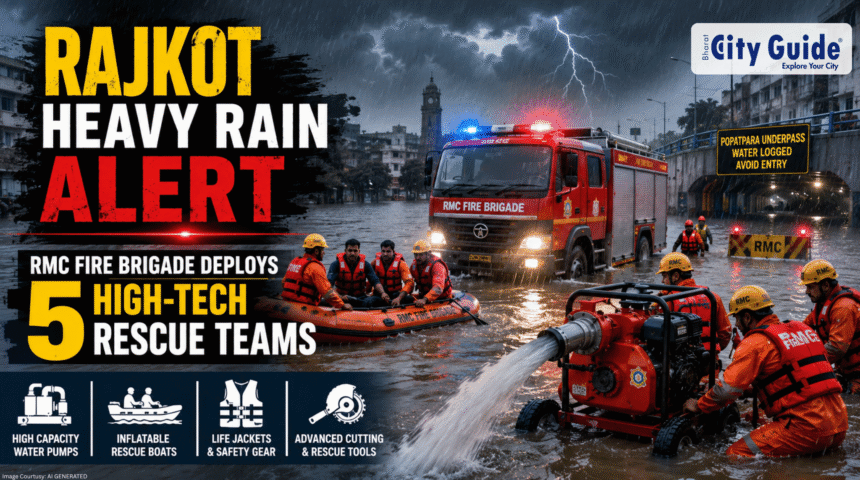
The mobilization under this Rajkot Heavy Rain Alert is important because it demonstrates a clear shift toward a proactive, equipment-first emergency response model. By organizing five dedicated, highly trained rescue squads equipped with advanced rescue gear, the RMC Fire Department is setting a clear standard for urban disaster preparedness. It assures residents that the city administration is actively managing potential vulnerabilities, rather than merely responding after a crisis unfolds.
Background Information and Geographical Context
To understand why a heavy rain warning requires such intensive preparation, it is helpful to look at Rajkot’s unique layout and topography. Situated on a relatively flat plateau in the center of the Saurashtra peninsula, Rajkot is intersected by several key natural waterways, most notably the Aji River and the Nyari River. The city also features major water bodies like Lalpari Lake and Randarda Lake, which act as vital reservoirs but can overflow during periods of continuous rainfall.
Historically, when these rivers and lakes experience sudden inflows from surrounding rural catchment areas, the radial drainage systems inside the city can back up. Low-lying areas, underpasses (such as the Mahila College underpass or Popatpara underpass), and residential societies situated close to the riverbeds are highly susceptible to sudden waterlogging.
In past monsoon seasons, unexpected cloudbursts have required large-scale evacuations. Recognizing these historical vulnerabilities, the RMC has mapped out the city’s key flood zones, allowing the fire brigade to deploy its newest equipment and rescue personnel precisely where they are needed most.
Key Highlights of the RMC Rescue Plan
The RMC’s tactical response plan includes several key operational measures:
- Five Specialized Rescue Teams: Five high-readiness rescue teams have been formed within the fire department, each assigned to specific zones across the city.
- Advanced Equipment Integration: Teams are equipped with high-capacity dewatering pumps, inflatable rubber rescue boats, life jackets, and automated wood and concrete cutters.
- 24/7 Central Control Room Monitoring: The District Emergency Operation Center (DEOC) is monitoring rainfall telemetry and water levels around key reservoirs in real time.
- Underpass and Low-Lying Area Protocols: Pre-planned barricading strategies have been established for vulnerable underpasses to prevent vehicles from entering deep water.
- Inter-Departmental Coordination: Smooth communication channels have been set up between the fire brigade, the PGVCL power distribution units, and local police teams.
Detailed Explanation of the Emergency Mobilization
The strategic deployment under the Rajkot Heavy Rain Alert is built on speed, equipment reliability, and clear communication. The RMC Fire Department has divided its forces to ensure that no single sector of the expanding city is left isolated during a severe weather event.
1. Spatial Distribution of the Five Teams
The five rescue squads are distributed across major fire stations in Rajkot, including the central station, Mavdi, Raiya Road, Bedipara, and the industrial zones. This ensures that even if traffic is snarled by rain, a team can reach a crisis point within minutes. Each team is led by an experienced fire officer who has undergone training in deep-water rescue and structural collapse management.
2. High-Capacity Dewatering Systems
A major component of this year’s flood response is the use of high-capacity, diesel-powered dewatering pumps. When low-lying residential basements or underpasses flood, standard electrical pumps often cannot be used due to electrocution risks or power grid outages. These specialized diesel pumps can move thousands of liters of water per minute, helping clear flooded corridors and keep critical roads open.
3. Deep-Water and Structural Rescue Gear
Each of the five teams carries durable, inflatable rescue boats equipped with outboard motors, allowing them to navigate strong currents if the Aji River overflows into surrounding neighborhoods. Additionally, because heavy rain and high winds can uproot older trees or damage weak structures, teams carry heavy-duty mechanical saws and hydraulic cutters to quickly clear blocked roads and rescue individuals trapped by debris.
Benefits and Features of Modernized Preparedness
The proactive steps taken under the Rajkot Heavy Rain Alert offer clear benefits for the city’s overall safety and stability:
Minimizing Emergency Response Times
By placing rescue teams on high alert before the rain peaks, the fire brigade eliminates the delay of gathering personnel and loading equipment during a storm. Teams are fully packed and ready to deploy the moment an emergency call comes in.
Modern, High-Performance Safety Equipment
The use of specialized rescue boats, commercial-grade life rings, and heavy-duty cutting tools increases both the safety of the citizens being rescued and the efficiency of the rescue personnel, allowing operations to proceed smoothly in challenging conditions.
Structured, Preventative Road Management
By closely monitoring underpasses and low-lying arterial roads, the city can close hazardous routes before cars and auto-rickshaws become trapped, preventing traffic gridlock and keeping drivers out of danger.
How It Impacts the Citizens of Rajkot
The RMC’s proactive measures provide vital support across various segments of the local community:
| Impacted Citizen Group | Direct Benefits & Safety Adjustments |
|---|---|
| Daily Commuters & Travelers | Access to real-time route diversions, automated underpass closures, and clearer roads due to rapid tree-clearing operations. |
| Low-Lying Area Residents | Pre-arranged evacuation routes, rapid basement dewatering services, and direct access to emergency rescue teams. |
| Local Business Owners | Reduced risk of prolonged structural flooding in commercial basements and faster restoration of access to market areas. |
| School & College Students | Clearer municipal communication regarding safety updates, institutional closures, and safer travel conditions across the city. |
For families living in older, vulnerable housing structures, the alert system provides an important safety net, ensuring that emergency help is readily available if heavy rain compromises building integrity.
Expert Insights on Urban Flood Management
Disaster management experts emphasize that effective urban flood response relies on structural readiness rather than last-minute emergency actions. Modern urban planning specialists note that cities with dedicated, localized rescue teams can reduce property damage and life risk by up to 50% during extreme weather events.
Meteorological analysts point out that as climate patterns shift, inland cities like Rajkot must expect more frequent instances of short, high-intensity rainfall. Consequently, investing in high-capacity dewatering pumps, marine-grade rescue boats, and specialized technical training for fire departments is no longer just a seasonal precaution—it is an essential element of modern urban infrastructure management.
Challenges and Operational Constraints
While the RMC Fire Department’s preparations are extensive, executing rescue operations during a major flood presents several inherent challenges:
- Severe Traffic Congestion: Heavy rain often leads to immediate traffic delays on major routes like the 150 Feet Ring Road or Kalawad Road, which can slow down rescue vehicles despite their sirens.
- Submerged Underwater Hazards: Debris, open manholes, and hidden structural elements beneath muddy floodwaters create significant safety hazards for rescue teams navigating inflatable boats.
- Unpredictable Weather Fluctuations: Sudden increases in rainfall intensity can cause water levels to rise faster than standard pumps can clear it, requiring teams to adjust their tactics on the fly.
- Electrical Safety Risks: Submerged transformer units or damaged underground cables can create electrocution hazards, requiring close coordination with PGVCL to isolate power grids before teams enter deep water.
Future Outlook for Rajkot’s Infrastructure
Looking forward, the Rajkot Municipal Corporation is focused on building long-term climate resilience. Future infrastructure initiatives aim to complement the fire brigade’s rescue capabilities with permanent engineering solutions. These include widening the storm-water drainage networks along the city’s main ring roads, building advanced retaining walls along the banks of the Aji River, and installing automated water-level sensors at all major underpasses.
Additionally, the city is exploring smart-city integrations where automated digital billboards across Rajkot can instantly display route diversions the moment a heavy rain alert is issued. These upgrades will help transition Rajkot from an exceptionally well-prepared emergency responder to a highly resilient, climate-adapted smart city.
Frequently Asked Questions (FAQs)
Q1: What does the Rajkot Heavy Rain Alert mean for local residents?
The alert indicates that meteorological systems are expected to bring heavy rainfall to the region, prompting municipal departments to deploy emergency personnel and equipment to secure high-risk areas.
Q2: How many rescue teams has the RMC Fire Department deployed?
The RMC Fire Department has established five specialized rescue teams, strategically stationed at key fire bases across Rajkot to ensure rapid response times.
Q3: What specialized equipment do these rescue teams carry?
Teams are equipped with high-capacity diesel dewatering pumps, inflatable rubber rescue boats, outboard motors, life jackets, life rings, and heavy-duty mechanical cutters for clearing wood and debris.
Q4: Which areas in Rajkot are most vulnerable to flooding during heavy rain?
Low-lying residential neighborhoods near the Aji and Nyari riverbeds, commercial basements, and major city underpasses (like the Popatpara and Mahila College underpasses) are historically prone to rapid waterlogging.
Q5: How does the RMC manage flooded underpasses?
The RMC coordinates with local traffic police to close and barricade flooded underpasses early, utilizing diesel pumps to clear the water as quickly as possible.
Q6: Who should citizens contact in the event of a flooding emergency?
Residents can contact the RMC Central Control Room via the official emergency helpline (101 for fire/rescue or the dedicated municipal disaster number +91 281 2224101) to report waterlogging or rescue needs.
Q7: Are there any specific safety precautions citizens should follow during the alert?
Residents should avoid driving through flooded streets or underpasses, stay away from open storm drains and electrical transformers, and secure loose items on balconies or rooftops against strong winds.
Conclusion
The mobilization under the current Rajkot Heavy Rain Alert demonstrates how structured planning and modern equipment can strengthen a city’s defenses against severe weather. By deploying five dedicated rescue teams and integrating advanced flood-response tools, the Rajkot Municipal Corporation is taking a clear, proactive approach to public safety.
While heavy monsoon storms present inevitable challenges to urban environments, these systematic preparations help protect communities, keep essential infrastructure functioning, and reduce risks across the city. As Rajkot continues to grow, this focus on proactive disaster readiness provides a reliable foundation for navigating the seasonal demands of the monsoon.