Introduction
The arrival of the monsoon season in India is traditionally a time of celebration, relief, and economic optimism. For the state of Gujarat, particularly the bustling urban hub of Rajkot located in the semi-arid region of Saurashtra, June is typically the month when parched lands receive their first refreshing showers. Farmers prepare their fields for the Kharif sowing season, reservoirs await vital replenishment, and citizens look forward to respite from the grueling summer heat.
- Introduction
- What is Rajkot Monsoon 2026?
- Why This News Matters
- Background Information and Historical Context
- Key Highlights from the Recent Weather Reports
- Detailed Explanation of the Climate Event
- Importance of Understanding this Climate Phenomenon
- How It Impacts People
- Expert Insights and Meteorological Perspective
- Challenges and Limitations in Overcoming the Crisis
- Future Outlook
- Frequently Asked Questions (FAQs)
- Conclusion
However, the reality of the Rajkot Monsoon 2026 has deviated drastically from historical patterns, raising significant alarm bells among meteorologists, agricultural experts, and everyday citizens. Instead of the anticipated “Meghvarsha” (cloudy rains), the region has endured a punishing “Tapvarsha” (rain of heat), turning the month of June into an extended, scorching summer rather than a welcoming monsoon kickoff.
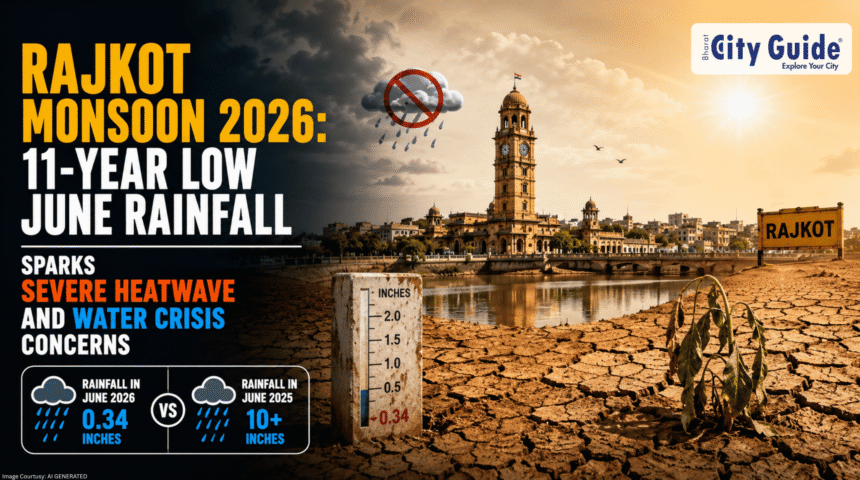
According to latest meteorological data, Rajkot has recorded its lowest June rainfall in 11 years, registering an astonishingly meager 0.34 inches of precipitation throughout the entire month. To put this figure into perspective, during the same month last year, the city was drenched in over 10 inches of water, driven by active monsoon systems and cyclonic disturbances. This sudden and extreme drop from abundance to absolute scarcity highlights the intensifying volatility of weather systems over western India.
The profound lack of rainfall combined with unrelenting high temperatures has transformed Rajkot Monsoon 2026 into a subject of urgent public discussion, presenting immediate challenges to water resource management, agricultural stability, and public health across the region.
What is Rajkot Monsoon 2026?
The Rajkot Monsoon 2026 refers to the seasonal progression, behavioral patterns, and quantitative rainfall recorded in the city of Rajkot and its surrounding districts during the current year’s Southwest Monsoon advancement. Nominally, the monsoon onset over Saurashtra occurs by mid-June, bringing steady showers that revive the local ecosystem and fill local reservoirs like the Aji, Nyari, and Bhadar dams.
This year, however, the Rajkot Monsoon 2026 has become synonymous with an unprecedented deficit. The term describes a meteorological anomaly where the atmospheric conditions required for sustained rainfall—such as adequate moisture convergence, favorable wind patterns, and low-pressure formations over the Arabian Sea—failed to materialize effectively over the Saurashtra peninsula during June.
Instead of steady rain-bearing clouds, the region experienced a prolonged dry spell dominated by solar radiation and dry continental winds. This anomaly has shifted the historical baseline for June weather in Rajkot, establishing a new 11-year low that contrasts sharply with the cyclical norms the region has relied upon for generations.
Why This News Matters
This developing situation regarding the Rajkot Monsoon 2026 is critical for several profound reasons. First and foremost, Rajkot serves as the economic and administrative heart of the Saurashtra region. The surrounding rural districts are heavily dependent on timely June rainfall to initiate the cultivation of primary cash crops such as groundnut, cotton, and castor. A delay or near-total absence of early monsoon rain disrupts the entire agricultural calendar, leading to delayed sowing, increased input costs for farmers, and potential crop failures.
Secondly, the news matters from an urban infrastructure and civic administration standpoint. Rajkot has historically faced structural water scarcity challenges, relying heavily on long-distance water pipelines from the Narmada canal network alongside its local dams. When local monsoon rains fail so drastically, the pressure on external water grids escalates exponentially, threatening municipal water supply schedules for millions of urban residents.
Finally, this extreme climate shift serves as a stark case study in regional climate change. The swing from 10 inches of rain last June to a mere fraction of an inch this year emphasizes the rapid loss of predictability in tropical monsoons, making it a vital indicator for policy planners, environmental scientists, and disaster management authorities.
Background Information and Historical Context
To truly comprehend the gravity of the 0.34-inch rainfall figure, one must look at the historical trajectory of June weather patterns in Rajkot over the past decade. The Saurashtra region is classified as semi-arid, characterized by erratic rainfall distributions. However, June usually marks a distinct transition phase where hot, dry winds give way to humid, cool maritime air masses.
The Contrast with Last Year
In June of the previous year, Rajkot witnessed a highly active monsoon onset phase, accumulating over 10 inches of rain. This massive volume of water was partially influenced by active low-pressure systems over the Arabian Sea which pushed immense moisture inland, filling low-lying areas, recharging groundwater tables early, and allowing farmers to complete their sowing operations well ahead of schedule.
The 11-Year Dry Spell Peak
A look back at the historical data over the last 11 years reveals that while Rajkot has had lean monsoon starts before, it has rarely seen a June as completely dry as 2026. Typically, even in deficit years, localized thunderstorms and convective activity yield at least 2 to 4 inches of rain across June. The current drop to just 0.34 inches breaks an 11-year cycle of reliable early-season precipitation, placing the city in uncharted meteorological territory for the mid-2020s.
Key Highlights from the Recent Weather Reports
- Unprecedented Deficit: Rajkot recorded just 0.34 inches of rainfall in June 2026, marking an 11-year low for the month.
- Extreme Year-on-Year Deviation: The rainfall plummeted drastically compared to the previous year, when the city received over 10 inches of rain during the same period.
- “Tapvarsha” vs. “Meghvarsha”: Instead of cooling rain showers, the city endured extended heatwave-like conditions throughout June, with temperatures consistently staying well above normal thresholds.
- Delayed Agricultural Sowing: Kharif crop sowing, particularly groundnut and cotton, has been severely delayed across Rajkot district due to lack of soil moisture.
- Depleting Reservoir Levels: Local water bodies and major dams supplying Rajkot have seen zero inflow from local catchments, increasing dependency on the Narmada water network.
- Elevated Cooling Demand: The prolonged heat has led to a major surge in electricity consumption across the city due to continuous usage of air conditioners and coolers.
Detailed Explanation of the Climate Event
The lack of rainfall during the kickoff of the Rajkot Monsoon 2026 can be attributed to an array of complex, interconnected meteorological factors. Typically, the Southwest Monsoon advances along the western coast of India, crossing Kerala, Karnataka, and Maharashtra before making landfall over the Gujarat coast. For the monsoon to break forcefully over Saurashtra, strong westerly or south-westerly winds must carry deep moisture from the Arabian Sea, supported by a favorable positioning of the Intertropical Convergence Zone (ITCZ) and the formation of off-shore troughs or low-pressure areas.
In June 2026, these atmospheric mechanisms encountered severe disruptions. Meteorologists point out that while the monsoon made its timely onset over the southern tip of India, its northward advancement stalled or weakened significantly as it approached central and western India. The wind patterns over Gujarat remained largely continental or dry northern-westerly for extended periods, effectively blocking the entry of moisture-laden maritime air masses into the interior of the Saurashtra peninsula.
As a direct result of this atmospheric blockage, the clouds that did manage to form over Rajkot were shallow and lacked the vertical development necessary to produce heavy downpours. The few instances of rain were limited to brief, localized drizzles or trace showers that evaporated almost immediately upon hitting the intensely hot ground.
Instead of the refreshing cloud cover that normally shields the city in late June, clear skies allowed uninhibited solar radiation to bake the region. This created a compounding cycle: dry soil led to higher ground temperatures, which in turn dissipated incoming weak moisture patches, solidifying the “Tapvarsha” effect that defined the month.
Importance of Understanding this Climate Phenomenon
Analyzing the failure of early rains in the Rajkot Monsoon 2026 is not merely about tracking numbers; it holds profound structural importance for regional planning:
Climate Adaptation Strategies
Understanding these sudden drops in rainfall helps environmental scientists modify climate models for western India. It emphasizes that adaptation plans must account for zero-rainfall months even within traditional monsoon periods.
Water Resource Allocation
For irrigation and municipal boards, tracking this trend provides critical data on how to balance water distribution. It helps authorities calculate exactly how long urban centers can survive solely on piped river water when local monsoonal reservoirs fail to replenish.
Agricultural Resiliency
This event highlights the crucial need for developing and distributing short-duration, drought-resistant seed varieties. When the monsoon window shrinks, agricultural systems must adapt rapidly to shorter, more intense growing periods.
How It Impacts People
The severe deficit defining the initial phase of the Rajkot Monsoon 2026 leaves no segment of the population untouched. Its ripple effects are felt across economic, social, and physical landscapes.
Rural Communities and Farmers
The agricultural community bears the immediate brunt of this dry spell. Farmers who rely entirely on rain-fed agriculture have been forced to halt seed sowing. Those who rushed to sow their crops after a few early traces of rain now face the grim prospect of seed burning under the intense heat, leading to significant financial losses and the added burden of purchasing fresh seeds for re-sowing once the rains finally arrive.
Common Citizens and Urban Residents
For the average resident of Rajkot, the lack of June rain means enduring extended summer discomfort. Public health facilities have noted a steady influx of cases related to dehydration, heat exhaustion, and seasonal viral infections exacerbated by fluctuating high temperatures. Furthermore, household water management has become stricter as residential societies begin rationing water in anticipation of a prolonged dry period.
Consumers and the Local Economy
The delayed monsoon has direct financial implications for consumers in Rajkot and surrounding urban centers. Delayed sowing heavily threatens to reduce overall crop yields, which naturally drives up the market prices of essential food commodities, vegetables, and cooking oils later in the year. Additionally, middle and lower-income families are facing inflated electricity bills due to the prolonged, unseasonal reliance on high-power cooling appliances throughout June.
Expert Insights and Meteorological Perspective
Climate scientists and weather experts emphasize that the extreme variation observed in the Rajkot Monsoon 2026 is a classic manifestation of climate variability. Experts generally note that over the past decade, the monsoon pattern over the Indian subcontinent has shown a distinct trend toward compression. This means that while the overall volume of seasonal rainfall across four months might sometimes remain near normal, the distribution is becoming highly erratic.
Instead of being distributed evenly over June, July, August, and September, the rains tend to dump massive quantities within a few weeks, interspersed with prolonged, intense dry spells. Climatologists warn that regional anomalies, such as the 11-year low recorded in Rajkot this June, show why cities must move away from traditional historical averages when planning for disaster management and water security, shifting instead toward dynamic, real-time climate risk mitigation frameworks.
Challenges and Limitations in Overcoming the Crisis
Addressing the challenges presented by the current state of the Rajkot Monsoon 2026 involves navigating a complex web of limitations:
- Heavy Reliance on Overstretched Infrastructure: Rajkot’s primary backup during local water deficits is the Narmada water pipeline. However, pumping water across hundreds of kilometers to fulfill the needs of multiple drought-prone districts simultaneously places an immense mechanical and financial load on state infrastructure.
- Groundwater Depletion: In the absence of early monsoon recharge, private tube wells and borewells across the city are running dry at an accelerated rate, forcing a heavy reliance on expensive private water tankers.
- Financial Constraints on Smallholder Farmers: Many local farmers lack the capital to invest in micro-irrigation systems, such as drip or sprinkler setups, which could help sustain crops during such prolonged early-season dry spells.
- Urban Heat Island Effect: Rapid urbanization, concrete construction, and a reduction in green cover within Rajkot city limits have exacerbated local temperatures, making the “Tapvarsha” feel substantially more intense for urban dwellers compared to surrounding rural areas.
Future Outlook
As Rajkot moves deeper into the monsoon season, all eyes are pinned on the weather forecasts for July and August. Traditionally, July is the wettest month for the Saurashtra region, and meteorological agencies express cautious optimism that shifting atmospheric depressions over the Bay of Bengal or a revival of the Arabian Sea branch could break the current deadlock.
If favorable low-pressure systems develop and move westward across central India, they could bring the much-needed monsoon surge to Rajkot, rapidly reversing the current deficit. However, if the monsoon stalling extends well into July, Rajkot will face an escalated water management challenge, requiring stringent municipal water cuts, emergency financial packages for the agricultural sector, and a complete re-evaluation of the city’s seasonal resource planning. The coming weeks remain absolutely pivotal to steering the course of the region’s economic and environmental health for the rest of the year.
Frequently Asked Questions (FAQs)
1. How much rain did Rajkot receive in June 2026?
Rajkot received a mere 0.34 inches of rainfall throughout the entire month of June 2026. This is considered an extreme deficit for the first month of the traditional monsoon season.
2. When was the last time Rajkot saw such low June rainfall?
The rainfall recorded during the opening phase of the Rajkot Monsoon 2026 represents an 11-year low, making it the driest June the city has experienced over the past decade.
3. How does this year’s June rainfall compare to last year?
There is a massive contrast. In June of last year, Rajkot received a generous 10 inches of rainfall due to highly active monsoon systems, whereas this year it dropped to just 0.34 inches.
4. What is meant by the phrase “Tapvarsha” used by locals?
“Tapvarsha” translates literally to a “rain of heat.” It is a term used to describe the phenomenon where, instead of receiving cooling monsoonal rain showers (Meghvarsha), the city experienced continuous scorching heat waves and clear skies throughout June.
5. How is the low rainfall affecting agriculture around Rajkot?
The lack of early rain has severely delayed the sowing of vital Kharif crops like groundnut and cotton. Farmers are unable to begin cultivating due to a critical lack of moisture in the soil, which threatens to delay the entire harvest cycle.
6. Is there an immediate water crisis in Rajkot city?
While local reservoirs have received no new inflows from rains, an immediate crisis is being mitigated through the supply of Narmada water via pipeline networks. However, continued lack of rain will put immense strain on this system.
7. What are meteorologists predicting for the rest of the monsoon season?
Meteorologists expect that the monsoon systems may revive during July and August, which are traditionally the highest rainfall-yielding months for the Saurashtra region, potentially compensating for the June deficit.
Conclusion
The striking anomaly observed during the kickoff of the Rajkot Monsoon 2026 serves as a powerful reminder of how vulnerable our cities and agricultural systems are to the changing faces of global weather patterns. Transitioning from a bountiful 10 inches of rain last year to an 11-year low of just 0.34 inches this June, Rajkot’s experience with “Tapvarsha” instead of refreshing showers underlines an urgent message.
While urban infrastructure like the Narmada pipeline continues to keep the city running, the long-term solution lies in building deep climate resilience through water conservation, urban greening, rainwater harvesting, and support for adaptive agriculture. As the city looks forward to the remainder of the monsoon season, the lessons taught by this dry June will undoubtedly shape Rajkot’s approach to environmental sustainability and water security for years to come.